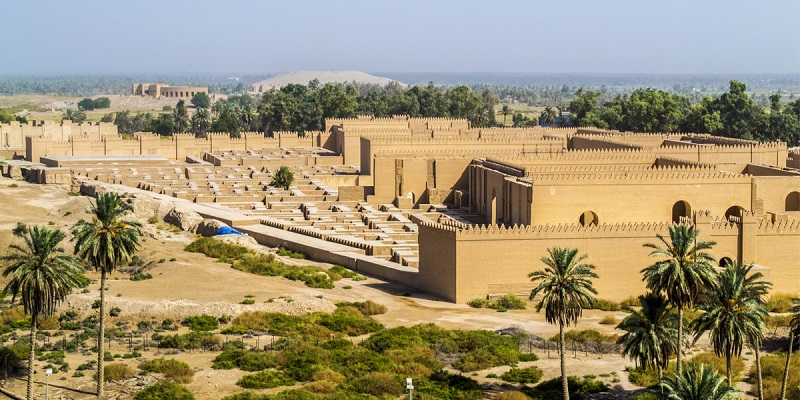
Recently I was talking with an evangelical pastor (Fernando García Sotomayorwho is rector of Seminario Teológico Rhema Internacional de Colombia) and the topic branched into the typical fundamentalist apology where Catholic Church(and the evangelical churches that participate in the ecumenical movement) are accused of being the “whore of Babylon”. Among the comments that came to light, my pastor friend told me that this was recognized even by the fathers of the Church, including Saint Augustine, for which he wrote:
“Saint Augustine on your libro The City of Godcalls Romea second Babylon”Babylon, it’s an earlier Romeand Romea later Babylon. Romeis the Daughter of babilonia””
Now, Saint Augustine actually saw in the pagan Rome(not the Christian) a second Babylon, and I pointed this out to the pastor, and that is why I emphasized the question and asked him to specify if he believed that when Saint Augustine spoke of Romehe was referring to the Catholic Church. Among other things, he responded:
“You make the difference between the Rome pagan and the Rome Christian. Not these distinguished men of faith”
He also provided the following source: Frank M Boyd. The Bible at your fingertips. Ed. Vida. P. 200-229.
In this study I will make a brief analysis of the work of Saint Augustine City of God, as well as some of his other writings, in order to elucidate if it is “my thing“and not the famous Saint Augustine to differentiate between the pagan Romeand the Romen Catholic Church. This will allow us to better understand Augustin ian thought and prevent it from being decontextualized in this way for future occasions.
The texts of the work City of Godwill be taken entirely from the Protestant site:
http://www.iglesiareformada.com/Agustin_Ciudad.html
Context and purpose of the work.
In the proem of libroI Saint Augustine talks about the purpose for which he wrote it. In summary, there are two reasons:
1) To defend the glory of la ciudad de Dios. Regarding this he writes:
“In this work, which is addressed to you, and is owed to you through my word, Marcelino, dearest son, I intend to defend the glorious City of God”Proemius. BookI
2) To denounce the destiny of the earthly city. “And so, neither will we pass in silence about the earthly City (which the more ambitiously it seeks to reign with despotism; therefore, the more the oppressed nations with its unbearable yoke render it obedience and vassalage, the same appetite to dominate comes to reign over it) anything that the nature of this work demands, and what I penetrate with my intellectual lights.”Proemio, BookI
But what were they for Saint Augustine la ciudad de Diosand the earthly city? He himself explains it in the fifteenth (XV) libroof the work.
“However, I feel that the most arduous, thorny and difficult questions that are cited about the beginning or end of the world or the soul, or of the human lineage itself, which we have distributed into two genres, are fully satisfied and proven: one of those who live according to man, and the other, according to God; and we also mystically call this two cities, that is, two societies or congregations of men of which one is predestined to reign eternally with God, and the other to suffer eternal torment with the devil.”
In the thought of Augustin e, two cities coexist on earth, one earthly, and the other heavenly, which is the pilgrim Church made up of Christians.
He leaves here to confront the supporters of paganism who attributed the calamities that occurred to Rometo them and to the name of Christ. Saint Augustine for whom the Church is la ciudad de Dioson earth, makes this apologetic defense to combat these accusations and by virtue of that titles the first libroof the work “The devastation of Romewas not punishment from the gods because of Christianity.”
Saint Augustine speaks of how the pagans took refuge in the sacred Catholic temples during the destruction of Rome.
In capítuloI of libroI Saint Augustine begins by talking about how these enemies of Catholic Churchshould be grateful, since many saved their lives in the destruction of the city by taking refuge in the Catholic temples of the city of Rome. So, title capítulofirst “from the enemies of the Christian name; and how these were forgiven by the barbarians, out of reverence for Christ, after having been defeated, in the plundering and destruction of the city”.
In this regard he writes:
“…many, abjuring their errors, become good citizens; but the majority manifest an inexorable and effective hatred, showing themselves so ungrateful and unaware of the obvious benefits of the Redeemer, that at present they could not move their damning tongues against it if, when they fled from the neck of the certain avenger of their opponent, they did not find the life, with which they pride themselves so much, in their sacred temples. By chance, do they not pursue the name of Christ the same Romens whose lives, out of respect and reverence for this great God, the barbarians spared? Witnesses to this truth are the chapels of the martyrs and the basilicas of the Apostles, which in the devastation of Romewelcomed within themselves those who hastily, and fearful of losing their lives, placed their hopes in flight, whose number included not only the Gentiles, but also the Christians.: The enemy came carrying out his fury up to these sacred places, but there he cushioned or quenched the fury of the fierce murderer, and, finally, to these sacred places they led the pious enemies whom, found outside the holy asylums, they had spared the lives, so that they would not fall into the hands of those who did not use to exercise such mercy, which is why it is very worthy of note that such a ferocious nation, which everywhere manifested itself cruel and bloodthirsty, doing cruel ravages, after he approached the temples and chapels, where their desecration was prohibited, as well as the exercise of violence that was permitted in other parts by the law of war, he completely restrained the furious impetus of his sword, also detaching himself from the affection of greed that possessed him to make a great prey in such a rich and well-supplied city. In this way, many who currently slander and murmur about Christian times freed their lives, imputing to Christ the labors and hardships that Romesuffered, and not attributing to this great God the incomparable benefit that they obtained out of respect for his holy name of preserving their lives;”BookI ChapterI
Anyone who had even read the beginning of the work could notice “curious”that Saint Augustine referred to Catholic Churchas “the whore”while referring to her temples in Romeand to “the chapels of the martyrs and basilicas of the apostles“as “sacred places“. Later it continues.
“For the same reason, these vain challengers should attribute to the times in which Catholic dogma flourished the particular grace of the barbarians having given them the mercy of their lives, contrary to the style observed in war, with no other respect than to indicate their submission and reverence to Jesus Christ, granting them this singular favor wherever they found them. and with specialization to those who took refuge in the sacredness of the temples, dedicated to the august name of our God” BookI ChapterI
He ends by reproaching them for how many of those who attacked the Church at that time had gone to the extreme of pretending to embrace the Catholic faith. However, once saved, they now behaved ungratefully, attacking the Church, and demonstrating that their confession of faith was not from the heart:
“…because, many of these whom you see who, with so much freedom and contempt, make mockery of the servants of Jesus Christ would not have fled from their ruin and death if they had not pretended that they were Catholics.; and now his ungratefulness, arrogance and sacrilegious madness, with a damaged heart, opposes that holy name; which, in the time of his misfortunes, served as a fortress, thus irritating divine justice and giving rise to his ingratitude being punished with that abyss of evils and pains, which are perpetually prepared for the wicked, since his confession, belief and gratitude was not from the heart, but with the mouth, to be able to enjoy the momentary and expired happiness of this life for longer.”
Later in capítuloIII of the same librospeaks of “How imprudent were the Romens to believe that the Penate gods, who could not save Troy, would take advantage of them?“He thus questioned not the Church of Rome, who was not precisely the one who entrusted the care of the city to the gods of Troy, but rather the pagan supporters who were enemies of the Church in the city.
How Saint Augustine refers to those who abandon the Catholic Church
In capítuloXXV of libroXXI, he talks about how stubborn heretics and heretiarchs who abandon Catholic Churchwill not be freed from eternal torment even if they have been baptized in it and received the sacrament of the Eucharist, since their state of apostasy makes them worse than an infidel.
“On the other hand, neither do these, who understand well that one who is not in the body of Christ should not be said to eat the body of Christ, erroneously promise those who from the unity of that body fall into heresy or the superstition of the Gentiles, deliverance from eternal fire. First, because they must consider how intolerable a thing it is and how extremely foreign and misguided from the sound doctrine that the most or almost all those who leave the guild of the Catholic Church, being authors of heresies and becoming heresiarchs are better than those who were never Catholic or fell into their traps, It was decided that such heresiarchs should be delivered from eternal torment because they were baptized in the Catholic Church and received at the beginning, being in the union of the true body of Christ, the Sacrament of the sacrosanct body of Christ; For without a doubt the one who apostatized and forsaken the faith, and as an apostate became a cruel fighter of the faith, is worse than the one who did not leave or forsake the faith he never had; The second, because the Apostle also stops these, after having insinuated the works of the flesh, threatening them with the same truth: “those who do such works will not possess the kingdom of God.”BookXXI ChapterXXV
However, in the second capítuloof the sixteenth librohe adds that the emergence of heresies strengthens the Catholic faith, since it gives the opportunity to preach the truth with greater vigor and gives the opportunity to learn:
“Although all this is to the benefit of the proficient, according to the expression of the Apostle: “It is fitting that there be heresies so that the good may be seen among you”; and for this very reason the Scripture says: “The troubled son and exercised in hardships will be wise, and the imprudent and evil one will be used as a minister and servant.”
Because many things that belong to the Catholic faith, when heretics, with their cautious and cunning concern, disturb and unsettle them, then, in order to defend them against them, they consider themselves with more scrupulosity and attention, perceive themselves with greater clarity, preach themselves with greater vigor and constancy., and the doubt or controversy that the opponent excites serves as a favorable opportunity to learn.” ChapterII BookXVI
Likewise in the capítuloLI of the libroXVII creature and the sacraments with their continuous divisions and dissensions are the cause of the name of Christ being blasphemed.
“Those in the Church of Christ who are imbued with some contagious error, having corrected and warned them so that they may know what is sound and right, nevertheless vigorously resist and do not want to amend their pestilent and deadly opinions, but obstinately defend them, These become heretics, and leaving the guild of the Church are considered among the enemies who exercise and afflict it.. Because even in this way with their evil they also benefit true Catholics who are members of Christ, God using good even from the bad…
“because because of them the Christian and Catholic name is discredited and blasphemed.; which, the more those who want to live holyly in Christ love and esteem him, the more it hurts them what is practiced by the evil ones within and that he is not as loved and appreciated as they desire from pious souls. The same heretics, when it is considered that they have the Christian name, the Christian Sacraments, the Scriptures and profession, cause great pain in the hearts of the pious, because to many who also want to be Christians these discords and dissensions force them to doubt, and many cursers also find in them suitable material and occasion to blaspheme the Christian name, since they call themselves Christians, whatever denomination one wants to give them.” ChapterI BookXVI
He also talks about how the prophets predicted Christ and his Church, which is no longer captive but now all people can take advantage of the protection of the Catholic faith:
“Therefore, three prophets remain of the twelve minor ones who prophesied in the last years of the captivity: Haggai, Zechariah and Malachi. Among these, Haggai clearly predicts Christ and his Church for us in these brief and compendious words: “This is what the Lord of hosts says: In a short time I will move heaven and earth, the sea and dry land; I will move all nations and the one desired by all nations will come. people.”We see this prophecy partly fulfilled, and what remains of it we hope will be fulfilled at the end of the world. Because he already moved the sky with the testimony of the angels and the stars when Christ incarnated; moved the earth with the stupendous miracle of the Virgin’s birth itself; moved the sea and the main land, since on the islands and throughout the world the name of Jesus Christ is preached, and thus we see all people coming to take refuge under the protection of the Catholic faith.” BookXVIII ChapterXXXV
Rome, a second Babylon, in its true context.
On several occasions in the work Saint Augustine refers to the pagan (non-Christian) Rome as a second Babylon, let’s look at them one by one to analyze their true context. One of them is in capítuloXVII of libroXVI.
“In Asia the empire and dominion of the impious city prevailed, whose head was Babylon, a very appropriate name for this earthly city, because Babylonis the same as confusion. In it Ninus reigned after the death of his father Belus, who was the first to reign there for sixty-five years; and his son Ninus, who, after his father died, succeeded to the kingdom, reigned fifty-two years, and it was the 43rd year of his reign when he was born. Abraham, which would be the year 1200, more or less, before the founding of Rome, what was like another second Babylonin the West.” ChapterXVII BookXVI
Here Augustin e speaks of Romein “past”as a second Babylon, when it was founded and came to be in the past as a second Babylon. Note that it refers to the City from Rome, not to the Christian Church which did not even exist at that time.
He does it in capítuloII of libroXVIII:
“But the matters that we would have to insert in this work, to compare both Cities with each other, namely, the earthly and the heavenly, we will take better from the Greeks and Latins, among which is the same Rome as another second Babylon.” ChapterII, BookXVIII
And in capítuloXXII of libroXVIII:
“Not to dwell too long, I will say that I know founded the city from Rome as another second Babylon, and as a daughter of the first Babylon, through whom God was pleased to conquer the entire area of the earth, and put it at peace, reducing everything under the government of a single republic and under the same laws.” ChapterXXII libroXVIII
On these three occasions Saint Augustine does not speak about the Church there, but about the city which after its foundation became a second Babylon. In all these texts it refers to the pagan and non-Christian Rome. This agrees perfectly with the traditional Catholic interpretation where the pagan Romepersecutor and oppressor of Christians would represent what Babylonrepresented for the Jewish people in other times. We Catholics even believe that when Saint Pedroin his epistle greets from “Babylon”he does so in code to indicate that he is in Rome, it would be absurd to think that he believed that the Church of Rome(for which the same apostle Paulspares no praise in his epistles) as “the harlot.”
That is why assuming right off the bat, ignoring the context, that Saint Augustine was referring to the Church of Romeis more than simplistic, is a tremendous decontextualization of his thinking, which if he knew even a little, he could have deduced that this reasoning is neither coherent nor makes sense. But to go deeper into this, let’s move on to the next point:
What was Saint Augustine’s position regarding the Church of Rome?
For Saint Augustine in Romethere is also Pedroheadquarters confirmed by the succession of bishops, which is why it is frequently referred to as the “apostolic seeThus, to the Manichaeans who had departed from the Catholic Churchhe writes:
“Even leaving aside the sincere and genuine wisdom…, which in your opinion is not found in the Catholic Church, many other reasons keep me in its bosom: the consent of the people and the people; the authority, erected with miracles, nourished with hope, increased with charity, confirmed by antiquity; the succession of bishops from the very seat of the apostle Pedro, to whom the Lord entrusted, after the resurrection, to feed his sheep, until today’s episcopate; and finally, the very appellation of Catholic, which without reason only the Church has achieved….These bonds of the Christian name – so many, so great and so sweet – keep the believer in the bosom of the Catholic Church, despite the fact that the truth, due to the clumsiness of our mind and the unworthiness of our life, has not yet shown itself.”Saint Augustine. C. ep. Man. 4,5.
In his epistle 53 he writes:
“If the succession of bishops is taken into account, the more certain and beneficial the Church that we recognize reaches Pedroitself, the one who carried the figure of the entire Church, the Lord told him: “On this rock I will build my Church, and the gates of hell will not prevail against it!” Pedro’s successor was Linus, and his successors in order of unbroken succession were these: Clement, Anacletus, Everisto, Alexander, Sixtus, Telesphorus, Hyginius, Anicetus, Pius, Sotero, Eleuterio, Victor, Cepherinus, Callistus, Urbanus, Pontianus, Antero, Fabian, Cornelius, Lycian, Stephen, Sixtus, Dionysius, Felix, Eutychianus, Gaius, Marcelino, Marcellus, Eusebius, Miltiades, Silvestre, Mark, Julius, Liberius, Damasus, and Siricius, whose successor is the present bishop Anastasius. In this order of succession, no Donatist bishop is found.”Saint Augustine. Ep. 53,2
In this epistle Saint Augustine is particularly clear because referring to the Church of Romehe points it out as the one that reaches up to Pedrohimself and mentions one by one the bishops of Rome.
But if there are still doubts about Augustin e’s thinking, nothing is clearer than the following words:
Those who do not teach that the Romen faith must be kept cannot be believed to keep the Catholic faith.. Saint Augustine, Serm.120 n.13
For Saint Augustine, the primacy of the apostolic chair always resided in the Church of Rome:
“…They saw that Caecilian was united by letters of communion to the Romen Church, in which the primacy of the apostolic chair always resided….” “Saint Augustine, Ep 43,3,7
In addition to this, we must not overlook that in the conflicts with the Pelagians Saint Augustine resorts to the authority of the apostolic see (Rome) to confirm the councils of Carthage and Milevis (411, 412 and 416) condemning Pelagianism. I attach an excerpt from the letter sent by 61 bishops (including Saint Augustine) to Pope Innocent:
“Since God by a special gift of His grace has placed you in the Apostolic See, and has given us someone like you in our times, so that it may rather be imputed to us as a lack of negligence if we fail to show to your Reverence what is suggested for the Church, than to you having received the same with contempt or negligence we ask you to involve your pastoral diligence towards the great danger of the weak members of Christ.”
“In hinting these things to your Apostolic breast we need not say much, and pile up words about this impiety, because it will undoubtedly move in you such wisdom that you will not be able to refrain from correcting them, so that they cannot continue to infiltrate any further… It is said that the authors of this pernicious heresy are Pelagius and Celestine, who, in truth, should prefer to be cured with the Church, instead of being needlessly separated from the Church. One of them, Celestine, is said to have even reached the priesthood in Asia. His Holiness is better informed by the Council of Carthage about what was done against him some years ago. Pelagius, we are informed by letters from some of our brothers, is in Jerusalén, and is said to have deceived many there. Many more, however, who have been able to examine his views more closely, are fighting him in the name of the Catholic Faith, but specifically his holy son, our brother and fellow priest, Jerome. But we consider that with the help of the mercy of our God, to whom we pray to advise him and hear his prayers, those who hold these perverse and banal opinions They will yield more easily to the authority of His Holiness, which has been taken from the authority of the Holy Scriptures (auctoritati sanctitatis tuae, de sanctarum scripturarum auctoritate depromptae facilius….esse cessuros), so that we can rejoice in its correction instead of being saddened by its destruction. But whatever they themselves choose, your Reverence perceives that at least care must be taken of those many who may be entangled in their networks if they do not submit honestly. We write this to your Holiness from the Council of Numidia, imitating our fellow bishops of the Church and province of Carthage, who we understand have written about this subject to the Apostolic See that your Grace adorns.” Council of Milevis to Pope Innocent I
It was here that Pope Innocent confirmed the decisions of the councils, reserving the duty to cite Pelagius and Celestius, and to reform, if necessary, the sentence of Diospolis, where he condemned the incriminated doctrine in a letter known as “In requirendis“addressed to the bishops who met in Carthage and Milevi.
Saint Augustine then writes to finalize the cause since the “apostolic see” has spoken.
“Iam de hac causa duo concilia missa sunt ad sedem apostolicam: inde etiam rescripta venerunt. Causa finita est, utinam aliquando finiatur error”
Which could be translated as:
“For this reason, two letters have already been sent to the apostolic see and two rescripts have also come from there. The case has ended so that the error can finally end.”Sermo 131,10,10; Ep 1507.
Conclusion
Any vestige of common sense should make fundamentalist supporters of this argument wonder how it could be possible that Saint Augustine- considering the Church of Rome as “Babylon”- was going to appeal to her on such important questions of faith. Was he perhaps insane? How do you say then that about the Rome Church always resided principality of the apostolic chair, and He who does not keep the Romen faith does not keep the Catholic faith.? Is he perhaps recommending keeping the Babylonian faith and embracing paganism? Why do not only him, but the rest of the bishops of the African councils appeal to the Pope with such submissive and obedient language? Why write to the Donatists inviting them to return to the Catholic Church the following?
“Come, Donatist brothers, if you wish to be united to the vine. It’s sad when we see them cut like this. Number priests even from the chair of Pedro. And in that order of parents, see who succeeded them: That is a rock in which the gates of hell cannot conquer.. All who rejoice in peace alone judge truly.” Saint Augustine, Psalmagainst the Donatist Party, 2 (A.D. 393), in GILES, 182
Why, after the decrees of the Church of Romeon the Pelagians were issued, did Saint Augustine not miss the opportunity to remind the Pelagians and the faithful of the decrees emanating from this authority?
“[Celestio] should maintain his assent to the decree of the apostolic chair which he had published by his predecessor of sacred memory. The accused, however, refused to condemn the objections made by the deacon, yet he He did not dare to openly hold the letter of the blessed Pope Innocent” Saint Augustine, On Original Sin,7:8(A.D. 418),in NPNF1,V:239
“…he answered that he consented to the letters of Pope Innocent of blessed memory, in whom all doubt on this matter was removed” Saint Augustine, Against Two Letters of the Pelagians, 3:5 (A.D. 420), in NPNF1, V:393
Why did the letters of Pope Innocent according to Saint Augustine remove all doubt among the heretics, when they had already been condemned by several African councils full of bishops? From seeing Saint Augustine the Romen Church as BabyloCould it be that the decrees of Babylonhad more authority than that of all the bishops gathered in the councils of Milevis and Carthage?
“The words of the venerable bishop Innocent referring to this matter to the Carthaginian Council. What could be more clear or manifest than the judgment of the apostolic chair?” Saint Augustine, Against Two Letters of the Pelagians, 4:6 (A.D. 420), in NPNF1, V:394
These are the questions that must be answered honestly by those who do not intend to give in.
I hope with these brief reflections I have contributed to knowing the true context of Saint Augustine’s words, and demonstrate that when he referred to Rome as a second Babylonhe was referring to the city Rome(the pagan Rome) and not the Romen Catholic Church. Presenting isolated fragments of his thought without the text in its context to insinuate that he had positions that he never had, cannot be less than characterized as dishonest. However, despite having presented these proofs to the pastor in detail, he did not want to acknowledge his mistake, and I heard:
“Anyway, if my answer about Saint Augustine and his work did not satisfy you, forgive me. That is why I have specialized in the Bible and not in patristics., because I do not base my faith on what other eminent Christians have said”
This is where one has to resist the temptation to answer: So why are you opening your mouth??
Author: José Miguel Arraiz
