Fragments of Papias
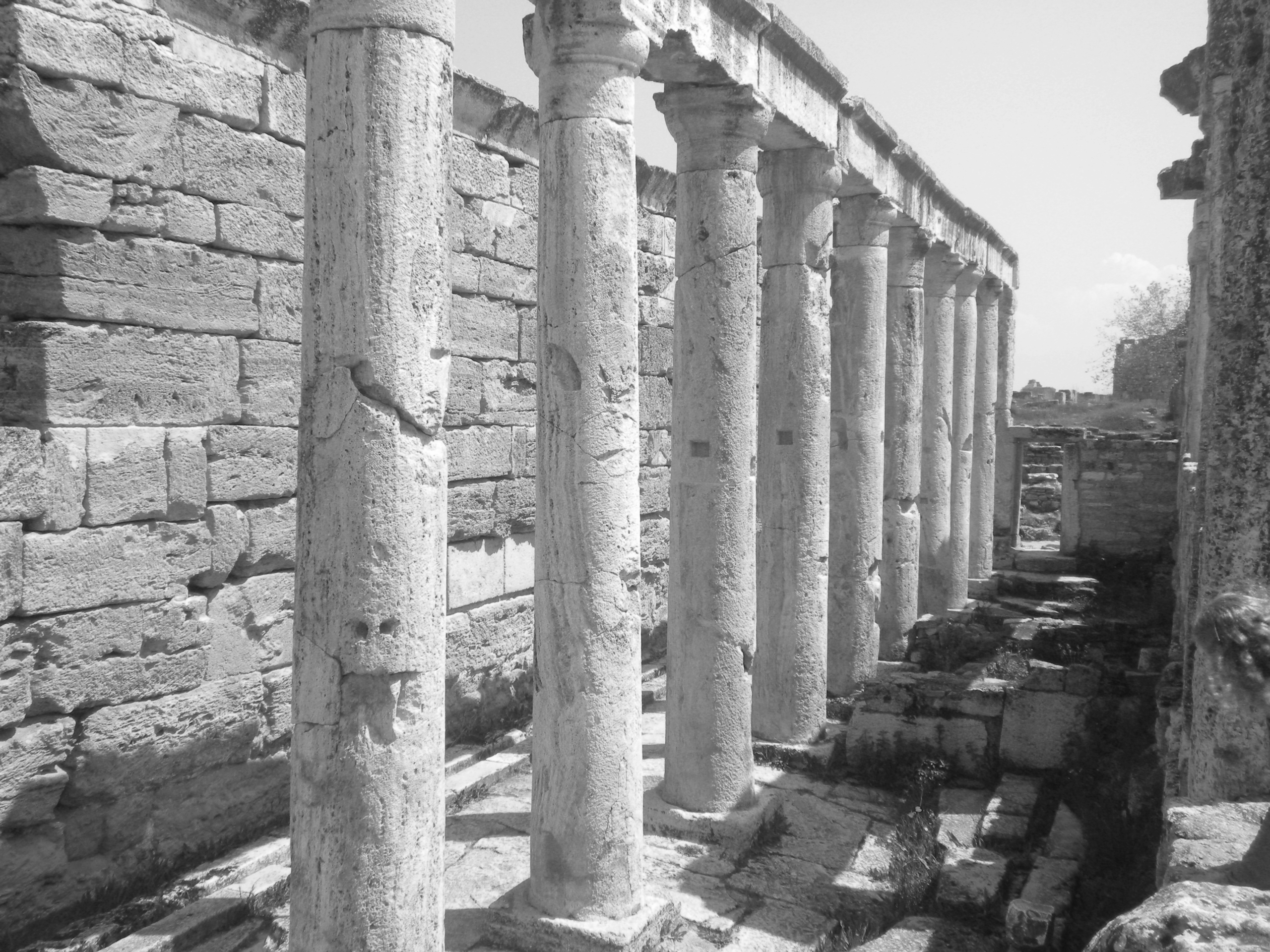
Ruins of Hierapolis (Pamukkale, Turkey) — episcopal see of Papias
According to Saint Jerome, Papias was bishop of Hierapolis in Asia; and from Saint Irenaeus of Lyon we know that he was a disciple of the Apostle John and a companion of Saint Polycarp. He is credited with the first known exegesis of the New Testament, entitled Exposition of the Dominical Oracles, of which some fragments survive thanks to their being preserved in the works of the Catholic historian Eusebius of Caesarea.
Oral Tradition versus Sola Scriptura
One of the most fundamental principles of Protestantism is the doctrine known as Sola Scriptura: the conviction that Sacred Scripture is the sole and infallible source and norm of the Christian faith. According to this doctrine, everything a Christian must believe is contained in the Bible and can be known from it alone, without any need of oral tradition, ecclesiastical Magisterium, or teaching authority of the Church. This position is historically untenable, and the very writings of the Apostolic Fathers demonstrate this with clarity. Papias of Hierapolis offers in this regard a testimony of particular importance.
In the preface to his work Exposition of the Dominical Oracles, preserved by Eusebius of Caesarea in his Ecclesiastical History, Papias reveals explicitly what the attitude of the first Christians was toward the relationship between written texts and the oral apostolic tradition. His words leave no room for doubt:
“I will not hesitate also to put down for you along with my interpretations whatsoever things I have at any time learned carefully from the elders and carefully remembered, guaranteeing their truth. For I did not, like the multitude, take pleasure in those that speak much, but in those that teach the truth; not in those that relate strange commandments, but in those that deliver the commandments given by the Lord to faith, and springing from the truth itself. If, then, any one came, who had been a follower of the elders, I questioned him in regard to the words of the elders — what Andrew or what Peter said, or what was said by Philip, or by Thomas, or by James, or by John, or by Matthew, or by any other of the disciples of the Lord, and what Aristion and the presbyter John, the disciples of the Lord, say. For I did not think that what was to be obtained from the books would profit me as much as what came from the living and abiding voice.” (Papias of Hierapolis, Exposition of the Dominical Oracles, Preface; in Eusebius of Caesarea, Ecclesiastical History 3:39:3–4)
This text is of capital importance for understanding the mentality of the first Christians. Papias, who was a disciple of the Apostle John and a companion of Polycarp, does not despise the Scriptures, but openly acknowledges that the living voice of the apostolic witnesses is worth more than written books. This conviction is by no means marginal: it is the conviction of a man who personally knew direct disciples of the Apostles, and who understood the Christian faith as something received and transmitted from person to person, in an unbroken chain stretching back to the Apostles themselves.
The doctrine of Sola Scriptura would have been incomprehensible to Papias. For him, as for all the Apostolic Fathers, supreme authority resided not in written texts considered in isolation, but in the living tradition transmitted by the Apostles and their disciples. This oral tradition is precisely what the Catholic Church calls Apostolic Tradition, and what Protestantism, in its rejection of all authority outside Scripture, cannot satisfactorily explain. The question that remains open for any evangelical Christian who reads Papias is obvious: how can one be faithful to the spirit of the first Christians while rejecting the very living tradition that they considered superior to written texts?
|
From the author The Church Fathers speak for themselvesThis article is part of Early Christianity: In Search of the Origins of the Catholic Church, a documented journey through the faith of the first centuries and its answers to the questions that still divide Catholics and Protestants. |
 |
The Transmission of the Gospel and Apostolic Succession
The fragments of Papias preserved by Eusebius of Caesarea also include testimonies of extraordinary value concerning the origin of the written Gospels. These testimonies are doubly important for our purpose: on the one hand, they shed light on how the Gospel texts themselves came to be; on the other, they confirm that even the Scriptures were transmitted through a chain of apostolic authority, and not independently of it.
Regarding the Gospel of Mark, Papias transmits the testimony of the presbyter John, a direct disciple of the Lord:
“And the presbyter said this. Mark having become the interpreter of Peter, wrote down accurately whatsoever he remembered. It was not, however, in exact order that he related the doings or sayings of Christ. For he neither heard the Lord nor accompanied Him. But afterwards, as I said, he accompanied Peter, who accommodated his instructions to the necessities of his hearers, but with no intention of giving a regular narrative of the Lord’s sayings. Wherefore Mark made no mistake in thus writing some things as he remembered them. For of one thing he took especial care, not to omit anything he had heard, and not to put anything fictitious into the statements.” (Papias of Hierapolis, Exposition of the Dominical Oracles; in Eusebius of Caesarea, Ecclesiastical History 3:39:15)
And regarding the Gospel of Matthew he adds:
“Matthew put together the oracles in the Hebrew language, and each one interpreted them as best he could.” (Papias of Hierapolis, Exposition of the Dominical Oracles; in Eusebius of Caesarea, Ecclesiastical History 3:39:16)
What Papias describes in these fragments is a chain of transmission that functions exactly as the Catholic Church has always taught that the transmission of Revelation works: from Christ to the Apostles, from the Apostles to their collaborators and disciples, and from these to the communities they founded and governed. The Gospel of Mark did not arise spontaneously from an individual who read the Old Testament Scriptures: it is the apostolic testimony of Peter, gathered and set down by his disciple and collaborator Mark. The authority of the written text derives from the apostolic authority that stands behind it.
This has direct implications for the debate with Protestantism. Even the Gospels, which are the foundation upon which the Protestant claims to build his entire faith, reached us through a chain of apostolic authority that preceded and sustained them. To then pretend that those same texts can be understood and applied independently of the apostolic tradition that produced them is to fall into a contradiction that is difficult to sustain. Papias understood this perfectly: without the living voice of tradition, not even the written Gospels could be rightly understood.
The Resurrection of the Flesh
Among the fragments of Papias that have reached us through the writings of Saint Irenaeus of Lyon, we also find an eloquent testimony on the doctrine of the resurrection of the dead. Papias affirms with energy the bodily resurrection — that is, the resurrection of the flesh — over against every merely spiritualist or allegorical interpretation of this fundamental doctrine.
In recounting what the elders heard from the Lord concerning the fullness of time, Saint Irenaeus of Lyon transmits the following text attributed to Papias:
“The days will come, in which vines shall grow, each having ten thousand branches, and in each branch ten thousand twigs, and in each true twig ten thousand shoots, and in every shoot ten thousand clusters, and on every cluster ten thousand grapes, and every grape pressed will give five-and-twenty metretes of wine. And when any one of the saints shall lay hold of a cluster, another shall cry out, I am a better cluster, take me; bless the Lord through me.” (Papias of Hierapolis, Exposition of the Dominical Oracles; in Irenaeus of Lyon, Adversus Haereses 5:33:3)
It is important to note that this passage reflects a millenarian vision — the expectation of a thousand-year earthly kingdom of Christ before the final end — which the Church did not adopt as doctrine, and which Eusebius of Caesarea already in his own time considered a problematic interpretation, the fruit of an error on the part of Papias in his understanding of the apostolic texts. On this point, Papias was mistaken, and the subsequent tradition of the Church acknowledged this. Nevertheless, behind the exuberant imagery employed, the doctrinal substratum is perfectly orthodox: the categorical affirmation that the resurrection is corporeal and material, that man is saved as a whole — soul and body — and not as a mere disembodied spirit.
On this point, Papias is in full agreement with the Catholic faith proclaimed from the origins of Christianity. The Apostles’ Creed expresses it with perfect clarity: I believe in the resurrection of the body, and the life everlasting. Many Protestant theological currents of a more spiritualist orientation have tended to strip Christian hope of its bodily dimension, reducing salvation to an immortality of the soul with no real connection to the body. Papias, representing the faith of the first disciples, reminds us that Christian hope is not of that nature: it is the hope of a full restoration of the human person, which includes the flesh.
