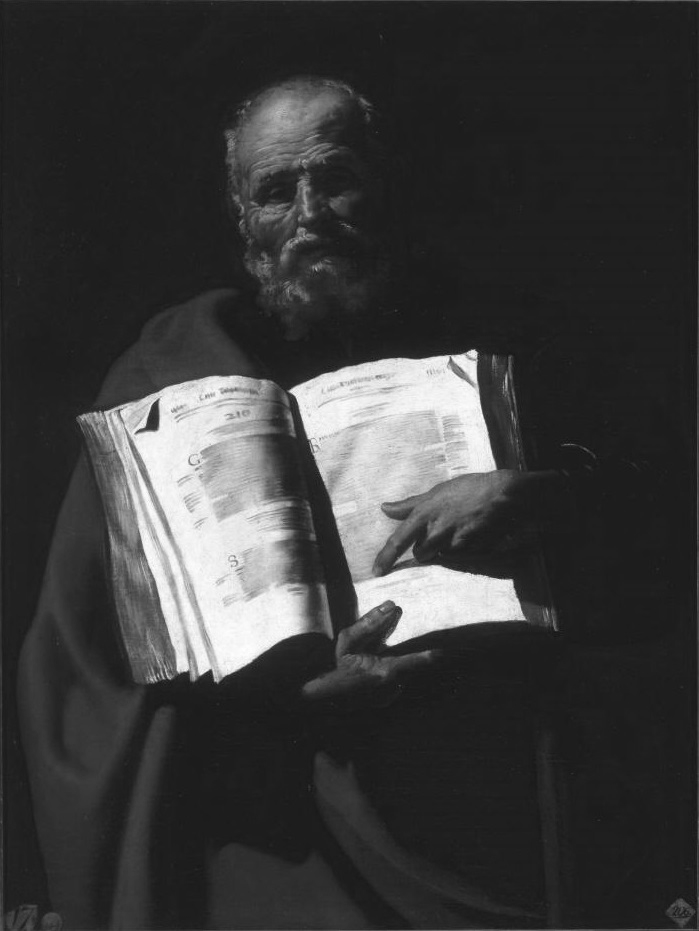
Saint Barnabas the Apostle — Royal Academy of Fine Arts of San Fernando, Madrid
Barnabas was one of the disciples closest to the Apostles. A native of Cyprus and a Levite by birth, he is presented in the Acts of the Apostles as a man of great generosity and faith, whom the Apostles themselves called “son of encouragement” (Acts 4:36). It was he who introduced the newly converted Paul to the community in Jerusalem when all feared him, and who accompanied him on his first missionary journey through Asia Minor and Greece.
The Epistle of Barnabas is one of the oldest texts of the post-apostolic period, dated between AD 70 and 132. Although ancient tradition attributed it to the Barnabas of the Acts of the Apostles, most modern scholars consider it to have been written by another Christian author who adopted his name as an authority. Whatever its authorship, the text was highly esteemed in the early Church: the Codex Sinaiticus itself — one of the oldest biblical manuscripts in the world — included it alongside the New Testament.
The letter has a strongly catechetical and theological character: its central aim is to show that the Old Testament is fulfilled completely in Christ, and that the Church is the true heir of the promises made to Israel. Its reading is an eloquent testimony to how the first Christians understood the relationship between the two Testaments.
Christology
Although it is not Barnabas’s intention to provide a complete dogmatic treatise on the divinity of Christ, in the course of his exposition he sets forth certain truths of faith that form part of the doctrine of the Blessed Trinity, such as the pre-existence of Christ. For Barnabas, Christ not only existed before the creation, but participated in it:
“Consider this also, my brethren: if the Lord endured to suffer for our soul, He being Lord of all the world, to whom God said at the foundation of the world, “Let us make man after our image, and after our likeness,” understand how it was that He endured to suffer at the hand of men.” (Epistle of Barnabas 5:5)
Christ is for Barnabas both Creator and the one who made our salvation possible by freely taking on human nature:
“For unless He had come in the flesh, how could men have been saved by beholding Him? Since looking upon the sun which is destined to cease to exist, and is the work of His hands, their eyes are not able to bear its rays… For this cause He was willing to suffer in this way.” (Epistle of Barnabas 5:10, 13)
Justification and Salvation
He holds to the consensus of the Apostolic Fathers, maintaining without any doubt that obedience to the commandments is a condition for salvation, and reminds the faithful that God will judge all men according to their works, as Scripture teaches.
“To us He says: A broken heart is a sacrifice to God, a sweet savor to the Lord is a heart that glorifies its Maker. We ought therefore, brethren, diligently to inquire concerning our salvation, lest the evil one should cause error to enter into us and hurl us away from our life.” (Epistle of Barnabas 2:10)
“Let us therefore give heed to the last days; for the whole time of your faith will profit you nothing, unless now in this wicked time we also withstand coming sources of danger, as becomes the sons of God. That the Black One may find no means of entrance, let us flee from every vanity, let us utterly hate the works of the way of wickedness.” (Epistle of Barnabas 4:9)
“For the Scripture says, Woe to those who are wise in their own sight, and prudent in their own estimation. Let us become spiritual, let us become a perfect temple to God. As much as in us lies, let us meditate upon the fear of God, and let us keep His commandments, that we may rejoice in His ordinances.
The Lord will judge the world without respect of persons. Each will receive as he has done: if he is righteous, his righteousness will precede him; if he is wicked, the reward of wickedness is before him. Take heed, lest resting at our ease, as those who are called, we should fall asleep in our sins, and the wicked prince, acquiring power over us, should thrust us away from the kingdom of the Lord.
|
From the author The Church Fathers speak for themselvesThis article is part of Early Christianity: In Search of the Origins of the Catholic Church, a documented journey through the faith of the first centuries and its answers to the questions that still divide Catholics and Protestants. |
 |
Moreover, brethren, consider this also: when you see that after so many signs and wonders had been wrought in Israel, even so they were abandoned — let us take heed lest we be found, as it is written, many called but few chosen.” (Epistle of Barnabas 4:11–14)
“And so Scripture says, Nets are not spread in vain for the birds. This means that a man deserves to perish who, having knowledge of the way of righteousness, rushes off into the way of darkness.” (Epistle of Barnabas 5:3)
Baptism
In Barnabas there is not a trace of the Protestant conception of baptism as a mere symbol. On the contrary, it is a sacrament that “brings the remission of sins,” in which we “go down into the water” full of sins and come up regenerated, “bearing fruit in our hearts.”
“But let us inquire whether the Lord took care to foreshadow the water and the cross. Concerning the water, indeed, it is written, in reference to Israel, that they should not receive that baptism which leads to the remission of sins, but should procure other things for themselves… Observe how He described the water and the cross together. For these words imply: Blessed are they who, placing their trust in the cross, have gone down into the water; for, says He, they shall receive their reward in due time: then He declares, I will give it to them. But now He says, Their leaves shall not fail. This means, that every word which proceeds out of your mouth in faith and love shall tend to bring conversion and hope to many.
Furthermore, another prophet declares: And the land of Jacob shall be extolled above every land. This means: He glorifies the vessel of His Spirit. What follows? And there was a river flowing on the right side, and beautiful trees grew up from it; and whosoever shall eat of them shall live forever. This means: we go down into the water full of sins and foulness, but come up, bearing the fruit of fear in our hearts, having the hope which is in Jesus in our spirit. And whosoever shall eat of them shall live forever means that whosoever shall hear and believe these things shall live forever.” (Epistle of Barnabas 11:1, 8–9)
Images
“And again Moses maketh an image of Jesus, showing that it was necessary for Him to suffer, and shall Himself give life to those who, when Israel was perishing, believed that the image set up was to be their salvation. For since transgression was wrought through the serpent, he maketh the likeness of a serpent, and sets it up, and Moses by the word of the Lord maketh a brazen serpent, and sets it up conspicuously, and calls the people together.
When therefore they were assembled, they besought Moses that he would offer sacrifice in their behalf and pray for their recovery. And Moses said to them: When one of you is bitten, let him come to the serpent placed on the pole, and let him hope and believe that, even though it is dead, it is able to give him life, and immediately he shall be restored. And so they did. Thou hast in this also the glory of Jesus, for all things are in Him and for Him.” (Epistle of Barnabas 12:5–7)
The apologetic importance of this passage in the debate with Protestantism over sacred images is considerable. The Reformed tradition — from Calvin and Zwingli to much of contemporary evangelicalism — rejects the use of religious images in worship, invoking the second commandment: “You shall not make for yourself a graven image, or any likeness of anything that is in heaven above” (Exod 20:4). Yet Scripture itself records that God commanded Moses to make the bronze serpent as an instrument of healing for those who looked upon it in faith (Num 21:8–9) — an apparent contradiction of the preceding prohibition. The Epistle of Barnabas not only knows this episode: it employs it as central typological catechesis, recognizing in the bronze serpent raised upon the pole a prefiguration of the crucified Christ. If the use of this image was a divine command and prefigures Christian salvation, the absolute prohibition of all sacred images becomes exegetically untenable. The author of Barnabas, writing in an environment deeply conscious of the Mosaic law, sees no contradiction between the second commandment and the typological use of images: what Scripture prohibits is idolatry — worshiping the image as though it were God — not the use of images as signs pointing to divine realities. This distinction, which Catholicism has maintained from its origins, is the very same one that the Epistle of Barnabas presupposes around AD 100 without finding it in the least problematic.
Sunday as the Lord’s Day
He adds further confirmation against the rejection by sabbatarian sects of Sunday as the Lord’s Day, explaining why Christians began to keep Sunday rather than the Sabbath as the Jews did.
“He says to them: Your new moons and your Sabbaths I cannot endure. You perceive how He speaks: Your present Sabbaths are not acceptable to Me, but that is which I have made, namely this, when, giving rest to all things, I shall make a beginning of the eighth day, that is, a beginning of another world. Wherefore, also, we keep the eighth day [Sunday] with joyfulness, the day also on which Jesus rose again from the dead, and when He had manifested Himself, ascended into the heavens.” (Epistle of Barnabas 15:8–9)
Abortion
Although on this topic nearly all Christians are in agreement (with the exception of a growing number of Protestant denominations that have embraced theological modernism), the position of Barnabas — together with the entire primitive Church — on abortion is clear: it is a divine commandment to respect life, including that of the unborn.
“You shall not slay the child by procuring abortion; nor, again, shall you destroy it after it is born.” (Epistle of Barnabas 19:5)
