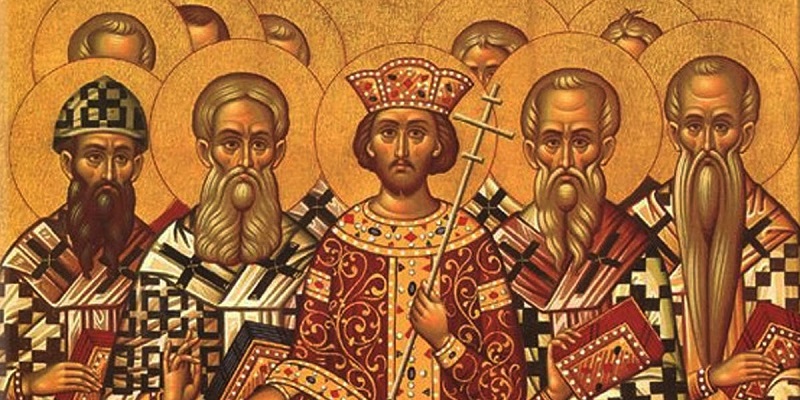
We call “ecclesiastical writers” all those writers on ecclesiastical subjects (doctrine, history, liturgy, discipline, etc.) who were active during the long period of the Church known as the Patristic era[1].
Within this group of writers, those known as the “Church Fathers” occupy a special place. They are recognized as the most eminent pastors—generally bishops—of the Church of the early centuries, whose collective teachings are considered the foundation of faith and orthodoxy in the Church.
For an ecclesiastical writer to be considered a Church Father, he was required to meet four fundamental criteria: antiquity, orthodoxy, holiness, and approval by the Church. Not all the writings of the Fathers are orthodox, but only those on which there is common agreement.
The Fathers are distinguished as Greek (from the East) and Latin (from the West). The last of the Latin Fathers is generally considered to be Isidore of Seville (560–636), and the last of the Greek Fathers is Saint John Damascene (675–749). Among the Church Fathers, those known as the “Apostolic Fathers” hold a special place of their own: they are those Christian writers of the first century or the early second century who were either direct disciples of the Apostles or were specially associated with them.
Throughout the various chapters of this book, numerous quotations and references to the Church Fathers are found. The reason is that through their writings we can come to know first-hand the thought of the earliest Christians, their vision and interpretation of Scripture and Tradition. Since some of them were direct disciples of the Apostles and their successors, their opinion on the fundamental points of Christian doctrine is of paramount importance if we wish to trace the origins and foundations of the purest Christian teaching.
At the end of this book the reader will find a very brief description of some of the Church Fathers, as a reference to be consulted whenever they are cited throughout the book. Should more detailed information be needed, it is recommended to consult the work of Professor Johannes Quasten, Patrology, published by the Biblioteca de Autores Cristianos.
The Didache, or Teaching of the Twelve Apostles
This is one of the oldest non-canonical Christian writings in the group of the Apostolic Fathers, considered earlier than many writings of the New Testament. It was written between the years 65 and 80 and printed in 1883, ten years after having been discovered in the library of the Monastery of the Holy Sepulchre, in Constantinople.
Clement of Rome (? – 101 A.D.)
Saint Clement of Rome was Bishop of Rome and the third successor of Saint Peter. During his pontificate he was faced with a rebellion that occurred approximately in the year 96, in which legitimately appointed presbyters were stripped of their ministries in the community of Corinth.
The Martyrdom of Polycarp (155 A.D.)
This is a letter belonging to the group of the Apostolic Fathers, from the Church of Smyrna to the community of Philomelium, which narrates the martyrdom of Saint Polycarp, a direct disciple of the Apostle Saint John and bishop of Smyrna.
Papias of Hierapolis (69 – 150 A.D.)
One of the Apostolic Fathers canonized as a saint. He was born in the year 69 and died in the year 150. According to Saint Irenaeus, he was a disciple of Saint John and a friend of Saint Polycarp.
The Shepherd of Hermas (141 – 155 A.D.)
The “Shepherd of Hermas” is a book that was greatly esteemed in the early Church, to the point that some of the Holy Fathers came to regard it as canonical—that is, as belonging to the body of Sacred Scripture. However, thanks to the Muratorian Fragment (a parchment from the year 180 that preserves the list of inspired books, discovered and published in the eighteenth century), we know that it was composed by a certain Hermas, brother of Pope Pius I, in the city of Rome, and therefore between the years 141 and 155.
Ignatius of Antioch (? – 107 A.D.)
A disciple of Peter and Paul, the second bishop of Antioch, and a martyr during the reign of Trajan, approximately in the year 107. When he was condemned to death, he was ordered to travel from Syria to Rome to be martyred. On his way to Rome he wrote seven epistles addressed to the churches of Ephesus, Magnesia, Tralles, Philadelphia, Smyrna, and Rome, as well as a letter to Saint Polycarp.
Justin Martyr (100 – 165 A.D.)
A martyr of the Christian faith around the year 165 (beheaded), he is considered the greatest apologist of the second century.
Perpetua (181 – 203 A.D.)
Saint Perpetua was a Christian martyr who suffered martyrdom in the year 203 together with five other Christians: Felicitas, Revocatus, Saturninus, Secundulus, and Saturus.
Theophilus of Antioch (? – ~185 A.D.)
Thanks to the ancient Church historian Eusebius of Caesarea, we know that he was bishop of Antioch, the sixth after Saint Peter. The same information is conveyed to us by Saint Jerome. He is the only one among the apologists whose apologetic work has survived in full who held the episcopal rank, and in a see of such importance by virtue of its ancient tradition.
Tertullian (160 – 220 A.D.)
He was born approximately in the year 160 and died around 220. Tertullian is not considered a Church Father, but rather an apologist and ecclesiastical writer of great erudition. Toward the end of his life he fell into heresy and became a Montanist, but he was widely read before his departure from the Catholic Church.
Origen (185 – 254 A.D.)
Origen was an ecclesiastical writer, theologian, and biblical commentator. He lived in Alexandria until the year 231, spent the last years of his life in Caesarea Maritima, Palestine, and traveling throughout the Roman Empire. He was the greatest teacher of Christian doctrine in his era and exerted an extraordinary influence as an interpreter of the Bible.
Athenagoras of Athens (Second Century)
A recognized early Christian apologist of the second century. He must have converted to Christianity after having pursued studies in rhetoric and philosophy: his writings are filled with erudition and the stylistic devices characteristic of the orators and writers of his day.
Gregory Thaumaturgus (213 – 270 A.D.)
He was born in Neocaesarea in the year 213, of a family of noble lineage. His name was Theodore. At the age of fourteen he lost his father, and that was the beginning of his path towards the faith. He pursued a legal career and attended certain courses given by Origen that were decisive in his life, and at baptism he received the name Gregory. He was consecrated the first bishop of his native city. On account of the legends associated with his person, he was called Thaumaturgus, or “Wonder-Worker.” The Cappadocians of the fourth century venerated him as the founder of the Church of Cappadocia.
Irenaeus of Lyon (130 – 202 A.D.)
Saint Irenaeus (bishop and martyr) was a disciple of Saint Polycarp, who was himself a disciple of the Apostle Saint John. He is celebrated for his treatise “Against Heresies,” in which he combats the heresies of his time, especially those of the Gnostics. In the year 177 he was a presbyter in Lyon (France), and shortly afterward he occupied the episcopal see of that city. He received the palm of martyrdom, as tradition holds, around the year 200.
Abercius of Hierapolis (? – 200 A.D.)
It is known that Saint Abercius was bishop of Hierapolis in the second half of the second century and the beginning of the third. The date of his birth is unknown, and it is estimated that he died around the year 200.
Clement of Alexandria (150 – 215 A.D.)
He was born around the year 150, probably in Athens, of pagan parents. After becoming a Christian, he traveled through southern Italy and through Syria and Palestine in search of Christian teachers, until he arrived in Alexandria; the teachings of Pantaenus led him to remain there. Around the year 202, the persecution of Septimius Severus forced him to leave Egypt, and he took refuge in Cappadocia, where he died shortly before the year 215.
His knowledge of pagan writings and Christian literature is remarkable; according to Johannes Quasten, his works contain quotations from some 360 classical authors, 1,500 from the Old Testament, and 2,000 from the New.
Hippolytus of Rome (? – 235 A.D.)
The place and date of his birth are unknown, though it is known that he was a disciple of Saint Irenaeus of Lyon. His extensive knowledge of philosophy, the Greek mysteries, and his own psychology indicate that he came from the East. Around the year 212 he was a presbyter in Rome, where Origen—during his journey to the capital of the Empire—heard him deliver a sermon.
On the occasion of the dispute over the readmission into the Church of those who had apostatized during a persecution, a grave conflict broke out that set him against Pope Callistus, for Hippolytus proved rigorist in this matter, although he did not deny that the Church has the power to forgive sins. So severe were the differences that he separated himself from the Church and, elected bishop of Rome by a small circle of his supporters, became the first antipope in history. The schism continued after the death of Callistus, during the pontificates of his successors Urban and Pontian. It ended in the year 235, with the persecution of Maximinus, who exiled the legitimate Pope (Pontian) and Hippolytus to the mines of Sardinia, where they were reconciled. There the two renounced the pontificate, in order to facilitate the reconciliation of the Roman community, which was thus able to elect a new Pope and bring the schism to an end. He died in the year 235.
Cyprian of Carthage (200 – 258 A.D.)
Bishop of Carthage, born around the year 200, probably in Carthage, of a wealthy and cultured family. In his youth he devoted himself to rhetoric. The revulsion he felt at the immorality of pagan circles, contrasted with the purity of life of the Christians, led him to embrace Christianity around the year 246. Shortly afterward, in the year 248, he was elected bishop. When the Decian persecution intensified in the year 250, he judged it better to withdraw to a secluded place, so that he could continue to attend to his flock.
Firmilian of Caesarea (? – 268 A.D.)
Bishop of Caesarea and disciple of Origen. Only one letter of his survives, addressed to Saint Cyprian, in which he declares his support for him in the dispute over the validity of baptism conferred by heretics. He died around the year 268.
Lactantius (250 – c. 325 A.D.)
Called the Christian Cicero for his elegant command of the Latin language, Lucius Caecilius Firmianus Lactantius was born in North Africa around the year 250, of a pagan family. He received an excellent education and gained a certain renown as a teacher of Rhetoric, which led the Emperor Diocletian to summon him to Nicomedia to teach at the school he had founded in the new capital of the Empire. It was there that he probably embraced the Christian faith. During the last great persecution, around the year 303, he was compelled to abandon his chair and leave Nicomedia. After the Edict of Milan, Constantine called him to Trier to entrust him with the education of Crispus, his eldest son. Little more is known of the life of Lactantius, who died after the year 317, probably around 320 or 325.
Eusebius of Caesarea (263 – 340 A.D.)
A theologian and historian who was born in the year 263 and died in the year 340. He is considered the Herodotus of Church history, because a great portion of the knowledge we have of the history of early Christianity derives from his Ecclesiastical History.
James of Nisibis (? – 338 A.D.)
From ancient times he has been regarded as a very important and venerated figure in the East, where almost all the Churches celebrate his feast and his name appears in the Martyrologium Hieronymianum. Around the year 308, the saint was appointed first bishop of Nisibis in Mesopotamia, and his disciple Saint Ephrem speaks of the important services he rendered to his diocese, since he erected a great basilica and possibly inaugurated the famous theological school. James attended the Council of Nicaea in the year 325, and Saint Athanasius, the historian Theodoret, and others bore witness to the firmness with which he opposed Arianism. He is estimated to have died in the year 338.
Athanasius of Alexandria (295 – 373 A.D.)
Saint, bishop of Alexandria, and Doctor of the Church, acclaimed by Pius V in the year 1568. He was born in Egypt, in Alexandria, in the year 295 and died in the year 373. He is considered the principal opponent of the Arian heresy.
Hilary of Poitiers (315 – 367 A.D.)
Saint Hilary was born in the year 315 and died approximately in the year 367. He was bishop of Poitiers in Gaul (present-day France) and was the greatest defender of the Catholic faith as expressed at the Council of Nicaea, in the face of the advance of the Arian heresy, which earned him the title “Athanasius of the West.” His most important work is his treatise on the Trinity (De Trinitate), which he wrote during his exile in Asia Minor, between the years 356 and 360.
Ambrosiaster (366 – 384 A.D.)
This is an anonymous author, known by that name since Erasmus, author of an important commentary on the letters of Saint Paul. It was formerly attributed to Saint Ambrose of Milan.
John Chrysostom (347 – 407 A.D.)
Saint, Patriarch of Constantinople, and Doctor of the Church, born in Antioch, Syria, in the year 347, he is considered one of the four great Fathers of the Eastern Church. In the Greek Orthodox Church he is recognized as one of the greatest theologians and one of the Three Pillars of the Church, together with Saint Basil and Saint Gregory.
Jerome (340 – 420 A.D.)
One of the four original Doctors of the Latin Church, Father of the biblical sciences, and translator of the Bible into Latin (the Vulgate), he was born in Stridon (Dalmatia) around the year 340, studied in Rome, and was baptized there. He embraced the ascetic life, traveled to the East, and was ordained a presbyter. He returned to Rome and served as secretary to Pope Damasus. It was during this period that he began his Latin translation of the Bible. He also promoted monastic life. He later settled in Bethlehem, where he labored greatly for the good of the Church. He wrote a great number of works, chiefly commentaries on Sacred Scripture. He died in Bethlehem in the year 420.
Cyril of Alexandria (370 – 444 A.D.)
He is one of the most celebrated Holy Fathers of the ancient Eastern Church. For thirty-two years he was patriarch of Alexandria. His literary activity coincides with the golden age of patristic literature. He was born in the year 370 and died in the year 444.
Didymus the Blind (313 – 398 A.D.)
An ecclesiastical writer and head of the catechetical school of Alexandria. He was considered a doctrinal and spiritual guide of great renown. He was born around the year 313 in Alexandria and died around the year 398. At the age of four or five he lost his sight for the rest of his life, yet he excelled as one of the most learned men of his time.
Basil of Caesarea (329 – 379 A.D.)
Saint and bishop of Caesarea and Doctor of the Church, he was born in the year 329 and died in the year 379. He is recognized as one of the four great Fathers of the Eastern Church, together with Saint Athanasius, Saint Gregory of Nazianzus, and Saint John Chrysostom.
Augustine of Hippo (354 – 430 A.D.)
Saint and Doctor of the Church, he is recognized as one of the four most eminent Doctors of the Latin Church. He was born in the year 354 and was bishop of Hippo for thirty-four years. He vigorously combated all the heresies of his time and died in the year 430.
Ephrem the Syrian (306 – 373 A.D.)
Saint Ephrem was a deacon of the Church in Syria, born around the year 306 in Nisibis, a city of Mesopotamia. Saint Ephrem holds a privileged place among the Holy Fathers both for the abundance of his writings and for the authority of his doctrine. Evidence of this is that many of his hymns have formed part of various Eastern liturgies since the fifth century. Thanks to this, a great portion of his extensive work has been preserved. He died in the year 373.
Aphraates the Syrian (? – 350 A.D.)
The oldest of the Church Fathers of Syria, called “the Persian Sage” by later Syriac writers. Very little is known about his life. From his writings we can conclude that he was born in paganism and that, upon converting, he embraced the religious or ascetic life. It is estimated that he lived between the years 280 and 350.
Epiphanius of Salamis (315 – 403 A.D.)
He was born approximately in the year 315 and died in the year 403. He was made bishop of Salamis and therefore metropolitan of Cyprus in the year 367. He was an austere man of sound doctrine, but aggressive and excessive in temperament; he played an important role in the first anti-Origenist controversy and, without realizing it, became entangled in intrigues against John Chrysostom. In his work he rejects Greek culture, philosophical and theological speculation, and historical criticism; his works are nonetheless important for the many quotations he makes from lost writings.
Basil of Seleucia (? – 469 A.D.)
He was archbishop of Seleucia from approximately the year 440. He behaved in a peculiar manner in the events that led up to the Council of Chalcedon in 451. First, at the Synod of Constantinople in 448, he voted against Monophysitism; at the “Robber Council” of Ephesus in 449, he declared himself in favor of Eutyches; and then at Chalcedon he signed the Tome of Pope Leo the Great Ad Flavianum, which condemned Eutyches and Dioscorus. He died around the year 469.
Cyril of Jerusalem (315 – 386 A.D.)
He was born in Jerusalem or its environs around the year 313 or 315, and it is estimated that he died in the year 386. He was a Father of the Church and archbishop of Jerusalem. His parents were Christians and gave him an excellent education. He knew the Sacred Scriptures very well and quoted them frequently in his instructions. It is believed that he was ordained a priest by the bishop of Jerusalem, Saint Maximus, who entrusted him with the task of instructing the catechumens, which he did for several years. He succeeded Maximus in the see of Jerusalem around the year 350 and served as bishop of that city for about 35 years. For his defense of orthodoxy in the Arian controversy, he was condemned to exile more than once.
Gregory of Nazianzus (329 – 390 A.D.)
He was called the Christian Demosthenes for his eloquence and is known in the Eastern Church as “the Theologian” for the depth of his doctrine. He is one of the Cappadocian Fathers, very close to the brothers Saint Basil and Saint Gregory of Nyssa, with whom he cooperated to defeat the Arian heresy. He is one of the four great Doctors of the Greek Church. He was born in Cappadocia (in present-day Turkey) in the year 329 and died in the year 390.
Gregory of Nyssa (331 – 394 A.D.)
He was born between the years 331 and 335. He was a professor of Rhetoric, but encouraged by his friends, especially by the one who would later become Saint Gregory of Nazianzus, he withdrew to the monastery of Iris in Pontus to devote himself to ascetic practices and the study of Theology. His brother Basil, metropolitan of Caesarea, consecrated him bishop in the year 371 to occupy the see of Nyssa. For his fidelity to the Council of Nicaea he was deposed by a synod of Arian bishops convened in his absence with the assistance of the governor of Pontus. After the death of Emperor Valens, who was an Arian, Saint Gregory returned to his see. In the year 380 he was elected, against his will, archbishop of Sebaste, a see he administered for only a few months, and in the year 381 he took a very active part—together with Saint Gregory of Nazianzus—in the First Council of Constantinople, which definitively resolved the Arian question, reaffirming the faith of Nicaea and setting forth the divinity and consubstantiality of the Holy Spirit. In his final years he composed the most memorable writings of his spiritual doctrine, until his death in the year 394.
Ambrose of Milan (340 – 397 A.D.)
Considered one of the four great Doctors of the Latin Church. He was born in Trier, probably in the year 340, and died in 397.
Nilus of Ancyra (? – 430 A.D.)
He was abbot or archimandrite of a monastery near Ancyra (Ankara), living at the end of the fourth century and the beginning of the fifth, dying shortly after the year 430. His letters attest that he regarded John Chrysostom as his master.
Theodoret of Cyrrhus (393 – 458 A.D.)
He was born in Antioch around the year 393 and was educated in the monasteries of that city. In the year 423 he was elected bishop of Cyrrhus and governed his diocese for thirty-five years.
Leo I the Great (400 – 461 A.D.)
He was born in the region of Tuscany, and in the year 440 he was raised to the Chair of Peter, exercising his office as a true shepherd and father of souls. He worked intensely for the integrity of the faith and defended the unity of the Church with fervor. He wrote against the heresies of Nestorianism, Monophysitism, Manichaeism, and Pelagianism. He died in the year 461.
Gregory I the Great (540 – 604 A.D.)
He is the fourth and last of the original Doctors of the Latin Church. He defended the supremacy of the Pope and worked for the reform of the clergy and monastic life. He sent Augustine of Canterbury to evangelize England, promoted Gregorian chant and liturgical reform, and wrote foundational works such as the Dialogues, the Moralia in Job, and the Pastoral Rule. He was born in Rome around the year 540 and died on March 12 in the year 604.
Bede the Venerable (672 – 735 A.D.)
A Benedictine monk at the monastery of Saint Peter in Wearmouth (now part of Sunderland) and at its sister monastery, Saint Paul, in what is now Jarrow. He is known as a writer and scholar, his most celebrated work being the Historia Ecclesiastica Gentis Anglorum (Ecclesiastical History of the English People), which earned him the title “Father of English History.” Bede wrote on many other subjects, from music to religion. He was born in the year 672 and died in the year 735.
Notes
- Period extending from apostolic times until approximately the eighth century ↩
