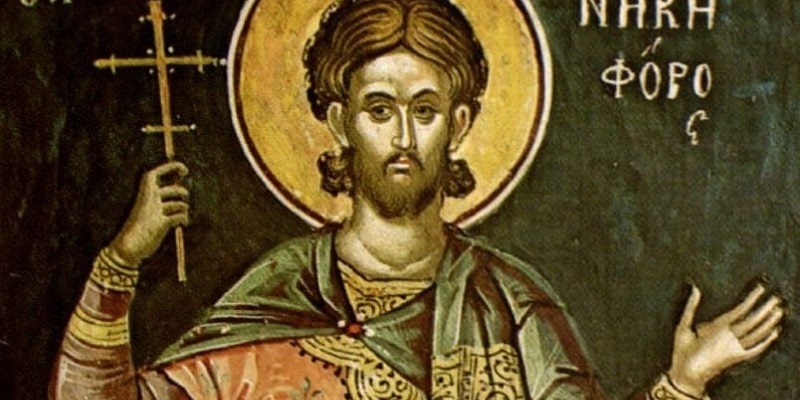
Saint Justin Martyr
Icon of Justin Martyr, Theophanes the Cretan (c. 1546)
Saint Justin was born in Flavia Neapolis, the ancient Shechem of Samaria, around the year 100. A philosopher by training, he passed through several schools of ancient thought before converting to Christianity, which he recognized as the true philosophy. In Rome he founded a Christian school and wrote his two Apologies, addressed to Emperor Antoninus Pius, and the Dialogue with Trypho, a lengthy disputation with a learned Jew. He was martyred around the year 165. His writings are of inestimable value for Catholic apologetics, as they describe in detail the liturgical and doctrinal life of the first Christians of the mid-second century.
The Eucharist: The Real Presence of Christ
The testimony of Saint Justin Martyr on the Eucharist is one of the clearest and most forceful in all patristic literature. Protestants, in their various versions, reject the Catholic doctrine of the Real Presence of Christ in the Eucharist: for Luther, the bread and wine coexist with the body and blood of Christ (consubstantiation); for Calvin, Christ is present in a spiritual but not bodily manner; for Zwingli and much of evangelical Protestantism, the Eucharist is a simple symbolic memorial. Against all of these positions, the testimony of Justin, written barely a hundred years after the death of the Apostles, is definitive.
In chapter 65 of his First Apology, Justin describes the celebration of the Eucharist immediately after baptism, and in chapter 66 he explains in unequivocal terms what the Christians understand the consecrated bread and wine to be:
“And this food is called among us the Eucharist, of which no one is allowed to partake but the man who believes that the things which we teach are true, and who has been washed with the washing that is for the remission of sins, and unto regeneration, and who is so living as Christ has enjoined. For not as common bread and common drink do we receive these; but in like manner as Jesus Christ our Savior, having been made flesh by the Word of God, had both flesh and blood for our salvation, so likewise have we been taught that the food which is blessed by the prayer of His word, and from which our blood and flesh by transmutation are nourished, is the Flesh and Blood of that Jesus who was made flesh.” (Justin Martyr, First Apology 66)
Justin’s formulation admits no symbolic or merely memorial readings. The eucharistic food is the Flesh and Blood of the incarnate Jesus, in the same way that Jesus took flesh and blood in the Incarnation. The expression “by transmutation” points directly to what later theology will call transubstantiation: the bread and wine are transformed into the Flesh and Blood of Christ by virtue of the consecratory prayer. There is not the slightest trace of a symbolic interpretation in this text. Justin writes this in an Apology addressed to the Roman emperor — that is, for a pagan audience — and uses the clearest and most direct language possible. He says what he says.
Justin further adds a significant condition: only those who have been baptized and live according to the commandments of Christ may partake of the Eucharist. This condition confirms that it is not a mere symbolic act that anyone may perform, but a sacrament requiring full communion with the Church. The Eucharist, for Justin as for the Catholic Church, is inseparable from baptism, from the professed faith, and from a moral life conformable to the Gospel.
An argument of singular apologetic value that Saint Justin adds to his eucharistic testimony is the demonstration that the Eucharist fulfills the prophecy of Malachi 1:10–12, which we have already mentioned. In his Dialogue with Trypho, a debate imagined with a Jewish interlocutor, Justin explicitly cites the prophet Malachi to demonstrate that the sacrifices of the Old Testament were shadows of the Christian Eucharist. The prophetic passage is the one in which God announces that He will reject the sacrifices of Israel and in their place receive a pure offering made everywhere by the Gentiles. And Justin applies it to the Eucharist without circumlocution:
|
From the author The Church Fathers speak for themselvesThis article is part of Early Christianity: In Search of the Origins of the Catholic Church, a documented journey through the faith of the first centuries and its answers to the questions that still divide Catholics and Protestants. |
 |
“In the same way, God speaks through Malachi […] about the sacrifices which we the Gentiles offer in every place, that is, the bread of the Eucharist and likewise the cup of the Eucharist, saying: From the rising of the sun even to its setting, My name is great among the Gentiles; and in every place incense is offered to My name, and a pure offering, because My name is great among the Gentiles.” (Justin Martyr, Dialogue with Trypho 41)
This passage makes visible the coherence and antiquity of the Catholic eucharistic doctrine. For Justin, the Eucharist is not a religious practice invented by the Christian community: it is the fulfillment of an Old Testament prophecy. If the Mass were, as Protestantism maintains, a late and pagan corruption of the Gospel, it would be necessary to explain why the oldest apologists of the second century — those closest to the Apostles in time and formation — were already identifying it as the fulfillment of Hebrew Scripture. The Didache had cited Malachi without naming him; Justin names him and applies him. Two independent voices, from the earliest documents of Christianity, converge on the same interpretation. The Protestantism of the sixteenth century would have to wait fifteen centuries to contradict it.
Baptism and Regeneration
Saint Justin is also one of the oldest and most precise testimonies on the doctrine of baptism as an efficacious sacrament of spiritual regeneration. This doctrine is directly contrary to the position of those Protestant traditions that reduce baptism to an outward sign of a faith already existing in the individual, denying that the baptismal water confers by itself the grace of God. For Justin, baptism is the “bath of regeneration,” the gateway to Christian life:
“I will also relate the manner in which we dedicated ourselves to God when we had been made new through Christ; lest, if we omit this, we seem to be unfair in the explanation we are making. As many as are persuaded and believe that what we teach and say is true, and undertake to be able to live accordingly, are instructed to pray and to entreat God with fasting, for the remission of their sins that are past, we praying and fasting with them. Then they are brought by us where there is water, and are regenerated in the same manner in which we were ourselves regenerated. For, in the name of God, the Father and Lord of the universe, and of our Savior Jesus Christ, and of the Holy Spirit, they then receive the washing with water. For Christ also said, Unless you be born again, you shall not enter into the kingdom of heaven.” (Justin Martyr, First Apology 61)
The text is of perfect clarity. Baptism is “the bath of regeneration”: through the baptismal water, the believer is regenerated, born again spiritually. Justin explicitly cites the words of Christ to Nicodemus in John 3:5 as the foundation of this doctrine. Baptismal regeneration is not a metaphor: it is the manner in which God, through water and the Spirit, gives new life to man. This conviction is constant in all primitive writings, from the Didache to Hermas, from Ignatius to Justin himself, and leaves no room for the merely symbolic interpretation that many Protestant traditions would adopt centuries later.
The Sunday Liturgy
Another inestimable contribution of Saint Justin is the oldest surviving description of the liturgical celebration of Christians on the Lord’s Day. In chapter 67 of his First Apology, he describes in notable detail how the Eucharist was celebrated in Rome around the year 155. This description confirms that the eucharistic liturgy of the first Christians had a structure that we recognize as identical to that of the Catholic Mass:
“And on the day called Sunday, all who live in cities or in the country gather together to one place, and the memoirs of the apostles or the writings of the prophets are read, as long as time permits; then, when the reader has ceased, the president verbally instructs, and exhorts to the imitation of these good things. Then we all rise together and pray… When our prayer is ended, bread and wine and water are brought, and the president in like manner offers prayers and thanksgivings, according to his ability, and the people assent, saying Amen; and there is a distribution to each, and a participation of that over which thanks have been given, and to those who are absent a portion is sent by the deacons.” (Justin Martyr, First Apology 67)
The structure Justin describes is as follows: Liturgy of the Word (reading of the Apostles and Prophets, homily by the president), Prayer of the Faithful, Eucharistic Liturgy (presentation of bread and wine, eucharistic prayer by the president, the people’s response with Amen, communion and conveying communion to the absent). This is exactly the structure of the Catholic Mass as we know it today. Nineteen centuries of continuous liturgical tradition separated the Protestants of the sixteenth century from this reality when they broke with Rome. The liturgy they rejected as a medieval invention was the very same one Justin described around the year 155.
