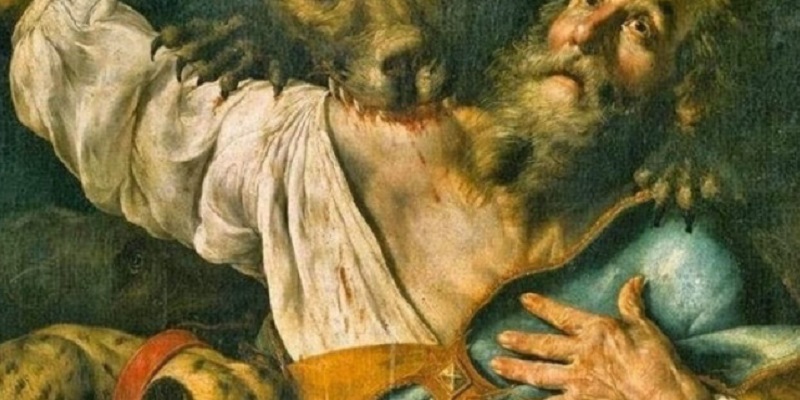
Saint Ignatius of Antioch was a disciple of Saint Paul and Saint John and the second successor of Saint Peter as bishop in the see of Antioch. He was born between the years 30 to 35 AD and died a martyr devoured by wild beasts in January 107 during the reign of the Roman emperor Trajan. On the way to Rome he wrote seven epistles addressed to the churches of Ephesus, Magnesia, Tralia, Philadelphia, Smyrna, Rome and a letter to Saint Polycarp.
Doctrine
Divinity of Christ
Thanks to Saint Ignatius we receive the testimony of a direct disciple of the apostles who helps us understand how clear the awareness of the divinity of Christ was in the early church, which is quite useful when combating the attacks of some sects.
Jehovah’s Witnesses and other Arian-type sects[1], for example, deny that the first Christians believed and accepted the divinity of Jesus Christ. For these sects, Jesus Christ would not be true God, he would not have shared the nature of the Father and the Holy Spirit, but would only be a creature. Catholics, on the other hand, profess to believe in one God in Three divine Persons: the Father, the Son and the Holy Spirit, who share the same divine nature.
These sects assume that the doctrine of the divinity of Christ was imposed as a product of the manipulations of Emperor Constantine during the 4th century, who wanted to deify Christ for political purposes. In the epistles of Saint Ignatius, however, we find testimony several centuries old that demonstrates that at such an early time the full divinity of Jesus Christ was already accepted. In this regard Saint Ignatius writes in his letters:
“There is one God, who has manifested Himself by Jesus Christ His Son, who is His eternal Word, not proceeding forth from silence, and who in all things pleased Him that sent Him.” (Ignatius of Antioch, Letter to the Magnesians 8)
“Ignatius, who is also called Theophorus, to the Church which is at Ephesus, in Asia, deservedly most happy, being blessed in the greatness and fullness of God the Father, and predestinated before the ages of time, that it should be always for an enduring and unchangeable glory, being united and elected through the true passion by the will of the Father, and Jesus Christ, our God: Abundant happiness through Jesus Christ, and His undefiled grace.” (Ignatius of Antioch, Letter to the Ephesians, Greeting)
He states in simple words the key points of Catholic Christology, including the dogma of the incarnation:
“There is one Physician who is possessed both of flesh and spirit; both made and not made; God existing in flesh; true life in death; both of Mary and of God; first passible and then impassible—even Jesus Christ our Lord.” (Ignatius of Antioch, Letter to the Ephesians 7,2)
“Every kind of magic was destroyed, and every bond of wickedness disappeared; ignorance was removed and the old kingdom abolished, God Himself being manifested in human form for the renewal of eternal life.” (Ignatius of Antioch, Letter to the Ephesians 19,1)
“For our God, Jesus Christ, was, according to the appointment of God, conceived in the womb by Mary, of the seed of David, but by the Holy Ghost. He was born and baptized, that by His passion He might purify the water.” (Ignatius of Antioch, Letter to the Ephesians 18)
Throughout his epistles he continues again and again to recognize Jesus Christ as his God, while at the same time affirming that there is only one God:
“Ignatius, who is also called Theophorus, to the Church which has obtained mercy, through the majesty of the Most High Father, and Jesus Christ, His only-begotten Son; the Church which is beloved and enlightened by the will of Him that wills all things which are according to the love of Jesus Christ our God.” (Ignatius of Antioch, Letter to the Romans, Greeting)
“Permit me to be an imitator of the passion of my God.” (Ignatius of Antioch, Letter to the Romans 6)
“I glorify God, even Jesus Christ, who has given you such wisdom. For I have observed that you are perfected in an immoveable faith, as if you were nailed to the cross of our Lord Jesus Christ, both in the flesh and in the spirit.” (Ignatius of Antioch, Letter to the Smyrnaeans 1)
Faced with the heresy of the Gnostics who maintained that Christ had not had a real body but an apparent one, and therefore apparently suffered on the cross, he implicitly affirms the traditional Catholic doctrine later explained through the term “hypostatic union”: Christ is true God but also true man:
“For I know that after His resurrection also He was still possessed of flesh, and I believe that He is so now. When, for instance, He came to those who were with Peter, He said to them, ‘Lay hold, handle Me, and see that I am not an incorporeal spirit.’ And immediately they touched Him, and believed, being convinced both by His flesh and spirit. For this cause also they despised death, and were found its conquerors. And after His resurrection He ate and drank with them, as being possessed of flesh, although spiritually He was united to the Father.” (Ignatius of Antioch, Letter to the Smyrnaeans 3)
Saint Ignatius also rejects one of the elements that would become key in the doctrine of Arianism, which, by considering Jesus Christ as a created being, or what is the same, assuming that there was a moment in time when Jesus Christ did not exist. For him, however, Christ is above time and is timeless:
“Look for Him who is above all time, eternal and invisible, yet who became visible for our sakes; impalpable and impassible, yet who became passible on our account; and who in every kind of way suffered for our sakes.” (Ignatius of Antioch, Letter to Polycarp 3)
Eucharist
It is much more explicit than the Didache in admitting the real presence of Christ in the Eucharist, a doctrine that in ancient times was also rejected by heresies of Gnostic origin. For the Docets, a Gnostic sect of the time, the consecrated bread and wine could not really become the body and blood of Christ, since they started from the aforementioned conception that Christ would not have had a real body but an apparent one. Against this, Saint Ignatius reaffirmed the traditional faith of the Church:
“They abstain from the Eucharist and from prayer, because they confess not the Eucharist to be the flesh of our Saviour Jesus Christ, which suffered for our sins and which the Father, of His goodness, raised up again. Those, therefore, who speak against this gift of God incur death in the midst of their disputings. But it were better for them to treat it with respect, that they also might rise again. It is fitting, therefore, that ye should keep aloof from such persons, and not speak of them either in private or in public.” (Ignatius of Antioch, Letter to the Smyrnaeans 7,1-2)
Probably inspired by chapter 6 of the Gospel of John, he calls the Eucharist the “medicine of immortality” and his flesh the “bread of God”:
“…breaking one and the same bread, which is the medicine of immortality and the antidote to prevent us from dying, but which causes us to live for ever in Jesus Christ.” (Ignatius of Antioch, Letter to the Ephesians 20,2)
“I have no pleasure in corruptible food or in the delights of this life. I desire the bread of God, which is the flesh of Jesus Christ, who was of the seed of David; and for drink I desire His blood, which is incorruptible love.” (Ignatius of Antioch, Letter to the Romans 7,3)
“Take heed, then, to have but one Eucharist. For there is one flesh of our Lord Jesus Christ, and one cup to show forth the unity of His blood; one altar, as there is one bishop, along with the presbytery and deacons, my fellow-servants: that so, whatsoever you do, you may do it according to the will of God.” (Ignatius of Antioch, Letter to the Philadelphians 4)
It accepts as valid only the Eucharist celebrated by a bishop who has a legitimate apostolic succession.
“Let that be deemed a proper Eucharist which is administered either by the bishop, or by one to whom he has entrusted it. … It is not lawful without the bishop either to baptize or to celebrate a love-feast.” (Ignatius of Antioch, Letter to the Smyrnaeans 8,1)
He also exhorts Christians to celebrate the Eucharist frequently:
“Take heed, then, to often come together to give thanks to God and show forth His praise.” (Ignatius of Antioch, Letter to the Ephesians 13,1)
The Catholic Church and its hierarchical constitution
From Saint Ignatius we have the first testimony that has been preserved where the Christian Church is called “Catholic Church”. Writes: “Wherever Jesus Christ is, there is the Catholic Church.” He also sheds a lot of light on the hierarchical organization of the Church of his time, since he addresses his letters to recipient churches that had a perfectly defined tripartite hierarchy: a bishop who governed them (monarchical episcopate), a college of priests subordinate to him, and one or more deacons.
“See that ye all follow the bishop, even as Jesus Christ does the Father, and the presbytery as ye would the apostles; and reverence the deacons as being the institution of God. Let no man do anything connected with the Church without the bishop. Let that be deemed a proper Eucharist which is administered either by the bishop or by one to whom he has entrusted it. Wheresoever the bishop shall appear, there let the multitude also be; even as, wherever Jesus Christ is, there is the Catholic Church. It is not lawful without the bishop either to baptize or to celebrate a love-feast; but whatsoever he shall approve of, that is also pleasing to God, so that everything that is done may be secure and valid.” (Ignatius of Antioch, Letter to the Smyrnaeans 8,1-2)
“Since therefore I have, in the persons before mentioned, beheld the whole multitude of you in faith and love, I exhort you to study to do all things with a divine harmony, while your bishop presides in the place of God, and your presbyters in the place of the assembly of the apostles, along with your deacons, who are most dear to me and are entrusted with the ministry of Jesus Christ, who was with the Father before the beginning of time and in the end was revealed.” (Ignatius of Antioch, Letter to the Magnesians 6,1)
“It is fitting that you should run together in accordance with the will of your bishop, which thing also you do. For your justly renowned presbytery, worthy of God, is fitted as exactly to the bishop as the strings are to the harp.” (Ignatius of Antioch, Letter to the Ephesians 4,1)
“Since I have had the privilege of seeing you through Damas, your most worthy bishop, and through your worthy presbyters Bassus and Apollonius, as well as the deacon Sotio, my fellow-servant, whose friendship may I ever enjoy, inasmuch as he is subject to the bishop as to the grace of God, and to the presbytery as to the law of Jesus Christ.” (Ignatius of Antioch, Letter to the Magnesians 2,1)
The same is observed throughout his epistles (Letter to the Ephesians 1,3; 3,2; 4,1; Letter to the Magnesians 2; 3,1; 6,1; 7,1; 13,1; 15,1; Letter to the Trailians 1,1; 3,1; 12,2; Letter to Philadelphians 1; 3,2; 7,1-2; Letter to Polycarp 1; 6,1; Letter to the Smyrnaeans 8,1-2; 12,2.)
Something important in all this is that Saint Ignatius speaks to an audience who assumes that, just as he knows well, all Christian churches have this hierarchical structure:
“Since love permits me not to be silent in regard to you, I have therefore taken upon me first to exhort you that ye would all run together in accordance with the will of God. For even Jesus Christ, our inseparable life, is the manifested will of the Father; as also the bishops, settled everywhere to the utmost bounds of the earth, are so by the will of Jesus Christ.” (Ignatius of Antioch, Letter to the Ephesians 3,2)
This supports the traditional thesis that the monarchical episcopate has had its origin in the apostles themselves, and therefore, in Jesus Christ himself, and has not been, as much of contemporary theology has assumed,[2], a late development of Christian doctrine. In this regard, the historian and patrologist Daniel Ruiz Bueno explains:
|
From the author The Church Fathers speak for themselvesThis article is part of Early Christianity: In Search of the Origins of the Catholic Church, a documented journey through the faith of the first centuries and its answers to the questions that still divide Catholics and Protestants. |
 |
“This has long been another of the criticism’s stumbling blocks in admitting the authenticity of the letters of Saint Ignatius, since With them a monarchical episcopate and a perfectly defined hierarchy had to be swallowed at the end of the 1st century., with which many expensive theories fell to the ground. But theories are theories and texts are texts. Now, the texts of the Ignatian letters attest to us with absolute clarity and with crushing insistence that each Church – Antioch, Smyrna, Ephesus, Trales, Philadelphia – has at its head an ἐπίσκοπος, “intendant, inspector”, supreme authority in the community, who is added as dependent and subordinate, aπρεσβυτέριον, a college of “elders” that assists him as a kind of “senate”, and a third body of deacons or ministers.”[3]
The Catholic historian José Orlandis adds:
“Many churches of the 1st century were founded by the Apostles and, while they lived, they remained under their superior authority, directed by a college of presbyters who ordered their liturgical and disciplinary life. This regime can be especially attested in the Pauline Churches, founded by the Apostle of the Gentiles. But as the Apostles disappeared, the monarchical episcopacy, which had already been introduced from the first moment in other particular churches, became generalized everywhere..The bishop was the head of the Church, pastor of the faithful, and as successor of the Apostles, he possessed the fullness of the priesthood and the power necessary for the government of the community.”[4]
Heresy and schism
For Saint Ignatius, the succession of bishops in a direct line to the apostles is one of the necessary pillars for the Church to remain incorruptible and not give in to the temptation of falling into heresies and schisms:
“For, when I was among you, I cried, I spoke with a loud voice: Give heed to the bishop, and to the presbytery and deacons. Now, some suspected me of having spoken thus, as knowing beforehand the division caused by some among you. But He is my witness, for whose sake I am in bonds, that I got no intelligence from any man. But the Spirit proclaimed these words: Do nothing without the bishop; keep your bodies as the temples of God; love unity; avoid divisions. Be the followers of Jesus Christ, even as He is of His Father.” (Ignatius of Antioch, Letter to the Philadelphians 7,1-2)
“I therefore, yet not I, but the love of Jesus Christ, entreat you that you use Christian nourishment only, and abstain from herbage of a different kind; I mean heresy. For those that are given to this mix up Jesus Christ with their own poison, speaking things which are unworthy of credit, like those who administer a deadly drug in sweet wine, which he who is ignorant of does greedily take, with a fatal pleasure leading to his own death. Be on your guard, therefore, against such persons. And this will be the case with you if you are not puffed up, and continue in intimate union with Jesus Christ our God, and the bishop, and the enactments of the apostles. He that is within the altar is pure, but he that is without is not pure; that is, he who does anything apart from the bishop, and presbytery, and deacons, such a man is not pure in his conscience.” (Ignatius of Antioch, Letter to the Trallians 6–7)
He identifies heresy as a very serious sin, even more so than adultery, because it corrupts the true faith:
“Do not err, my brethren. Those that corrupt families shall not inherit the kingdom of God. If, then, those who do this as respects the flesh have suffered death, how much more shall this be the case with any one who corrupts by wicked doctrine the faith of God, for which Jesus Christ was crucified! Such an one, becoming defiled [in this way], shall go away into everlasting fire, and so shall every one that hearkens unto him.
For this end did the Lord allow the ointment to be poured upon His head, that He might breathe immortality into His Church. Be not anointed with the bad odour of the doctrine of the prince of this world; let him not lead you away captive from the life which is set before you. (Ignatius of Antioch, Letter to the Ephesians 16,2; 17,1-2)
“Let no one deceive you, as indeed you are not deceived, inasmuch as you are wholly devoted to God. For since there is no strife raging among you which might distress you, you are certainly living in accordance with God.” (Ignatius of Antioch, Letter to the Ephesians 8,1)
He also adds that those who have fallen into heresy can repent and return to the bosom of the Catholic Church:
“I therefore did what belonged to me, as a man devoted to unity. For where there is division and wrath, God does not dwell. To all those who repent, the Lord grants forgiveness, if they turn in penitence to the unity of God and to communion with the bishop. I trust in the grace of Jesus Christ, who shall free you from every bond. And I exhort you to do nothing out of strife, but according to the doctrine of Christ.” (Ignatius of Antioch, Letter to the Philadelphians 8,1-2)
“Keep yourselves from those evil plants which Jesus Christ does not tend, because they are not the planting of the Father. Not that I have found any division among you, but exceeding purity. For as many as are of God and of Jesus Christ are also with the bishop. And as many as shall, in the exercise of repentance, return into the unity of the Church, these, too, shall belong to God, that they may live according to Jesus Christ. Do not err, my brethren. If any man follows him that makes a schism in the Church, he shall not inherit the kingdom of God. If any one walks according to a strange opinion, he agrees not with the passion of Christ.” (Ignatius of Antioch, Letter to the Philadelphians 3)
It is also important to gather together in community in the Church, and this attitude contrasts with that of the arrogant who claims to have faith but does not attend the meeting of the faithful:
“Let no man deceive himself: if any one be not within the altar, he is deprived of the bread of life. For if the prayer of one or two possesses such power, how much more that of the bishop and the whole Church! He, therefore, that does not assemble with the Church has even by this manifested his pride, and condemned himself. For it is written, God resisteth the proud. Let us be careful, then, not to resist the bishop, that we may be subject to God.” (Ignatius of Antioch, Letter to the Ephesians 5,2-3)
Justification by faith
His doctrine on justification remains in line with that of all the first fathers: we are justified by faith, but by faith that is united to charity, therefore, the faith that saves is that which is a true fidelity that leads us to remain united and firm in obedience to God and his commandments until the end:
“They that are carnal cannot do those things which are spiritual, nor they that are spiritual the things which are carnal; even as faith cannot do the works of unbelief, nor unbelief the works of faith. But even those things which you do according to the flesh are spiritual; for you do all things in Jesus Christ.” (Ignatius of Antioch, Letter to the Ephesians 8,2)
“None of these things is hidden from you, if you perfectly possess that faith and love towards Christ Jesus which are the beginning and the end of life. For the beginning is faith, and the end is love. Now these two, being inseparably connected together, are of God, while all other things which are requisite for a holy life follow after them. No man truly making a profession of faith sins; nor does he that possesses love hate any one. The tree is made manifest by its fruit; so those that profess themselves to be Christians shall be recognised by their conduct. For there is not now a demand for mere profession, but that a man be found continuing in the power of faith to the end.” (Ignatius of Antioch, Letter to the Ephesians 14,1-2)
It is clear that he thought, unlike the Protestant reformers, that salvation was something that could be lost if one did not remain in a state of grace. So much so that he asks for prayers for his salvation, so that he may be found worthy and not reprobate at the time of death:
“I entreat you in love to hear me, that I may not, by having written, be a testimony against you. And also pray for me, who have need of your love, along with the mercy of God, that I may be worthy of the lot for which I am destined, and that I may not be found reprobate.” (Ignatius of Antioch, Letter to the Trallians 12,3)
Primate of the Roman See
Although Saint Ignatius does not address in his letters the jurisdictional primacy of the Church of Rome as the see of Saint Peter’s successors, the distinctive tone he uses when addressing the Church of Rome is evident on a careful reading. One may compare the greetings addressed to the different churches with that addressed to the one which “presides in the place of the region of the Romans” and “presides over love.” The tone stands out not only for its many praises, but also for the deference of one addressing a superior, taking it for granted that Rome presided over the other churches and not only over its own territory.
“Ignatius, who is also called Theophorus, to the Church which has obtained mercy through the majesty of the Most High Father and Jesus Christ, His only-begotten Son; the Church which is beloved and enlightened by the will of Him that wills all things which are according to the love of Jesus Christ our God, which also presides in the place of the region of the Romans; worthy of God, worthy of honour, worthy of the highest happiness, worthy of praise, worthy of obtaining her every desire, worthy of being deemed holy, and which presides over love, named from Christ and from the Father: I also salute her in the name of Jesus Christ, the Son of the Father…” (Ignatius of Antioch, Letter to the Romans, Greeting)
The Church which “presides over love” also gives instruction to the other churches and to the very Church of which Saint Ignatius is bishop:
“You have never envied anyone; you have taught others. Now I desire that those things which in your instructions you enjoin on others may be confirmed by your conduct. Only request on my behalf both inward and outward strength, that I may not only speak, but truly will; and that I may not merely be called a Christian, but really be found to be one.” (Ignatius of Antioch, Letter to the Romans 3,1)
It is also significant that, although he entrusts the care of his Church to no other, he does so with Rome, asking her to fulfil the office of bishop toward it.
“Remember in your prayers the Church in Syria, which now has God for its shepherd, instead of me. Jesus Christ alone will oversee it, and your love will also regard it.” (Ignatius of Antioch, Letter to the Romans 9)
It is also deduced that Saint Ignatius was well aware of the fact that the church of Rome was governed by Saints Peter and Saint Paul:
“I do not, as Peter and Paul, issue commandments unto you. They were apostles; I am but a condemned man: they were free, while I am, even until now, a servant.” (Ignatius of Antioch, Letter to the Romans 4,3)
Virginity of Mary
Saint Ignatius speaks of Mary’s virginity as a miracle so amazing that it was hidden from Satan himself, although he is not explicit enough to be certain that he was referring not only to virginity before childbirth, but also to virginity in and after childbirth:
“Mary’s virginity was hidden from the prince of this world and her birth, in the same way as the death of the Lord: three sonorous mysteries that were fulfilled in the silence of God.” (Ignatius of Antioch, Letter to the Ephesians 19,1)
Sunday as the Lord’s Day
Seventh-day Adventists and other Sabbatarian sects accuse the Catholic Church of replacing the Sabbath with Sunday as the day of rest, thereby violating God’s commandment. They also claim that this change resulted from manipulations by Emperor Constantine in the fourth century, intended to impose secretly the worship of the sun god.
Yet, almost three centuries earlier, Saint Ignatius stated that those who observed the Sabbath rather than Sunday as Christians do had been deceived by strange doctrines and had ended up Judaizing; Christians, however, observed Sunday as the Lord’s Day because it was the day on which the Lord rose again.
“Be not deceived with strange doctrines, nor with old fables, which are unprofitable. For if we still live according to the Jewish law, we acknowledge that we have not received grace. …”
If, therefore, those who were brought up in the ancient order of things have come to the newness of hope, no longer observing the Sabbath, but living in the observance of the Lord’s Day, on which our life also sprang up again through Him and through His death—a mystery which some deny—then through it we received the grace to believe and through it we suffer, so that we may be found disciples of Jesus Christ, our only Master. (Ignatius of Antioch, Letter to the Magnesians 8,1; 9,1)
“It is absurd to profess Christ Jesus and to Judaize. For Christianity did not embrace Judaism, but Judaism Christianity, so that every tongue that believes might be gathered together to God.” (Ignatius of Antioch, Letter to the Magnesians 10,3)
“But if anyone preach the Jewish law to you, do not listen to him. For it is better for a man to hear Christianity from one who is circumcised than Judaism from one who is uncircumcised.” (Ignatius of Antioch, Letter to the Philadelphians 6,1)
It is likely that these warnings are due to the fact that there were still some Christians who clung to the ancient ordinances of the Mosaic Law (circumcision, tithing, Saturday as a day of rest, impure foods), a conflict that already left its mark on the New Testament and which triggered the Council of Jerusalem (Acts 15). Saint Paul himself, of whom Saint Ignatius was a disciple, had already warned along the same lines in the New Testament: “Therefore, let no one criticize you for matters of food or drink, or regarding festivals, new moons, or Sabbaths.” (Colossians 2:16)
Marriage and celibacy
Saint Ignatius follows Saint Paul’s line of thought in his recommendations concerning celibacy and marriage. The Apostle to the Gentiles wrote to the Corinthian community that celibacy was the ideal state for serving the Lord: “I say to the unmarried and to widows: it is good for them to remain as I am. But if they cannot exercise self-control, let them marry; for it is better to marry than to burn… The unmarried person is concerned with the affairs of the Lord, how to please the Lord. But the married man is concerned with worldly affairs, how to please his wife, and he is divided.” (1 Corinthians 7:8–9, 33–34). Saint Ignatius’s recommendations are practically identical:
“Speak to my sisters, that they love the Lord, and be satisfied with their husbands both in the flesh and spirit. In like manner also, exhort my brethren, in the name of Jesus Christ, that they love their wives, even as the Lord the Church. If any one can continue in a state of purity, to the honour of Him who is Lord of the flesh, let him so remain without boasting. If he begins to boast, he is undone; and if he reckon himself greater than the bishop, he is ruined. But it becomes both men and women who marry, to form their union with the approval of the bishop, that their marriage may be according to God and not after their own lust. Let all things be done to the honour of God.” (Ignatius of Antioch, Letter to Polycarp 5,1–2)
Detachment and spiritual poverty
The early Church’s perspective on material goods and detachment from them was very different from contemporary heretical theologies circulating in, and gaining popularity among, Protestant ecclesial communities and even some Catholic communities. In contrast to what is known as “prosperity theology,” Saint Ignatius holds that the goods of this world, and even life itself, are worth nothing in comparison with eternal life; greed is therefore a hindrance and an obstacle:
“All the pleasures of the world, and all the kingdoms of this earth, shall profit me nothing. It is better for me to die on behalf of Jesus Christ, than to reign over all the ends of the earth.” (Ignatius of Antioch, Letter to the Romans 6,1)
“Do not have Jesus Christ in your mouths and the world in your hearts.” (Ignatius of Antioch, Letter to the Romans 7,1)
Author: José Miguel Arraiz
NOTES
[1] Arianism is a fourth-century heresy named after Arius (256–336), a priest of Alexandria and later a Libyan bishop. From 318 he propagated the idea that there are not three persons in God, but only one person, the Father. Jesus Christ was not God, but was created by God from nothing as an instrument of His plan. The Son is therefore a creature and His being has a beginning; there was, therefore, a time when He did not exist. By holding this theory, Arius denied the eternity of the Word, which amounts to denying His divinity. From this perspective, Jesus is not truly God. Although Arius was chiefly concerned with stripping Jesus Christ of divinity, he did the same with the Holy Spirit, whom he also considered a creature, and even inferior to the Word.
[2] It has become increasingly common among modern theologians to accept the hypothesis of the late development of the monarchical episcopate, as Francis A. Sullivan explains (From Apostles to Bishops, The Newman Press, New York, 2001). The author himself adopts that hypothesis in the cited work.
[3] Daniel Ruiz Bueno, Padres Apostólicos, Biblioteca de Autores Cristianos 65, 5th ed., Madrid, 1985, pp. 421–422.
[4] José Orlandis, Breve Historia del Cristianismo, Ediciones RIALP, 6th ed., Madrid, 1999, pp. 25–26.
