
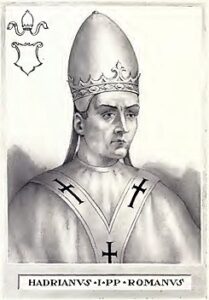
 Pope Adrian I. Against the iconoclasts. Empress regent, Irene. He regulates the iconoclast controversy by pronouncing in favor of the cult of images, while carefully distinguishing the cult of veneration from the cult of adoration, which is due to God alone.
The legitimacy of the use and cult of sacred images is vindicated.
Between East and West, and between their imperial capitals, Rome and Constantinople, there was always antagonism, whether in the political aspect or in the religious one. If the Pope is first in Christendom, the second place is undoubtedly occupied by the patriarch of Constantinople. In the middle of the ninth century an ambitious figure occupied the patriarchal see; his name was Photius. He committed every kind of arbitrary act and inflamed the feelings of the Easterners against Rome. This grave situation led to the opening of a new council.
Magisterium of the Second Council of Nicaea seventh ecumenical council (against the iconoclasts)
Definition on the sacred images and tradition
SESSION VII
[I. Definition.] …Entering, as it were, upon the royal highway, following the divinely inspired teaching of our Holy Fathers and the tradition of the Catholic Church — for we recognize that it belongs to the Holy Spirit who dwells in her — we define with all exactness and care that, in a manner similar to the image of the precious and life-giving cross, the sacred and holy images are to be set forth, whether painted, made of mosaic, or of other suitable material, in the holy churches of God, on sacred vessels and vestments, on walls and panels, in houses and by the wayside: those of our Lord and God and Savior Jesus Christ, of our immaculate Lady, the holy Mother of God, of the precious angels, and of all holy and venerable men. For the more frequently they are contemplated through their representation in the image, the more those who look upon them are moved to the remembrance and desire of the originals and to pay them salutation and honorable adoration; certainly not the true latria which, according to our faith, belongs only to the divine nature, but, as is done with the figure of the precious and life-giving cross, with the Gospels, and with the other sacred objects of worship, they are to be honored with the offering of incense and lights, as was the pious custom of the ancients. “For the honor paid to the image passes to the original,” and whoever adores an image adores the person represented in it.
 [II. Proof.] For in this way the teaching of our holy Fathers is maintained, that is, the tradition of the Catholic Church, which has received the Gospel from one end of the earth to the other; in this way we follow Paul, who spoke in Christ [2 Cor. 2:17], and the divine college of the Apostles and the holiness of the Fathers, holding the traditions [2 Thess. 2:14] that we have received; in this way we prophetically sing to the Church the hymns of victory: Rejoice exceedingly, daughter of Zion; proclaim, daughter of Jerusalem; rejoice and exult with all your heart: the Lord has removed from around you all the iniquities of his adversaries; you have been redeemed from the hands of your enemies. The Lord the king is in your midst: you shall see evil no more, and peace shall be upon you for ever [Zeph. 3:14 ff.; LXX].
[III. Sanction.] Therefore, those who dare to think or teach otherwise; or who, following the sacrilegious heretics, reject the traditions of the Church and invent novelties, or reject any of the things consecrated to the Church — the Gospel, or the figure of the cross, or the painting of an image, or a holy relic of a martyr; or who crookedly and cunningly devise schemes with a view to overturning any of the lawful traditions of the Catholic Church; and who, moreover, put sacred vessels or holy monasteries to profane uses: if they are bishops or clerics, we order that they be deposed; if monks or lay people, that they be separated from communion.
On sacred elections
SESSION VII
Every election of a bishop, priest, or deacon made by princes shall be null, according to the canon [Apost. Can. 30] which says: “If any bishop, by making use of secular princes, takes possession of the Church through them, let him be deposed and excommunicated, and likewise all who communicate with him. For it is necessary that the one who is to be raised to the episcopate be elected by the bishops, as was determined by the Holy Fathers of Nicaea in the canon which says [Can. 4]: “It is especially fitting that the bishop be established by all the bishops of the province. But if this is difficult, either because of pressing necessity or because of the length of the journey, let three necessarily come together, and let all the absent give their consent by letters, and then let hands be imposed upon him; but the validity of all that has been done is to be attributed in each province to the metropolitan.”
On the images, on the humanity of Christ, on tradition
 We receive the sacred images; we subject to anathema those who do not think thus…
If anyone does not confess Christ our God as circumscribed according to his humanity, let him be anathema…
If anyone rejects every ecclesiastical tradition, written or unwritten, let him be anathema.
On the errors of the Adoptionists
[From Adrian’s Letter Si tamen licet to the bishops of Gaul and Spain, 793]
When the matter of causal perfidy had been brought together with false arguments, among other things worthy of reprobation, concerning the adoption of Jesus Christ, Son of God according to the flesh, heaps of perfidious words from a disordered pen were read there. The Catholic Church never believed this, never taught it, and never gave assent to those who wrongly believed it…
Impious and ungrateful for so many benefits, are you not horrified to murmur with venomous jaws that our Liberator is an adoptive son, as though he were a mere man, subject to human misery, and — shameful to say — that he is a servant?… How do you not fear, querulous detractors, hateful to God, to call servant the One who freed you from the slavery of the devil?… For although in the shadow of prophecy he was called servant [cf. Job 1:8 ff.], because of the condition of the servile form that he took from the Virgin,… we… understand this as said, according to history, of holy Job, and allegorically.
Source: Mercaba.org
