A true story
The disapproval many Protestants have toward the Catholic custom of having religious images and statues originates in the suspicion that Catholics commit the sin of idolatry by worshiping them (which is forbidden in Exodus 20:3-5 and Deuteronomy 5:6-9). Let me say it: this error is much more widespread than we might think.
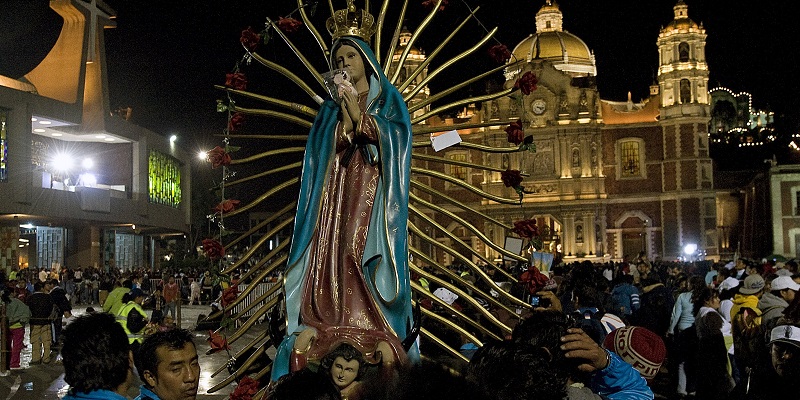
About 20 years ago, upon arriving at a parish in Chicago where an apologetics seminar was being held, I noticed the life-size statue of Our Lady of Fatima in a prominent place on the rectory lawn.
Right in front of the statue were three smaller statues of Lucia, Francisco, and Jacinta — the children to whom the Virgin appeared. Their statues were kneeling in prayer, with hands joined and heads bowed before the statue of the Virgin Mary.
With Karl Keating in the car with me, I jokingly said to him: “What a great religion Catholicism is! Not only can we worship statues, but our statues worship statues too”. We burst out laughing at the absurdity of the idea.
I repeated this sarcastic joke during the seminar and, predictably, it also made the Catholics in the audience laugh. Some people, however, seemed puzzled by the laughter. The reason? As I discovered during the question-and-answer session, some of them really believed that Catholics worshiped images. I had a good opportunity, there and then, to explain the biblical teaching about religious images in the Catholic Church.
The following explanation is an excerpt from my book Does the Bible Really Say That? Discovering Catholic Teaching in Scripture (Servant Books):
Admonitions against idolatry appear throughout Scripture (for example, Numbers 33:52; Deuteronomy 7:5, 25; 9:12; 12:3; 2 Kings 17:9-18; 23:24; 2 Chronicles 23:17; 28:1-3; 22:18-25; 34:1-7). In 1 Corinthians 10:14 Saint Paul wrote: “Beloved, flee from the worship of idols” (Romans 1:18-23).
God condemns the sin of idolatry, whether in the form of statues, material things, sex, power, or anything that becomes an idol. But He does not forbid religious images, provided they are used correctly. For example, in Exodus chapter 25 God orders Moses to carve statues of angels.
“Yahweh spoke to Moses, saying… You shall make two cherubim of hammered gold; you shall make them at the two ends of the mercy seat: make one cherub at one end and the other cherub at the other end. The cherubim shall form one piece with the mercy seat at its two ends. They shall have their wings spread out above, covering the mercy seat with their wings, one facing the other, with their faces turned toward the mercy seat… There I will meet with you; from above the mercy seat, from between the two cherubim placed upon the ark of the Testimony, I will communicate to you all that I shall command you for the Israelites. ”(Exodus 25:1, 18-20, 22; see also 26:1)
This clearly shows that there are circumstances in which religious images are not only permitted but also truly pleasing to God. Another example is the incident described in 1 Samuel 6:1-18. In Exodus 28:31-34 the Lord commanded that Aaron’s priestly vestments be adorned with images of pomegranates. In Numbers 21:8-9 He commanded Moses to sculpt the image of a serpent that miraculously healed the bites of poisonous serpents (a mysterious prefiguration of the cross of Christ [cf. John 3:14). And in 2 Kings 18:4, when the people began to worship the bronze serpent, the king immediately destroyed it. What had once been a legitimate sacred image had become an object of idolatry. (A cautionary tale for any temptation toward superstition or idolatry).
And note what God said to Solomon when he built the Temple:
“«Concerning this House that you are building, if you walk according to my statutes, act according to my ordinances, and keep all my commandments by walking in them, I will fulfill my word with you, the word I spoke to David your father; I will dwell among the children of Israel and will not abandon my people Israel». Solomon built the House and finished it” (1 Kings 6:12-14).
This text is relevant because the temple contained a large number of statues and images, including angels, trees, flowers, oxen, and lions (cf. 1 Kings 6:23-35; 7:25,36). Solomon’s decision to include these religious images came from the gift of wisdom with which God had blessed him (cf. 1 Kings 3:1-28). And far from being displeased by this kind of images, “Yahweh said to him: «I have heard the prayer and the supplication you have made before me. I have sanctified this House that you have built, to put my Name there forever; my eyes and my heart will be there always” And (1 Kings 9:3).
Obviously God would not have blessed Solomon and “sanctified” his temple full of statues and images if He did not approve of them — further proof that images can be good when they are used to direct our thoughts toward God and toward heavenly realities.
Remember also that Saint Paul called Christ the “Image of the invisible God” (Colossians 1:15). The Greek word for “image” is eikonos, from which the word “icon” is derived. Just as we keep photos of our family and friends that remind us of them, we also have statues and images in our homes and churches to remind us of Our Lord, the Virgin, and the Saints.
Additional passages for study:
John 14:9
Colossians 1:15
Hebrews 1:3
1 John 1:1-3
Author: Patrick Madrid
