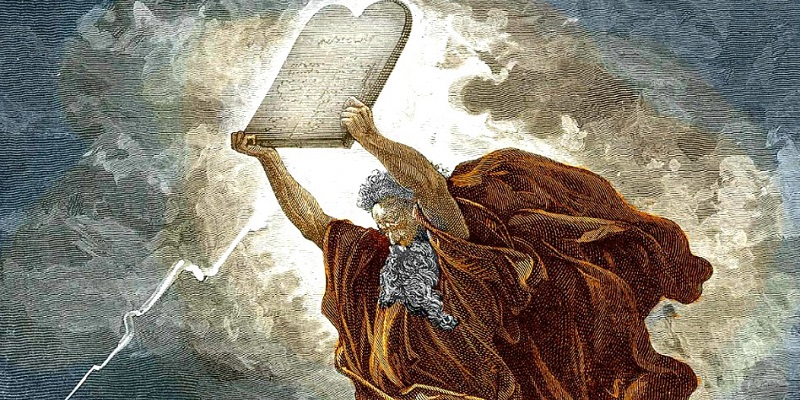
Michael: Our last conversation was very interesting, and I could tell you that I really get your doctrine about saints, but I would like to ask you a question: Why has the Catholic Church eliminated the second commandment?
Joseph: What do you mean when you say that we eliminated the second commandment?
Michael: Of course, look at this list that I brought and compare the Ten Commandments according to the Bible and the Ten Commandments according to the Catholic Church:
Look at how they eliminated the second and divided the ninth commandment in two to complete the Ten Commandments. Why?
Pauline: I can find two reasons, and I will tell them to you with respect:
1) Because the Catholic Church is an idolatrous church and this commandment clearly condemns these idolatrous practices of the Catholic Church. If the idolatry falls, the Catholic Church falls too.
2) Because they don’t care about the Catholic’s soul or about your soul, as well they know that if you die in sin of idolatry you’re going to hell, as the Bible says: “But the fearful and unbelieving and the abominable and murderers and whoremongers and sorcerers and idolaters and all liars, they shall have their portion in the pool burning with fire and brimstone, which is the second death.”(Rev 21,8)[1]
Joseph: Ok, we need to have a long and extended talk to answer the accusation of idolatry. What about in our next conversation, we talk about that, and in this conversation, I share with you my opinion about the alleged removal of the second commandment?
Michael: I agree.
Pauline: Sounds good.
Joseph: Before we start, I want you to notice something: In the text that you gave me (Rev 21,8), it doesn’t say that those who are idolaters are the only ones who sin gravely, but also those who raise false testimony.
Michael: We know that.
Joseph: So it is very important to be careful when we make accusations against others, and especially one as serious as that of removing a commandment or mutilating the word of God.[2]
Michael: Joseph, it would only be a sin if we were saying something that is not the truth, but I just have shown you that the Catholic Church eliminated the second commandment. Compare your own Catechism with your own Catholic Bible.
Joseph: It so happens that I have the 1992 Catechism right here. Let me search and we’ll read it together and check if it is true.
Pauline: Ok, we will wait.
Joseph: (Searching the Catechism)
Let’s see what it says about the first commandment[3]:
SECOND SECTION
THE TEN COMMANDMENTS
CHAPTER ONE
«YOU SHALL LOVE THE LORD YOUR GOD WITH ALL YOUR HEART,
WITH ALL YOUR SOUL AND WITH ALL YOUR STRENGTH»
ARTICLE 1
THE FIRST COMMANDMENT
“I am the LORD your God, who brought you out of the land of Egypt, out of the house of bondage. You shall have no other gods before me. You shall not make for yourself a graven image, or any likeness of anything that is in heaven above, or that is in the earth beneath, or that is in the water under the earth; you shall not bow down to them or serve them” (Ex 20:2-5)
It is written: “You shall worship the Lord your God and him only shall you serve.” (Mt 4:10)
I “You shall worship the Lord your God and him only shall you serve”
2084 God makes himself known by recalling his all-powerful loving, and liberating action in the history of the one he addresses: “I brought you out of the land of Egypt, out of the house of bondage.” the first word contains the first commandment of the Law: “You shall fear the LORD your God; you shall serve him…. You shall not go after other gods.” (Deut 6:13-14) God’s first call and just demand is that man accept him and worship him
2085 The one and true God first reveals his glory to Israel. (Cf. Ex 19:16-25; 24:15-18) The revelation of the vocation and truth of man is linked to the revelation of God. Man’s vocation is to make God manifest by acting in conformity with his creation “in the image and likeness of God.”
Look at that. I’m showing you with the Catechism in my hand that it is not true that the Catholic Church has eliminated from the commandments the prohibition of idol worship. And not only has the Catholic Church not eliminated this but later, it gives a detailed explanation of the sin of idolatry.
Idolatry
2112 The first commandment condemns polytheism. It requires man neither to believe in nor to venerate, other divinities than the one true God. Scripture constantly recalls this rejection of “idols, (of) silver and gold, the work of men’s hands. They have mouths, but do not speak; eyes, but do not see.” These empty idols make their worshippers empty: “Those who make them are like them; so are all who trust in them.” (Ps 115:4-5, 8; cf. Isa 44:9-20; Jer 10:1-16; Dan 14:1-30; Bar 6; Wis 13: 1- 15:19) God, however, is the “living God” (Josh 3:10; Ps 42:3; etc.) who gives life and intervenes in history.
2113 Idolatry not only refers to false pagan worship. It remains a constant temptation to faith. Idolatry consists in divinizing what is not God. Man commits idolatry whenever he honors and reveres a creature in place of God, whether this be gods or demons (for example, satanism), power, pleasure, race, ancestors, the state, money, etc. Jesus says, “You cannot serve God and mammon.”(Mt 6:24) Many martyrs died for not adoring “the Beast” (Rev 13-14) refusing even to simulate such worship. Idolatry rejects the unique Lordship of God; it is therefore incompatible with communion with God. (Cf. Gal 5:20; Eph 5:5)
2114 Human life finds its unity in the adoration of the one God. The commandment to worship the Lord alone integrates man and saves him from an endless disintegration. Idolatry is a perversion of man’s innate religious sense. An idolater is someone who “transfers his indestructible notion of God to anything other than God.” (Origen, Contra Celsum 2, 40: PG 11, 861)
If the interest of the Catholic Church was hiding from its devotees the divine prohibition of idol worship, don’t you think it would be foolish to put it in the Official Catechism that is used in the teaching of all the Catholics in the world?
Pauline: But the Catechism is putting this as a part of the first commandment, and it is really part of the second commandment.
Joseph: Here we get to another point. Let’s go to the Bible and let’s see if the commandments are numbered as they appear in your booklet so we can know which one is the first one and which one is the second.
Michael: Of course they are not numbered, but every commandment is placed in a different verse.
Joseph: Remember that the organization of the Bible in chapters and verses as we know it today is a different and later work, which should be attributed to the work of three persons: Stephen Langton, Santos Pagnino and Robert Estienne, in a process that lasted more than three centuries, which started in 1220 and finished in 1555. Taking the division of the commandments as a group based on a human work that exceeds by more than a millennium the writing of the Bible, by people who were not even hagiographers, it’s something that not even the people who do this work were pretending. They were only looking for an easier way to find the location of specific passages of the Bible.
We know from history that the commandments were put in groups in different ways over the centuries. We use the grouping of San Augustine that with catechetical purposes put the commandments according to what they prohibit or order. This same organization was used by Martin Luther and it is still used in the Lutheran Evangelical churches. So, what you call the first and second commandment, for us it is only one, in which the prohibition of idol worship is a regulation of the first commandment and refers to the same thing. Because if someone has an idol and worship is not also violating what you also consider the first commandment that says “you Shall have no other gods but me”?
Pauline: It is true that whoever violates the second commandment and does idol worship has also violated the first commandment, but it doesn’t mean that it is a commandment.
Joseph: If they both order or prohibit the same thing, it is perfectly logical to conclude that they are essentially the same commandment. It is not necessary to say things with the same words to mean the same thing. Even when Jesus speaks of the first commandment, he says it in so many different ways that are not the same thing literally. For example, when in the Gospel Jesus reminds the demon of the first commandment, he tells: “Begone, Satan: for it is written: The Lord thy God shalt thou adore, and him only shalt thou serve” (Matt 4,10). About Deuteronomy 6,4-5 said: “The first commandment of all is, Hear, O Israel: the Lord thy God is one God. And thou shalt love the Lord thy God with thy whole heart and with thy whole soul and with thy whole mind and with thy whole strength. This is the first commandment. And the second is like to it: Thou shalt love thy neighbor as thyself. There is no other commandment greater than these.” (Mark 12,29-31).
The Catechism of the Catholic Church enunciates the first commandment in different ways, and sometimes as a summary like this: “You shall love God above all things”, but this is not different from what make Jesus quoting Deuteronomy 6,4-5 answering the Pharisee, because who loves God above all things has no other gods but Him, or worships idols.
Michael: That is true, but it is not necessary to appeal to the division in chapters and verses to notice that the tenth commandment was divided in two to complete the number of the Ten Commandments. Look how it says: “Thou shalt not covet thy neighbor’s house; neither shalt thou desire his wife, nor his servant, nor his handmaid, nor his ox, nor his ass, nor anything that is his.” (Exod 20,17). They have brought from the middle of the text covet your neighbor’s wife to make it a different commandment and at the same time, they have changed the order.
Joseph: On the contrary, if we study the text we will find two different prohibitions because one condemns the concupiscence of the flesh, which is caused by the lust and manifests itself by the desire for the wife or husband of the neighbor and the other condemns the greed for the good of others[4] which is caused by avarice.
In the book of Deuteronomy, where the commandments are also enunciated, you can see this more clearly, since it gives a different order:
“And you shall not covet your neighbor’s wife.
And you shall not desire your neighbor’s house, his field, or his male servant, or his female servant, his ox, or his donkey, or anything that is your neighbor’s.”(Deut 5,21).
Notice that there you can distinguish better that they are two different prohibitions, because they use different verbs for each one. First, the verbחָמַד is used to forbid “desiring”[5] the neighbor’s wife, while the verb אָוָה is then used to forbid “coveting” [6] his properties.
You may say that it is not valid to group a commandment at the beginning, but that is as valid as splitting one in two at the end, and even more so with regard to the commandment about the wife, since we do not place the wife as just one more of the husband’s possessions; rather, we separate her, as the Bible itself does in the passage from Deuteronomy[7].
Throughout the Bible when the commandments are mentioned, it is not always done in exactly the same order and with the same words. When Jesus himself enunciated them he said: “Who said to him: Why askest thou me concerning good? One is good, God. But if thou wilt enter into life, keep the commandments. He said to him: Which? And Jesus said: Thou shalt do no murder, Thou shalt not commit adultery, Thou shalt not steal, Thou shalt not bear false witness. Honor thy father and thy mother: and, Thou shalt love thy neighbor as thyself.”(Matt 19,17-19) Here, they also appear in a different order than they appear in the book of Exodus, so do we also accuse him of mutilation?
Remember that it’s one thing to disagree on how they group them, which is completely legitimate and respectable, and another thing to raise such a serious accusation of mutilating and hiding this prohibition from our catechisms. After that, we can see that this is not true with the Catechism. I invite you fraternally to no longer use that argument in the future.
Pauline: This time I have to admit you are right, because I was really unaware that they included the second commandment of Exodus 20 in the first, which pleased me because it is not eliminated[8], but that leaves us with another more important question: If the prohibition of making images and worshipping them appears on your own Catechism, then why do you do it?
Joseph: We do not worship images, and I hope we can talk about this in our next conversation.
Notes
- The reasons that are here attributed to my evangelical friends are those that various protestant apologetics sites on the internet sustain. I have taken these from the site www.volviendoalabiblia.com. ↩
- The sin of lying means to distort the truth consciously. When they make this accusation, most of our evangelical brothers are usually not aware that what they’re saying is not true, so they’re not lying, but they’re wrong, probably out of negligence. But, if they persist in maintaining the accusation after they found that the accusation is false, then they will be committing the sin of false testimony and slander. ↩
- At the time this book was written, the Catechism of the Catholic Church was published online on the Vatican’s website and could be consulted free of charge by anyone. The part concerning the first commandment was specifically published at this URL:
http://www.vatican.va/archive/ccc_css/archive/catechism/p3s2c1a1.htm ↩ - Although the commandment doesn’t say it explicitly, it means that not only is it forbidden for a man to desire the neighbor’s wife, but also for the woman to desire another’s spouse. ↩
- Among the various meanings of the verb חָמַד are: lust, love, desire, find pleasure in something, esteem, appreciate (Moisés Chávez, Diccionario de Hebreo Bíblico, Mundo Hispano, Third edition, year 1997, p. 181) ↩
- Among the various meanings of the verb אָוָה are: desire, greed, pleasure, attraction (Ibid, p 667) ↩
- In the Law of Moses, the woman was considered a man’s possession. Christ restored her dignity to women in their dealings with them, as it is evidenced in the Gospels. In the Commandment in Exodus, the woman goes between male possessions, and between the ox and the house, in Deuteronomy, she is already separate. The Church wanted that, in learning the Commandments, the woman would not remain as just another object, and that is why it uses the grouping of the commandment as Deuteronomy does, so as not to put our wives on the level of an ox or a house. ↩
- In a debate on the Internet from the forums Catholic.net an Adventist finally acknowledged that he did not know that the text of the commandments appears in full in the Catechism of the Catholic Church, after several Catholics showed him, with the Catechism and the Bible in hand, that his accusations were false. At the time this book was written, it could be found using any search engine (like Google or Yahoo) seeking “Foros Catholic.net – ¿Porque la iglesia catolica cambio los diez mandamientos?” ↩
