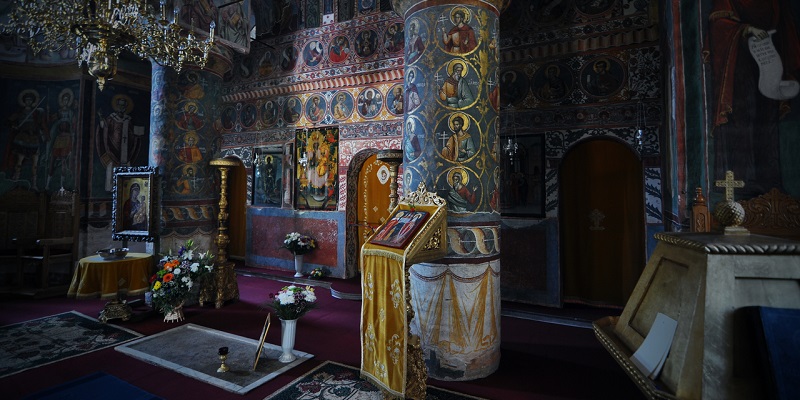
Reflections on the reality behind appearances.
A friend who is an Evangelical Christian wrote me a message in which she said, referring to the use of images in the Church, that idolatry is clearly forbidden in Exodus 20 for every believer… and she insisted that no one could ever convince her that images of Mary and the other saints are not idolatry. She added that if one has truly understood the message of Christ, one could never bend the knee before an image: “You shall not make for yourself a graven image, or any likeness of anything that is in heaven above, or that is in the earth beneath, or that is in the water under the earth; you shall not bow down to them or serve them…”. Here is my reply. (JMR, Madrid)
Thank you for sending me your opinion about Exodus 20 and the Catholic Church.
In my view, anything can become an idol: food, images, family, success, sex, physical appearance and beauty, money, power, art, particular practices of a church, our personal interpretation of the Bible, etc., etc.
In any case, I refuse to judge what is inside people, whether Catholics in a procession or Protestants gathered for worship on Sunday. Many times people who seemed to me to have a superficial spiritual life have surprised me. I have been wrong too many times in my life when judging others. I only know that, for me, images refer me to the one they represent, and that this person points me to God; and that praying to Mary and the saints helps me, since they are masterpieces, each in its own way and with its own particular features, of what God has done in the human race, and they are intercessors, not intermediaries, of great stature. (Does God not like us to remember that the wonders of nature are his work? Mary and the saints are also his work, since through humility they allowed themselves to be shaped by him. Does the Bible not say that the prayer of a righteous man has great power? — Jas 5:16. God wants to grant his graces not directly to isolated individuals in a solitary relationship with him, but through the Church that he created.)
The fact that you quoted to me your personal interpretation of Exodus 20—a text that, although inspired by the Holy Spirit, as you know, belongs to the old covenant, when the Word had not yet become flesh—means that you wish to speak and are interested in dialogue; otherwise you would not have quoted and explained it to me. Philologists say that when we read something we put on lenses through which we interpret what we read. No one reads anything in a “pure state.” We are fragile human beings, limited by the coordinates of time and space, conditioned by the culture in which we live. I think we must always keep our limitations in mind.
It is important to establish the context in which that is said. It is the Old Covenant and, therefore, no one yet knew the face of God through his Son. The Son had not yet completed his redemptive work and risen. He had not yet created a Church which he would enlighten with the Holy Spirit until the end of time (Jn 16:12-13; Mt 28:20), and against which the gates of hell would not prevail (Mt 16:18-19). A Church empowered to bind and loose. And in the society in which the Jews lived, images did indeed mean idolatry. But gestures and words change meaning in the course of history. What matters is not the signifier (the word or the gesture), but what they signify.
For the Catholic Church, images are not idols that are worshiped (God alone is worshiped; theologians call this the worship of latria), but reminders of persons who are absent from our present form of life, from the pilgrim Church (the Church on earth), yet who still belong to the Church as the Church triumphant, since they are alive, more alive than we are, being with the Lord, who is the source of life. Is not the God of Abraham, Isaac, and Jacob a God of the living and not of the dead? (Mk 12:26-27). When you ask a friend to pray for you, are you bypassing Christ’s mediating role? (1 Tim 2:5). God already knows what you or your friend are going to ask him, even before it occurs to you. Paul asked Christians to pray for him (Rom 15:30; Col 4:3; 2 Thess 1:11), even though he also prayed (and even though God already knew what Paul was going to ask before he asked it). Well then, when someone asks Mary or the saints to intercede for him or her, they are not denying Christ’s mediating role either. Mary and the saints, and our friends who pray for us, are intercessors; and their intercession comes from belonging to the body of Christ, that is, to the Church. We could go directly to God without our friends or the saints praying for us. But it seems that God wants us, besides going directly to him, to pray for one another. Instead of saving us in isolation, he created a Church through which to carry out his work. Are you worshiping your son or your husband when you look at a photograph of him and enter into a dialogue in your head?
Mary and the saints have no value except that derived from their union with Christ. Apart from him they are mere creatures. But they are creatures divinized by their union with him. Mary made the redemption possible by saying yes to the Incarnation and, moreover, all the flesh of Our Lord comes from Mary. Let us remember that Jesus is “born of woman.” She is humility personified, and for that reason God chose her to dwell among us. All generations will call her blessed. (Lk 1:48). The saints are the greatest cooperators her Son has had. And their lives, modeled in the image of Jesus, are an example for all Christians to imitate.
All the members of the Church are united to Christ as the body is united to the head and as the branches to the vine (Jn 15:1-8; 1 Cor 12:25-27).
In Rev 5:8; 8:3 you can read about the prayers of the saints and of the angels.
If we are to interpret some passages literally, we must also interpret others, especially if they belong to the New Covenant.
1 Cor 11: must women today wear a veil in worship? Is it proper for a woman today to pray without covering her head? Must we exclude from worship today men who wear long hair? Is woman the glory of man?
And what do you say about 1 Cor 14:34-35? Must women keep silent in Christian congregations? Must they ask their husbands when they want to learn something?
And regarding goods held in common: must we all become monks and nuns and live the vow of poverty? (Acts 2:44-46)
As you say: it is not I who say it; the Bible says it. The problem is: who interprets it? The Church that preceded the New Testament and in whose bosom it was written, or each individual according to his or her personal judgment, or according to what he or she believes the Holy Spirit is telling him or her? If the Bible is inspired, why should that same Church not be inspired—the Church which, founded on apostolic succession, besides determining its canon and affirming its inspiration, transmitted it to us down to our own day? I am with you always, to the end of the age.
How is it possible that the Holy Spirit was absent for so many centuries from the only Church that Christ founded? That is not what I understand the Bible to say.
I hope these reflections are useful to you.
May God bless you.
Author: JMR, Spain
