The Catholic doctrine on the meaning of religious images by the Congregation for Divine Worship and the Discipline of the Sacraments
Sacred Images
18. The use of sacred images is of major importance in the whole area of popular piety, since culturally and artistically they assist the faithful in encountering the mysteries of the Christian faith. Indeed, the veneration of sacred images belongs to the very nature of Catholic piety. Such is clear from its artistic patrimony, which can be seen in many churches and sanctuaries, and to which popular devotion has often contributed.
Here, the principles apply which govern the liturgical use of images of Christ, Our Lady and the Saints. These have been traditionally asserted and defended by the Church in the knowledge that “the honour rendered to the image is directed to the person represented”. The necessary rigour which has to be applied in drawing up the iconographic scheme of churches — in matters relating to the truths of the faith and their hierarchy, beauty and quality — must also be applied to images and objects destined for private and personal devotion.
So as to ensure that the iconography used in sacred places is not left to private initiatives, those with responsibility for churches and oratories should safeguard the dignity, beauty and quality of those sacred images exposed for public veneration. Likewise, they should avoid the de facto imposition on the community of pictures or statues inspired by the private devotion of individuals.
The Bishops, therefore, and the rectors of sanctuaries are to ensure that the sacred images produced for the use of the faithful, either in their homes or on their persons, or those borne aloft on their shoulders, are not reduced to banalities, nor risk giving rise to error. […]
Holy Images
238. The Second Council of Nicea, “following the divinely inspired teaching of our Holy Fathers and the tradition of the Catholic Church”, vigorously defended the veneration of the images of the Saints: “we order with ever rigour and exactitude that, similar to the depictions of the precious and vivifying Cross of our redemption, the sacred images to be used for veneration, are to be depicted in mosaic or any other suitable material, and exposed in the holy churches of God, on their furnishings, vestments, on their walls, as well as in the homes of the faithful and in the streets, be they images of Our Lord God and Saviour Jesus Christ, or of Our Immaculate Lady, the holy Mother of God, or of the Angels, the Saints and the just”.
The Fathers of Nicea see the basis for the use of sacred images in the mystery of the Incarnation of Christ, “the image of the invisible God” (Col 1, 15): “the Incarnation of the Son of God initiated a new ‘economy’ of images”.
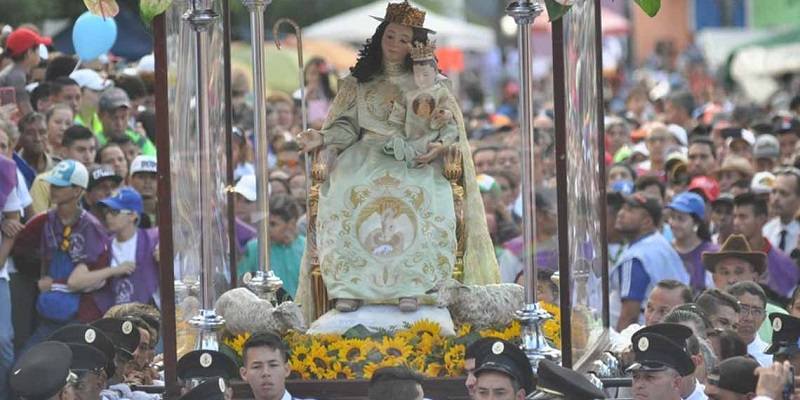
239. The veneration of sacred images, whether paintings, statues, bas reliefs or other representations, apart from being a liturgical phenomenon, is an important aspect of popular piety: the faithful pray before sacred images, both in churches and in their homes. They decorate them with flowers, lights, and jewels; they pay respect to them in various ways, carrying them in procession, hanging ex votos near them in thanksgiving; they place them in shrines in the fields and along the roads.
Veneration of sacred images requires theological guidance if it is to avoid certain abuses. It is therefore necessary that the faithful be constantly reminded of the doctrine of the Church on the veneration of sacred images, as exemplified in the ecumenical Councils, and in the Catechism of the Catholic Church.
240. According to the teaching of the Church, sacred images are:
– iconographical transcriptions of the Gospel message, in which image and revealed word are mutually clarified; ecclesiastical tradition requires that images conform “to the letter of the Gospel message”;
– sacred signs which, in common with all liturgical signs, ultimately refer to Christ; images of the Saints “signify Christ who is glorified in them”;
– memorials of our brethren who are Saints, and who “continue to participate in the salvation of the world, and to whom we are united, above all in sacramental celebrations”;
– an assistance in prayer: contemplation of the sacred images facilitates supplication and prompts us to give glory to God for the marvels done by his grace working in the Saints;
– a stimulus to their imitation because “the more the eye rests on these sacred images, the more the recollection of those whom they depict grows vivid in the contemplative beholder”; the faithful tend to imprint on their hearts what they contemplate with the eye: “a true image of the new man”, transformed in Christ, through the power of the Holy Spirit, and in fidelity to his proper vocation;
– and a form of catechesis, because “through the history of the mysteries of our redemption, expressed in pictures and other media, the faithful are instructed and confirmed in the faith, since they are afforded the means of meditating constantly on the articles of faith”.
241. It is necessary for the faithful to understand the relative nature of the cult of images. The image is not venerated in itself. Rather, that which it represents is venerated. Thus, sacred images “are given due honour and veneration, not because there are believed to contain some divinity or power justifying such cult, nor because something has to be requested of an image, nor because trust is reposed in them, as the pagans used to do with idols, but because the honour given to sacred images is given to the prototypes whom they represent”.
242. In the light of the foregoing, the faithful should be careful not to fall into the error of raising sacred images to the level of paragons. The fact that some sacred images are the object of such devotion that they have become embodiments of the religious culture of nations or cities or particular groups, should be explained in the light of the grace which is at the basis of the veneration accorded them, and of the historical and social circumstances of the history surrounding them. It is good that a people should recall such events, to strengthen its faith, glorify God, conserve its cultural identity, and pray incessantly with confidence to the Lord who, according to his own words (cf. Mt. 7, 7; Lk 11, 9; Mk 11, 24), is always prepared to hear them; thereby causing an increase of charity and hope, and the growth of the spiritual life of the Christian faithful.
243. By their very nature, sacred images belong to the realm of sacred signs and to the realm of art. These “are often works of art infused with innate religious feeling, and seem almost to reflect that beauty that comes from God and that leads to God”. The primary function of sacred images is not, however, to evince aesthetic pleasure but to dispose towards Mystery. Sometimes, the artistic aspects of an image can assume a disproportionate importance, seeing the image as an “artistic” theme, rather than conveying a spiritual message.
The production of sacred images in the West is not governed by strict canons that have been in place for centuries, as is the case in the Eastern Church. This does not imply that the Latin Church has overlooked or neglected its oversight of sacred images: the exposition of images contrary to the faith, or indecorous images, or images likely to lead the faithful into error, or images deriving from a disincarnate abstraction or dehumanizing images, have been prohibited on numerous occasions. Some images are examples of anthropocentric humanism rather than reflections of a genuine spirituality. The tendency to remove sacred images from sacred places is to be strongly condemned, since this is detrimental for the piety of the Christian faithful.
Popular piety encourages sacred images which reflect the characteristics of particular cultures; realistic representations in which the saints are clearly identifiable, or which evidently depict specific junctures in human life: birth, suffering, marriage, work, death. Efforts should be made, however, to ensure that popular religious art does not degenerate into mere oleography: in the Liturgy, there is a correlation between iconography and art, and the Christian art of specific cultural epochs.
244. The Church blesses sacred images because of their cultic significance. This is especially true of the images of the Saints which are destined for public veneration, when she prays that, guided by a particular Saint, “we may progress in following the footsteps of Christ, so that the perfect man may be formed in us to the full measure of Christ”. The Church has published norms for the exposition of sacred images in churches and other sacred places which are to be diligently observed. No statue or image is to be exposed on the table of an altar. Neither are the relics of the Saints to be exposed on the table of an altar. It is for the local ordinary to ensure that inappropriate images or those leading to error or superstition, are not exposed for the veneration of the faithful.
Source: Vatican.va, Directory on Popular Piety and the Liturgy. Principles and Guidelines, nn. 18 and 238-244.
