
Frequently Asked Questions about Images.
Canon III of the Fourth Council of Constantinople (869-870) and Conciliabulum of Hieria
On some evangelical websites they use Canon III of the Fourth Council of Constantinople (869-870) to “prove” that the Catholic Church “worships” images, distorting what the Catholic Church teaches about the veneration of images.
Canon III says:
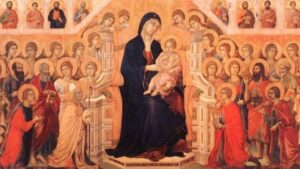
“If anyone, then, does not adore the image of Christ the Savior, let him not see his form in his second advent. In the same way we honor and adore the image of his Immaculate Mother, and the images of the saints…those who do not feel this way, let them be anathema.”
These are the most frequently asked Protestant questions:
“Isn’t it that you shouldn’t “worship” images? Doesn’t the Catholic doctrine teach that worship is only of God?
How, then, does the Council of Constantinople say: “We adore the image of his Immaculate Mother and of the saints”? How is this contradiction clarified?”
Here it must be clarified that it is a terminological problem and not a dogmatic one; “venerate” and “worship” have the same meaning in Greek: “proskyneo” (it is known that all the gospels were written in Greek).
It should be said that although the concept is clear, the Church is understanding more and better the data revealed throughout the centuries. It is what Newman has called Development of Christian Doctrine. The revealed datum does not change, the Church grows in her understanding and with this she becomes more precise in its terminology.
It is good to clarify these points:
1. The Greek verb used to worship is the same as that used to venerate.
2. This verb is proskyneo. The dictionary of the Greek language Montanari, which is one of the most complete that has been published recently, lists the following meanings for this verb: (1) greet with affection, embrace; (2) adore, venerate; (3) prostrate, consider with respect or veneration; (4) conjure, try to appease by pleading; etc… With this it is clear that the same Greek verb, which is the one used in Constantinople IV, is used to worship and to venerate.
3. However, the Fourth Council of Constantinople, despite using proskyneo for the adoration of the image of Christ and the Virgin and the angels and saints, establishes a clear and subtle distinction between the four. In the case of Christ it is said that this adoration is similar to the adoration of the gospels and that is not said of the Virgin, the angels or the saints; On the other hand, in the case of Christ the verb proskyneo is used to indicate a strong, absolute veneration. In the other three cases, two verbs are used, and not only “adore”: it says, “we honor and adore”; this “honoring and adoring” is what today is called veneration. The gradation of these four groups is not accidental either: the cult/veneration reserved for Mary is privileged over the other two; That is why she appears before them and the council gives the reason: she is the Mother of God, something that angels and saints do not incarnate.
 4. By the year 869-870 there was no clear or precise terminology to designate the cult reserved for the Virgin and the saints (some distinction had been established by the Second Council of Nicaea, but it had not been well understood, due to a poor translation, to which rivalries between the two Roman empires of the east and the west were added); That is why the verb venerate does not appear. Venerate in Greek was also said proskyneo, and worship in Greek was also said proskyneo as the Montanari dictionary has pointed out. The Church over the centuries has refined this terminology, so that today the catechism establishes a clear distinction between worship and veneration. Something similar happened with the term person. Before Chalcedon, there was no clear distinction between person and nature. It was Chalcedon’s merit to specify the concept of person. Something similar can be said of infallibility: although infallible decrees were promulgated in the Church on several occasions, the precision of the term as such was declared in 1870. Today we know that infallibility is a gift of Christ to his Church: thus the Pope is infallible when he expressly commits his teaching in a definitive, solemn and universal way in matters of faith and customs; They are the bishops gathered in an ecumenical council presided over by the Pope, who in the exercise of the supreme magisterium, propose a truth as contained in revelation, and it is the entire people of God, when they are unfailingly united to the faith under the guidance of the living magisterium of the Church.
5. A serious and frequent error of our separated brothers consists of isolating quotations from Sacred Scripture and, as in this case, from Church documents, from their historical and doctrinal context, and interpreting them with today’s concepts, as if centuries of distance and understanding did not exist. This leads to the most aberrant anachronisms. I wonder what would happen if that were done with Dante’s Divine Comedy, or Don Quixote. It would undoubtedly be a serious injustice. Unfortunately, they do this with the most respectable documents we have. Sometimes, when reading Church documents from the first centuries, one can get the impression of partiality; However, they do not propose to offer a synthesis of the Catholic faith in all its details, but rather they note the manipulations that, within their particular historical contexts, have threatened the true understanding of the revealed data.
Another frequently asked question is about Conciliabulum of Hieria:
“At the Council of Hieria, convened by Constantine V in the year 754 and attended by more than 300 bishops, the cult of images was condemned and those who supported that cult were called iconolaters.
And this? How is it also clarified?”
Here we must also clarify these points:
1. It is not the Council of Hieria but the Conciliabulum of Hieria. A conciliabulum is an assembly. IT IS NOT INFALLIBLE because no Pope approved it, but rather many bishops deceived or intimidated by Constantine Copronymus.
2. The one who opposed the images was a tyrant and ruthless Emperor who sought to dominate the Church. Anyone who opposed him was savagely punished.
3. The monks opposed the tyrant Constantine V and were martyred. Many had their eyes gouged out, their ears, noses or hands were cut off, or their beards were smeared with pitch (tar) to set on fire.
4. In the Second Ecumenical Council of Nicaea of September 24, 787, this iconoclasm was condemned. This Council IS INFALLIBLE.
With the death of Leo the Isaurian in the year 740 and the ascension to the throne of Constantine Copronymus, a new chapter opens in the iconoclastic persecution. The beginnings of Copronymus’s reign were not happy, since his brother-in-law Artabasdos disputed the crown, seized Constantinople and reestablished the cult of images. Patriarch Anastasius endorsed Artabasdos. Constantine returned from Asia Minor with a strong army and reconquered the throne. He gouged out the eyes of Artabasdos and his children, and made Anastasius ride around the city on a donkey after being whipped, although he did not lose the patriarchal seat.
The first twelve years of Copronymus meant a continuous devastation of Churches: walls decorated with images were whitewashed, sacred vessels with icons were desecrated, monks were persecuted and made to emigrate. Like the Isaurian, he was a good administrator and soldier, but he surpassed him in sectarianism, viciousness and cruelty to impose iconoclastic ideas with blood and fire. For him only the Eucharistic bread and wine are the image of Christ; not even the relics of the saints were to be venerated; He spoke of the two natures of Christ in terms close to Monophysitism. He rejected the doctrine of the intercession of the Virgin and the saints. He repudiated the crucifix, but he did admit the image of the cross, repeating Paul’s words in Gal 6,14 in a false sense.
He collected and explained these errors in a book that he had the bishops read.
When he realized that many were on his side, out of conviction or weakness, he called a council of “ecumenical aspirations.” In fact, it did not have such a character, because although it was made up of 338 bishops, neither the Pope nor the eastern patriarchates of Antioch, Jerusalem, Alexandria and Constantinople were represented there. The Patriarchate of Constantinople was vacant due to the death of Anastasius. The archbishop of Ephesus was the one who presided over it in the palace of Hieria around February 10, 754. The bishops did not approve of the emperor’s other heresies, but they did relent on the issue of the images.
The council decreed that every material image or painting from the churches must be removed as an abominable thing, that from now on no one could dare to make an icon or worship it, to place it in any temple, to hide it in any home, under penalty of being deposed, in the case of a bishop, and of being excommunicated if it was a monk or layman. The last anathema was nominally against the three great iconophiles: Germanus of Constantinople, George of Cyprus, hermit of Mount Taurus, and above all Mansur, family name of St. John Damascene.
With the support of such conciliar decrees that declared iconophiles enemies of God and the holy faith, Copronymus proposed to exterminate what he called idolatry and the work of Satan. He gave the order to destroy and throw the sacred images and illuminated manuscripts into the flames; or else to the sea, like the relics of the saints; The mosaics and paintings of the basilicas were covered with a layer of lime, with messages, fruits, and animals painted on top so that the churches looked like bird cages or fruit markets, according to Life I of St. Stephen the Younger.
Most of the bishops cowardly bowed before the tyrant, but the monks resisted tenaciously, facing death or exile. In May 764 Peter the Kalybite was martyred, John of Monagria died a month later, sewn in a sack and thrown into the sea: Stephen the Younger was thrown into prison, where he found 342 monks, almost all of whom were mutilated. He is followed in martyrdom by Andrew of Crete and others. In order to humiliate and mock the monks before the people, he made a good number appear at the hippodrome, each one led by the hand of a woman; Thus he forced them to parade among the laughter and saliva of the populace. The monasteries were destroyed or converted into barracks, while all kinds of honors and riches were offered to those who apostatized or married. Those who were recalcitrant had their eyes gouged out, their ears, noses or hands cut off, or their beards were smeared with pitch (tar) to be set on fire. Some are exiled, others flee to Cyprus, the Black Sea and especially to Southern Italy. In his madness, the emperor even demanded that all the inhabitants of the capital take an oath by which they were obliged to combat the images as idols and not to deal with any monks. The very name “monk” was as hateful to him as that of “saint.” The persecution ceased with the death of Copronymus, in 775.
The condemnation of this iconoclasm came on September 24, 787 with the meeting of more than 300 bishops at the Seventh Ecumenical Council of the Church, the Second Council of Nicaea.
Consult volume II of the History of the Catholic Church by Llorca, G. Villoslada, Laboa (BAC 2003)
Source: Catholic.net
