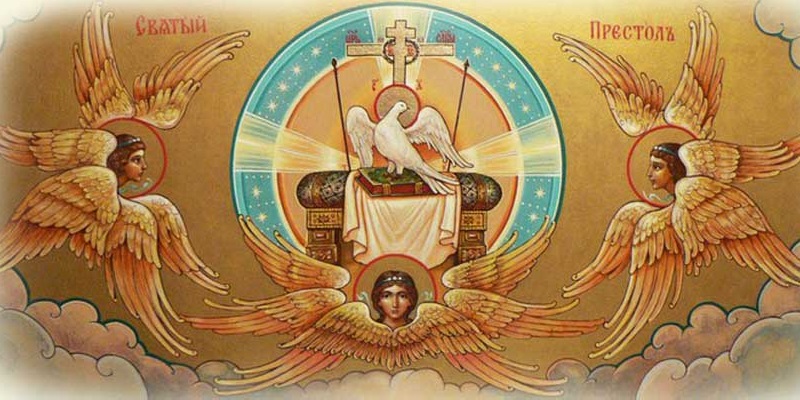
Second chapter of the book “The Sects in front of the Bible”
Biblical reflections on the divinity of the Holy Spirit
(What the author in his book has written in the form of footnote, in this digital edition you will find between [ ])
NOTE ON THE VERSIONS OF THE SACRED TEXT: Throughout the work I have preferably used my own direct translation from Greek for the New Testament, and from Hebrew and Aramaic for the Old. In the first case I have used the Greek-English New Testament, by Nestlé and Aland, Editio XXVI, Stuttgart 1981, and in the second, the Bible Hebraica Stuttgartensia, Editio Minor, Stuttgart 1984. I also quote from the prestigious versions of the Bible common in the Spanish-speaking world and from the sects’ own editions. The following acronyms are those used in relation to the various translations of the Bible: VNM: New World Version or Bible of Jehovah’s Witnesses; EP: The Holy Bible, from Ediciones Paulinas; BJ: Jerusalem Bible;NC: Colunga Nacre;VP: Popular Version;VM: Modern Version;NBE: New Spanish Bible;RV: Reina-Valera. When no reference is indicated, the translation is mine.
The objections that have historically been raised against the doctrine of the Trinity have mostly been directed against the full divinity of the person of the Son. However, it seems that, supposedly, having denied this, the anti-Trinitarians did not have much interest in refuting the divinity of the Holy Spirit. It is as if it were pointless to continue a dispute about the Trinity when it has already been made clear that one of the three persons is not God, but a god or a mere man.
Perhaps this explains why the arguments against the Holy Spirit are so little elaborated in the sects, in many cases not even existing. The same Jehovah’s Witnesses, who define the Holy Spirit as the “active force of God” and compare it to forms of energy such as electricity that powers household appliances, reveal extreme poverty in the denial of the personality and divinity of the Holy Spirit.
But does the Bible really teach that the Holy Spirit has no personality and is not God?
l. Sect Objections
There are basically three objections that I have collected in conversations with witnesses and studies of their publications in relation to the personality and divinity of the Holy Spirit. The first is to affirm that the Bible nowhere teaches that the Holy Spirit is a person or that he is God. We will dedicate the next two sections of this chapter to answering this objection.
The second is to point out that the Holy Spirit is an impersonal force, like water is, since we are told in the Bible that one is baptized with the Holy Spirit and also that one is baptized in water. It is obvious, the Jehovists claim, that if the Holy Spirit were a person he could not be on so many people at once.
It goes without saying that such an objection is ultimately ridiculous, and in fact provides an argument in favor of the divinity of the Holy Spirit. If the Holy Spirit really can be in so many places (as witnesses acknowledge that Scripture indicates), it can only be explained because he is God. Like God precisely, he enjoys the gift of ubiquity, that is, being able to be in various places at the same time. Paul himself points out that “in him (God) we live, move and have our being” (Acts 17:28) (BJ);And from this ubiquity it does not follow that God is not God – because, for example, we also move in the middle of the air, and it has no personality – but rather it concludes that God is omnipotent and that he is going to judge us all. As can be seen, then, this objection has no validity to deny the personality and divinity of the Holy Spirit.[A variant of this objection is to affirm that the Holy Spirit lacks personality, since it enters people. The argument, once again, is very poor. Demons enter the interior of people in cases of possession, and do not lose their personality;Why would that happen, however, to the Holy Spirit?Do the witnesses intend to affirm that the spirit of Satan has more qualities than that of God?]
The third objection is similar to the second. It means that the Holy Spirit is neither God nor has personality, because it is stated in the Bible that it is drunk (1Cor 12:14). Now, since what is drunk are always substances without personality (water, wine, etc.), the Holy Spirit is not God and does not have personality either.
The truth is that Paul, just a few lines before, has pointed out that the Israelites also drank from Christ, who is a personal being and also God: “And they all drank the same spiritual drink, for they drank from the spiritual rock that followed them; and the rock was Christ” (1Cor 10:4) (BJ). The passage so clearly refutes the objection of the witnesses, that they have not had the slightest qualms about changing it in their New World Version, where it is said: “and that rocky mass meant Christ”; crude falsification on the other hand, since the Greek word that appears in the original is ēn, that is, “was”, and not “meant”. But, as the reader has already had the opportunity to verify in the previous chapter, changing Bible verses to adapt them to their doctrines is common in the Watchtower tactics.
These two witness objections present little, if any, consistency. Let us now examine whether or not the Bible actually teaches the personality of the Holy Spirit.
2. The Holy Spirit is a personal being
Defining whether or not an entity has personality does not pose any special difficulty. It is obvious that an impersonal force, such as electricity, water, nuclear energy, etc., cannot develop activities typical of beings endowed with personality, whether human or spiritual. Now, if electricity could reveal, teach, guide, order, intercede, send, speak, etc., we would no longer be faced with an impersonal force, but rather with a personal entity. Now, in the Bible, does the Holy Spirit appear as an impersonal force, like electricity, as witnesses claim, or, on the contrary, is it inextricably linked to personal qualities? We think that the reader himself can draw his own conclusions from the texts that we quote below as examples, which is why we will limit the comments on them to an essential minimum:
The Holy Spirit teaches and reminds.”But the helper, the holy spirit, whom the Father will send in my name, he will teach you all things and will remind you of all the things that I have told you” (Jn 14:26) (VNM). How can teach – the Greek word didásei used here contains the idea of teaching as a teacher – and remember an entire entity that has no personality?
The Holy Spirit bears witness. “When the helper that I will send to you from the Father, the spirit of truth, who proceeds from the Father, arrives, he will testify about me, and you in turn must testify, because you have been with me since I began” (Jn 15:26) (VNM). Both the Holy Spirit and Jesus’ disciples bear witness. How is it possible that the former lacks personality and the latter does not?How is it possible that an entity lacking personality is in charge of instructing beings who do have it?
“The spirit itself bears witness with our spirit that we are children of God” (Rom 8:16) (VNM).
The Holy Spirit guides to the Truth. “However, when he, the spirit of truth, comes, he will guide you into all the truth, for he will not speak to you on his own initiative, but he will speak the things that he hears, and he will declare to you the things that are coming” (Jn 16:13) (VNM).
The words of Jesus transmitted by the author of the fourth gospel could not be clearer: the Spirit will guide into all truth; He will speak not according to his own impulse, but what he hears, and he will announce the future. Can an impersonal force – like electricity – do this?
The Holy Spirit glorifies. “He (the Holy Spirit) will glorify me, because he will receive what is mine and give it to you” (Jn 16:14) (VNM).
The Holy Spirit directs evangelization. “They also passed through Phrygia and the country of Galatia, because the holy spirit had forbidden them to speak the word in the district of Asia” (Acts 16:6) (VNM).
Is it even plausible that an impersonal force could formulate prohibitions and orders regarding a topic like evangelization?
The Holy Spirit leads.”For as many as are led by the spirit of God, these are the sons of God” (Rom 7:14) (VNM).
How is it possible that a force lacking personality – such as electricity – leads to people who do have personality, in such a way that if they submit to its guidance they show that they are children of God?
The Holy Spirit intercedes. “In the same way the spirit also comes with help for our weakness; for the (problem of) what we should ask in prayer how we need to do it we do not know, but the spirit itself pleads for us with unexpressed groans. However, he who searches the hearts knows what the intention of the spirit is, because it pleads in accordance with God for the saints” (Rom 8:26-27) (VNM).
Does it fit into the human mind that an entity without any personality knows more than human beings who do have it?Is it logical to think that an entity that has no personality would care to the point of advocating for human beings with moans that cannot be narrated?Is it even assimilable that an entity without personality also advocates in full accordance with what God desires?
The Holy Spirit sends.”Therefore these men, sent by the Holy Spirit, went down to Seleucia, and from there they embarked for Cyprus” (Acts 13:4).
How is it possible that an entity without personality can send beings that do have it, also marking their specific itinerary?
The Holy Spirit makes decisions within the Church. “For it seemed good to the Holy Spirit and to ourselves not to add any other burden to them except these necessary things” (Acts 15:28) (VNM).
Since when can an impersonal force – like electricity – make decisions alongside human beings?
“Pay attention to yourselves and to all the flock, among which the Holy Spirit has appointed you overseers, to shepherd the congregation of God…” (Acts 20:28) (VNM).
But how can a force without personality appoint bishops to shepherd the Church?
The Holy Spirit causes prophecy. “Now in these days some prophets came down from Jerusalem to Antioch. One of them, by the name of Agabus, arose, and by the spirit proceeded to indicate that a great famine was about to come upon the whole inhabited earth; which in fact took place in the time of Claudius” (Acts 11:27-28) (VNM).
“And coming to us and taking Paul’s belt, he tied his feet and his hands and said: Thus says the Holy Spirit: The Jews will bind the man to whom this belt belongs in this way in Jerusalem and hand him over into the hands of the nations” (Acts 21:11) (VNM).
In these passages we witness two occasions in which the Holy Spirit moved a prophet to predict the future, even pointing out the specific words he should pronounce. The prophecies, unlike those given by witnesses, Adventists, Mormons or Children of God, were fulfilled. Can an impersonal force really drive prophecy to the point of articulating concrete words and determining their fulfillment?
The Holy Spirit order.”So the spirit told me to go with them without hesitation” (Acts 11:12) (VNM).
“While they were publicly ministering to Jehovah and fasting, the holy spirit said: “Of all people, set apart for me Barnabas and Saul for the work to which I have called them” (Acts 13:2) (VNM).
How is it possible that an impersonal force like electricity can give orders to Peter, the prince of the apostles, and the Church, even uttering complete sentences?
The Holy Spirit gives gifts. “But the manifestation of the spirit is given to each one for a beneficial purpose. For example, to one it is given through the spirit wisdom, to another knowledge according to the same spirit, to another faith by the same spirit, to another gifts of healing by that one spirit, to another operations of mighty works, to another prophesying, to another discernment of inspired utterances, to another different tongues, and to another interpretation of tongues. But all these operations are performed by the one and the same spirit. Distributing to eachrespectively as provided” (1Cor 12:7-11).
Now, we ask ourselves: How is it possible that a force without personality and which, therefore, lacks discernment, wisdom, faith, knowledge – all personal qualities – can endow human beings with these gifts?Isn’t it precisely because it does have personality and because it also has all these qualities?
The Holy Spirit reveals. “Moreover, it had been divinely revealed to him by the holy spirit that he would not see death before he had seen the Christ of Jehovah” (Luke 2:26) (VNM).
But how can an entity that has no personality reveal the future to a person?
The Holy Spirit speaks whole sentences. We have already seen some examples in the previous sections, but we are going to cite some more:
“So the spirit said to Philip, Come near and join that chariot” (Acts 8:29) (VNM).
How can an impersonal force utter coherent and articulate phrases that have a purpose and even predict the future?
The Holy Spirit can be resisted.”O stubborn men and uncircumcised in heart and ears, you are always resisting the holy spirit; just as your ancestors did before you” (Acts 7:51) (VNM).
We believe that the texts reproduced above, scarce examples on the other hand, establish in an indisputable way the concept that the first Christians had about the Holy Spirit. For them it was not an active and impersonal force, comparable to electricity, as the Watchtower claims. On the contrary, the Holy Spirit not only had personality, but also had a role in the life of the Church and believers (a role already announced by Jesus himself) that revealed his superhuman and, as we will examine more clearly in the next section, divine value. We sincerely do not think that it can be claimed under any circumstances that, in the light of the New Testament, the Holy Spirit is an energy lacking personality.
3. The Holy Spirit is God
Now, does Scripture show with the same certainty that the Holy Spirit is God?Once again we are going to let the Bible speak, limiting our comments to their minimum expression.
Lying to the Holy Spirit is lying to God. “But Peter said: Ananias, why has Satan emboldened you to deal deceitfully with the holy spirit and secretly withhold part of the price of the field? While it remained with you, did it not remain yours? And after it was sold, did it not continue under your control? Why did you set such a deed in your heart? You have dealt deceitfully, not with men, but with God” (Acts 5:3-4) (VNM).
The Holy Spirit is the same Jehovah who spoke in the Old Testament. “So, because they were at odds with each other, they began to leave, while Paul made this one comment: The holy spirit spoke aptly through Isaiah the prophet to your ancestors, saying: Go to this people and say: Hearing, they will hear, but in no way will they understand; and looking, they will look, but in no way will they see” (Acts 28:25-26) (VNM).
Now, the truth is that Paul quotes Is 6:8-9; and there it is not said that the Holy Spirit spoke, but Jehovah himself: “And I began to hear the voice of Jehovah, saying: ‘Whom shall I send, and who will go for us?’ And I proceeded to say: ‘Here I am. Send me.’ And he went on to say: ‘Go, and you must say to this people: Hear again and again, but do not understand; and see again and again, but do not get knowledge’” (Is 6:8-9).
Was the apostle Paul wrong in identifying Jehovah with the Holy Spirit, or are the witnesses wrong in saying that the Holy Spirit is not God?
“For this reason, just as the holy spirit says: Today, if you listen to his own voice, do not harden your hearts as in the occasion of causing bitter anger, as in the day of testing in the wilderness, in which your ancestors tried me with a test, and yet they had seen my works for forty years. For this reason I was disgusted with this generation and said: They always go astray in their hearts and they themselves have not come to know my ways. So I sworein my anger: They will not enter into my rest” (Heb 3:7-11) (VNM).
The author of the letter to the Hebrews reproduces here an extensive quote from Ps 95:7-11, attributing it to the Holy Spirit. It is enough to go to the Old Testament to verify that the one who speaks in it is Jehovah. Now, was the author of the letter to the Hebrews wrong in identifying the Holy Spirit with the Jehovah of the Old Testament, or is Watchtower wrong in saying that the Holy Spirit is neither God nor has personality?
The Holy Spirit is Jehovah. For all of the above, it is easy to understand that the New Testament clearly identifies the Holy Spirit with the Lord of the Old: “Now, Jehovah is the spirit; and where the spirit of Jehovah is, there is freedom” (2Cor 3:17) (VNM).
The Watchtower Bible itself expresses it with such clear clarity that we believe there are no more comments.
Only the Holy Spirit encompasses the things of God. For all this, it is not surprising that in the minds of the authors of the New Testament, who, as we have seen, did not believe that the Holy Spirit was not God nor did they think that it was an impersonal force, there was the certainty that all the immensity of God could only be penetrated by the Holy Spirit, something impossible if it had been a simple active force lacking personality:
“For who among men knows the things of man except the spirit of man which is in him? Likewise, no one has come to know the things of God except the spirit of God” (1Cor 2:11) (VNM).
Because the Holy Spirit is God, he can be blasphemed. “However, anyone who blasphemes against the holy spirit is never forgiven, but is guilty of eternal sin” (Mk 3:29) (VNM).[Blasphemy against the Holy Spirit is resistance to it. While other sins allow for forgiveness as they do not necessarily entail hardness of heart, he who closes himself to the Holy Spirit prevents repentance from entering his soul and with it the mercy of God.]
4. Conclusion
In the opinion of the writer of these lines, the doctrine of the Holy Spirit is one of the most beautiful and moving realities that the Scriptures tell us about. Active in a less manifest way in the Old Testament, it is from Pentecost onwards that it bursts with all its greatness and power into the history of humanity.
When the believer is alone, it is the Holy Spirit who intercedes for him with groans that cannot be expressed in human terms; when he feels doubt, he cries out in unison with our souls, reminding us that we have a Father in heaven;When the Church is tossed in the sea of history, he offers to guide it and distributes, without fear of waste, his charismas (in which the Watchtower does not believe) for the edification of the body of Christ. That spirit opened the door of the Church to the Pentecostal Jews who came from the most remote places on earth;It was poured out on Cornelius, the first Gentile Christian, and opened the routes of the gospel in the midst of a society that, like ours today, ardently needed it. That spirit teaches and remembers the word and work of Jesus, witnesses and reveals. Without him we would be nothing, because he hatched the life that was at the bottom of the waters before creation (Gen 1:2). In his name we are baptized, and he sustains sustains us in our lives so that, as children of God, one day we can be with Christ forever. It is not surprising, then, that the first Christians cited him profusely in their prayers and that they yearned for his closeness more and more; and it is not strange that perhaps the most beautiful Christian hymn of all time, the Veni Creator Spiritus is dedicated and directed to him.
The Watchtower’s boast, however, qualifies him simply as a force without personality, resembling electricity, who is not God, who no longer showers his gifts on God’s people. If falsehood can sometimes be externally beautiful, it is not in this case, because the sublime and unspeakable greatness of the Scriptures has only been replaced by a very poor sectarian caricature.
