Note on versions of the Sacred text: Throughout the work I have preferably used my own direct translation from Greek for the New Testament, and from Hebrew and Aramaic for the Old. In the first case I have used the Greek-English New Testament, by Nestlé and Aland, Editio XXVI, Stuttgart 1981, and in the second the Bible Hebraica Stuttgartensia, Editio Minor, Stuttgart 1984. I also quote from the prestigious versions of the Bible common in the Spanish-speaking world and from the sects’ own editions. The following acronyms are those used in relation to the various translations of the Bible: VNM: New World Version or Bible of Jehovah’s Witnesses; EP: The Holy Bible, from Ediciones Paulinas; BJ: Jerusalem Bible; NC: Nácar-Colunga; VP: Popular Version; VM: Modern Version; NBE: New Spanish Bible; RV: Reina-Valera. When no reference is indicated, the translation is mine.
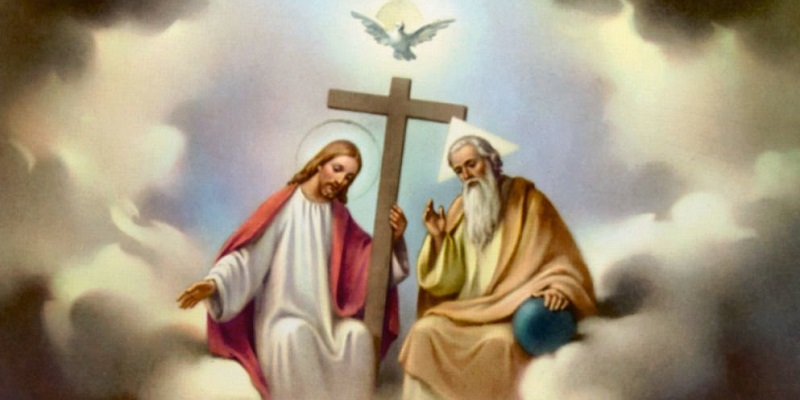
Anyone who has patiently followed the two previous chapters on the divinity of Christ and the divinity of the Holy Spirit, whose reading I assume in this chapter) will surely have come to the conclusion that the Trinity is a fully biblical teaching, as well as capital for the understanding of Christianity. Catholics, Protestants and Orthodox, even separated by theological issues of no small importance, agree in accepting it as a revealed and essential truth of the Christian faith, which is logical.
I would like, however, and even briefly, to make some references to this doctrine, not only in the partial aspects of the full divinity of the Son and the Holy Spirit, but in those of the connection of the three persons in the biblical text. We will dedicate the following pages to this question, albeit briefly.
l. The prefiguration of the doctrine of the Trinity in the OT
It is evident that the full manifestation of the doctrine of the Trinity is found in the New Testament. However, the Old Testament seems to contain some prefigurations of the plurality of persons within the divinity that were pointed out by the first Christians and that constituted a real headache for their Jewish opponents. Let’s look at some of these texts: “And God went on to say: Let us make man in our image, in our likeness… And God proceeded to create man in his image, in the image of God he created him” (Gen 1,26-27) (VNM).”And the Lord God went on to say: Behold, the man has become like one of us, knowing good and evil” (Gen 3:22).”And Jehovah went down to see the city and the tower which the sons of men had built. Then Jehovah said: See, they are one people and there is one language for all of them, and this is what they begin to do. For now there is nothing that they intend to do that they cannot accomplish.build the city” (Gen 11,5-9) (VNM).”And I began to hear the voice of the Lord saying: Whom shall we send and who will go for us? And I proceeded to say: Here am I. Send me” (Is 6,8) (VNM).
All of these passages were interpreted by the first Christians as irrefutable proof that the Old Testament already made reference to the plurality of persons in God. Proof that this was the case is that the Talmud and other Jewish theological writings record the way in which Jewish rabbis attempted to distort their content in order to deny the possibility that God was a Trinity. Thus, for example, we read in Gen. R., VIII, 9: “R. Simlai said: In every place where you find a text that is used by the minim [One of the derogatory names with which Christians (and other heretics) in Jewish literature. The decree against the minim, prior, in our opinion, to the year 70 AD, involved the general excommunication of all Judeo-Christians who were still connected with Judaism.] In support of his opinions, you will find the refutation at the side. They returned and asked him: What about what is written: Let us make man in our image, according to our likeness?He answered: Read what follows;It is not said: And gods created man in their own image, but God created man in his own image. When they had departed, his disciples said to him: You have gotten rid of them with a foolish thing;What answer will you give us?He told them: In the past Adam was created from the dust of the ground, and Eve was created from Adam. That is why it is in our image, according to our likeness;wanting to imply that the man cannot come to exist without the woman, nor the woman without the man, nor any of them without the Shechinah.”
The text is extremely revealing for several reasons. The first, because it alludes to the fact that the first Christians (and since we are talking about Jewish Christians here, it must be a very early time) believed in the Trinity and tried to demonstrate it to the Jews by appealing to Old Testament texts like the ones I have pointed out above. The second, because it is clear that rabbinic Judaism itself did not know very well how to refute the primitive Christians and had to resort to convoluted answers to do so. The third, because it shows that the only way to deny the Trinity is to create a caricature of it that equates it with polytheism (which it is not), exposing it to ridicule. Until now, such has been the tactic of Talmudic rabbinism, rationalism and Islam. In none of the three cases, however, does it seem that what this dogma implies is understood.
Another example of the extent to which the trinitarian belief of the first Christians must have impressed rabbinic Judaism is found in the statement contained in the Principles of Faith of Judaism, that God is a unity (clear contrast to Trinity). It should be noted, however, that the word used in the Principles of Faith In Hebrew for “unity” it is yajid. This implies a substantial change from the Hebrew term used when saying that God is one in, for example, Deut 6:4. There the term used is ejad. What is this change due to?In our opinion, the idea is clear: ejad appears in the Old Testament on many occasions as “one”;but not “a simple one”, but “one made up of several.”Let us cite some examples: “That is why a man will leave his father and his mother, and must adhere to his wife, and they must become one flesh” (Gen 2:24) (VNM).”Now the whole earth continued to be of one language and of one set of words” (Gen 11:1) (VNM).”They are one people and there is one language for all of them” (Gen 11:6) (VNM).”And make them draw near to each other until they form a single stick for you, and they will truly become one in your hand” (Ezek 37:17).
In all the preceding cases the Hebrew word that appears is ejad, but it retains the idea of ”one made up of several”: a marriage made up of a man and a woman, a language spoken by several, a single people made up of all men, etc.
Post-Christian Judaism could not deny that there were references in the Old Testament that could serve as an argument in favor of the Trinity (as well as supporting the idea that the messiah would be a suffering servant) and it reinterpreted the passages to avoid their apologetic use by early Christians. However, as we saw above, that reinterpretation was far from solid. Thus, to cite just one example, the very term “God” in Hebrew is Elohim, which literally means “gods”;and, although it generally takes the verb in the singular, on repeated occasions it also goes in the plural;v.gr.: Gen 20,13;35.7, etc. Not only that;Also on repeated occasions the qualifying adjective that accompanies Elohim, although it is translated as singular, is plural;v.gr.: Dt 4,7, Jos 24,19, etc.
It is not surprising, therefore, that secular outbreaks of this consciousness have appeared, here and there, in Jewish literature of all times as vestiges of the time when, with Christianity not yet appearing, there was no reason to fiercely oppose the idea of the divinity of the messiah or the plural God. I would like to conclude this section with a quote taken from the Zohar, one of the classics of Jewish spirituality literature:
“Listen, O Israel: Yahweh our God, Yahweh is one. Why is there a need to mention the name of God in this verse? The first Jehovah is the Father above. The second is the offspring of Jesse, the messiah who will come from the family of Jesse through David. And the third is the Way that is beneath (that is, the Holy Spirit, who shows us the way), and these three are one.”
A Trinitarian author could hardly have expressed it better.
2. Trinitarian references in the NT
Given everything we have seen in the preceding pages, it should not be surprising to us that the New Testament repeatedly unites the Father, the Son and the Holy Spirit. Such behavior would be illogical if its authors did not believe in the Trinity, because what would be the reason to justify the joint presentation of the omnipotent God, a mini-god and a force without personality?We are not going to discuss this topic exhaustively, but we can see some examples before concluding this chapter:
The first Christians used Trinitarian formulas. “The undeserved kindness of the Lord Jesus Christ and the love of God and participation in the Holy Spirit be with you all” (2Cor 13,13) (in the VNM it appears numbered for unknown reasons as verse 14).
“But you have been washed, but you have been sanctified, but you have been declared righteous in the name of our Lord Jesus Christ and with the spirit of our God” (1Cor 6,11) (VNM).
“There is one body and one spirit, just as you were called in one hope to which you were called: one Lord, one faith, one baptism, one God and Father of all, who is over all and through all and in all” (Eph 4:4-6) (VNM).
Those early Christians were not ashamed to conclude their letters, as the Second to the Corinthians, with a triple invocation in which the Father, the Son and the Spirit were united;Nor were they ashamed to remember that all the work of salvation in their life was the fruit of the Father, the Son and the Spirit, and they felt a special pride in being able to say that one Lord, one Spirit and one Father was present in their life. That was their life experience and their faith, and it could never have occurred to them that the Spirit that moved the Church was a simple active force without personality, and that the Son was nothing but a god, an incarnate archangel.
The Early Christians believed that the charismas given to the Church came from the Trinity. It was not only the testimony of the apostles that moved the first Christians to confirm themselves in that Trinitarian faith, but also their own daily experience of ecclesial life. There was in them the absolute conviction that their life of faith built by the divine charismas was nourished by the three persons of the Trinity: “Now there are varieties of gifts, but there is the same Spirit, and there are varieties of ministries, and yet there is the same Lord, and there are varieties of operations, and yet it is the same God who executes all the operations in all” (1Cor 12:4-6).
Baptism in the name of the Trinity. After all, everything we have seen before had nothing strange for the first Christians. In the teaching of the apostles, the order given by Jesus himself had been transmitted in the sense that the sacrament of entry into the communion of believers, baptism, would be celebrated in the common name of the Father, the Son and the Holy Spirit: “Go therefore and make disciples of people of all nations, baptizing them in the name of the Father and of the Son and of the holy spirit” (Mt 28:19) (VNM).
The reader should note carefully that Jesus did not attribute different names to each of the three persons of the Trinity, but rather taught the existence of a common name for all three. But is it even plausible that God would have a common name with an archangel and a force that does not even have a personality? Clearly not; as it will surely be clear to the reader, after reading the biblical evidence indicated in the previous pages, that the Bible does teach the doctrine of the Trinity.
3. Conclusion
To the author of these lines, and he does not say this petulantly, it seems that the concept of divinity that appears in the New Testament is by far the greatest that could capture the attention of human beings. Faced with the coarseness of polytheisms or the coldness of pantheism, the moral greatness of monotheism arises. But it is not a monotheism like that of Islam (and, to a large extent, that of Judaism), in which God is a being distant and inaccessible to us. The New Testament teaches that this God became flesh and dwelt among us, that he grew as a human being, that he knows even the most intimate fiber of our being and that, therefore, makes it possible for us to approach him with complete confidence (Heb 2:17-18; 4:15-16). This same God, full of love and compassion, did not back down from anything in our favor, to the point of seeing himself unjustly judged, mocked, spit upon, tortured, condemned and, finally, died in one of the most terrible tortures that human beings have devised: the cross.
But death could not contain the author of life (Acts 3:15) and, returned from the dead, he provoked among his disciples an even firmer conviction that he was their Lord and their God (Jn 20:28).
That was not the end, but almost the beginning. The Holy Spirit sent by the Father has since guided the Church redeemed by the blood of the Son. He has encouraged her, he has given her gifts and charisma, he has interceded for her. Ecclesial life itself would be inconceivable without his continuous presence.
Faced with these glorious realities, the sects offer a panorama that, in reality, stems from pagan conceptions: Jesus was just a man or, at best, an archangel, a god. His work was of much less value than the Scriptures indicate, and even needs to be amended by the revelations of the prophets or messiahs on duty.
The Holy Spirit is a mere force, like electricity. An impulse devoid of reason or personality that, in most sect theologies, no longer operates among the people of God.
Someone may find such a pathetic, diminished, distorted vision of the God of the Bible comforting. The writer of these lines, however, is more attracted to the glorious reality that we have only been able to see from a bird’s eye view in the previous pages. He is more convinced by the God of incarnate love than by the archangel sent to replace God to save us. He is more moved by the God-Holy Spirit who intercedes for him with inexpressible groans (Rom 8:26-27) than by that impersonal active force that, like electricity, neither feels nor suffers and moves blindly and without knowing where it is being taken. To that God, Father, Son and Holy Spirit, be glory forever and ever.
Source: Third chapter of the book “The Sects in front of the Bible”
