
It is common to hear from the mouths of anti-Catholic fundamentalists that it was the emperor Constantine who, by means of a feigned conversion to Christianity, managed to “paganize the Church,” causing the Christianity that until then had remained pure to blend with the pagan culture then prevailing in the Roman Empire, degenerating into the Catholic Church.
It was in order to answer this question that I decided to write these lines. I have taken as my starting point the typical accusation, analyzing the comments of Mr. Jaime Alfaro Moldiz (who often takes part in Web forums of which I am administrator, under the nickname Hecho Nuevo).
I will place Mr. Jaime’s comments in a box with a blue background.
Analyzing the Arguments
 Part of the argument put forward by the fundamentalist is set out by Mr. Jaime in this comment: Constantine (a supposed “converted Christian” in the year 313 A.D.), through this “miraculous conversion” of his and in close collaboration with paganism, gave the “Christian church” official status. Thanks to this, the church became a religious body recognized in the empire. Aspects through which we can clearly see that his “miraculous conversion” was more a very convenient shrewd political maneuver than a spiritual event. Since Constantine was emperor, he ought to be recognized as head of the church, de facto. To this end he convoked the first ecumenical council (Council of Nicaea, year 325)
Something that should powerfully draw our attention is the fact that while Constantine governed the “Christian church,” he continued to head the pagan priesthood, now presiding over pagan celebrations, now donating temples, even after he had begun to build “Christian” temples or churches.
Within paganism, Constantine, as head of the pagan priesthood, held the rank of Pontifex Maximus (Pont Max), and he needed this same rank within the “Christian church”; that is why he had himself named by the Christians, who honored him as “bishop of bishops,” while he had himself called “Vicarius Christi,” Vicar of Christ. We must note that this phrase (not by chance, obviously!), translated into Greek, literally means Antichrist. Constantine thus being the prototype of the Antichrist who is to come according to Biblical prophecy.
Let us begin by reviewing what the historical facts really were and the context in which the events took place.
Before Constantine
It is a well-known fact that before Constantine, Rome had witnessed one of the most brutal persecutions of Christians. The emperors, attached to the ancient religious traditions and convinced that Christianity was a problem for the political cohesion the empire needed, felt driven to do away with any religion not approved by the empire.
The emperor Diocletian (1) began one of the harshest persecutions ever carried out against the Christian Church. It started with an edict proclaimed on March 31 of the year 297 A.D. which, although directed against the Manichaeans, laid the foundations for the persecution of Christians by declaring, “It is criminal to call into question the validity of what has been established since ancient times” (2). From February 23 of the year 303 A.D. until February of 304 A.D. he promulgated four successive edicts. The first prohibited Christian worship; religious books were confiscated and churches destroyed, and the Christian was excluded from any public office and subjected to legal restrictions. The second edict went even further, ordering the arrest of the leaders of the churches, followed immediately by the third edict, which allowed the release of those imprisoned if they consented to make libations and sacrifices to the pagan gods. In spite of this the Church remained firm and refused to apostatize from the faith, and so came the fourth edict: all inhabitants were compelled to sacrifice to pagan gods under threat of the most terrible tortures, death, and condemnation to forced labor in the mines.
The persecutions were not only long-lasting but atrocious. In Gaul and Britain, which were under the authority of the caesar Constantius Chlorus (3) (Constantine’s father), only the first edict was applied, while in the provinces directly subject to the augustus Maximian the persecutions were intense, to the point that the Church went more than four years without being able to give a successor to Pope Marcellinus, who died during the persecution. In Africa it is not certain that all four edicts were applied, but there were likewise many martyrs. In the East the persecution was much more severe and lasted until 313 (with some periods of calm), and the successive sovereigns who reigned in Egypt, Syria and Asia Minor persisted in their growing hostility toward Christianity.
When Diocletian (1) abdicated in 305 A.D., he was succeeded as augustus by Galerius (4) and as caesar by Maximinus Daia (5). Maximinus was even more fanatical and resorted to propaganda methods that we might well call modern: he organized “spontaneous” demonstrations against the Christians, and imposed as a school text the apocryphal Acts of Pilate (a book full of blasphemies against Jesus).
It was in this period that the most savage persecutions occurred, many of them recorded by the historian Eusebius of Caesarea(6), who was an eyewitness, in his work “Martyrs of Palestine” where he presents not only the savagery of the executioners but also the heroism of the martyrs.
The resistance of the Church was so steadfast and the heroism of the martyrs so great that the repression finally lost its force, to the point that on April 30 of the year 311 (six days before his death) the emperor Galerius promulgated an edict of toleration. The emperor deplores the obstinacy and “madness” of the Christians who, even at the cost of their lives, refused to return to the religion of ancient Rome. Maximinus Daia did the same with far worse grace, since after six months he had already resumed the persecution, redoubled once again but for only a short time, for at the end of 312 he would return to a more or less complete toleration in the face of threats, and then under the blows that came upon him from Constantine and Licinius (7).
Among the events that took place in the rest of the empire in the years 306-312, it is worth noting that there was a moment at the beginning of the year 310 when the empire counted seven emperors (most of them regarded by the others as usurpers). Constantine was proclaimed in 306 after the death of Constantius (his father); his father-in-law Maximian, who twice took up again the purple he had laid down in 305; the latter’s son, Maxentius (8), real master of Italy, though not, for the moment, of Africa, where Domitius Alexander had rebelled; in Illyria (present-day Yugoslavia), Licinius, the only one who would remain at Constantine’s side until 324; in the Balkans and Asia Minor, Galerius; in Syria and Egypt, Maximinus Daia.
Under Constantine
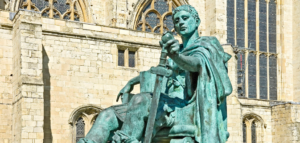
There is no doubt that the emperor Constantine, who was originally a pagan, converted to Christianity, rejecting paganism. We shall not speculate here as to whether the motivation for his conversion was merely political or the product of an interior evolution in his personal convictions, because these would only be hypotheses. What we can do, however, is analyze the facts.
On June 15 of 313 Maximinus Daia was defeated; at this point his colleague Licinius promulgated a decree granting freedom of worship to the Christians and the immediate restitution of confiscated property. He did so with reference to a decision taken jointly with Constantine at the beginning of that same year, on the occasion of the meeting that had brought them together in Milan for the wedding of Licinius and Constantia (Constantine’s half-sister).
Now then, regardless of the reasons Constantine had for sympathizing with Christianity, the facts are very clear: Constantine added favors for the benefit of the clergy of the Church. At the beginning of his reign he was tolerant as regards freedom of worship, which was the official doctrine, but as he consolidated his power he began to be less tolerant of paganism. The first Christian symbols appeared on the coinage from 315 onward. The Church received a privileged legal status: the rulings of the episcopal tribunal, even in civil matters, were recognized as valid by the state. Centers of worship multiplied. The emperor and his mother (Saint Helena) were generous with the Church and made possible the construction of buildings such as the Lateran Basilica.
In the year 318 he struck the first blow against paganism and promulgated the first restrictive measures against pagan practices: private sacrifices, magic, and the taking of auspices in private homes were prohibited.
At this moment the Church enjoyed true peace, since the legal obstacles that had hindered evangelization had disappeared. Conversions multiplied and theological activity was immense. Imperial policy favored the new religion, which pushed forward the Christianization of the empire. (It is also true that many Christians in name only, or nominal Catholics, attached themselves to the Christian faith.)
All this came to a halt for a few months during the reign of the successor of Constantius, a nephew of Constantine: Julian the Apostate (9) who, having returned to paganism, tried to make the whole empire follow him. This setback did not last long, for the following emperors were once again Christians, each day more fervent and convinced. By the year 381 A.D. Christianity had become the religion of the State, heretics were banished, and paganism was finally prohibited, all its temples closed or destroyed (391 A.D.)
After having studied the events a little, we find several problems in our friend’s argumentation:
First: It does not seem sensible to assume that Christians who withstood terrible persecutions to the point of martyrdom would now have been so ready to become paganized.
The fact that freedom of worship was promulgated in the reign of Constantine need not be interpreted as the paganization of the Church. Something similar happened when Cyrus (King of Persia), while a pagan, granted religious freedom to the Jewish people by means of a decree and allowed them to return to Jerusalem after seventy years of Exile (Ezra 1:2), and this did not cause the Jewish people to become paganized.
Second: If Constantine and the rest of the Christian emperors were “close” collaborators with paganism, it sounds curious that they should have accepted freedom of worship, with Christianity afterwards ending up as the official religion of the state. Subsequently they hindered paganism to the point of finally prohibiting it, including its private sacrifices, and destroying its temples.
Third: If the Church had really been paganized as a result of the Edict of Milan, what Christians thought and professed before Constantine and after Constantine would have to be different; but when the patristic writings are examined it can be proven that in fact this is not so. The faith of the Church before and after Constantine is the same in substance, with the magisterium defining in a more explicit way truths always believed by the Church. A clear example is found in the Eucharist: Christians before and after Constantine professed that the Eucharist was truly the Body and Blood of the Lord (see “Transubstantiation and the Early Church”). It is rather after the Protestant Reformation that a radical change is seen with respect to the doctrines the Church had always believed. Now the Lutherans believe in consubstantiation, the Reformed hold that the bread and wine are mere symbols (they anathematize one another), and thus new doctrines never professed by the Christian Church in pre-Nicene times are taught by the “reformers” as biblical truth.
Constantine and the Council of Nicaea
 The next thing our friend puts forward is that Constantine convoked the Council of Nicaea for the purpose of being recognized as head of the Church “de facto.” This must be a mental lapse.
Once the empire had been Christianized, and with the religious and the secular spheres closely intertwined, the emperor certainly had a special interest in keeping the empire at peace. It was not pleasant for him to see how disputes among Christians might threaten the unity of the empire.
While Saint Sylvester I (10) was Pope, there arose at that time the heresy of Arianism, which was the first great heresy the Church had to face on emerging from clandestinity and the persecutions. Arius was a Christian priest born around the year 256, who governed one of the most important churches of Alexandria. He set forth his ideas on the Trinity, and when these began to become known, questions and criticisms arose. Arius expressed his doubts about the consubstantiality of the divine Word, the second Person of the Trinity. In his opinion, the whole problem lay in the difficulty of explaining the unity and the Trinity of God and the relation of the infinite and the finite in Creation. How can three distinct persons exist in one uncreated essence? Arius asked himself. The suppression of every distinction among the persons had been judged heretical by the Church, which, in this regard, had rejected the doctrine of Sabellius (11). The Father, the Son and the Holy Spirit each fully possess a real personality; they are three distinct Persons in a single substance. And this was inconceivable to Arius. Consequently he preferred to distance the Father from the Son. In his eyes, the Word was nothing more than — a creature! (which is what the Jehovah’s Witnesses profess today). Although he affirmed that it was the first and most perfect of all, he separated it from God in the same way that the finite is separated from the infinite.
Referring to the Gospel of John, Arius, drawing his inspiration from Philo, explained that God could not put himself in direct contact with the finite; in order to create the world he needed an intermediary, and he had entrusted the task to the Word, creature and creator at the same time. A kind of architect of the universe. In other words, creation was the work of the Father as inspirer, and creatures were the work of the Word, who had taken up the ideas of the Father and carried them out in the best way possible.
This implied that the Son is not consubstantial with the Father; he possesses the nature of the beings created by him, though in a higher degree, since the rest of creatures owed him their existence. Arius said that God had not always been Father, and that the Son had not existed from all eternity.
Arius was condemned by his bishop and had recourse to Eusebius of Nicomedia, who gave him asylum and protection. From Nicomedia, Arius and his disciples began to make rapid progress; his disciples mingled with the rest of the faithful in the same churches. Since Arius was quite learned and eloquent, it did not take him long to become popular among the common people. It is said that, in order to deny the eternity of the Word, he would say to women: “Did you have a son before you brought him into the world?” and he composed light verses and songs ridiculing the apparent contradictions of orthodox Catholicism.
Arianism gathered such strength that the Church grew alarmed. Arius had to appear before a council in Alexandria, where he was excommunicated. Another council, convoked in Nicomedia at the initiative of Eusebius, vindicated him as a defender of the truth. The controversy became so virulent that the dioceses of the East were plunged into turmoil.
In view of this situation, and with the unity of the Church in danger (by no means convenient for the emperor), Constantine, with the consent of Pope Saint Sylvester I, convoked the Ecumenical Council of Nicaea in the year 325.
Before continuing I wish to place on record that, in fact, I know of no serious historical source affirming that Nicaea was convoked by Constantine in order to be recognized as head of the Church. Our friend’s claim must be a confusion picked up from some little article published on the Web.
It should come as no surprise that the Emperor wanted to involve himself in the affairs of the Church. Some historians, such as Eusebius of Caesarea (6) in the Vita Constantini, attribute to the emperor an excessive importance in Church affairs and in the councils, to the point of assigning him the task of opening the debates, reconciling adversaries, convincing some and bending others, urging all to concord. Constantine, according to the image Eusebius gives us of him, seems to influence the bishops gathered at the Council even in doctrinal questions, and hence some fundamentalists wish to accuse him of influencing the outcome of the Council of Nicaea.
The scholar J. M. Sansterre, in his work “Eusebius of Caesarea and the Birth of the Caesaropapist Theory,” carefully examined fourteen texts proceeding from the emperor, dated between 325 and 335. From the analysis of this documentation he concluded that although Constantine convoked the Council of Nicaea for the purpose of fostering unity and eliminating heresy (bringing stability to the empire), and felt obliged to watch over its dogmatic and disciplinary resolutions, he never aspired to supplant the Bishops. He understood the imperial intervention as merely subsidiary, since the ultimate norm in doctrinal questions had to be, as in fact it was, the ecclesial traditions and canons and the assistance of the Holy Spirit to the Bishops. Only if the Bishops did not succeed in having the conciliar decisions carried out was the Emperor prepared to intervene to enforce them; never to impose them himself.
Constantine did not claim for himself supremacy over the council in questions of faith, something demonstrated by the analysis of the imperial documents from 325 to 335, which prove conclusively that the emperor did not influence the Creed of Nicaea.
Analyzing everything set forth above, Nicaea, far from being a council manipulated by the Emperor, becomes one of the most important councils in the history of Christianity, in which battle was joined against the monstrous heresy that sought to teach that Christ was simply a creature, a “thing,” as the Jehovah’s Witnesses tend to interpret it today, now that Arianism has come back to life under different names.
Does our fundamentalist friend think that the Council of Nicaea was a fraud? A trick of Constantine’s? Then he thinks that Christ is a “thing.” Of course, everyone is free to think as he pleases; whether his reasoning has any foundation is quite another matter.
Constantine: Bishop of Bishops?
This too is nonsense. History shows us that Constantine was baptized on his deathbed, and indeed, if this is so, one might well ask: how did Constantine manage to become a bishop?
Let us look a little more deeply into the meaning of the word bishop.
Bishop:
- From the Greek epíscopos we have a first meaning: overseer.
- Biblically, a bishop is one to whom a portion of the flock has been entrusted in order to set things in order (cf. Tit 1:5), to prevent sins (cf. 1 Tim 5:22), to teach as Paul did (cf. 2 Tim 2:2), to command and teach (cf. 1 Tim 4:6), to ensure the salvation of those who hear him (cf. 1 Tim 4:16), to guard the faith received (see 1 Tim 6:3, 13-14, 20), to reprove, exhort, argue, insist in season and out of season (2 Tim 4:1ff); to speak, exhort and rebuke with authority (Tit 2:15), and even to reject, that is, to expel someone from the community when the case warrants it (Tit 3:10)
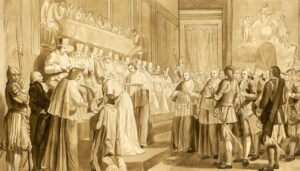 In the History of the Catholic Church by Llorca-García Montalbán, mention is made of the fact that when the emperor convoked the Council of Nicaea so that the controversy over the divinity of Christ might be resolved, he provided the material means so that the bishops could meet and deliberate. He was a bishop “from the outside,” and the author immediately clarifies what we have just mentioned; that is, that the emperor gathered the bishops together and let them deliberate. Using a little common sense we can see that he is using the word bishop not in a biblical but in an etymological sense, that is, as an overseer who watches from the outside so that everything may take place in peace and order. So too in providing the means for it to be carried into practice; but in fact, there is NO historical evidence whatsoever that Constantine was “Bishop of Bishops.” It is important to note that the author could here cite some historical document testifying to the fact — where and when: some text of some council, some patristic record, etc., that calls Constantine by this title. The truth is that he gives none, because IT DOES NOT EXIST.
Constantine: Vicar of Christ? Vicar of Christ = Antichrist?
Vicar of Christ comes from the Latin vicarius, and it is of Latin, not Greek, origin. Of the multiple meanings the word has according to the dictionary of the Royal Spanish Academy, we may take the first: 1. adj. One who holds the place, power and faculties of another person or substitutes for him. Also used as a noun.
The illustrated Latin-Spanish dictionary “Spes” gives these meanings for “Vicarius”: representative, deputy, stand-in, lieutenant, substitute, among others. One may also consult the Vocabulary of the Latin Language by Castiglioni-Mariotti, published by Loescher, which is even more complete. It indicates these senses: one who takes the place of, in the position of, in substitution for, substitute, representative, successor, subordinate slave (Horace and Martial use it in this sense), vicar, lieutenant. It appears frequently in the works of Cicero: vicaria fides amicorum supponitur (Pro Roscio Amerino 111), nolite subtrahere vicarium diligentiae meae (Pro Murena 80). But it also appears in Livy: Hunc ego vicarium pro me (Ab Urbe Condita 5,18, 5), etc.
On the other hand, it is also false that Vicar in Greek means antichrist; the Vox Greek-Spanish dictionary does not contain the word “Vicarius.” Antichrist in Greek comes from the preposition “antí” (in place of) plus Christós (from the verb Chrío, which means to anoint; hence, anointed). That the word “Vicarius” is of Latin and not Greek origin you can verify for yourself by consulting any of the following four Greek dictionaries we have consulted: that of Franco Montanari, published by Loescher; the Lexicon Graecum Novi Testamenti of Zorell; the Kittel (Theological Dictionary of the New Testament); and the Exegetical Dictionary of the New Testament of Balz-Schneider. The word Vicarius appears in none of them, whereas Antíchristos does.
To say that Vicarius is Greek and that it means Antichrist is equivalent to saying that the Aztec emperor Montezuma spoke Latin and not Nahuatl.
It is no surprise that the Pope is with good reason called “Vicar of Christ”; as we have seen, it means to hold the place and power and faculties of another person (whom one represents). Thus the Vicar of Christ is he who represents Christ. In that sense, the Holy Spirit is a vicar of Christ: “But the Paraclete, the Holy Ghost, whom the Father will send in my name, he will teach you all things, and bring all things to your mind, whatsoever I shall have said to you.” John 14:26. The apostles and their successors are also vicars of Christ: “As the Father hath sent me, I also send you” John 20:21, and “He that heareth you, heareth me; and he that despiseth you, despiseth me; and he that despiseth me, despiseth him that sent me.” Luke 10:16.
For this reason, not only is the Pope a vicar of Christ, but so is the Holy Spirit (John 14:26), and so are the bishops and priests (Catechism of the Catholic Church #1560); indeed, we ourselves are as well. But the truth is that there is likewise NO historical evidence whatsoever that Constantine proclaimed himself Vicar of Christ (in fact, our friend once again cites no historical source, because NONE EXISTS).
The most comical part of the matter is that the fundamentalists cannot manage to agree among themselves when it comes to reinventing meanings with which to attack the Catholic Church. In fact, in the anti-Catholic book “Understanding Roman Catholicism” by Rick Jones, in its chapter 6, that author translates “vicar” as “substitute” and not as antichrist. He even affirms that the vicar of Christ is “only” the Holy Spirit:
|
Understanding Roman Catholicism, Rick Jones, chapter 6 “…Is the pope the vicar (substitute) of Christ on earth, with universal power over the whole church?… …the Word of God reveals to us that another person already occupies that position… “But the Paraclete, the Holy Ghost, whom the Father will send in my name, he will teach you all things, and bring all things to your mind, whatsoever I shall have said to you.” John 14:26 …The pope has clearly usurped a position reserved for the Holy Spirit of God. It is a position that no man can occupy… Source: http://www.chick.com/es/reading/books/216/216_06.asp |
Without entering at this moment into the discussion of whether the Pope and the bishops are vicars of Christ (which in fact they are), according to our friend’s argument, in which “vicar of Christ” means “Antichrist,” does that mean he then considers the Holy Spirit an antichrist as well?
It is false that vicar means antichrist (in Latin, Greek, Chinese or Swahili), and it is false that Constantine ever proclaimed himself such.
Conclusion
I hope these brief lines have served to clarify the picture a little in the face of so much historical distortion found on the Web. Most of this nonsense is drawn from various anti-Catholic books, such as that of Dave Hunt (A Woman Rides the Beast), that of Alexander Hislop (The Two Babylons) and that of Ralph Woodrow (Babylon Mystery Religion), which represent the teachings of the most sectarian and anti-Catholic wing of Protestant fundamentalism. These books are characterized by their utter lack of historical rigor, each repeating what the previous ones said — to such a degree that Ralph Woodrow (one of the authors just mentioned), after a conversation with the history professor Scott Klemm of California, in which the latter remarked to him that Hislop was not a reliable historian, began to investigate seriously, to the point that he ended up not only withdrawing his book from the market (at his own expense), but publishing another (The Babylon Connection?), retracting and refuting his first book. Woodrow today remains a Protestant and even an anti-Catholic, but he has had honesty enough to retract the nonsense he had written. (The same has not happened with Dave Hunt, from whom our friend has drawn his comments.)
Notes
- Gaius Valerius Aurelius Diocletianus (243-313), Roman emperor chosen by the troops on November 17 of 284 A.D. at Nicomedia. He fought and defeated Carinus (proclaimed emperor of the West). He revitalized the ancient Roman religion and carried out the harshest persecution of Christians conducted up to that time. ↩
- Mosaicarum et Romanarum legum collatio, 15, 2nd ed. E. Seckel-R. Kuebler (Iurisprudentia anteiustiniana, t. II,2), p. 382. ↩
- Flavius Valerius Constantius Chlorus (250-306), father of Constantine, adopted by the emperor Maximian and appointed by Diocletian. He received the government of Hispania, Gaul and Britain. The abdication of Diocletian and Maximian made Constantius augustus alongside Galerius. The appointment of the new caesars fell to Galerius, leaving Maxentius and Constantine — sons of Maximian and Constantius — out of office. These appointments provoked a grave crisis in the tetrarchy, which deepened with the death of Constantius in the summer of the year 306, while he was fighting against the tribe of the Picts in Britain. ↩
- Gaius Galerius Valerius Maximianus (?-311). Chosen caesar by Diocletian to form part of the tetrarchy, while Maximian chose Constantius Chlorus. He was the son of a shepherd but was adopted by Diocletian. In the distribution of power that accompanied these choices, Galerius received the Balkan peninsula, except Thrace, at the same time contracting marriage with Valeria, Diocletian’s daughter. Both the augustus and the caesar devoted part of their efforts to consolidating the eastern territories, undertaking war against the Persians, who had occupied Armenia and Mesopotamia. At first Galerius suffered a defeat, for which he made amends some time later with Diocletian’s help. The peace that put an end to the conflict brought the incorporation into the empire of an important Mesopotamian zone. The Danube frontier was consolidated after a confrontation with the peoples of that area. In the year 305 Diocletian and Maximian renounced power after having held it for twenty years. Galerius became augustus of the eastern zone and Constantius Chlorus of the western. Galerius was charged with choosing the corresponding caesars, opting for Flavius Valerius Severus for the West and Maximinus Daia for the East. The appointments pleased neither Maximian nor Constantius Chlorus, as they left their sons Maxentius and Constantine out of the succession. The crisis of the tetrarchy was not long in appearing, and a struggle began among the holders of power. The death of Galerius in the year 311 set off the second phase of the struggle, which would end with the triumph of Constantine. ↩
- Maximinus Daia (? – 313). Named caesar by his uncle Galerius, which provoked the discontent of Maximian and Constantius Chlorus. Three years later Maximinus declared himself augustus with the approval of Galerius, entering fully into the struggle. An alliance was formed between Maxentius and Maximinus against Licinius and Constantine, and civil war broke out. Constantine defeated Maxentius at the Milvian Bridge, and Maximinus held out alone until Licinius defeated him in Asia Minor, dying in that encounter. ↩
- Eusebius of Caesarea (265-340). A renowned Christian historian whose best-known work is the Ecclesiastical History in which he wrote the history of Christianity up to his own day. He is also the author of two apologetic works: Preparation for the Gospel and Demonstration of the Gospel. ↩
- Licinius (270-325). He took part in the tetrarchy of Diocletian on being named caesar for the East by Galerius in the year 308. On the death of the augustus three years later he came to occupy that office. He married Constantia, daughter of Constantius Chlorus and sister of Constantine. Licinius proclaimed the freedom of the Christians in the Edict of Milan (313) together with his brother-in-law. The following year he defeated Maximinus. The existing tensions between the augusti of East and West led to armed confrontation, from which Constantine emerged victorious, defeating Licinius at the battle of Adrianople (324). Licinius was executed. ↩
- Maxentius (?-312). Acclaimed as Caesar in Rome. In the year 308 we find four legal augusti — Constantine, Galerius, Maximinus Daia and Licinius — and one illegal caesar in Rome — Maxentius. The second stage of the confrontation brought about the alliance of Maxentius with Maximinus Daia against Licinius and Constantine. The first battle between Maxentius and Constantine took place in the valley of the Po, the former being defeated and falling back on Rome. Near the city the final confrontation took place at the battle of the Milvian Bridge, which ended with Maxentius drowned in the waters of the Tiber on October 28 of the year 312. ↩
- Flavius Claudius Julianus (331-363). Nephew of Constantine and one of the survivors of the family massacre organized by Constantius when he came to power. In Nicomedia he attended the school of Libanius, where he became interested in Neoplatonism and pagan philosophy. Constantius named Julian caesar in the year 355. In the year 360 Julian was acclaimed augustus by the troops in Paris. Constantius did not recognize him, and Julian marched to meet him, but the death of Constantius before the battle meant that Julian was recognized as augustus of the whole Empire. His first measures were to combat Christianity, for which reason Julian received the name “the Apostate.” He wrote “Against the Christians,” in which he criticized the Christian dogmas; he eliminated the privileges of the clergy, prohibited Christian teaching in the schools, restored to their owners the goods seized for religious motives, and lifted the sentences of exile on those banished by Constantius. The tension between pagans and Christians grew to the point of open clashes. He even tried to create a pagan clergy, recruiting its members from among the firmest defenders of paganism. Nevertheless, Julian’s attempts were in vain, for Christianity was by then too deeply rooted in society. Julian also carried out a reform of the public treasury, reducing court expenses and taxes. In the year 363 he continued the war against the Persians, at first with success, until the Roman troops were defeated at the battle of Ctesiphon, Julian himself being mortally wounded. Jovian would be chosen as his successor by the army. ↩
- Saint Sylvester I. Born in the year 270 in Rome, he suffered the last throes of the persecution of the Christians. He succeeded Saint Miltiades as pontiff on January 31 of 314 as Sylvester I, a year after the promulgation of the Edict of Milan, by which Christians enjoyed freedom of worship. He is known for being the first Pope who did not die a martyr, though he did die a saint, on December 31 of 335 A.D. ↩
- Sabellius. A heresiarch of the third century. He taught that in God there is only one person, the Father. The Son and the Holy Spirit are nothing more than attributes, operations, emanations, but they are not subsistent persons. He compared the Father to the sun, of which the Son would be the Light and the Holy Spirit the Heat. From the single substance of the Father emanates the Word, like a divine ray that unites itself to Jesus Christ in order to accomplish our redemption. The Sabellian heresy consists in denying the personality of the Son and of the Holy Spirit, in seeing in the Trinity nothing more than the divine nature considered under the three aspects of substance, thought and will. In this scheme, Jesus Christ is Son of God only by adoption; he is the fruit of a power and not the constituent of a substantial union. They consider the incarnation to be the result of a simple effusion of power and wisdom in the soul of Jesus Christ. The Fathers of the Church who refuted Sabellius’s conception classified him among the patripassians. He was excommunicated by Pope Saint Callixtus I ↩
- Eusebius of Nicomedia (280-341). Among the unconditional followers of Arianism we find Eusebius of Nicomedia, bishop of Nicomedia and Patriarch of Constantinople. He declared himself the enemy of those who opposed Arius and succeeded in having the bishop of Alexandria, Athanasius, sent into exile.
Author: José Miguel Arráiz
Bibliography
A New History of the Church, Volume I, From the Origins to Saint Gregory the Great, by Professors J. Danielou / H. I. Marrou. Ediciones Cristiandad.
History of the Catholic Church; BAC Madrid 1964; volume 1, Bernardino Llorca
Manual of Heresies, H. Masson
Web Sources Consulted
Online Encyclopedia, Wikipedia
Online Encyclopedia, Arte Historia
Encyclopedia of Biographies, Biografías y Vidas
Online dictionary on the origin of words, etimologias.dechile.net
Did Constantine Manipulate the Council of Nicaea?, by Guillermo Juan Morado
Nonsense on the Net: How Did the First Pope Appear?, by Pepe Piedra
