
Although within Protestantism there are countless good and excellent people with a sincere interest in loving and serving God, I am convinced that Protestantism in itself is an aberrant mutilation of Christian doctrine that drives those who adhere to it to reason in a defective way.
I realize this often, because all kinds of people write to the mailbox of apologeticacatolica.org: atheists, agnostics, Catholics, and Protestants. And among the Protestants, I also get letters from people who come to try to «convince» me, by means of their «arguments», that I am serving Satan when I defend and promote the Catholic faith.
As you can imagine, after more than 14 years in the apologetics ministry, it is rare for me to hear from any of them an argument that is not worn out. And the fact is that they seldom stray from the same topics: that Catholics supposedly worship Mary, the saints, or images; that salvation is by faith alone; that purgatory does not exist; and so on.
Most come like the typical soldier with a wooden rifle thinking he is carrying an antiaircraft bazooka, machine-gunning biblical texts left and right, convinced that they support their point of view. And herein lies the key to the matter: this is the very way in which they reason, a way that is of course defective, but only the person who understands how their fallacious reasonings work and where their flaws lie can see it clearly.
Today I am going to speak a little about the flaw that I most frequently find throughout their thinking:
The Protestant aut-aut versus the Catholic et-et.
The fundamental principle in Catholicism, summed up in Latin, is the “et-et” (this and that), and it is constantly opposed by the Protestant “aut-aut” (this or that). In the latter there is a blind stubbornness in seeing as mutually exclusive concepts that are complementary. In logic, this type of reasoning error is defined as the fallacy of false disjunction or the fallacy of the false dilemma.
I will illustrate it with several examples:
The doctrine of the communion of saints
When a Protestant reads that Jesus taught us the «Our Father» prayer, he usually reasons:
«Oh, it says that we should pray like this: «Our Father…», that means that our prayers must be directed to the Father, ONLY to the Father!! Those deceitful Catholic rascals will see!»
From there many not only reject that one may pray to the Virgin or to the saints, but even to Jesus Christ himself or to the Holy Spirit.
The key is to understand that the fact that Jesus teaches us a prayer directed to the Father does not mean that he is excluding or forbidding any prayer directed to someone else. Since prayer is «communication», it makes no sense to think that we cannot address the Holy Spirit or Jesus Christ himself, when he told us that he would be with us always, until the end of the world, and that he would send us the Holy Spirit in his name. Therefore, the two things do not mutually exclude each other (aut-aut), they complement each other (et-et).
On the basis of this same error of reasoning, Protestantism suffers a total incapacity to understand the dogma of the communion of saints, in which, being members of a single body, the Church, of which Christ is the head, we are united in a communion of love. That communion is not entirely interrupted when a member passes from this life to the next to enjoy the presence of God. In this way, both in this life and in the next, I will continue loving and asking for the good of my brothers and sisters through intercession in Christ.
On the basis of this same way of reasoning, Protestants often issue the challenge that we find them a single text in the Bible where someone alive addresses (prayer = communication) someone dead, and the latter has heard him.
That text exists, and Protestants, although they must have read it dozens of times, do not notice it: recall, for example, how Saint Peter (being alive) addressed a deceased Christian woman (Tabitha) and she not only hears him but obeys him and rises (Acts 9:40), which makes it evident that the barrier of communication between the members of the body of Christ, once one passes from life to death, is not as impassable as Protestants think.
But even if that text did not exist, the doctrine of the communion of saints would not thereby be any less biblical and deeply grounded in the word of God. And that is so even though the deficiency in the Protestant way of reasoning renders them incapable of understanding it.
The doctrine of the Bible Alone
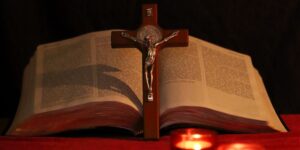
Another example we have is with the doctrine of the Bible Alone or Scripture Alone. I recently recall that one of the Protestants who wrote to me to «convert» me passed me a pamphlet in which an attempt was made to demonstrate that the Bible was the only authority.
That pamphlet cited biblical texts left and right in which it was said that the Bible was the Word of God, was true and imperishable, was useful for teaching and training in righteousness, and had authority. After machine-gunning the texts, it solemnly pontificated:
«Do you see? These texts conclusively prove that the Bible is the only authority!»
But when one reads each of those texts carefully, one finds that none of them says that the Bible (much less interpreted individually) is the only authority.
To say, for example, that the Bible is useful for teaching is not equivalent to saying that only the Bible is useful for doing so. I can say that paying attention in class is useful for getting good grades, but that does not exclude that it is also useful to study at home, to research in the library, to take private lessons, and so on.
Once again here we have the Protestant «aut-aut» appearing to mutilate everything else, and so, in their minds, those texts serve to justify inwardly a doctrine rejected in other passages of the same Bible. And it is clear that if the Bible were the «only» authority, the Bible itself would not say that Jesus granted his disciples authority:
«Then calling together the twelve apostles, he gave them power and authority over all devils, and to cure diseases.» (Luke 9:1)
«Whereas we might have been burdensome to you, as the apostles of Christ: but we became little ones in the midst of you, as if a nurse should cherish her children.» (1 Thessalonians 2:7)
«These things speak, and exhort and rebuke with all authority. Let no man despise thee.» (Titus 2:15)
«And I say to thee: That thou art Peter; and upon this rock I will build my church, and the gates of hell shall not prevail against it. And I will give to thee the keys of the kingdom of heaven; and whatsoever thou shalt bind upon earth, it shall be bound also in heaven: and whatsoever thou shalt loose on earth, it shall be loosed also in heaven.» (Mt 16:18-19)
And perhaps the clearest text that demonstrates the anti-biblical character of the doctrine of Scripture Alone is this:
«Therefore, brethren, stand fast; and hold the traditions which you have learned, whether by word or by our epistle.» (2 Thessalonians 2:15)
There we have a text taken from the very Bible that teaches without a doubt that the apostle commands us to keep not only the teachings that they received in written form, but also those they received «by word of mouth». Nevertheless, the defective Protestant reasoning that led Protestants to understand that ONLY (aut-aut) the Bible has authority impels them to sweep (sometimes subconsciously) these texts under the rug.
And the fact is that if you have already assumed, by means of defective reasoning, that «only» the Bible matters, everything else becomes superfluous. It is not possible for them to consider «the Bible together with Tradition» (et-et).
The doctrine of Faith Alone
When Luther read in the Epistle to the Romans that we are saved by faith, he inaugurated the error of reasoning that we have been discussing and that infected the entire Protestant mentality. He added the «only» where it is not.
He thus understood that we are saved “only” by faith, but not by the faith that works through charity, but rather by fiducial faith, or the mere confidence that by the merits of Christ we receive the forgiveness of sins.
For the Catholic faith it is not mutually exclusive to say that we are saved by faith, but that we must also live in accordance with the will of God, and it is God himself who gives us the faith and the ability to act in accordance with it (Philippians 2:13). «Faith Alone» led Luther to teach that he could fornicate a thousand times a day without that affecting his salvation. It would be impossible for them to harmonize the necessity of «faith and works» (et-et); instead they would opt for one or the other, «Faith or Works» (aut-aut).
The doctrine of Grace Alone
As part of his previous error, Luther understood that if salvation was a free gift of God, this had to exclude any kind of cooperation with human freedom. The error was again to exclude instead of to harmonize, ending up with an image where the good action comes solely from God and not from God through man. It would no longer be for them «Grace and Freedom» (et-et) but «Grace or Freedom» (aut-aut).
Christ Alone Saves, understood in the Protestant manner
Once again the same thing is repeated here: under the Protestant aut-aut, if Christ alone saves, the Church is not necessary for salvation. Nor is the Pope necessary, nor a hierarchy of bishops and presbyters.
Before continuing it is important to point out that the phrase understood in the Protestant manner contains another heresy, because not only Christ saves: God the Father saves, as well as the Holy Spirit saves, as well as Christ saves.
From the Catholic perspective, on the other hand, it is understood that to be united to Christ implies being united to the Church that is his body; therefore, to say that Christ saves implies accepting and not excluding the means by which he saves us: the Church, the sacraments, etc. One thing does not exclude the other (aut-aut); it comprehends it (et-et).
From the Catholic perspective, to say also that Christ saves comprehends and does not exclude the rest of the Persons of the Most Holy Trinity, and, in a manner subordinate to us as «secondary causes». That is why it is said that we ourselves can save so long as this does not exclude that salvation principally comes from God. In the following biblical text this is made manifest:
«He must know that he who causeth a sinner to be converted from the error of his way, shall save his soul from death, and shall cover a multitude of sins.» James 5:20
Soli Deo gloria (Glory to God alone)
If, from within Protestantism, the veneration of any creature that is not God, including the Virgin or the saints, was considered an idolatrous excess, the solution was once again to suppress and not to subordinate. For Protestants it is a matter of giving glory «only» to God or to the saints; for Catholics, on the other hand, it is a matter of giving glory to God for what he has done in his saints:
«And if sons, heirs also; heirs indeed of God, and joint heirs with Christ: yet so, if we suffer with him, that we may be also glorified with him.» (Rom 8:17)
For Protestantism all glory must be given only to God, so upon reading a biblical passage such as the following, they will reaffirm themselves in their position of excluding any kind of veneration and honor to the Virgin Mary and the saints:
«I am the Lord, this is my name: I will not give my glory to another, nor my praise to graven things.» (Isaiah 42:8)
Reading the same text from the Catholic understanding, it is understood that it refers to the fact that the glory that only God, by being God, deserves must not be granted to anyone else (for example: an idol that is also considered a divinity), but this does not prevent us from accepting that, in a subordinate manner, God is also glorified when the work of his hands is glorified. This is a concept that extends throughout all of Catholic doctrine and is known as «participation». For this reason Scripture itself says of Christians:
«And if sons, heirs also; heirs indeed of God, and joint heirs with Christ: yet so, if we suffer with him, that we may be also glorified with him» (Romans 8:17)
Jesus himself, at the moment of praying, exclaims:
«And the glory which thou hast given me, I have given to them; that they may be one, as we also are one.» (John 17:22).
Hence, in Catholic doctrine a distinction is made between adoration (the greatest possible love toward God as the supreme being and creator of the universe) and veneration (subordinate love in which the creature is honored for its relationship with God). When a Protestant tries to convince a Catholic that he must adore only God, and must not venerate either the Virgin Mary or the saints, what he is trying to do is make him understand the first commandment «You shall love God above all things» as if it really said «You shall love only God and not the other things» (Protestant aut-aut).
If one had to identify in a graphic way the representation of the «Edward Scissorhands» that Johnny Depp played in a film. Everything he touches he mutilates and deforms. Trying to combat the «excesses», he also suppresses truths that belong to the Gospel, producing as a result an incomplete and distorted Christian doctrine that barely maintains still some elements of truth inherited from Catholic doctrine but that keeps degrading as it divides exponentially into sects. That is why more recent sects such as Jehovah’s Witnesses, Adventists, or Mormons move ever further away from authentic Christianity.
I normally also receive many of the inquiries from Catholic brothers and sisters at ApologeticaCatolica.org, who write to me so that I may help them understand the error of this or that argument. Almost always the same thing happens: a Protestant reasoning masked beneath the fallacy of false disjunction. But once the fallacy is unmasked, the objection vanishes.
Let us learn to reason as Catholics, so as not to be vulnerable to the Protestant way of reasoning.
Author: José Miguel Arráiz
