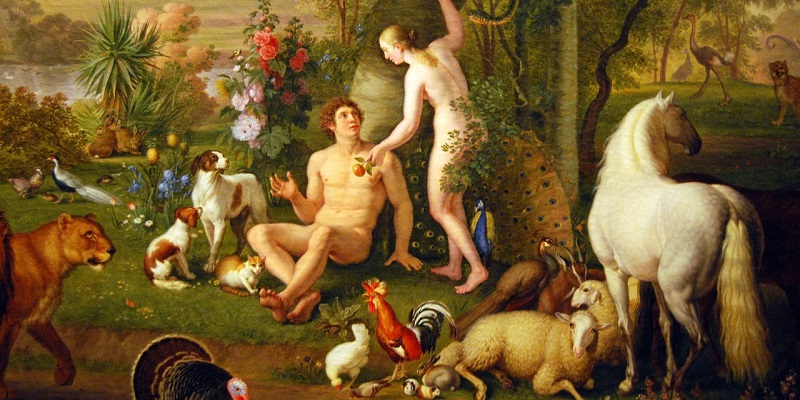
Genesis teaches us that the first human beings had their origin in a first couple: Adam and Eve. Is it unacceptable for the faith to say that humanity evolved from a lower animal form?
These “bridge” beings between the two worlds—that of the spirit and that of matter—had their origin in a first couple: Adam and Eve, according to the teaching of the first Book of the Bible, Genesis. Well and good, but then: don’t we come from the monkey, as some say? Is it unacceptable for the faith to say that humanity evolved from a lower animal form?
Although this is not the occasion for a detailed examination of the theory of evolution, we can follow a brief line of reasoning about the theory that holds that everything that exists—the world and what it contains—has evolved from a great formless mass of initial matter. “As regards the world itself, the world of minerals, rocks, and inert matter, there is solid scientific evidence that it underwent a slow and gradual process, extending over a very long period of time.”
In this theory there is nothing contrary to the Bible or the faith. If God chose to form the world by originally creating a mass of atoms and establishing at the same time the natural laws by which, step by step, it would evolve until becoming the universe as we know it today, He could very well have done so. He would still be the Creator of all things.
Furthermore: a gradual unfolding of His plan, carried out through secondary causes, would reflect His creative power better than if He had made the universe we know in an instant. The manufacturer who makes his products by teaching supervisors and foremen shows his talents better than the boss who has to personally attend to every step of the process.
This phase of the creative process, the development of inert matter, is called “inorganic evolution.” If we apply the same theory to living matter, we have the so-called theory of organic evolution, according to which living matter—even that of the human body—has evolved over long ages from certain simple forms of living cells to plants and fish, from birds and reptiles to man.
The theory of organic evolution is far from being scientifically proven. There are good books that can provide the interested reader with a balanced examination of this whole question. But for our purpose it suffices to point out that exhaustive scientific research has been unable to find the remains of the creature that would be halfway between man and monkey. The defenders of organic evolutionism base their doctrine on the similarities between the body of the apes and that of man, but a truly impartial judgment will make us see that the differences are as great as the similarities.
Alcázar, J. El origen del hombre, Libros MC, Madrid, 1986. Arnaldich, L. El origen del mundo y del hombre según la Biblia, Rialp, Madrid, 1972. Artigas, M. Las fronteras del evolucionismo, Libros MC, Madrid, 1985. Dailey, K. Cronología del hombre fósil, Editorial Labor, Barcelona, 1968. Palafox, E. Evolución y Darwinismo, México, 1987.
Thus, the search for the “missing link” continues. From time to time some ancient bones are discovered in caves and excavations. For a while there is great excitement, but then it is seen that those bones were either clearly human or clearly of a monkey. We have “Peking Man,” “Java ape-man,” “Foxhall Man,” and a further collection. But these creatures, a little more than apes and a little less than man, are still to be unearthed (Trese).
And even if they were to find it, for the faith it would have no great significance. God could have gone on preparing the body of man by means of an evolutionary process, if He had so desired. He could have guided the development of a certain species of monkey until it reached the point of perfection He required. But then, upon reaching that point of perfection, God would create a spiritual soul, would infuse it into that body, and we would have the first man. The biblical account that God created man from the clay of the earth would be equally true. The Church does not forbid, as is commonly thought, “that the doctrine of evolution be a subject of study, in as far as it inquires into the origin of the human body as coming from pre-existent and living matter.”
But the Catholic faith obliges us to hold—we are quoting the Encyclical Humani Generis of Pius XII—“that souls are immediately created by God. Since the spirit is of an order absolutely superior to that of matter, the soul cannot “evolve” from the body, nor can it be inherited from our parents. Husband and wife cooperate with God in the formation of the human body. But the spiritual soul that makes of that body a human being must be created directly by God and infused at the moment of conception into that newly formed body.”
The search for the “missing link” will continue, and whatever the future results may be, we shall remain just as calm. We know that, since all truth comes from God, there can be no contradiction between the datum of faith and that of science. Whatever the way God chose to make our body, it is the soul that matters most. It is the soul that raises from the ground the eyes of the animal—from its poor craving for food and sex, for pleasure and escape from pain—it is the soul that lifts our eyes so that we may discover the ineffable truth of our eternal destiny.
Author: Ricardo Sada Fernández
Source: Encuentra.com
