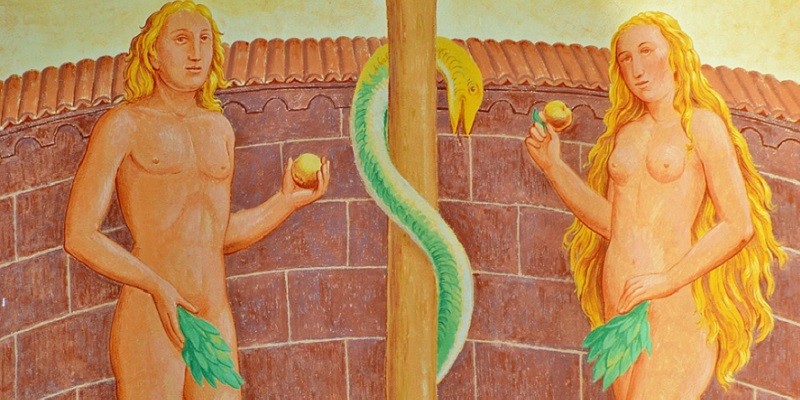
1. Thanks to the catecheses given within the current cycle, we have before our eyes, on the one hand, the analysis of the first sin in human history according to the description contained in Gen 3; and, on the other, the broad picture of what divine Revelation teaches on the subject of the universality and hereditary character of sin. This truth is constantly proposed by the Magisterium of the Church, also in our own time. For this reason it is necessary to refer to the documents of Vatican II, especially the Constitution Gaudium et Spes, without forgetting the post-synodal Exhortation Reconciliatio et Poenitentia (1984).
2. The source of this Magisterium is above all the passage from the book of Genesis, in which we see that man, tempted by the Evil One (“the day you eat of it, you will be like God, knowing good and evil”: Gen 3:5), “abused his liberty, setting himself against God and seeking to attain his own end apart from God” (Gaudium et Spes 13). Then “the eyes of both were opened” (that is, of the man and the woman), “and they saw that they were naked” (Gen 3:7). And when the Lord “called to the man and said to him: Where are you?”, he answered: “I was afraid, because I was naked, and I hid myself” (Gen 3:9-10). A very significant answer. The man who previously (in the state of original justice) dealt with the Creator in friendship and trust, in the whole truth of his spiritual-corporeal being created in the image of God, has now lost the foundation of that friendship and covenant. He has lost the grace of participation in the life of God: the good of belonging to him in the holiness of the original relationship of subordination and sonship. Sin, on the contrary, immediately made its presence felt in the existence and in all the behavior of the man and the woman: shame for their own transgression and for the consequent condition of sinners and, therefore, fear of God. Revelation and psychological analysis come together in this biblical page to express the “state” of man after the fall.
3. We have seen that another truth emerges from the books of the Old and New Testaments: something like an “invasion” of sin into the history of humanity. Sin has become man’s common destiny, his inheritance “from the womb.” “In sin did my mother conceive me,” the Psalmist exclaims in a moment of existential anguish, in which repentance and the invocation of divine mercy are joined (Ps 51). Saint Paul, for his part, who frequently refers, as we saw in the previous catechesis, to that same anguishing experience, formulates this truth theoretically in the Letter to the Romans: “All are under sin” (Rom 3:9). “That every mouth may be stopped, and the whole world may be held accountable to God” (Rom 3:19). “We were by nature children of wrath” (Eph 2:3). In all these texts, biblical scholars comment, there are allusions to human nature left to itself, without the help of grace; to nature as it has been reduced by the sin of the first parents and, consequently, to the condition of all their descendants and heirs.
4. The biblical texts on the universality and hereditary character of sin, almost “congenital” to nature itself—the state in which all men receive it at their very conception by their parents—introduce us to a more direct examination of the Catholic doctrine on original sin.
It is a truth transmitted implicitly in the teachings of the Church from the beginning and made a formal declaration of the Magisterium at the Fifteenth Synod of Carthage in the year 418 and at the Synod of Orange in the year 529, chiefly against the errors of Pelagius. Later, in the period of the Reformation, this truth was solemnly formulated by the Council of Trent in 1546. The Tridentine Decree on original sin expresses this truth in the precise form in which it is the object of the faith and doctrine of the Church. We can therefore refer to this Decree in order to draw out the essential contents of the Catholic dogma on this point.
5. Our first parents (the Decree says: “Primum hominem Adam”), in the earthly paradise (therefore in the state of original justice and perfection), sinned gravely by transgressing the divine command. Because of their sin they lost sanctifying grace; they also lost, therefore, the holiness and justice in which they had been “constituted” from the beginning, bringing upon themselves the wrath of God. The consequence of this sin was death as we experience it. Here we must recall the words of the Lord in Gen 2:17: “Of the tree of the knowledge of good and evil you shall not eat, for on the day that you eat of it you shall surely die.” We have dealt with the meaning of this prohibition in the previous catecheses. As a consequence of sin, Satan succeeded in extending his “dominion” over man. The Tridentine Decree speaks of “slavery under the dominion of him who has the power of death.” Thus the situation under Satan’s dominion is described as “slavery.”
It will be necessary to return to this aspect of the drama of the origins in order to examine the elements of “alienation” that sin brought with it. Let us note meanwhile that the Tridentine Decree refers to “Adam’s sin” as the proper and personal sin of the first parents (what theologians call peccatum originale originans), but it does not forget to describe the harmful consequences that this sin had in human history (the so-called peccatum originale originatum).
Modern culture shows serious reservations, especially toward original sin in this second sense. It cannot admit the idea of a hereditary sin, that is, one linked to the decision of one who is the “head of a stock” and not to that of the subject concerned. It considers such a conception to be in contrast with the personalist vision of man and with the demands that derive from full respect for his subjectivity.
And yet the Church’s teaching on original sin can prove extremely precious also for contemporary man, who, after rejecting the datum of faith in this matter, cannot explain to himself the mysterious and anguishing evasions of evil that he experiences daily, and ends up oscillating between hasty and irresponsible optimism and radical, desperate pessimism.
Source: Encuentra.com
