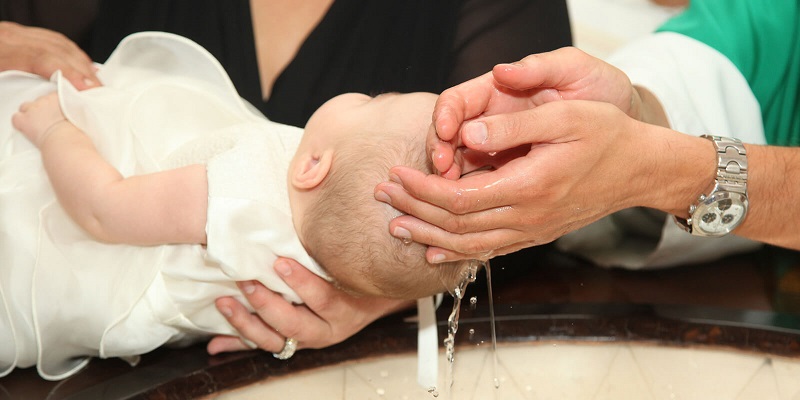
Below we present section 2 of chapter 4 of a study manual used by Lutherans today by Prof. Georg Metzger, originally published in German, which is a commentary on Luther’s Small Catechism for those who teach it.
Despite not agreeing with many points of Lutheran doctrine, we provide this manual as interesting evidence of the arguments of the Protestant brothers who are in favor today of baptizing children just as the Protestants were at the time of the Reformation.
(Bold letters are ApologeticaCatolica.org)
____________________________________________________________________________________
The Baptism of children, Chapter 4, section 2
 Introduction: We have already indicated that our church baptizes children when their parents or those who have authority over them bring them to be baptized. Those who call themselves Baptists and other similar sects reject the baptism of children. They say that baptizing them is not correct, that it is against the word of God. Only adults, those who were previously instructed in the word of God and have confessed their faith in Christ, should be baptized. Thus they baptize those who join their communion even if they were baptized as children. And you will surely find such people. That is why they must know what they can answer so that they do not cause doubts about their baptism. Again we will talk especially about the baptism of children and we will see that it is well founded in the word of God. Question 241, 241.
1. When we have to decide the question who we should baptize and who we should not, above all we must look at the words of institution, Christ’s command to baptize, Matthew 28:18-20. There the Lord commands us to baptize all nations, which are all people, young and old. When the Lord Jesus Christ commands that we must baptize all nations, he certainly does not exclude children, rather it includes them, because they too belong to “all nations.” It is true that we do not read in Holy Scripture with explicit words that the apostles baptized children, but we are told that they baptized entire families, for example Lydia and her household, Acts 16:15, the Philippian Jailer and all his people, Acts 16:33. Surely there were small children in those families too.
2. We have the main proof that little children should also be baptized in Mark 10:13-15. Christ wants children to come to him, to be brought to him. He says theirs is the kingdom of God. Our children cannot enter the kingdom of God as they are by nature. Our Savior explicitly says that only those who are born of water and the Spirit can enter the kingdom of God. For that which is born of flesh is flesh, and the flesh cannot inherit the kingdom of God. John 3:5,6. Our children are children born of flesh. If they are to enter the kingdom of God, they must be born again. These children are begotten by God, by water and the Spirit, through holy baptism. And the Holy Spirit comes to them and makes them children of God. Holy baptism is then the means by which we bring our children to Jesus, through which they are received by him into the kingdom of heaven, which the Lord has promised them. Yes, there is no doubt that it is God’s will for us to baptize our children.
 3. Those who oppose the baptism of infants, however, generally plead this: What benefit can infants receive from baptism? Children do not know what is happening to them and they cannot believe either. And without faith your baptism cannot help you. It is true that faith has to be added to baptism for it to have a salutary effect. We confess in our catechism that baptism gives great and glorious things “to all who believe.” If our children could not believe, certainly baptism would profit them nothing. But they can believe, and they really do. God Himself says it in Matthew 18:6. In baptism, God the Holy Spirit works faith in them, and thus baptism is beneficial to them, they receive its full blessing. Therefore, we stick with our baptism of children, no matter what the opposing sects say. It is according to the word of God, who has given glorious testimony of it, and through it has kept his Christianity.
4. We must still briefly discuss a custom found in the baptism of our children. They have frequently seen how we baptize children. There are people there who answer in the child’s place. They speak for him, that is, since he himself cannot do so, he renounces the devil through them and confesses his faith in the Triune God. We call those people godfathers. Why do we have godparents for our children at baptism? The word of God tells us nothing about godparents for baptism, but the Christian church has instituted this custom for powerful reasons. We have already heard one reason why we have godparents for our children at baptism. They must answer the questions that the pastor asks the child in the child’s place.— Another reason: Baptism is important for a Christian throughout his life, since it should comfort him in the tribulation caused by his sins until death. The Christian must then be very sure that he has been properly baptized and our children do not remember their baptism. Thus the godparents must then assure them that they have been duly baptized according to God’s command and institution. The word of God says that every matter, especially an important matter, must be confirmed by the testimony of two or three. Matthew 18:16.— Another reason. Our children are baptized, but they must also be taught to keep everything the Lord has commanded us. (Matthew 28:20) And godparents should help with that. Especially in the event that their parents die, they must take care of the Christian education of the children.—When we baptize our children we also intercede for them. Godparents should also pray for the children. The question of whom we should choose to be godparents for our children is not a matter of indifference. We must not look so much at kinship, as so many do, but above all we must take care to choose people who will diligently fulfill their duties as godparents. We must choose Christian, believing, serious people as godparents for our children, who share the same faith with us.
“What gifts or benefits does baptism confer?”
 Introduction: We have learned what holy baptism is, which is not simple water alone, but water understood “in the divine command and linked with the word of God.” It is an act that God himself has ordered and instituted and in which he makes his word reach the water. That makes baptism something great and glorious, and of great blessing and benefit to him who receives it. Our catechism continues to describe this benefit and blessing by answering the question: “What gifts or benefits does baptism confer?” It gives a twofold answer, that is, what the benefit of baptism consists of, and then, who receives it, to finally demonstrate that we teach this in accordance with the words and promises of God.
1. Our catechism first of all tells us what the benefit of baptism consists of. Questions 243, 244.
Our catechism speaks of three benefits of baptism; It tells us that it confers the remission of sins, that it redeems from death and the devil, and that it gives eternal salvation. It presents these benefits according to the words and promises of God: “as the words and promises of God say.” To the second question: “What words and promises are these?” the catechism adds the passage Mark 16:16. There God himself tells us the benefit of baptism. He who is baptized will be saved. The benefit that baptism gives us is salvation. But how? Doesn’t our catechism tell us more? It also presents forgiveness of sins, redemption from death and the devil as benefits of baptism. Doesn’t our catechism here tell us more than the word of God, or at least more than this promise says? By no means. He who is saved must first have forgiveness of sins. He is also freed from death and the power of the devil. If baptism saves us, it also works the forgiveness of sins and frees us from death and the devil.(“Secondly, since we know what baptism is and how it is to be regarded, we must learn why and for what purpose it has been instituted, that is, what it is for, what it gives, and what it accomplishes. This cannot be better captured than in the words of Christ quoted above: He who believes and is baptized will be saved, Mark 16:16. Here you must understand in the simplest way that the power, work, benefit, fruit, and end of baptism consists in making us saved. In fact, when someone is baptized it is not so that he becomes a prince, but, according to the words, so that he is saved. And it is well known that being saved does not mean anything else, but only to be freed from sin, from death and from the devil; to enter the kingdom of Christ and to live with him eternally.” Large Catechism, Baptism #23-25.) Baptism then works the forgiveness of sins, frees us from death and the devil and gives us eternal salvation. In the second article we confess that Jesus Christ has redeemed us, freed us and rescued us from all sins, death and the power of the devil. Christ has obtained all of these benefits for us through his life, suffering, and death. But in order for these great benefits that Christ has obtained for us to be beneficial to us, they must become ours. To this end Christ has placed all his great treasure, the forgiveness of sins, life and salvation, in baptism, as one keeps jewels and precious stones in a chest. When we are baptized, we receive these goods that Christ has obtained for us. The Holy Spirit makes them ours. Baptism is the hand of God through which God offers and gives us these wonderful things. Thus baptism is the means by which the Holy Spirit makes all these blessings ours. Baptism then is also a means of grace, by which the Holy Spirit makes us participate in the benefits of his grace. 1 Corinthians 6:11.
We then look more closely at the benefits of baptism as our Small Catechism presents them.
a. First of all he says that baptism works the forgiveness of sins, and this fact is verified in the general promise. Mark 16:16. Holy Scripture, however, also tells us explicitly. So In Acts 2:38 the apostle commands the Jews that they must be baptized so that they may have forgiveness of their sins..” Thus baptism has to do this. Also the passage of 1 Peter 3:20-21 tells us the same thing. There baptism is called: “aspiration of a good conscience toward God.” Through baptism we receive a good conscience before God. But this is only possible if we are freed from the guilt of sin, if we have forgiveness of sins. If baptism gives us a good conscience, then it gives us forgiveness of sins.
But how does baptism work the forgiveness of sins? We learn it in the passage of Galatians 3:26,27. In baptism we have put on Christ, just as one puts on clothes. If we are baptized, Christ is already ours with all that he has deserved and earned for us. In baptism Christ is given to us with all his merit. But Christ has mainly obtained for us the forgiveness of sins. Thus baptism works the forgiveness of sins when it gives us and makes the merit of Christ ours.
b. Our catechism continues to tell us that baptism redeems us from death and the devil. This is a consequence of the above. It can’t be any other way. Death entered the world because of sin. It is the wages of sin. If baptism works the forgiveness of sins and takes away sin, it also takes away the punishment of sin and redeems from death. — We distinguish between eternal and temporary death. Eternal death is eternal damnation. If the Christian no longer has sin, if his sins are taken away through baptism, he no longer has to fear any condemnation. In this way temporal death also loses its pain. It is true that baptized Christians also still die. But for them death has lost its terror. The sting of it, what makes death horrible and fearful, is sin. He who does not yet have forgiveness of sins has to fear the terrible condemnation of eternal death after temporal death. Christians have now received forgiveness of sins through baptism. Thus death has lost its sting. Temporary death for Christians is the entrance to eternal life. They can boast with the apostle that death is swallowed up in the victory of Christ, 1 Corinthians 15:55-57.
If baptism works the forgiveness of sins, then it also delivers from the devil. The devil tempted the first men to sin; he deceived them. They sinned, and thus submitted to the power and authority of Satan. Through sin, the devil received power and authority over humans, we were cast into the kingdom and under the authority of the prince of darkness. As long as sin dominated us, we remained in this kingdom. Now that baptism has taken away our sins, and we are delivered from the power of the devil. Through baptism God saved us from the authority of darkness, freed us from the power of darkness, that is, from the kingdom of Satan, and transferred us to the kingdom of his beloved Son, Colossians 1:12-14. In Christ we have forgiveness of sins. This forgiveness that Christ deserved for us in baptism becomes ours. Thus in baptism we also have deliverance from the devil. — It is true that the devil also after baptism still has a little time to try to make Christians fall. But he can no longer retain them in his power if they remain in their baptism. In the power of their baptism they guard against the devil and his temptations and more and more they gain victory.
c. Finally our catechism tells us that baptism also gives eternal salvation. The Lord clearly and unequivocally says in his promise that this is what happens. Mark 16:16. Also Peter explicitly says that baptismal water saves us. 1 Peter 3:20-21. The catechism says that baptism gives us salvation. And he does it now, not only in eternal life. Through baptism we already have blessedness in hope; there we will enjoy it in its perfection with all its benefits. The blessing of baptism thus reaches to heaven.
Here we see again what a great and glorious act baptism is, bringing us such precious benefits. No asset on this earth can compare to these.
2. But our catechism still shows us who receives these gifts and benefits. Questions 245, 246.
a. Who are the people who receive the benefits of holy baptism? The catechism answers us with the words: “All who believe”, that is, those who believe what is said here about baptism according to the word of God, which gives forgiveness of sins, which delivers from death and the devil and which gives eternal salvation. “That is also what God’s words and promises say.” The Lord not only says in Mark 16:16: He who is baptized will be saved, but He says: “He who believes and is baptized will be saved.”Faith also has to accompany baptism for it to be beneficial. Certainly faith does not make baptism a baptism in the first place. It is in itself a true baptism, a powerful means of grace, through which God offers forgiveness of sins, life and salvation, whether we believe it or not. Also those who do not believe are certainly offered in baptism forgiveness of sins, liberation from death and the devil, and eternal salvation.—But we also have to receive, apprehend these benefits. What good will it do to a poor man if a rich man offers him a large amount of money if he does not accept it? The money is really given to him, it really belongs to him, but he does not receive any benefit or benefit from it. So it is also with baptism. Baptism is the hand of God, through which he offers us his glorious treasures of grace; but we have to receive them through faith. Faith is our hand, with which we appropriate these treasures of grace. (“In fact, since these benefits are offered and promised here in these words with water and united to water, they cannot be received in any other way than if we believe it with a sincere heart. Without faith, baptism is of no use. Although in itself it does not cease to be a divine and superabundant treasure.” Large Catechism, Baptism #33. — “Thus you see clearly that here there is no work done by us, but a treasure that God grants us and of which such faith takes possession, just as the Lord Jesus Christ on the cross is not a work, but a treasure, which, contained and offered to us in the word, is received by faith.”
b. Still the Lord adds: “He who does not believe will be condemned.” Perhaps it will surprise us that God does not say: He who does not believe and was not baptized, but only says: “He who does not believe will be condemned.” With this the Lord demonstrates that unbelief is what really condemns. It may happen that a man believes in his heart and has not yet received baptism. We can think of the thief on the cross. When he became a believer, he could no longer be baptized, and yet Christ assures him that he will be saved. Especially when a believing Christian in an emergency cannot receive baptism, he will be saved by his faith. God has bound us to use his means of grace, but he has not bound himself. — The case is different, surely, if a man has the opportunity to be baptized, but does not want to use this means. The Pharisees and scribes we read about in Luke 7:30 were such people. They did not allow themselves to be baptized by John. And it is said of them: “And they rejected the counsels of God concerning themselves.”He who can have baptism and does not want to be baptized does not use it, thereby rejecting the counsel of God, the means that God has given him for salvation. By rejecting it you show that you do not believe what God has told you in his word. And because of his unbelief he is condemned. Saving faith can coexist with the lack of baptism, but not with the rejection of baptism.
c. All Christians must, through faith, appropriate the benefits that God gives us in baptism. We must do it throughout our lives. Our baptism has meaning and is valid and beneficial for our entire life. Baptism is, as we have heard, a covenant with God. 1 Peter 3:21. God has promised us that because of Christ he will be our Father and we will be his dear children. He wants to forgive us our sins and save us. And God faithfully keeps his covenants. (Isaiah 54:10) The grace that he has promised us in baptism remains firm, even if we have been unfaithful. Unfortunately we have been. We sin many times after baptism, due to the weakness of our flesh, or also voluntarily, against our conscience. Then when our sins terrify us and press us, we again look to our baptism, and we appropriate the benefits that God has promised us in baptism, the forgiveness of sins, life and salvation. And we truly and surely have it. In this way we constantly receive again a good conscience before God, since baptism is the covenant of a good conscience. Thus we console ourselves in our holy baptism throughout our lives.
Author: Prof. Georg Metzger based on Martin Luther’s Small Catechism
