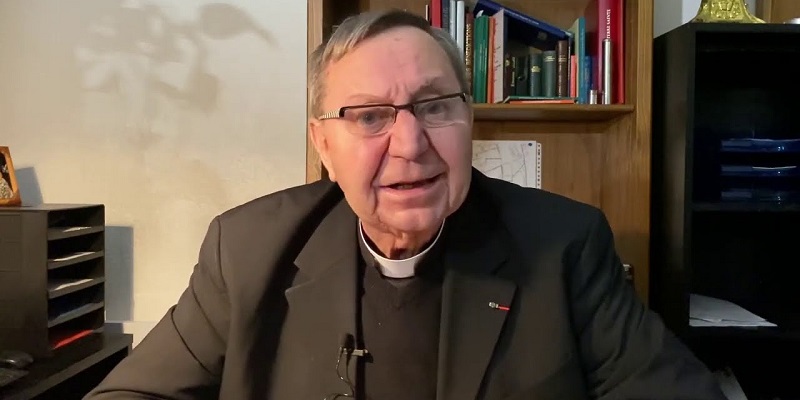
The first case in France since the Reformation
Michel Viot, Ecclesiastical Inspector (a rank equivalent to Bishop) of the Evangelical Lutheran Church in France, converted to Catholicism on June 28, in the course of a ceremony presided over by the Bishop of Chartres (Palabra 447-448, VII-IX-01, p. 21). Two weeks later, the news was made public, along with Viot’s intention to be ordained a Catholic priest, which constitutes the first such case in France. Viot, who was born in Paris in 1944, had spent thirty years in positions of responsibility within the Lutheran Church.
By Dominique Le Tourneau. Paris
The news did not take by surprise those who knew him or followed his sermons at the church of Billettes in Paris, where he was the pastor. Michael Viot took the definitive step toward Catholicism in the wake of the Lutheran-Catholic Joint Declaration on justification, and shortly after the Synod of the French Reformed Church resolved in May to allow Eucharistic communion to the non-baptized as well.
—Mr. Viot, what will your personal itinerary be from now on?
—For the moment, I have joined the service of the parish of Chateaudun and of the diocese of Chartres as a layman. I will have a time of reflection, study and testing. But I wish to return to the full exercise of the ministry of the Word and of the sacraments, as I have been doing for these thirty-five years.
—Are you happy with the decision you have made?
—I am happy with the choice I have made, but I will be fully happy when I have been ordained a priest, because it is in the exercise of the priestly ministry that I will be able to fulfill the commitments I have taken on in my life.
WHY I CONVERTED
—What was the reason for your conversion?
—I have always placed myself among those Lutherans who did not resign themselves to a definitive schism with Rome. I have followed with great interest the theological dialogue between the Holy See and the Lutheran World Federation. As the years went by, I saw positions drawing closer, and I followed the evolution of Lutheran-Catholic reflection on justification by faith. In 1989, a collective work co-signed by Cardinal Ratzinger reached the conclusion that the anathemas of the Council of Trent were no longer valid with respect to contemporary Lutheranism. From that moment on, in my opinion, the maintenance of the sixteenth-century schism should have been called into question, and an answer should also have been offered to the challenge posed by John Paul II in the encyclical Ut unum sint on the exercise of the ministry of Peter. It did not seem to me that European Lutherans were sufficiently prepared to face that challenge. Nor do I have the impression that the Lutheran Federation has hastened to respond to the question of the papacy. Therefore, I decided to take the step forward myself, because I have always believed that complete unity will never come about without communion with the Bishop of Rome, recognized as primate.
Lutheran-Catholic agreement
—The Lutheran-Catholic Joint Declaration on justification has made it possible to take a step forward on the path of ecumenism. But, as far as Catholics are concerned, does it not seem to you that this doctrine is already found in the Council of Trent?
—Indeed, the doctrine of justification by faith is found in the articles of the Council of Trent published in 1547. But it is worth recalling a few points in order to understand why no agreement could be reached at that time. Luther had died a year earlier, and his flock was already beginning to break apart. It would be necessary to wait until the year 1580 and the publication of the Formula of Concord to restore peace among them. Moreover, the text of the Council of Trent hurled anathemas against doctrinal formulations in which not all Lutherans recognized themselves, with the resulting feeling of injustice. Politics counted too, and not everyone was in favor of a return to unity! I also think that, from the debate over the Augsburg Confession of 1530-1531 onward, the two sides no longer understood each other and easily fell into the trap of words. Hence the need for the new, present-day formulation.
—Then what is it that still separates Lutherans and Catholics?
—There are different sensibilities within Lutheranism, ranging from an almost complete identification with the thought of the Reformer to the tendency known as the “High Church”, which attaches great value to the Augsburg Confession, to its Apology and to the Formula of Concord of 1580. I belonged to this current of thought before converting. For this sector of Lutheranism, the differences with Catholicism lie in the formulation of ecclesiological and Mariological doctrines. I hope that both sides will strive to make a new reading in the light of the Joint Declaration signed on October 31, 1999. Lutherans must discover that the Marian and ecclesiological dogmas in no way affect the unique and universal saving mediation of Jesus Christ. On the contrary, it finds in them its fullest meaning.
the “dominus iesus” declaration
—In a more general context, the declaration Dominus Iesus specifies that the term “Church” cannot be used to refer to confessions that have neither all the sacraments nor apostolic succession. How do you perceive this clarification, which has provoked contrasting reactions?
—First of all, I would like to protest against the veritable “media lynching” to which this declaration has been subjected. The consequence has been to obscure its main objective –interreligious dialogue–; and that is a pity, since a good number of Protestants could, and indeed should, have subscribed to what it affirms about the excellence of Christianity. As for the use of the word “Church”, it seems to me that nothing has substantially changed since Vatican II. One cannot speak of a step backward on Rome’s part; it merely reflects the current reality, since no Catholic-Protestant agreement has been signed in matters of Ecclesiology or on ecclesial ministries. The Catholic Church does not recognize Protestant ministers, and vice versa, so that intercommunion is very limited. Under such conditions, Rome is obliged to keep to the formulation of Vatican II, which designates Protestants as an “ecclesial community”, not as a Church. For a change to take place, Protestants would have to return to the seven sacraments and rediscover apostolic succession.
—What aspects of Catholic doctrine and life would you highlight?
—Thanks to its Magisterium, the Catholic Church has an official doctrine. It maintains a Christology founded on Scripture and Tradition, but also illuminated by Marian veneration, as happens, for example, in the way it approaches the mystery of Christmas. I am convinced that most of the great heresies, if not all of them, stem from errors in Christology. Now, to get Christology right, one must not separate Jesus from his Mother, the Blessed Virgin Mary. The Catholic Church recommends Marian piety, which constitutes one more essential element with respect to Protestantism that makes it possible to speak more accurately of Christ and of the faith. The doctrine of the seven sacraments also seems to me of capital importance. Despite the crisis of penance in Catholicism, it is not comparable to the absence of its practice in most Protestant confessions. At least in Catholicism there is a clear doctrine that can set the situation right.
Moreover, the fact that priestly ordination is a Catholic sacrament has prevented any deviation in the celebration of the Eucharist. Only one who has been ordained a priest can consecrate the bread and wine. Never, despite the shortage of priests, will it be possible to give a “pastoral delegation” to a layperson to do so, something that is done in a very large number of Protestant ecclesial communities.
Finally, the ministry of the Pope must be regarded as a precious fruit of the grace of God.
magisterium
—What is, in your opinion, the role of the ecclesiastical Magisterium?
—First of all, I would like to recall that for me the ecclesiastical Magisterium is not an accident of history. It is an institution of divine law. The promises made to Peter in the Gospels, the Lord’s farewell discourses promising the assistance of the Holy Spirit to the Twelve to keep them in the Truth, the functioning of the early Church as described in the Acts of the Apostles, and then Tradition, show the antiquity and legitimacy of the Magisterium. History also shows us the capital role it plays in defending the faith against heresies.
—At a Synod recently held in Soissons, the Reformed Church of France agreed to admit the non-baptized to the reception of the Eucharist. How do you interpret this decision?
—The Reformed Church of France raises questions of particular gravity. By allowing the non-baptized to take part in the Lord’s Supper (even if on an exceptional basis), the Synod, whether it likes it or not, calls into question the very nature of Baptism and of the Lord’s Supper. So one asks oneself: What then becomes of the creation of the new man through Baptism and his growth through participation in the Eucharist? What necessity would Baptism then have, and what specificity the Eucharist?
The Reformed Church of France had signed several doctrinal agreements with the Lutherans: the Leuenberg Concord of 1973 and other texts drawn up at periodic meetings. The question decided at the Synod of Soissons had already been addressed in 1994. On that occasion the assembly pronounced against it. Therefore, the Reformed Church now stands alone on this question, in clear disagreement with the Leuenberg group. It will have to explain its reasons. In any case, it introduces a new and serious difficulty into the Protestant-Catholic dialogue, since there had never been any conflict over this question.
freemasonry
—You held high degrees in French Freemasonry. Last year you resigned from all of them.
—I have left all the degrees of Freemasonry, high and less high, because of the negative judgment that the Catholic Church holds concerning Freemasonry. Indeed, my desire is to become a priest, and I believe that a priest must avoid being a cause of division among his parishioners. Since the question of Freemasonry continues to arouse controversy and sharp clashes today, and since I have always given priority to the service of the faithful, I have preferred to leave Freemasonry so as to avoid everything that hinders the exercise of the priestly ministry.
