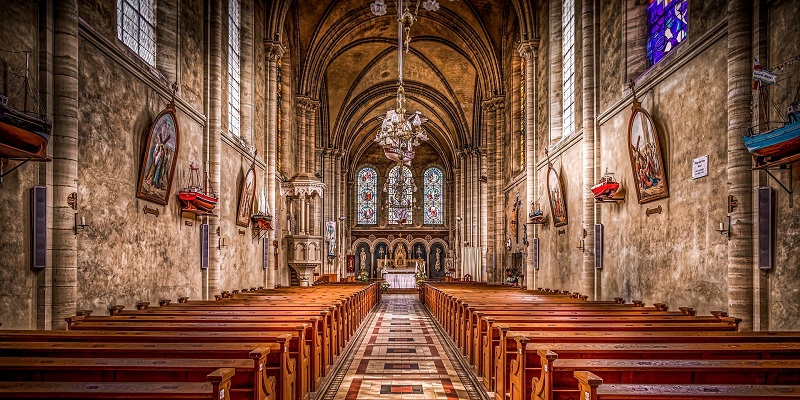
Catholic Church
How could you do that? Are you serious about your conversion? So now you worship Mary? How can you tell your most intimate secrets to another man in confession? Why did you convert? How can you accept teachings that are not in the Bible?
Those are some of the questions I have been bombarded with ever since I was received into the Catholic Church. As the years go by they have become more frequent, so I have decided to put pen to paper to inform the curious. I hope this brief account will help Catholics understand the “Evangelical” mindset, and that it will also help Evangelicals think a little about the central problem that lies at the heart of this matter: authority.
My entrance into the Catholic Church was not a Pauline conversion, like the one that happened on the road to Damascus. While it is true that God can do such things, my road to the faith of the ages was a gradual, educational experience. Conversion is, in the end, a spiritual matter, but many factors can contribute to bringing it about. My distaste for the confusion in which Evangelical Christianity finds itself was the starting point. I believe it was the grace of God that allowed me to discern the weakness of that religious system.
Before my dissatisfaction made itself felt, I was very happy in Evangelical Christianity. I trusted in Christ, I believed my sins would be forgiven, and I thought I knew the Gospels and the New Testament. I also thought that all other religions were wrong, and I saw the Catholic Church as an apostate church full of medieval corruption, obscuring the Gospel to the ruin of souls. I was convinced that the Word of God in the Bible was the only authority for the believer (Sola Scriptura) and that I was justified only by my faith and nothing but my faith (Sola Fide). These were, for me, the chief battle cries of the Reformation. Whenever I met a Catholic, I would try to show him the “truth” and lead him to the knowledge of Christ. I was so anti-Catholic that I refused to pray in the chaplain’s chapel at the university where I taught. I knew that the Christian Evangelical Union sought to convert Catholics, and I thought at the time that the whole Catholic business was nothing but sheer hypocrisy.
But the grace of God was beginning to work in my heart. It all began with the question of baptism. Evangelical Christians are deeply divided on this. Some accept infant baptism, and others believe that baptism is only for the adult believer. I studied the facts and could not find any explicit reference to infant baptism in the New Testament, so I decided to find out when this practice had begun among Christians. Could it go all the way back to the times of the apostles, or had it seeped into the Church during the first centuries? In due time I found that infant baptism was clearly supported by the historical record. If it had been an innovation, there should have been some trace of protest against its introduction into the Church. I could not find a single Christian group before the sixteenth century that rejected the baptism of children. And I even discovered that those first Baptist Christians merely sprinkled the adult’s head when baptizing him. I found that immersion (which was also an important point for some Evangelicals) did not begin until the seventeenth century. I concluded, then, that the Baptist churches fell short when it came to rigor and historical continuity.
I therefore rejected “adults-only” baptism. For me this was a crucial part of the truth, and now that I knew the error of their beliefs, I tried to convince Baptist Evangelicals of it. Some told me I was becoming obsessed with a matter of secondary importance. This shocked me. How could a solemn commandment of Jesus Christ be considered of secondary importance? I was astonished when the renowned Evangelical leader Martyn Lloyd-Jones, in his book What Is an Evangelical?, commented on the issue of disunity in the Evangelical churches, saying: “Another matter that we must put into the same category is the age and mode of baptism: the age of the candidate and the mode of administering the rite of baptism. I have to put it into the category of non-essentials, then, because you cannot prove either one using the Scriptures alone. I have been reading books on the subject for forty-four years, and I believe I know less now than I did before I started. Therefore, while I affirm together with all of us that I believe in baptism, since it is evidently a command of God, we must not separate over the age of the candidate and the mode of administering it.”
Here we have a man who, believing in the authority of the Bible as the sole guide for the believer, could not establish the biblical pattern for baptism. This is what I call “learning and NEVER arriving at a knowledge of the truth.” Ironically, in the same work Lloyd-Jones teaches the sufficiency of Scripture and that Evangelicalism is far clearer in its reasoning than Catholicism! This helped me focus my mind on other disagreements that exist among Evangelicals. If they were merely secondary matters, there would be no need for separate denominations, each one brandishing different theories about the Lord’s return, the meaning of the Lord’s Supper, whether or not the believer can lose his salvation, or the dispute over the charismatic gifts. The list is long.
My academic training is as a historian, and as such I have concentrated on the history of the Church. I could not get over my astonishment when I found that I could not discover a single trace of Evangelical Christianity in the Church prior to the sixteenth century. Neither the Waldensians nor the followers of Wyclif had any notion of salvation by faith alone. Both groups took part in the sacraments of the Catholic Church and began as reform movements within the Church, not as separate churches. Not one of the Fathers of the Church preached salvation by faith alone. Wyclif himself died while attending Mass, without ever having been baptized as a believer, content with his Catholic baptism as an infant!
The theory that the conversion of the Roman emperor Constantine in the fourth century began the corruption of the Church is even more incredible. I found that the early Church believed in infant baptism, baptismal regeneration, bishops, apostolic succession, the presence of Christ in the Eucharist, the sacrificial priesthood, prayers for the dead, and a special role for the bishop of Rome. All of this is clearly found centuries before Constantine. In the words of Cardinal Newman, “to be deep in history is to cease to be a Protestant.” I could not find a single trace of biblical Evangelicals, some handful of faithful clinging to the beliefs that distinguish today’s Evangelicals: the Bible alone and justification by faith alone. The Evangelical treatment of Church history is superficial: it speaks of people like Ambrose, Augustine, and Athanasius as if they were “Bible-only” Christians, completely ignoring the Catholic context in which they lived. I find this intellectually dishonest.
I have found that the history told by Evangelicals rests on myths. The Catholic Church, I was told, had burned copies of the Bible. On the contrary, I discovered that the Catholic Church has preserved the Bible, defining its canon—and yes, it has burned and forbidden the reading of editions that were inaccurate and heretical translations. For example, Bibles like Tyndale’s translation, which sported footnotes attacking the Church and the Pope. I have also found versions translated into the vernacular languages produced years and years before the German Reformation. The Gospels had already been translated into Anglo-Saxon long before the English language was even formed!
I also found that the famous Book of Martyrs by John Foxe, an apostate Catholic of the sixteenth century, was inaccurate. Many of the “martyrs” under the reign of Mary Tudor were anti-orthodox men who would have been burned under the reign of the Protestant Queen Elizabeth. In fact, Foxe supported a regime that tortured and killed Catholics who simply wanted to live in the faith of their ancestors. He also supported a regime that burned Evangelical Christians such as the Baptists! It was Protestant Christians who persecuted the fathers of Puritanism in sixteenth-century England, and that group, in turn, once established in America, took part in persecuting its own companions in the faith.
I had accepted the false idea, perpetuated by Lloyd-Jones and other Evangelical teachers, that Catholics believe in continuing revelation. I found, quite to the contrary, that Catholic doctrine teaches that public revelation ended with what was received by the apostles, and that the faith was delivered once for all to the saints. It is the duty of the Church, as “the pillar and bulwark of the truth” (1 Tim 3:15), to interpret and discern the original deposit of faith. The Catholic Church did not invent transubstantiation in the twelfth century any more than it invented the Trinitarian dogma in the fourth. As an Evangelical, I was perplexed to find myself in the very same position as the Jehovah’s Witnesses, who argue that the word “Trinity” is not in the Bible. I thought the teaching was there and that the word simply defined it. But then I had the problem that I could not use that argument with a Catholic when discussing purgatory. My answer was that the case of purgatory could not be clearly defined. This was a rather weak answer, since it was subjectively Evangelical. After all, Luther, Calvin, Wesley, and a number of other Reformers could “see” infant baptism, while Spurgeon, Billy Graham, and many others could not find it in the Bible. The Catholic teaching was more logical: God has established a Church as the final arbiter, and He cannot be blamed for the confusion. The development of doctrine is like the developing of photographic film. The image is on the film, but as time and circumstances change, the image becomes more visible.
I could not find a single text affirming that the Bible alone was sufficient. The famous passage which affirms that Scripture is profitable (2 Tim 3:16) clearly means that it is a help, not that it is sufficient. Just as drinking water regularly is profitable for my health but is not sufficient as a complete diet. I could not find a single verse teaching that the Word of God had to be exclusively the written word. I found that Jesus had honored the traditions of the Jewish faith of His community that are not found in Scripture. His condemnation of the false interpretations of traditions given by the Pharisees was not a condemnation of tradition itself, since the Church He founded upon the apostles has accepted both the writings and the oral tradition.
At one point I decided to reexamine my belief in Christ. Is it possible that one could have been deceived? Is it possible that Christ was a false Messiah? After all, the Jews had rejected Him. Could it be that the most brilliant and enduring people in the world had gotten it wrong? So I began to read Jewish apologetics against Christianity, which focused its attacks mainly on claiming that the prophecies about the Messiah have not been fulfilled. They also claim that Jesus never declared Himself to be God and that His Gentile followers added “pagan concepts” such as the Virgin Birth and the Incarnation. This fascinated me, because it sounded very much like the accusations of anti-Catholics who claim that those very things are pagan additions. I began to see this as the logical culmination of the Evangelical theory: if paganism contaminated Christianity, then how can it be a divine and permanent teaching comparable to the incorruptible Torah? Another anti-Christian book took me even further in that direction by asking: if the religion of Christ is the truth, why are there so many different Christian churches? That is how the Jewish intellect sees Christianity—as a failure.
Then I turned to look at Christ once again. I could not reject His divinity. I could see that the New Testament taught that He is God, and this was no pagan addition. Modern Judaism was not the same as the Judaism of Our Lord’s time. It was something that had developed over time and had split into sects. Even within Orthodox Judaism there are conflicting rabbinical interpretations. I went on clinging to my belief in “Bible-only” Christianity. The Evangelical way of life and community are very welcoming, and in my eyes Catholic services seemed cold by comparison. At the same time, I was growing more and more disillusioned with anti-Catholic apologetics. Books like Roman Catholicism by Loraine Boettner (an anti-Catholic classic) presented gross distortions of the reality of doctrine and history. I remember reading a book by an Evangelical that ridiculed the Catholic doctrine of sacramental intention. In fact, he was ridiculing a misrepresentation of that doctrine. The classic Evangelical interpretation of the crucial Petrine texts, such as Matthew 16, rested on a flawed view, and even then I could see it clearly. The wordplay between “Petros” and “petra” was peripheral, since Our Lord spoke Aramaic. The overwhelming majority of Evangelical scholars today accept that Peter is the rock and that he received the keys of authority in a special way. For just as the ancient kings of Israel delegated their keys of authority to their chief minister or vizier, Jesus had appointed Peter as His representative or vicar. Keys, in any civilized culture, represent power. I realized that the writings of the Fathers of the Church were being deliberately forced to fit the anti-Catholic mold.
There are those who propose that the Fathers of the Church disagree with the idea that Peter is the Rock spoken of in Matthew 16. A careful examination of the patristic writings reveals that they are referring to various aspects and meanings of the Scriptures; just as a house is built upon a series of foundations, the patristic writers observe the different senses of Scripture without contradicting one another at all.
Contrary to what the Evangelical myth proclaimed, there I found abundant historical evidence for Peter’s stay in Rome and for the establishment of his bishopric. Listening to Our Lord say that flesh and blood had not revealed His divinity to Peter, one can see the papacy—that gift of God—in embryonic form, if you will. I was surprised to find that as early as the first century (while the apostle John was still alive) the bishop of Rome wrote to the church at Corinth, giving instructions and warning its members that ignoring his counsel would place them in grave danger. As the centuries progress, the evidence for the papacy grows, and I found that there were reasonable answers to the Evangelical objections. I remember very well a comment I read in a guest book at a certain Anglican church; it was obviously written by a Catholic visitor, and it said, “Where Peter is, there is the Church.” Those words, which engraved themselves on my mind, were the words of Ambrose, spoken in the fourth century. The Anglican church may have kept the Catholic buildings built before the Reformation, but it has certainly not kept the ancient faith. Despite its patina of Catholicism, the Anglican church of the twentieth century is Protestant. That shows itself in the ordination of women and other aberrations that have taken shape within it. Peter’s role became so clear to me that I could not even consider the claim of the Eastern Orthodox churches to be the true Church of Christ. In those churches (or rather, in those communions) I could appreciate a beautiful liturgy, but also a lack of magisterial clarity. For example, until the 1930s the Christian churches clearly rejected contraception as something intrinsically immoral. In 1930 the Anglican church approved it, and others have followed since. That includes the Orthodox, who also accept divorce and remarriage. Only the Catholic Church has held a firm position on these matters, and that at the cost of losing England in the sixteenth century.
The Orthodox abandoned the successor of Peter to bow to the imperial power of Constantinople. Having put their trust in princes, they have in the end reaped failure. While all these things showed me beyond doubt that the rock of the Catholic Church was firm, the liberalism of some people within the Church disturbed me. Then, reading the parable of the house built on the rock, I realized that the rain and the wind batter it too. The eccentrics and the dissidents cannot demolish the house. They may chip pieces off the rock, but they cannot destroy it. Thus I found that, paralleling what happened to Our Lord, the opposition concentrates on three main areas.
During His earthly ministry, the religious authorities were horrified at His claims to be God, at the fact that He forgave sins, and at His declaration that, in order to have eternal life, one had to eat His body and drink His blood. This continues to be the reason for virulent opposition among Evangelicals. I remember very well that when I was an Evangelical I scorned the Catholic teaching of confession to a priest, the belief in transubstantiation, the Mass, and the infallibility of the Pope and of the Church. I remember retorting that only God can be infallible.
My careful examination of the Scriptures also showed me that the Catholic doctrine of Mary is rooted in the Word of God and is not imported from paganism. The fact that the pagans had goddesses does not invalidate belief in Mary, any more than the fact that the pagans offered sacrifices invalidates the sacrifices ordained in the Bible. I could see that Catholics do not worship her any more than Anglicans worship Oliver Cromwell when they lay a wreath at the foot of his statue on holidays.
The Catholic doctrine of the communion of saints became for me an established truth. If “the prayer of a righteous man has great power,” then those who have died in the Lord, being the perfected spirits of just men, must be of superlative value to us. This is perfectly illustrated in chapter five of Revelation, where the twenty-four elders represent the saints offering their prayers to God. Before entering the Catholic Church, one of the Evangelical’s last lines of resistance is to argue that the lives of certain Catholics are in many cases disastrous. That objection was answered for me when I read Ronald Knox. Knox was raised in a strongly Evangelical home and later converted to Catholicism. He once said that if he left his umbrella at the entrance of a Methodist chapel, he would find it there when he returned, but that the same could not be guaranteed in a Catholic church. The Methodists often used that line against him, but in reality it is a testimony against them. Christ came to save sinners, and the net of the Church is cast for all men and women. The Church is not a club for middle-class Bible readers; the Church of Jesus Christ is a mixed potion, and the error of the Reformers was to believe that the Church must be composed one hundred percent of God’s elect.
Our Lord clearly said that “many are called, but few are chosen.” While it is true that I have known some Catholics who have strayed rather far from the faith, it is also true that the great majority of Catholics are good people who try to live their lives according to the teachings of the Church. The fact that many Catholics disobey the teachings of the Church confirms the words of Our Lord that “every one to whom much is given, of him will much be required.” It is Catholics who will face the most severe judgment, which begins with the House of God, when the Lord at the end of time separates the wheat from the tares.
I began to realize that, like the Pharisees of Jesus’ time, Evangelicals had a superficial view of the worship of God. This may sound a bit harsh, but in effect many “Bible-only” Christians have piled up a series of rules condemning certainly harmless behaviors as if they were something anti-Christian. First the opinion is favored that drinking alcohol is a sin, and then it is taught that Our Lord drank only grape juice and that the wine of the miracle at Cana was non-alcoholic juice. To someone else, dancing may seem abominable. One could draw up a long list of similar customs. There are Evangelicals who think that smoking is evidence that one is not a believer, yet Spurgeon, the nineteenth-century Baptist commentator, smoked. Others will not buy lottery tickets but invest their money in the stock market. It is almost impossible to create a stereotype of the Evangelical believer, but it can safely be said that the great majority believe in contraception. They tithe their earnings to God (Evangelicalism does not come cheap to anyone) but not their bodies. The entire “Bible-only” system is subjective. There is a story about a lady who was asked whether she really believed that she and her servant were the only Christians, to which she replied: “Well… I am not quite sure about James.”
I am not alone, and in recent years many traditional Evangelicals have come over to the Catholic faith. They have done so even though the road to the Church was blocked by false representations sown by the opposition. This is surely a grace of God, for there will always be opposition for those who want to fulfill Our Lord’s words perfectly. The opposition comes from the forces of secularism, materialism, modernism, and other philosophies. They all reject the teachings that are peculiar to the Catholic Church. The Church is the small stone foretold by the prophet Daniel that will break the false image in pieces. It is the seed that grows into a mighty tree. It is the way that Isaiah prophesied, which men will not fail to find. It is the house founded upon the rock.
Cardinal Herbert Vaughan (1832–1903) summed it up in very wise words that I will use as a corollary:
“It is a common practice of the opponents of the Catholic Church to try to hold souls back by presenting them with a multitude of difficulties and objections against the doctrines of the Church. On this, two things may be said. First, it would be very easy to examine this list of difficulties and publish an examination of them, already carried out by learned Catholics in great works. But it is obvious that to contend with such problems one would have to be a theologian, or spend one’s whole life in research, since every charge must be answered. On the other hand, we have the works of anti-Catholic writers, written to blind or confuse the way. Works composed of slanders, altered quotations, and a carefully measured mixture of error and truth. These attempt at once to strike at and alienate both the moral sense and the intellectual sense. If they do not succeed completely in this way, they can at least sow perplexity and anxiety and delay the path of the one who seeks God. But instead of entering a labyrinth strewn with difficulties and a puzzle of objections, the shortest and most satisfying way should be chosen. First, find the divine teacher, the supreme shepherd, the Vicar of Christ. Concentrate all your mental and moral faculties on the earthly head of the Church of God. That is the key to resolving this situation.”
Translator: Ignacio de Argenzola
Source: Voxfidei.com
Courtesy: This Rock
References
Originally published in English in This Rock, Vol. 9, No. 3, March 1998.
Robert Ian Williams, a native of Wales, teaches in London and has published a series of short tracts on the Catholic faith and its history. He receives correspondence (in English) at Ecclesia Press, Y Garreg Lwyd, Whitchurch Road, Bangor is y Coed, Wrexham LL13 0BB, U.K.
