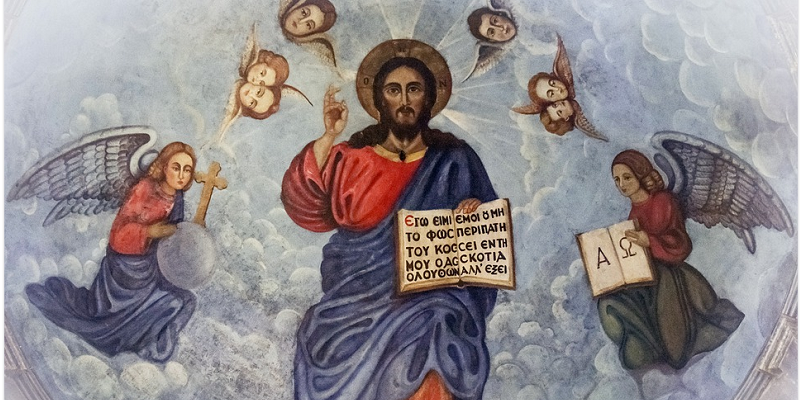
Christ the one mediator, the Church necessary for salvation.
Your Eminences; venerable brothers in the episcopate and in the priesthood; beloved faithful collaborators:
1. I am very pleased to meet with you at the close of your plenary assembly. I wish to express my gratitude and appreciation for the daily work your dicastery carries out in the service of the Church for the good of souls, in harmony with the Successor of Peter, the first guardian and defender of the sacred deposit of faith.
I thank Cardinal Joseph Ratzinger for the sentiments which, in the name of all, he has expressed to me in his words of greeting and for his presentation of the themes that have been the object of careful reflection during your assembly, devoted in particular to deepening the problem of the uniqueness of Christ and to the revision of the norms concerning the so-called “delicta graviora”.
Uniqueness and universality of the Church
 2. I would now like to refer briefly to the principal themes discussed in your assembly. Your dicastery has considered it fitting and necessary to study the themes of the uniqueness and salvific universality of Christ and of the Church. The reaffirmation of the Magisterium’s doctrine on these themes is made in order to let the world see “the light of the Gospel of the glory of Christ” (2 Cor 4:4) and to refute certain errors and serious ambiguities that have arisen and are spreading in various circles.
In fact, in recent years there has arisen in theological and ecclesial settings a mentality that tends to relativize the revelation of Christ and his one and universal mediation with regard to salvation, as well as to weaken the necessity of the Church of Christ as the universal sacrament of salvation.
To remedy this relativistic mentality, it is necessary first of all to reaffirm the definitive and complete character of Christ’s revelation. The Second Vatican Council, faithful to the word of God, teaches: “The deepest truth about God and the salvation of man shines out for our sake in Christ, who is both the mediator and the fullness of all revelation” (Dei Verbum, 2).
For this reason, in the encyclical letter Redemptoris missio I once again proposed to the Church the task of proclaiming the Gospel as the fullness of the truth: “In this definitive Word of his revelation, God has made himself known in the fullest possible way; he has revealed to mankind who he is. This definitive self-revelation of God is the fundamental reason why the Church is missionary by her very nature. She cannot do otherwise than proclaim the Gospel, that is, the fullness of the truth which God has enabled us to know about himself” (n. 5).
Jesus Christ is the full and complete revelation
 3. Thus the thesis concerning the limited character of Christ’s revelation, which would find a complement in the other religions, is contrary to the faith of the Church. The underlying reason for this assertion claims to be founded on the fact that the truth about God could not be grasped and manifested in its totality and integrity by any historical religion and, consequently, neither by Christianity nor even by Jesus Christ. However, this position contradicts the affirmations of faith according to which in Jesus Christ there is the full and complete revelation of God’s saving mystery, while the understanding of the infinite mystery must always be evaluated and deepened in the light of the Spirit of truth who, in the time of the Church, guides us “into all the truth” (Jn 16:13).
The words, the works and the whole historical event of Jesus, although limited as human realities, have as their source the divine Person of the incarnate Word and therefore possess the character of definitiveness and integrity in the revelation of his saving ways and of the divine mystery itself. The truth about God is not abolished or reduced by the fact that it is expressed in human language. On the contrary, it remains unique, full and complete, because the one who speaks and acts is the incarnate Son of God.
Avoiding indifferentism and relativism
4. Connected with the uniqueness of Christ’s salvific mediation is the uniqueness of the Church which he founded. Indeed, the Lord Jesus constituted his Church as a saving reality: as his Body, through which he himself acts in the history of salvation. As there is only one Christ, so there exists only one Body of his: “one holy catholic and apostolic Church” (cf. Symbol of faith, DS 48). The Second Vatican Council states in this regard: “This holy Council, basing itself on Sacred Scripture and Tradition, teaches that the Church, now sojourning on earth as an exile, is necessary for salvation” (Lumen gentium, 14).
Consequently, it is erroneous to consider the Church as one way of salvation alongside those constituted by other religions, which would be complementary to the Church, moving together with her toward the eschatological kingdom of God. Thus a certain mentality of indifferentism must be excluded, one “characterized by a religious relativism which leads to the belief that ‘one religion is as good as another’” (Redemptoris missio, 36).
It is true that, as the Second Vatican Council recalled, non-Christians can “attain” eternal salvation “with the help of grace” if they “seek God with a sincere heart” (Lumen gentium, 16). But in their sincere search for the truth of God they are in fact “ordered” to Christ and to his Body, the Church (cf. ibid.). In any case, they are in a deficient situation when compared with those who, in the Church, possess the fullness of the means of salvation. Thus, understandably, following the Lord’s command (cf. Mt 28:19-20) and as a requirement of love for all people, the Church “proclaims and is bound to proclaim without fail Christ, who is ‘the way, and the truth, and the life’ (Jn 14:6), in whom people find the fullness of religious life and in whom God has reconciled all things to himself” (Nostra aetate, 2).
Continuing on the path of ecumenism
5. In the encyclical letter Ut unum sint I solemnly confirmed the Catholic Church’s commitment to the “restoration of unity”, in line with the great cause of ecumenism so strongly promoted by the Second Vatican Council. You, together with the Pontifical Council for Promoting Christian Unity, have contributed to the achievement of the agreement on fundamental truths of the doctrine of justification, signed on 31 October of last year in Augsburg. Trusting in the help of divine grace, let us continue along this path, even though difficulties are not lacking. However, our ardent desire to attain one day full communion with the other Churches and ecclesial Communities must not obscure the truth that the Church of Christ is not a utopia to be remade by putting together the fragments that now exist, by our human powers. The decree Unitatis redintegratio spoke explicitly of the unity “which we believe subsists in the Catholic Church as something she can never lose, and we hope that it will continue to increase until the end of time” (n. 4).
Beloved brothers, through the service that your Congregation offers to the Successor of Peter and to the Magisterium of the Church, you help ensure that the revelation of Christ remains in history “the true lodestar” that guides all humanity (cf. Fides et ratio, 15).
As I congratulate you on this important and valuable ministry, I encourage you to continue with renewed vigor in the service of saving truth: Christ yesterday, today and forever.
With these sentiments, I cordially impart to all of you, as a pledge of affection and gratitude, a special Apostolic Blessing.
(Translation from «L’Osservatore Romano»)
Address of His Holiness John Paul II to the Congregation for the Doctrine of the Faith, 28/01/2000
