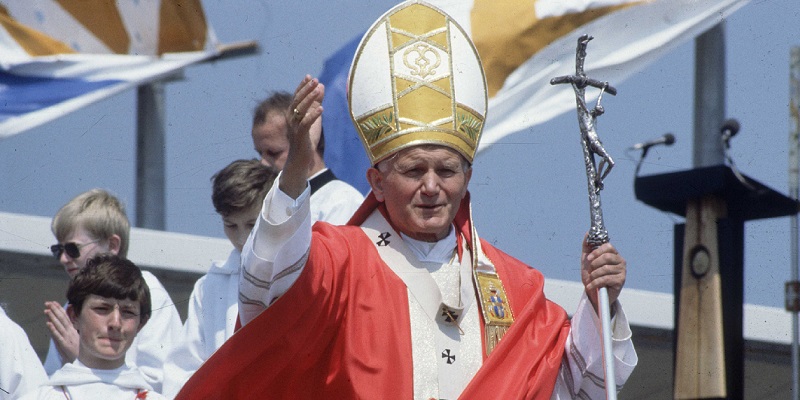
A group of prominent historians and theologians analyzed the papal request for forgiveness, questioning the exaggerated media promotion of a gesture that is not unprecedented in the Holy Father and that, they said, should encourage similar attitudes in numerous groups.
In recent days, the world press has devoted entire pages to drawing attention to the Day of Forgiveness as the “expected” mea culpa of the Catholic Church for the errors of her children, without recalling that when it comes to asking forgiveness, Pope John Paul II has always been in the lead.
According to the experts interviewed by Catholic News Service, in his 21 years of pontificate John Paul II has apologized to different groups — including indigenous peoples, Christian churches and women — on more than one hundred occasions. The expressions of regret were always unconditional, and the Church never expected similar requests for forgiveness in return.
“The Church’s ‘mea culpa’ is absolute. Nobody is asking for an exchange, but it seems to me that it serves as a challenge to others who should make a similar examination of conscience,” explained the Italian historian Franco Cardini.
John Paul II himself pointed out in 1997 that “the Church and the Pope are the ones who always ask forgiveness, while others remain silent.” “Perhaps that is the way things have to be,” he said.
Indeed, tomorrow, Sunday, the Pope will ask forgiveness for past errors of Catholics at a special Mass, after publishing an extensive document entitled “Memory and Reconciliation,” written by the International Theological Commission.
Thus, while the media have focused on questioning whether the Holy See has been specific enough in its request for forgiveness, a quick look at what the pope has done in recent years reveals many specific points:
– On the Inquisition: in 1982 John Paul II referred to “errors of excess,” and on several occasions he condemned the use of “intolerance and even violence in the service of truth” by the inquisitors.
– On the Holocaust: in 1997 he expressed his sorrow for the dormant consciences of some Christians during Nazism and the inadequate “spiritual resistance” of other groups in the face of the persecution of the Jews. In 1998 the Vatican published a document on the Shoah, the Hebrew word used for the Holocaust, expressing regret for the same moral problems.
– On the Crusades: in 1995 he characterized the armed expeditions as errors.
He praised the zeal of the medieval crusaders but stated that now we should “give thanks to God” for dialogue and not resort to weapons.
– On native peoples: in 1985 he apologized to Africans for the way they had been treated in recent centuries. In the United States in 1984 he asked forgiveness for the excesses of missionaries, and in 1987 he acknowledged that Christians were among those who destroyed the way of life of the Indians.
– On ecumenism: the Pope has spoken on several occasions about mutual forgiveness among separated Christian churches. In 1995 he apologized “in the name of all Catholics, for the errors committed against non-Catholics throughout history.”
– On women: in a 1995 letter that briefly examined the historical discrimination against women, the Pope stated that among those responsible were “not a few members of the Church,” something he deeply regretted.
The Pope has made similar statements on slavery and racism, closeness to dictatorial political power, and scientific theories such as those of Galileo, who was condemned for saying that the Earth revolved around the sun.
With these and other “apologies” in John Paul II’s record, some Church leaders are seeking a certain company — in some sense — hoping that the request for forgiveness will spread to others in the spirit of the Jubilee.
Father Bruno Forte, one of the theologians who collaborated in drafting “Memory and Reconciliation,” explained that the document touches a nerve when it observes that the acknowledgment of faults has for a long time been unilateral.
For his part, the historian Cardini said it would be gratifying, for example, to hear expressions of regret from the Queen of England for the treatment given to Catholics in her country, not to mention the numerous persecutions against Catholic leaders in France, Spain and Mexico.
“An examination of conscience, or to use a less Catholic term, a historical reflection could be carried out by the Protestant churches that had their own problems with Catholics, or by the Russian Orthodox leaders who in the past supported the repressive actions of the tsarist government,” Cardini said.
The historian adds that “perhaps Muslims should make their own reflection on the numerous holy wars proclaimed in the past” and indicates that today China could begin to work on its apology for the current treatment it gives to the Catholic Church.
Source: VATICAN, Mar. 11 (ACI)
