
Some texts of the Magisterium on the apostolic origin of the bishops
Introductory note: The whole Church is the Body of Christ, the People of God, the temple of the Holy Spirit. And all the members of the Church share the same fundamental dignity of the children of God, have Christ for their Head, and have as their end the spread of the Kingdom of God. But not all have the same functions within the community, nor the same responsibilities. And this is so not merely because of the necessity inherent in every well-ordered community, but by the express will of the Lord, who founded the Church upon the apostolic ministry united in the rock of Peter and perpetuated until the end of time in his successors. They are the ones who received from Christ the mission of founding and perpetuating the Church, preaching the word of God, of which they were made authentic custodians; conferring the sacraments of the new Covenant; and organizing the Church with authority received from Christ and not by delegation from the community. This means that the sacramental structure of the divine-human Church of God has received from Christ, through the apostolic succession, the charge of teaching, of sanctifying, and of governing the Church. The faith of the Church affirms that these are the bishops. It likewise affirms that the episcopate has its principle of unity in the successor of Peter, the Bishop of Rome. We here transcribe some texts of the Magisterium concerning the authority of the bishops as successors of the Apostles. It should be noted that doubts on this subject arise in the Church almost exclusively from the Reformation of the “Protestants” onward, that is, some fifteen centuries after Christ. For this reason the pronouncements of the Magisterium before the Reformation are indirect.
1.- Letter of Pope Clement of Rome to the Corinthians (around the year 97)[1]

“The Apostles were appointed to preach the Gospel to us by the Lord Jesus Christ; Jesus Christ was sent by God. Christ, therefore, was sent by God, and the Apostles by Christ; and both these things were done in due order, according to the will of God. Having therefore received their orders, and being fully assured by the resurrection of the Lord Jesus Christ, and confirmed in faith by the word of God, they went forth with the full assurance imparted to them by the Holy Spirit, preaching the good news that the Kingdom of God was at hand. And so, preaching through countries and cities, they appointed — after testing them in the Spirit — their firstfruits to be bishops and deacons of those who should afterwards believe. […] And our Apostles also knew, through our Lord Jesus Christ, that there would be strife over the office of the episcopate. For this reason, having received perfect foreknowledge, they appointed the aforesaid, and afterwards laid down the rule that, when these should fall asleep, other approved men should succeed to their ministry. Those, therefore, who were appointed by them, or afterwards by other eminent men, with the consent of the whole Church, and who have ministered blamelessly to the flock of Christ in humility, peaceably and disinterestedly, and who for a long time have obtained the approval of all — these men we consider are not justly deposed from their ministry.”.[2]
2.- Letter of Pope Julius I to the Antiochenes (year 341)[3]

“And if truly, as you say, there was some fault against them, the trial ought to have been conducted according to the norms of the Church and not in that manner. It ought to have been written to all of us, so that what was just might be determined by all. For it was bishops who were suffering, and not ordinary churches that were being wronged, but those which the Apostles themselves personally governed. Why, above all in the case of Alexandria, was nothing written to us? Are you perhaps unaware that this is the custom — that first it be written to us, and from here what is just be determined? If, then, any suspicion fell upon the bishop there, it ought to have been written to the bishop here (Rome).”[4].
3.- Synod of Sens (under Pope Innocent II, year 1140–1141) against the errors of Peter Abelard
Among the list of errors condemned by the Synod, the following is read:
“The power of binding and loosing was given only to the Apostles, not to their successors.”[5]
4.- Council of Florence, Bull on the union with the Armenians (year 1439)
“The ordinary minister — of confirmation — is the bishop. And although a simple priest may administer the other anointings, this one must not be conferred except by the bishop, because only of the Apostles — whose place the bishops hold — do we read that they gave the Holy Spirit by the imposition of hands, as the passage of the Acts of the Apostles makes clear” (8:14–17)..[6]
5.- Council of Trent, Session XXIII (year 1563)

“And forasmuch as in the sacrament of Order, as also in Baptism and Confirmation, a character is imprinted which can neither be effaced nor taken away, the holy Synod with reason condemns the opinion of those who assert that the priests of the New Testament have only a temporal power, or one limited to a certain time, and that those who have once been rightly ordained can again become laymen, if only they do not exercise the ministry of the word. For whoever should affirm that all Christians indiscriminately are priests of the New Testament, or that they are all mutually endowed with an equal spiritual power, would seem to do nothing else than confound the ecclesiastical hierarchy, which is as an army set in array; as if, contrary to the doctrine of blessed Paul, all were Apostles, all Prophets, all Evangelists, all Pastors, all Doctors. Wherefore the holy Synod declares that, besides the other ecclesiastical degrees, the bishops, who have succeeded to the place of the Apostles, principally belong to this hierarchical order; that they are, as the same Apostle says, placed by the Holy Spirit to rule the Church of God (Acts 20:28); that they are superior to priests; that they administer the sacrament of Confirmation; that they ordain the ministers of the Church; and that they can perform very many other things over which the other ministers of an inferior order have no power. Furthermore, the holy Synod teaches that, in the ordination of Bishops, priests, and the other orders, neither the consent, nor the vocation, nor the authority of the people, nor of any secular power or magistrate, is so required that without it the ordination be invalid; rather it decrees that all those who, being called and instituted only by the people, or by the secular power or magistrate, ascend to exercise these ministries, and those who by their own rashness take these offices upon themselves, are not to be regarded as ministers of the Church, but as thieves and robbers who have not entered by the door. These are the points which it has seemed good to the sacred Synod to teach the faithful of Christ in general concerning the sacrament of Order, that, all following this rule of faith with the help of Jesus Christ, they may, amid the darkness of so many errors, easily recognize the Catholic truths and hold fast to them.”
6. First Vatican Council, Session IV (year 1870)
“So far, however, is this power of the Supreme Pontiff from being any prejudice to that ordinary and immediate power of episcopal jurisdiction, by which the bishops, who, set by the Holy Spirit (cf. Acts 20:28), have succeeded to the place of the Apostles, feed and govern, as true pastors, each the particular flock assigned to him…”[7]
7. Second Vatican Council, Lumen Gentium (1964), Nos. 19–27.

(We include only the notes that are of particular importance; for all the notes of the text, consult a printed edition. The subtitles are not part of the document; they are introduced claritatis causa.)
The institution of the Apostles
19. The Lord Jesus, after praying to the Father, calling to Himself those whom He desired, appointed twelve to be with Him, and whom He would send to preach the Kingdom of God; and these apostles He formed after the manner of a college or a stable group, over which He placed Peter chosen from among them. He sent them first to the children of Israel and then to all nations, so that as sharers in His power they might make all peoples His disciples, and sanctify and govern them, and thus spread His Church, and by ministering to it under the guidance of the Lord, direct it all days even to the consummation of the world. And in this mission they were fully confirmed on the day of Pentecost in accordance with the Lord’s promise: “You shall receive power when the Holy Spirit comes upon you, and you shall be witnesses for me in Jerusalem, and in all Judea and in Samaria, and even to the very ends of the earth.” And the Apostles, by preaching the Gospel everywhere, and it being accepted by their hearers under the influence of the Holy Spirit, gather together the universal Church, which the Lord established on the Apostles and built upon blessed Peter, their chief, Christ Jesus Himself being the supreme cornerstone.
The Bishops, successors of the Apostles
20. That divine mission, entrusted by Christ to the Apostles, will last until the end of the world (cf. Mt 28:20), since the Gospel they are to teach is for all time the source of all life for the Church. And for this reason the Apostles, appointed as rulers in this hierarchically organized society, took care to appoint successors.
For they not only had various helpers in their ministry[8], but also, in order that the mission assigned to them might continue after their death, the Apostles passed on to their immediate cooperators, as it were, in the form of a testament, the duty of confirming and finishing the work begun by themselves[9], recommending to them that they attend to the whole flock in which the Holy Spirit placed them to shepherd the Church of God (cf. Acts 20:28). They therefore appointed such men, and gave them the order that, when they should have died, other approved men would take up their ministry[10]. Among those various ministries which, according to the testimony of tradition, were exercised in the Church from the earliest times, the chief place belongs to the office of those who, appointed to the episcopate, by a succession running from the beginning[11], are passers-on of the apostolic seed[12]. Thus, as St. Irenaeus testifies, through those who were appointed bishops by the Apostles, and through their successors down in our own time, the apostolic tradition is manifested[13] and preserved[14] throughout the whole world.
Bishops, therefore, together with the priests and deacons, have taken up the service of the community[15], presiding in place of God over the flock, whose shepherds they are[16], as teachers for doctrine, priests for sacred worship, and ministers endowed with authority for governing[17]. And just as the office granted individually to Peter, the first among the Apostles, is permanent and is to be transmitted to his successors, so also the Apostles’ office of nurturing the Church is permanent, and is to be exercised without interruption by the sacred order of bishops[18]. Therefore, the Sacred Council teaches that bishops by divine institution have succeeded to the place of the Apostles[19], as shepherds of the Church, and he who hears them, hears Christ, and he who rejects them, rejects Christ and Him who sent Christ (cf. Lk 10:16)[20].
The episcopate as a sacrament
21. In the bishops, therefore, for whom priests are assistants, Our Lord Jesus Christ, the Supreme High Priest, is present in the midst of those who believe. For sitting at the right hand of God the Father, He is not absent from the gathering of His high priests, but above all through their excellent service He is preaching the word of God to all nations, and constantly administering the sacraments of faith to those who believe, and by their paternal functioning (cf. 1 Cor 4:15) He incorporates new members in His Body by a heavenly regeneration; and finally by their wisdom and prudence He directs and guides the People of the New Testament in their pilgrimage toward eternal happiness. These pastors, chosen to shepherd the Lord’s flock, are the servants of Christ and the stewards of the mysteries of God (cf. 1 Cor 4:1), to whom has been entrusted the bearing of witness to the Gospel of the grace of God (cf. Rom 15:16; Acts 20:24), and the ministration of the Spirit and of justice in glory (cf. 2 Cor 3:8–9).
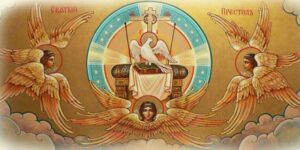
For the discharging of such great duties, the Apostles were enriched by Christ with a special outpouring of the Holy Spirit coming upon them (cf. Acts 1:8; 2:4; Jn 20:22–23), and they in turn passed on this spiritual gift to their helpers by the imposition of hands (cf. 1 Tim 4:14; 2 Tim 1:6–7), and it has been transmitted down to us in episcopal consecration. And the Sacred Council teaches that by episcopal consecration the fullness of the sacrament of Orders is conferred, that fullness which both in the Church’s liturgical practice and in the language of the holy Fathers of the Church is called the high priesthood, the supreme power of the sacred ministry[21]. But episcopal consecration, together with the office of sanctifying, also confers the office of teaching and of governing, which, however, of their very nature, can be exercised only in hierarchical communion with the head and the members of the college. For from the tradition, which is expressed especially in liturgical rites and in the practice of both the Church of the East and of the West, it is clear that, by means of the imposition of hands, the grace of the Holy Spirit is conferred[22] and the sacred character so impressed, that bishops in an eminent and visible way sustain the roles of Christ Himself as Teacher, Shepherd and High Priest, and that they act in His person[23]. It pertains to the bishops to admit newly elected members into the episcopal body by means of the sacrament of Orders.
The College of Bishops and its Head
22. Just as, by the Lord’s disposition, St. Peter and the other Apostles constitute one apostolic college, so in a similar way the Roman Pontiff, the successor of Peter, and the bishops, the successors of the Apostles, are joined together. Indeed, the very ancient practice whereby bishops duly established in all parts of the world were in communion with one another and with the Bishop of Rome in a bond of unity, charity and peace[24], and also the councils[25], assembled together to settle in common the more important matters[26], the opinion of the many having been prudently considered[27], are an indication of the collegiate character and aspect of the episcopal order; and the ecumenical councils held in the course of centuries are also a manifest proof of that same character. And it is intimated also in the practice, introduced in ancient times, of summoning several bishops to take part in the elevation of the newly elected to the ministry of the high priesthood. Hence, one is constituted a member of the episcopal body in virtue of sacramental consecration and hierarchical communion with the head and members of the college.
The college or body of bishops has no authority unless it is understood together with the Roman Pontiff, the successor of Peter, as its head, the primatial power of the latter over all, both pastors and faithful, remaining whole and intact. For the Roman Pontiff has, in virtue of his office as Vicar of Christ and pastor of the whole Church, full, supreme and universal power over the Church, which he can always freely exercise. On the other hand, the order of bishops, which succeeds to the college of the Apostles in the magisterium and in pastoral governance, and indeed in which the apostolic body continually endures, together with its head the Roman Pontiff, and never without this head, is also the subject of supreme and full power over the universal Church, a power which can be exercised only with the consent of the Roman Pontiff. For the Lord placed Simon alone as the rock and the bearer of the keys of the Church (Mt 16:18–19), and made him shepherd of His whole flock (cf. Jn 21:15ff); but the office of binding and loosing which was given to Peter was also assuredly granted to the college of the Apostles joined with its head. This college, insofar as it is composed of many, expresses the variety and universality of the People of God; but insofar as it is assembled under one head, it expresses the unity of the flock of Christ. In it, the bishops, faithfully recognizing the primacy and pre-eminence of their head, exercise their own authority for the good not only of their own faithful, but of the whole Church, the Holy Spirit unceasingly strengthening its organic structure and harmony. The supreme power over the universal Church, which this college possesses, is exercised in a solemn way in an ecumenical council. There can be no ecumenical council which is not confirmed, or at least accepted as such, by the successor of Peter; and it is the prerogative of the Roman Pontiff to convoke these councils, to preside over them, and to confirm them. This same collegiate power can be exercised together with the pope by the bishops dispersed throughout the world, provided that the head of the college calls them to collegiate action, or at least approves of or freely accepts the united action of the dispersed bishops, so that it is thereby made a true collegiate act.
Relations of the Bishops within the Church
23. This collegial union is apparent also in the mutual relations of the individual bishops with particular churches and with the universal Church. The Roman Pontiff, as the successor of Peter, is the perpetual and visible principle and foundation of unity both of the bishops and of the multitude of the faithful. The individual bishops, in the same way, are the visible principle and foundation of unity in their own particular churches[28], fashioned after the model of the universal Church; and from all these particular churches there comes into being the one and only Catholic Church[29]. For this reason each bishop represents his own church, while all of them together with the Pope represent the whole Church in the bond of peace, love and unity.
The individual bishops, who are placed in charge of particular churches, exercise their pastoral government over the portion of the People of God committed to their care, and not over other churches nor over the universal Church. But each of them, as a member of the episcopal college and legitimate successor of the Apostles, is obliged by Christ’s institution and command to have that solicitude for the whole Church which, though it is not exercised by an act of jurisdiction, nevertheless contributes greatly to the advantage of the universal Church. For all the bishops must promote and safeguard the unity of the faith and the discipline common to the whole Church, instruct the faithful in love for the whole Mystical Body of Christ, especially for its poor and suffering members and for those who are persecuted for justice’s sake (cf. Mt 5:10), and finally promote every activity that is common to the whole Church, especially that the faith may grow and the light of full truth may appear to all men. Moreover, it is clear that, by governing well their own churches as portions of the universal Church, they contribute greatly to the good of the whole Mystical Body, which is also the body of the churches[30].
The task of proclaiming the Gospel throughout the whole world pertains to the body of pastors, since to all of them in common Christ gave His command, thereby imposing upon them a common duty, as Pope Celestine in his time explained to the Fathers of the Council of Ephesus. Therefore, all the bishops, insofar as the discharge of their own office permits, are obliged to collaborate among themselves and with the successor of Peter, upon whom in a special way has been imposed the excellent office of spreading the Christian religion. With all their strength, therefore, they must supply to the missions both workers for the harvest and spiritual and material aid, both directly by themselves and by arousing the ardent cooperation of the faithful. And finally, following the venerable example of antiquity, the bishops should gladly extend their fraternal aid to other churches, especially to neighboring and more needy churches, within this universal fellowship of charity.
By divine Providence it has come about that various churches, established in various regions by the Apostles and their successors, have in the course of time coalesced into several groups, organically united, which, preserving the unity of faith and the unique divine constitution of the universal Church, enjoy their own discipline, their own liturgical rites, and their own theological and spiritual heritage. Among these, notably the ancient patriarchal churches, as mothers in the faith, begot others as daughter churches, with which they have remained united down to our own time by special bonds of charity, both in their sacramental life and in their mutual respect for their rights and duties. This variety of local churches, directed toward one common goal, splendidly manifests the undivided catholicity of the Church. In like manner the Episcopal Conferences today can render a manifold and fruitful service, so that the sense of collegiality may find a concrete application.
The ministry of the Bishops
24. Bishops, as successors of the Apostles, receive from the Lord, to whom was given all power in heaven and on earth, the mission to teach all nations and to preach the Gospel to every creature, so that all men may attain to salvation through faith, baptism and the fulfilment of the commandments (cf. Mt 28:18; Mk 16:15–16; Acts 26:17ff). To fulfil this mission, Christ the Lord promised the Holy Spirit to His Apostles, and on the day of Pentecost He in fact sent the Spirit from heaven, so that, strengthened by His power, they might be His witnesses before the nations and peoples and kings even to the ends of the earth (cf. Acts 1:8; 2:1ff; 9:15). And that charge which the Lord committed to the shepherds of His people is a true service, which in Sacred Scripture is significantly called “diakonia” or ministry (cf. Acts 1:17,25; 21:19; Rom 11:13; 1 Tim 1:12).
The canonical mission of bishops can come about by legitimate customs that have not been revoked by the supreme and universal authority of the Church, or by laws made or recognized by that same authority, or directly through the successor of Peter himself; and no bishop can be raised to such an office against his will, that is, when he refuses apostolic communion.
The teaching office of the Bishops
25. Among the principal duties of bishops the preaching of the Gospel occupies an eminent place. For bishops are preachers of the faith, who lead new disciples to Christ, and they are authentic teachers, that is, teachers endowed with the authority of Christ, who preach to the people committed to them the faith they must believe and put into practice, and by the light of the Holy Spirit illustrate that faith, bringing forth from the treasury of Revelation new things and old (cf. Mt 13:52), making it bear fruit and vigilantly warding off any errors that threaten their flock (cf. 2 Tim 4:1–4). Bishops, teaching in communion with the Roman Pontiff, are to be respected by all as witnesses to divine and Catholic truth; and the faithful, for their part, are obliged to accept and to adhere with a religious submission of mind to their bishop’s opinion on matters of faith and morals when he speaks in the name of Christ. This religious submission of will and of mind must be shown in a special way to the authentic magisterium of the Roman Pontiff, even when he is not speaking ex cathedra; that is, it must be shown in such a way that his supreme magisterium is acknowledged with reverence, and the judgments made by him are sincerely adhered to, according to his manifest mind and will, which may be known chiefly either from the character of the documents, or from his frequent repetition of the same doctrine, or from the manner of his speaking.
Although the individual bishops do not enjoy the prerogative of infallibility, they nevertheless proclaim Christ’s doctrine infallibly whenever, even though dispersed throughout the world, but still maintaining the bond of communion among themselves and with the successor of Peter, and authentically teaching matters of faith and morals, they are in agreement on one position as definitively to be held. This is even more clearly verified when, gathered together in an ecumenical council, they are teachers and judges of faith and morals for the universal Church, whose definitions must be adhered to with the submission of faith. And this infallibility with which the Divine Redeemer willed His Church to be endowed in defining doctrine of faith and morals extends as far as extends the deposit of divine Revelation, which must be religiously guarded and faithfully expounded.
And this is the infallibility which the Roman Pontiff, the head of the college of bishops, enjoys in virtue of his office, when, as the supreme shepherd and teacher of all the faithful — who confirms his brethren in their faith (cf. Lk 22:32) — he proclaims by a definitive act a doctrine of faith or morals. And therefore his definitions, of themselves, and not from the consent of the Church, are justly styled irreformable, since they are pronounced with the assistance of the Holy Spirit, promised to him in blessed Peter, and therefore they need no approval of others, nor do they admit an appeal to any other tribunal. For then the Roman Pontiff is not pronouncing judgment as a private person, but as the supreme teacher of the universal Church, in whom the charism of infallibility of the Church itself is individually present, he is expounding or defending a doctrine of Catholic faith. The infallibility promised to the Church resides also in the body of bishops when that body exercises the supreme magisterium with the successor of Peter. To these definitions the assent of the Church can never be wanting, on account of the activity of that same Holy Spirit, by which the whole flock of Christ is preserved and progresses in unity of faith.
But when either the Roman Pontiff or the Body of Bishops together with him defines a doctrine, they pronounce it in accordance with Revelation itself, which all are obliged to abide by and to be in conformity with, that is, the Revelation which, whether in written form or handed down through the legitimate succession of bishops, and especially through the care of the Roman Pontiff himself, is transmitted in its entirety; and which, under the guiding light of the Spirit of truth, is religiously preserved and faithfully expounded in the Church. The Roman Pontiff and the bishops, in view of their office and the importance of the matter, by fitting means diligently strive to inquire properly into that revelation and to give apt expression to its contents; but a new public revelation they do not accept as pertaining to the divine deposit of faith.
The office of the Bishops to sanctify
26. A bishop, marked with the fullness of the sacrament of Orders, is “the steward of the grace of the supreme priesthood,” especially in the Eucharist, which he offers or causes to be offered[31], and by which the Church continually lives and grows. This Church of Christ is truly present in all legitimate local congregations of the faithful which, united with their pastors, are themselves also called churches in the New Testament[32]. For in their locality these are the new People called by God, in the Holy Spirit and in much fullness (cf. 1 Thess 1:5). In them the faithful are gathered together by the preaching of the Gospel of Christ, and the mystery of the Lord’s Supper is celebrated “so that by the body and blood of the Lord the whole brotherhood may be joined together.” In every community of the altar, under the sacred ministry of the bishop[33], there is exhibited the symbol of that charity and “unity of the mystical Body, without which there can be no salvation”[34]. In these communities, though frequently small and poor, or living in the diaspora, Christ is present, by whose power the one, holy, catholic and apostolic Church is united[35]. For “the partaking of the body and blood of Christ does nothing other than make us pass over into that which we receive”[36].
Now every legitimate celebration of the Eucharist is regulated by the bishop, to whom is committed the office of offering to the Divine Majesty the worship of Christian religion and of administering it in accordance with the Lord’s commandments and the Church’s laws, which he further determines by his own judgment, adapting them to his diocese.
Thus the bishops, by praying and laboring for the people, dispense in many ways and in great abundance from the fullness of Christ’s holiness. By the ministry of the word they communicate God’s power to those who believe unto salvation (cf. Rom 1:16), and through the sacraments, the sound and fruitful administration of which they regulate by their authority, they sanctify the faithful[37]. They regulate the conferring of baptism, by which a sharing in the kingly priesthood of Christ is granted. They are the original ministers of confirmation, the dispensers of sacred Orders, and the moderators of penitential discipline; and they earnestly exhort and instruct their people to carry out with faith and reverence their part in the liturgy and especially in the holy sacrifice of the Mass. And lastly, by the example of their way of life they must build up those over whom they preside, keeping their conduct free from all evil and, with God’s help, transforming it into good as far as they are able, so that together with the flock committed to them they may attain to eternal life.
The office of the Bishops to govern
27. Bishops govern, as vicars and ambassadors of Christ, the particular churches entrusted to them, by their counsel, exhortations and example, but also by their authority and sacred power, which indeed they use only for the edification of their flock in truth and holiness, remembering that he who is greater must become as the lesser, and he who is the chief as the servant (cf. Lk 22:26–27). This power, which they personally exercise in Christ’s name, is proper, ordinary and immediate, although its exercise is ultimately regulated by the supreme authority, and can, with a view to the advantage of the Church or of the faithful, be circumscribed within certain limits. In virtue of this power, bishops have the sacred right and the duty before God of making laws for their subjects, of judging them, and of regulating everything that pertains to worship and the ordering of the apostolate.
The pastoral office, that is, the habitual and daily care of their sheep, is entrusted to them completely; nor are they to be regarded as vicars of the Roman Pontiff, for they exercise a power that is proper to them, and are most truly the heads of the people whom they govern. Their power, therefore, is not destroyed by the supreme and universal power, but on the contrary it is affirmed, strengthened and vindicated by it, since the Holy Spirit unfailingly preserves the form of government established by Christ the Lord in His Church.
A bishop, sent by the Father of the family to govern His household, must keep before his eyes the example of the Good Shepherd, who came not to be served but to serve (cf. Mt 20:28; Mk 10:45), and to lay down his life for his sheep (cf. Jn 10:11). Being taken from among men and himself beset with weakness, he is able to have compassion on the ignorant and erring (cf. Heb 5:1–2). Let him not refuse to listen to his subjects, whom he embraces as his true sons and exhorts to cooperate readily with him. Conscious that he must render an account to God for their souls (cf. Heb 13:17), let him take care of them by prayer, preaching, and all the works of charity, and also of those who are not yet of the one flock, whom he is to consider as commended to him in the Lord. Since, like Paul the Apostle, he is a debtor to all men, let him be ready to preach the Gospel to all (cf. Rom 1:14–15), and to urge his faithful to apostolic and missionary activity. The faithful, for their part, must be united to their bishop as the Church is to Christ, and as Christ is to the Father, so that all things may be in harmony through unity[38] and may abound to the glory of God (cf. 2 Cor 4:15).
8.- Catechism of the Catholic Church (year 1992), Nos. 857–865
The Church is apostolic

857 The Church is apostolic because she is founded on the apostles, and this in a threefold sense:
— she was and remains built on “the foundation of the Apostles” (Eph 2:20; cf. Rev 21:14), the witnesses chosen and sent on mission by Christ himself (cf. Mt 28:16–20; Acts 1:8; 1 Cor 9:1; 15:7–8; Gal 1:1; etc.);
— with the help of the Spirit dwelling in her, the Church keeps and hands on the teaching (cf. Acts 2:42), the “good deposit,” the salutary words she has heard from the apostles (cf. 2 Tim 1:13–14);
— she continues to be taught, sanctified, and guided by the apostles until Christ’s return, through their successors in pastoral office: the college of bishops, “assisted by priests, in union with the successor of Peter, the Church’s supreme pastor” (AG 5):
You are the eternal Shepherd who never leaves his flock untended. Through the apostles you watch over us and protect us always. You made them shepherds of the flock to share in the work of your Son… (Roman Missal, Preface of the Apostles I).
The Apostles’ mission
858 Jesus is the Father’s Emissary. From the beginning of his ministry, he “called to him those whom he desired; … And he appointed twelve, whom also he named apostles, to be with him, and to be sent out to preach” (Mk 3:13–14). From then on, they would also be his “emissaries” (Greek apostoloi). In them, Christ continues his own mission: “As the Father has sent me, even so I send you” (Jn 20:21; cf. 13:20; 17:18). The apostles’ ministry is the continuation of his mission; Jesus said to the Twelve: “he who receives you receives me” (Mt 10:40; cf. Lk 10:16).
859 Jesus unites them to the mission he received from the Father. As “the Son can do nothing of his own accord” (Jn 5:19,30), but receives everything from the Father who sent him, so those whom Jesus sends can do nothing apart from him (cf. Jn 15:5), from whom they received both the mandate for their mission and the power to carry it out. Christ’s apostles knew that they were qualified by God as “ministers of a new covenant” (2 Cor 3:6), “servants of God” (2 Cor 6:4), “ambassadors for Christ” (2 Cor 5:20), “servants of Christ and stewards of the mysteries of God” (1 Cor 4:1).
860 In the office of the apostles there is one aspect that cannot be transmitted: to be the chosen witnesses of the Lord’s Resurrection and so the foundation stones of the Church. But their office also has a permanent aspect. Christ promised to remain with them until the end of time (cf. Mt 28:20). “Since the Gospel they are to hand on is for the Church the principle of all its life for all time, the apostles took care to appoint successors” (LG 20).
The bishops — successors of the apostles
861 “In order that the mission entrusted to them might be continued after their death, [the apostles] consigned, by will and testament, as it were, to their immediate collaborators the duty of completing and consolidating the work they had begun, urging them to tend to the whole flock, in which the Holy Spirit had appointed them to shepherd the Church of God. They accordingly designated such men and then made the ruling that likewise on their death other proven men should take over their ministry” (LG 20).
862 “Just as the office which the Lord confided to Peter alone, as first of the apostles, destined to be transmitted to his successors, is a permanent one, so also endures the office, which the apostles received, of shepherding the Church, a charge destined to be exercised without interruption by the sacred order of bishops.” Hence the Church teaches that “the bishops have by divine institution taken the place of the apostles as pastors of the Church, in such wise that whoever listens to them is listening to Christ and whoever despises them despises Christ and him who sent Christ” (LG 20).
The apostolate
863 The whole Church is apostolic, in that she remains, through the successors of St. Peter and the other apostles, in communion of faith and life with her origin: and in that she is “sent out” into the whole world. All members of the Church share in this mission, though in various ways. “The Christian vocation is, of its nature, a vocation to the apostolate as well.” Indeed, we call an apostolate “every activity of the Mystical Body” that aims “to spread the Kingdom of Christ over all the earth” (AA 2).
864 “Christ, sent by the Father, is the source of the Church’s whole apostolate”; thus the fruitfulness of the apostolate for ordained ministers as well as for the laity clearly depends on their vital union with Christ (cf. Jn 15:5; AA 4). In keeping with their vocations, the demands of the times and the various gifts of the Holy Spirit, the apostolate assumes the most varied forms. But charity, drawn from the Eucharist above all, is always “as it were, the soul of the whole apostolate” (AA 3).
865 The Church is ultimately one, holy, catholic, and apostolic in her deepest and ultimate identity, because it is in her that “the Kingdom of heaven,” the “Reign of God” (cf. Rev 19:6), already exists and will be fulfilled at the end of time. The kingdom has come in the person of Christ and grows mysteriously in the hearts of those incorporated into him, until its full eschatological manifestation. Then all those he has redeemed and made “holy and blameless before him in love” (Eph 1:4), will be gathered together as the one People of God, the “Bride of the Lamb” (Rev 21:9), “the holy city Jerusalem coming down out of heaven from God, having the glory of God” (Rev 21:10–11); and “the wall of the city had twelve foundations, and on them the twelve names of the twelve apostles of the Lamb” (Rev 21:14).
Source: Apologetica.org
NOTES
- As to the authority of this letter, it suffices to note that it was regarded as canonical (part of the Bible) by some ancient communities, such as the church of Syria. It was written by Clement, bishop of Rome, to the Christian community of Corinth. This letter is interesting in many respects. Its occasion was the unjust deposition of several presbyters in the church of Corinth. Against this sedition Clement appeals to the principle of succession established by Christ and the apostles — a principle that establishes in the Church a hierarchical order that cannot be altered. Furthermore, the very fact of his intervention in a distant church, with formulas that convey his responsibility and seem to demand of the Corinthians a true obedience, shows that already at the end of the first century the Roman church possessed a solid organization, and that it watched with maternal care over distant communities. ↩
- Numbers 42 and 44. J. Collantes, La fe de la Iglesia Católica, Madrid 1995, p. 430. ↩
- The violent intrigues of the Arians against St. Athanasius (298–373) grew fierce upon the death of the emperor Constantine (337). Through petty campaigns of defamation and slander they sought to place in key positions bishops sympathetic to Arianism, a doctrine which, among other things, denied the divinity of Jesus Christ. This had been done at a synod of Tyre (335), in which Athanasius was deposed. Gathered at Antioch upon the death of Eusebius of Caesarea (337), the bishops appointed the Arian Acacius as his successor; they renewed the deposition of Athanasius and seized by force the churches of Alexandria, whence the holy champion of Nicaea had to flee. When Pope Julius I learned of this, he wrote a severe letter to the Antiochene bishops, asserting his right to be informed and to settle disputes among bishops. The awareness of this responsibility and arbitration of Rome was by then something experienced as traditional. ↩
- J. Collantes, La fe de la Iglesia Católica, Madrid 1995, pp. 434f. ↩
- Denzinger-Hünermann 732. ↩
- Denzinger-Hünermann 1318. ↩
- Denzinger-Hünermann 3061. ↩
- Cf. Acts 6:2–6; 11:30; 13:1; 14:23; 20:17; 1 Thess 5:12–13; Phil 1:1; Col 4:11 and passim. ↩
- Cf. Acts 20:25–27; 2 Tim 4:6f; 1 Tim 5:22; 2 Tim 2:2; Tit 1:5; St. Clement of Rome, Ad Corinthios 44:3, ed. Funk, I, pp. 154f. ↩
- St. Clement, Ad Corinthios 44:2, ed. Funk, I, pp. 154f. ↩
- Cf. Tertullian, Praescr. haer. 32; St. Ignatius of Antioch, passim. ↩
- Cf. Tertullian, Praescr. haer. 32. ↩
- Cf. St. Irenaeus, Adv. haer. III, 3,1. ↩
- Cf. St. Irenaeus, Adv. haer. III, 2,2. ↩
- St. Ignatius of Antioch, Ad Philad., preface, ed. Funk I, p. 264. ↩
- St. Ignatius of Antioch, Ad Philad. 1:1; Ad Magn. 6:1. ↩
- St. Clement of Rome, Ad Corint. 42:3–4; 44:3–4; 57:1–2; ed. Funk, I, 152–156, 171f; St. Ignatius of Antioch, Ad Philad. 2; Ad Smyrn. 8; Ad Magn. 3; Ad Trall. 7; St. Justin, Apol. 1:65; St. Cyprian, Epistol. passim. ↩
- Cf. Leo XIII, encyclical Satis cognitum of 29 June 1896. ↩
- Cf. Council of Trent, Session 23, decr. De sacr. Ordinis, ch. 4; First Vatican Council, Session 4, dogmatic const. De Ecclesia Christi, ch. 3; Pius XII, encycl. Mystici Corporis, 29 June 1943. ↩
- Cf. Leo XIII, letter Et sane, 17 December 1888. ↩
- In the work Apostolic Tradition 3 (written around the year 215 by Hippolytus of Rome), the “primacy of the priesthood” is attributed to the bishop; for the episcopal ordination of presbyters it says: “Complete in them, Lord, the fullness of the ministry.” Of the bishops it says: “grant them, Lord, the episcopal see to govern your Church and all the people.” ↩
- Apostolic Tradition 2. ↩
- Cf. St. Cyprian, Epist. 63:14; St. John Chrysostom, In 2 Tim. Hom. 2:4; St. Ambrose, In Ps. 38:25–26. ↩
- Cf. Eusebius, Hist. Eccl. V,24,10; Dionysius, in Eusebius, ib. VII,5,2. ↩
- Cf., concerning the ancient Councils, Eusebius, Hist. Eccl. V,23–24; Council of Nicaea, canon 5. ↩
- Cf. Tertullian, De ieiunio, 13. ↩
- St. Cyprian, Epist. 56:3. ↩
- St. Cyprian, Epist. 66:8. There he says: “The bishop in the Church, and the Church in the bishop.” ↩
- St. Cyprian, Epist. 55:24. There he says: “one single Church throughout the whole world divided into many members.” Also Epist. 36:4. ↩
- St. Hilary of Poitiers, In Ps. 14:3; St. Gregory the Great, Moral. IV,7,12.- ↩
- Cf. St. Ignatius of Antioch, Ad Smyrn. 8:1. ↩
- Cf. Acts 8:1; 14:22–23; 20:17 and passim. ↩
- Cf. St. Ignatius of Antioch, Ad Smyrn. 8:1. ↩
- St. Thomas Aquinas, Summa Theol. III, q.73, a.3. ↩
- Cf. St. Augustine, C. Faustum, 12:20; Serm. 57:7. ↩
- St. Leo the Great, Serm. 63:7. ↩
- Apostolic Tradition of Hippolytus, 2–3. ↩
- Cf. St. Ignatius of Antioch, Ad Ephes. 5:1 ↩
