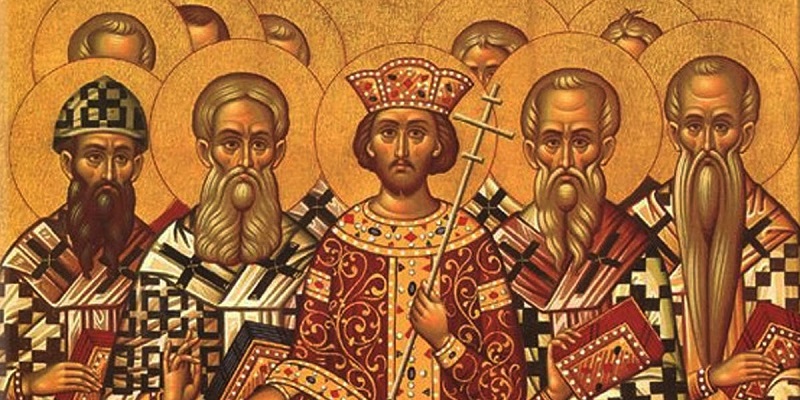
Taken from the Patristic works.
Doctrine of the Church Fathers from the 1st to the 4th century.
Introductory note: What is the point of bringing up the teaching of the Church Fathers on apostolic succession? We simply want to present to the reader the doctrine that existed in the first centuries of Christianity concerning the authority of the bishops, and the reason is simple: nowadays many non-Catholic Christians say that “apostolic succession” is an invention of the Catholic Church and that it is of no use. This position is quite understandable, for if what the Catholic Church teaches about the apostolic succession of the bishops is true, then whoever is not with the bishop is not with Jesus Christ. With the present article it will become clear that the great pastors, recognized by the whole post-apostolic church, many of whom gave their lives for Jesus Christ, firmly believed that the bishops of the Catholic Church succeeded the Apostles of Jesus in the office of guiding the Church with authority. In other words, if today a Christian says that in the Gospel “there is no trace” of the doctrine of apostolic succession, the present article will make clear what other Christians thought — with the difference that these latter (the Church Fathers) are chronologically much closer to Jesus and the Apostles than any of us (by a difference of some 1,800 years). If someone in the 21st century believes he has the authority to teach how we ought to interpret the Bible, why not listen to these other renowned Christians and see how the Church established by the Apostles and their disciples interpreted it? It certainly will not do us any harm… What will become clear, at the very least, is that the Catholic Church today holds THE SAME doctrine as the Church of the 1st, 2nd, 3rd and 4th centuries on the authority of the bishops as successors of the apostles. Then each one must draw his own conclusions.
See the biblical teaching on post-apostolic authority, A. Lang’s article on the meaning of the doctrine of apostolic succession, and also the Magisterium of the Church on this subject.
We offer only the paragraphs that touch on the subject directly. For a more in-depth study, consult the abundant existing literature.

1.- Letter of Clement of Rome to the church of Corinth (around the year 97)[1].
“The apostles were constituted by the Lord Jesus Christ the preachers of the Gospel for us; Jesus Christ was sent by God. Thus, Christ was sent by God, the apostles by Christ, and both things came about in an orderly way, according to the will of God. And so the apostles, having received the command, and being fully assured by the resurrection of the Lord Jesus Christ and confirmed in the faith by the word of God, went forth with the full assurance which the Holy Spirit gave them, announcing the good news that the kingdom of God was at hand. And so, as they preached through countries and cities, they appointed — after testing them in the spirit — the firstfruits of their labours as bishops and deacons of those who were to believe.
And our apostles also knew, through our Lord Jesus Christ, that there would be strife over the episcopate. For this reason, with full foreknowledge of what was to happen, they appointed the aforesaid, and afterwards gave the rule that when these should die, other approved men should succeed them (Greek “diadéxontai” = “to succeed”, ed.) in their ministry. Therefore the men appointed by them, or afterwards by other eminent men, with the consent of the whole Church; men who have served the flock of Christ blamelessly, in a spirit of humility, peaceably and disinterestedly; who for a long time have enjoyed the approval of all — these men, we believe, cannot in justice be removed from their ministry”.[2]
2.- Letter of Ignatius of Antioch to the Trallians (around the year 110).
“Certainly, when you submit to the bishop as you would to Jesus Christ, then it becomes clear that you are living not in a merely human way, but as Jesus Christ wills it, who died for us, so that by faith in his death you may escape death. It is therefore necessary — and this is what you already do — that you do nothing without the bishop, and that you be submissive also to the presbytery, as to the apostles of Jesus, our hope, in whom we shall be found, provided we live in Him […].
Likewise, let all respect the deacons as they would respect Jesus Christ, just as they respect the bishop as an image of the Father, and the presbyters as the council of God and the college of the Apostles. Without these, it cannot be called a “church”. I am sure that you understand these things, for I have received the good example of your love, and I have it with me in the person of your bishop […]”. [3]
3.- Letter of Ignatius of Antioch to the Philadelphians (around the year 110).
“Indeed, those who belong to God and to Jesus Christ, they are with the bishop. And those who repent and return to the unity of the church — they too shall be of God, and shall live according to Jesus Christ. Let no one be deceived, beloved brethren: if anyone follows a schismatic, he shall not enter the Kingdom of God. […] Be careful to keep one single eucharist, so that whatever you do may be in accordance with God: for there is one Flesh of Our Lord Jesus Christ, and one chalice in union with his Blood; there is one altar, just as there is one bishop with his presbyters and my fellow servants, the deacons”. [4]
4.- Letter of Ignatius of Antioch to the Smyrnaeans (around the year 110).
“For you must all follow the bishop, as Jesus Christ follows the Father, and you must follow the presbyters as you would the Apostles. […] Let no one do anything of importance with regard to the church without the bishop. Consider valid only that eucharist which is celebrated by the bishop, or by one whom he appoints. Let the people gather wherever the bishop is, just as the catholic church is wherever Christ is[5]. Neither is it permitted to baptize without the bishop, or to celebrate the agape; but whatever the bishop approves, that will be pleasing to God, so that whatever is done in this way will be valid and sure.” [6]
5.- Testimony of Hegesippus (around the year 180)[7].
“Hegesippus, without doubt, in the five books of Memoirs which have come down to us, has made clear what his opinion was. In these books he shows that he travelled as far as Rome, and met many bishops, and that from all of them he always heard the same and only doctrine. It is interesting to see what he says, after making some remarks on Clement’s letter to the Corinthians; he says: And the church in Corinth has continued in the sound doctrine until the time of Primus, who is the bishop of Corinth, and with whom I conversed at length on my way to Rome, when I spent some days with the Corinthians: during those conversations we encouraged one another in the true doctrine. When I arrived in Rome I drew up a list of the succession (of the bishops of Rome, ed.) down to Anicetus, whose deacon was Eleutherus. Anicetus was succeeded by Soter, and after him Eleutherus. In every succession and in every city there is a continuation of what is proclaimed in the Law, the Prophets and the Lord.”
6.- Saint Irenaeus, Treatise Against Heresies (around the year 190)
“But the tradition of the apostles is plainly manifest in all the world, and all who wish to contemplate the truth can contemplate it. Indeed, we can enumerate those who were instituted by the apostles as bishops, their successors down to our own time: and these taught nothing resembling the ravings (of the heretics). For if the apostles had known “hidden mysteries” to be taught exclusively to the “perfect” in secret from the rest, they would have communicated them before anyone else to those to whom they entrusted the churches themselves, for they wished these men to be truly “perfect” and blameless (1 Tim 3:2) in all respects, seeing that they were leaving them as their successors to occupy their own office as teachers. On their right conduct depended a great good; whereas, if they failed, a great ruin would follow.”[8]
“It would take too long, in a writing such as this, to enumerate the lists of succession of all the Churches. Therefore we shall indicate how the greatest of them, the most ancient and best known of all, the Church which the two most glorious apostles Peter and Paul founded and established at Rome, has a tradition which goes back to the apostles and reaches down to us, in the preaching of the faith to men (cf. Rom 1:8), through the succession of the bishops. Thus we confound all those who, in whatever way — whether to please themselves, or through vainglory, or through blindness or falsity of judgment — gather in illegitimate groups. In fact, with this Church (of Rome), on account of the greater authority of its origin, every other Church — that is, the faithful from everywhere — must necessarily agree; in her there has always been preserved, by those who come from all parts, that tradition which goes back to the apostles.”[9]
“Indeed, the apostles (Peter and Paul), having founded and built up this Church, handed over to Linus the episcopal charge of its administration; and of this Linus, Paul makes mention in the letter to Timothy. He was succeeded by Anacletus, and after him, in the third place from the apostles, the episcopate fell to Clement, who had seen the apostles themselves and had conversed with them; nor was he the only one in that situation, for the preaching of the apostles still resounded, and he had the tradition before his eyes, since there still survived many who had been taught by the apostles. In the time of this Clement, no small dissension arose among the brethren of Corinth, and the Church of Rome sent to the Corinthians a most fitting letter to bring them back to peace, to restore their faith, and to make known the tradition which they had so recently received from the apostles, namely: that there is one almighty God, creator of heaven and earth, creator of man, who caused the flood and called Abraham, who brought his people out of Egypt, spoke to Moses, established the law, sent the prophets and “prepared the fire for the devil and his angels” (Mt 25:41). That this God is preached by the Churches as the Father of our Lord Jesus Christ, those who wish may verify from this very letter. Likewise they may learn from it the apostolic tradition of the Church, since this letter is older than those who now teach falsely and invent a second God above the creator and maker of our universe.
Clement was succeeded by Evaristus, and he by Alexander. Then, in the sixth place from the apostles, Sixtus was appointed, and after him Telesphorus, who suffered a most glorious martyrdom. Then Hyginus; then Pius, and then Anicetus; and Soter having succeeded Anicetus, now, in the twelfth place after the apostles, Eleutherus holds the episcopal office. In this order and by this succession, the tradition of the Church which goes back to the apostles and the preaching of the truth have come down to us. This is a most abundant proof that one and the same life-giving faith has been preserved and transmitted in truth in the Church from the apostles down to us.”[10]
“Polycarp was not only instructed by the apostles, and dealt with many who had known Christ personally, but was also appointed bishop of the Church of Smyrna by the apostles in Asia. I knew him in my early youth; he lived many years, and died giving a glorious example by his martyrdom. He always taught the things he had learned from the apostles, which the Church hands down, and which are indeed true. To these things all the churches of Asia bear witness, as do all the successors of Polycarp to the present day. […] Once he met Marcion, who asked him: “Do you recognize me?”, to which Polycarp replied: “I recognize you as the firstborn of Satan!”.[11]
“Since our arguments carry such weight, there is no need to go looking elsewhere for the truth which is so easily found in the Church, for the apostles deposited in her, as in a rich storehouse, everything that belongs to the truth, so that everyone who wishes may draw from her the drink of life. And she is the gate of life: all the others are robbers and thieves. Therefore we must avoid them, and instead take the utmost care to love the things of the Church and to grasp the tradition of the truth (quae sunt Ecclesiae summa diligentia diligere et aprehendere veritatis traditionem). And what does this imply? If any dispute should arise, even over some minor question, would we not have to turn to the most ancient churches, which had enjoyed the presence of the apostles, to take from them what is certain and clear concerning the question at issue? If the apostles had not left us the Scriptures, would we not have to follow the order of the tradition which they handed over to those to whom they entrusted the Churches? It is precisely to this order that many barbarian peoples who believe in Christ have given their assent; they possess salvation, written by the Holy Spirit without ink or paper in their own hearts (cf. 2 Cor 3:3), and they carefully preserve the ancient tradition, believing in one God.”[12]
“It is necessary to obey the presbyters of the Church, those who, as we have shown, belong to the succession of the apostles; those who, together with the succession of the episcopate, have received the sure charism of the truth, according to the will of the Father. But the rest, those who have no part in the primordial succession, wherever they may gather, are to be held in suspicion”.[13]
“The authentic doctrine (Gr. “gnosis”) is the doctrine of the apostles, and the ancient organization of the Church throughout the whole world, and the manifestation of the body of Christ according to the succession of the bishops, by which the bishops have transmitted the Church which is found everywhere; and also the complete transmission of the Scriptures, which has reached us preserved from all falsification, received without additions or omissions; and a reading without falsification, and a diligent and legitimate exposition (of the doctrine) according to the Scriptures…”.[14]
7.- Tertullian, Prescription against the Heretics (around the year 200)
“If any heresy appears that claims to have its origins in apostolic times, so as to seem a doctrine handed down by the apostles themselves because — they say — they are from that time, we can say to them: let them show the origins of their churches, let them show the order of their bishops in succession from the beginning, in such a way that their first bishop had as his author and predecessor one of the apostles or of the apostolic men who worked side by side with the apostles. For this is how the apostolic churches transmit their lists: like the church of Smyrna, which knows that Polycarp was placed there by John; like the church of Rome, where Clement was ordained by Peter. In the same way all the other churches show whom they have had as shoots of the apostolic roots, having received the episcopal office from the hands of the apostles. Perhaps the heretics will want to invent fictitious lists: after all, if they have been capable of blasphemy, what will still seem sinful to them? […] Therefore, let even those churches that are of later origin in time take this test — new churches spring up every day — and which do not have an apostle or an apostolic man as their immediate founder, since those that hold the same doctrine as the churches of apostolic origin are also considered apostolic, because of the close kinship of their doctrines.”[15]
8.- Clement of Alexandria, Homily on the Rich Man (around the year 200)
“After the death of the tyrant, the apostle John returned to Ephesus from the island of Patmos. And on being invited, he went to the neighbouring cities of the pagans, whether to appoint bishops, to set the churches in order, or to establish ministers as the Spirit designated them”.[16]
9.- Cyprian of Carthage, Letter 69 (75), 3 (year 253)
“The Church is one, and just as she is one, one cannot be at the same time inside and outside the Church. For if the Church is with the doctrine of the (heretic) Novatian, then she is against (Pope) Cornelius. But if the Church is with Cornelius, who succeeded bishop (of Rome) Fabian in his office by a legitimate ordination, and to whom the Lord granted, besides the honour of the priesthood, the honour of martyrdom, then Novatian is outside the Church; nor can he even be considered a bishop, since he succeeded no one, and, despising the evangelical and apostolic tradition, he arose on his own account. For we know well that whoever was not ordained in the Church does not belong to her in any way.”
10.- Firmilian of Caesarea, Letter to Cyprian (around the year 256)
“So that the power of forgiving sins was given (by Christ) to the apostles, and to the churches founded by them, and to the bishops who succeeded them by being ordained in their place (qui iis ordinatione vicaria successerunt)”.[17]
11.- Jerome, Letter 14:8 (year 396)
“Far be it from me to speak against a single one of these clergy who, belonging to the succession that comes down from the apostles, confect by their holy words the Body of Christ, and through whose efforts we have come to be Christians”.
12.- Augustine of Hippo, Against the Letter of Mani called “The Foundation”, 4:5 (year 397)
“There are many other things that may most properly keep me in her bosom [that of the Catholic Church]. The unanimity of peoples and nations keeps me in her; her authority, inaugurated with miracles, strengthened by hope, increased by love and confirmed by her venerable age — all this keeps me in her bosom. And the succession of priests, from the very see of Peter, to whom the Lord, after his resurrection, entrusted the task of feeding his sheep (Jn 21:15-17), down to the present episcopal order — this too keeps me in her bosom. Finally, the very name of “Catholic” which, not without reason, applies solely and exclusively to this Church, though there are so very many heretics; and so much so that, although all the heretics want to seize the name of “Catholics”, when a stranger asks “Where does the Catholic Church meet?”, none of the heretics in question would dare to answer him by pointing to his own basilica or his own house”.
NOTES
- Concerning the authority of this letter of the bishop of Rome, written around the year 97, suffice it to mention that in the church of Syria it was for a time considered canonical. According to Eusebius (HE 3,15), this Clement is the co-worker of Saint Paul (Phil 4:3); and he succeeded Linus and Cletus in the direction of the Church of Rome (cf. Irenaeus, Adv. Haer. 3,3,3). ↩
- Letter to the Corinthians, 42 and 44, in J. Collantes, La fe de la Iglesia Católica, Madrid 1995, p. 430. ↩
- Letter to the Trallians 2,1-3,2. ↩
- Letter to the Philadelphians 3,2-4,1. ↩
- This is the first time, as far as we know, that the Church is called “katholiké”, “catholic”. Let us note that this expression is born on the lips of Ignatius, bishop of Antioch, the city where believers began to be called “Christians” (Acts 11:26). ↩
- Letter to the Smyrnaeans 8,1-2. ↩
- The testimony is given by Eusebius of Caesarea, Hist. Eccl. 4,22,1-3. ↩
- III, 3, 1 ↩
- III, 3,2. ↩
- III,3,3. ↩
- III, 3, 4. ↩
- III, 4, 1ff. ↩
- IV, 26,2. ↩
- IV, 33,8. ↩
- 32,1. ↩
- 42,2. ↩
- 75,16. ↩
