“…lest, being puffed up with pride, he fall into the judgment of the devil.” 1 Timothy 3:6
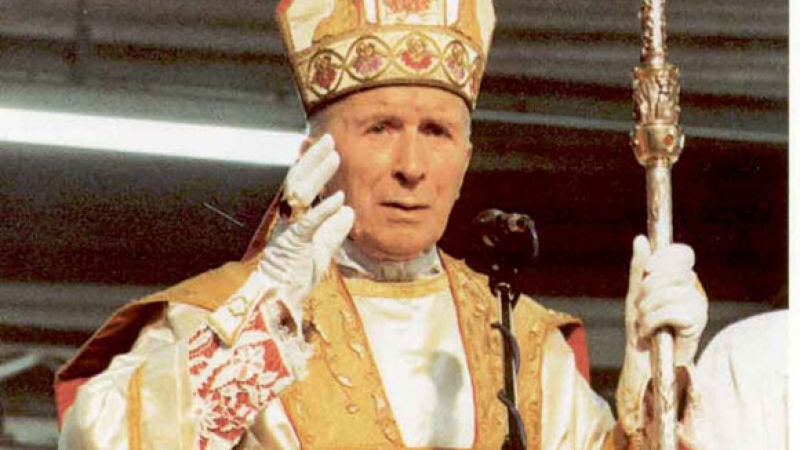
The Lefebvrist schism began in 1988, when Archbishop Marcel Lefebvre (founder of the Society of St. Pius X) ordained four bishops without a pontifical mandate, thereby incurring—together with the bishops he ordained—a “latae sententiae” excommunication. The problem, however, began much earlier, when, after repeated acts of disobedience to the Apostolic See, they fixed their position: “‘We refuse, and have always refused, to follow the Rome of neo-Modernist and neo-Protestant leanings that showed itself clearly at the Second Vatican Council and, after the Council, in all the reforms that came out of it,’ ‘No authority, not even the highest in the hierarchy, can compel us to abandon or diminish our Catholic faith, clearly expressed and professed by the Magisterium of the Church for nineteen centuries.’”
In sum: the Lefebvrists rejected the authority not only of an Ecumenical Council, but of any authority (including that of the Pope) which, in their view, did not agree with their notion of Tradition. On this point the Apostolic Letter given in the form of a “motu proprio,” “Ecclesia Dei,” of His Holiness John Paul II states: .
“The particular circumstances, both objective and subjective, in which Archbishop Lefebvre’s act took place offer everyone an occasion for deep reflection and for renewing their duty of fidelity to Christ and to his Church.
That act was in itself an act of disobedience to the Roman Pontiff in a matter of the utmost gravity and of capital importance for the unity of the Church, namely the ordination of bishops, whereby apostolic succession is sacramentally perpetuated. For this reason, that disobedience—which carries with it a real rejection of the Roman primacy—constitutes a schismatic act. In carrying out that act, notwithstanding the public monitum addressed to him by the Cardinal Prefect of the Congregation for Bishops this past 17 June, the Most Reverend Archbishop Lefebvre and the priests Bernard Fellay, Bernard Tissier de Mallerais, Richard Williamson and Alfonso de Galarreta have incurred the grave penalty of excommunication laid down by ecclesiastical discipline” .
Further on:
The root of this schismatic act can be discerned in an incomplete and contradictory notion of Tradition: incomplete, because it does not take sufficient account of the living character of Tradition, which—as the Second Vatican Council clearly teaches—originates with the Apostles and “develops in the Church with the help of the Holy Spirit; that is, it grows through the understanding of the realities and words that have been handed down, as the faithful contemplate and study them, pondering them in their hearts, as they inwardly grasp the mysteries they live, and as they are proclaimed by the bishops, successors of the Apostles in the charism of truth.”
…
In the present circumstances I wish above all to address an appeal at once solemn and heartfelt, paternal and fraternal, to all those who until now have been bound in various ways to the activities of Archbishop Lefebvre, that they may fulfill the grave duty of remaining united to the Vicar of Christ in the unity of the Catholic Church, and cease to uphold in any way that reprehensible course of action. Everyone should know that formal adherence to the schism is a grave offense against God and carries with it the excommunication duly established by the law of the Church(8).
A Brief Review: Tradition, Scripture and Magisterium
The Catechism explains (in nos. 76-87) that the transmission of the Gospel took place in two ways: orally and in writing (2 Thessalonians 2:15). It also explains that, so that the Gospel might always be kept whole and alive within the Church, the Apostles appointed the bishops as their successors, leaving to them their own teaching office.
This living transmission of the Gospel, which we call Tradition, is closely bound to Scripture, and through it the Church hands on to every age all that she is and all that she believes. Tradition and Sacred Scripture are intimately united and interpenetrating, for both spring from the same source, merge in a certain way, and tend toward the same end.
While Sacred Scripture is the word of God inasmuch as it is set down in writing under the inspiration of the Holy Spirit, Tradition receives the word of God, entrusted by Christ and the Holy Spirit to the Apostles, and hands it on whole to their successors, so that, enlightened by the Spirit of truth, they may faithfully preserve, expound and spread it in their preaching.
It is important to note that the office of authentically interpreting the word of God, whether oral or written, has been entrusted solely to the living Magisterium of the Church, which exercises it in the name of Jesus Christ—that is, to the bishops in communion with the successor of Peter, the Bishop of Rome.
From the earliest times in the history of the Church, Christians have held that theology must be formulated in accordance with these three principles. Scripture and Tradition serve as the material principles of theology, while the Magisterium serves as its formal principle—meaning that, whereas the former contain Revelation, in the latter resides the office of giving its correct interpretation. They thus constitute the tripod on the basis of which all Catholic truths are formulated.
What Happens if Tradition or the Magisterium Is Rejected?
Just as a tripod falls if one of its legs is missing, so it happens with anyone who claims to do theology while rejecting any one of the three foregoing elements: in short, he runs the risk of misinterpreting the Scriptures, or of misinterpreting Tradition, which exposes him to a further risk—that of falling into dissent (by rejecting non-definitive teachings of the Magisterium), heresy (by denying a truth that must be believed with divine and Catholic faith, or by persistent doubt about it), or even schism (rejection of submission to the Supreme Pontiff or of communion with the members of the Church subject to him).
The Fathers of the Church always warned against the deviations of those who tried to usurp the place of the Magisterium in order to impose their own conception of the faith. Not for nothing did St. Augustine reaffirm his submission to the authority of the Church when writing to the Manichaeans: “I should not believe the Gospel, did not the authority of the Catholic Church move me thereto.” (St. Augustine, C. ep. Man. 5,6; cf. C. Faustum 28,2).
Just as St. Augustine attributes heresy to pride (De Doct. Christ., praef. 2; Ep. 208,2), St. Thomas attributes it to the overvaluing of one’s own judgment (S. Th. II-II 5,3.), because such a one “does not give his assent to all that the Church teaches, but admits the things he wishes and excludes the things he does not wish, thus following his own will.” . And although it is not the subject of this study to enter into the sphere of each person’s concrete responsibility, one may affirm without fear of error that every baptized person who rejects the authority of the Magisterium—whether through invincible ignorance or not—ends up usurping its office.
If we examine history, we shall see that again and again heresies and schisms share this common factor: a schismatic and/or heresiarch who proclaims himself master of the truth and convinces others that he is. And this story keeps repeating itself every time someone “overvalues his own judgment” above the judgment of the Church.
Parallels in History
1. The Judaizing Conflict
The first conflict that the primitive Church faced, narrated in Acts 15 and referred to many times in Paul’s letters (especially Romans and Galatians).
It arose after a group of Pharisees converted to Christianity sought to force the first Christians to be circumcised, according to the precept of the Jewish Law that commanded it as a sign of the perpetual covenant between God and his people: “This is my covenant which you shall observe, between me and you, and thy seed after thee: All the male kind of you shall be circumcised…And the infant of eight days old shall be circumcised among you, every man child in your generations…for a perpetual covenant.” Genesis 17:10-13.
The Church gathers in Council and the first interpretation-actualization of Tradition takes place. The Magisterium, exercising its office as authentic interpreter of Revelation, distinguishes what is temporary from what abides. In that age there were those who resisted what the Church decreed, rejecting the Council of Jerusalem and persevering in Judaizing; yet today not even the dust of their doctrines remains.
Donatists
A schism of the fourth century. The Donatists held that the Church was made up of the good and that the wicked were excluded; those who had not endured martyrdom during the persecutions of the preceding periods, and who were unwilling to accept it should the occasion arise, no longer belonged to the Church, and therefore their sacraments were invalid.
For the Donatists, the Church of Rome and the churches in communion with her were condemned for having admitted false Christians into their midst, they themselves being the faithful remnant, the true Church faithful to Tradition.
The results were disastrous: their exaggerated fanaticism showed itself in cruel persecutions of Catholics, killing them and burning their altars; they threw the consecrated hosts to the dogs and, out of a craving for martyrdom, resorted to collective suicide. (It is impossible not to notice here a similarity between the attitude of the Donatists of that time and that of the Lefebvrists.)
2. Tertullianists and Montanists
Even the most brilliant ecclesiastical writers have fallen into the temptation of overvaluing their own judgment, and of passing from guardians of orthodoxy to schismatics and heretics.
Such was the case of Tertullian, who had once been a renowned apologist of his time. In De praescriptione haereticorum he denies heretics any argument, objecting that they have no right to appeal to the Scriptures, and holds that only in the apostolic Churches can their correct interpretation be found.
His extreme rigorism even led him to assert that adultery and fornication were unforgivable sins, so that not even the Bishop of Rome, as successor of Peter, had authority to absolve them. He finally denies that the power granted to Peter was passed on to his successors (Tertullian, On Modesty 21).
Result: he embraces the Montanist heresy, which saw in Montanus (another heretic) the incarnation of the Holy Spirit, only to end up founding his own sect (the Tertullianists), today vanished.
Protestantism
Under this name are grouped all the sects and ecclesial communities that arose from the Protestant Reformation of the sixteenth century.
Under the banner of the three “Solas” (Sola Fide, Sola Gratia and Sola Scriptura) the Protestant reformers found themselves preaching teachings that were opposed to Tradition (see Sola Fides and the Fathers of the Church) and to the Magisterium. Being unable to appeal either to the one or to the other, they ended up rejecting both and replacing them with the doctrine of Sola Scriptura (the Bible as the sole rule of faith) and of free examination or private judgment (whereby it is each believer who has the final word in matters of faith).
When each Protestant decided to exercise the right they received from the reformers, the exponential fragmentation we know today in Protestantism was produced: thousands of denominations and sectarian groupings differing among themselves in almost everything, yet united to a greater or lesser degree in their rejection of the Catholic Church and the Pope. (See Sola Scriptura and Private Judgment)
Old Catholics
A movement initially schismatic and subsequently heretical, arising from the First Vatican Council over the rejection of the dogma of papal infallibility. A group of priests and theologians later gathered under the direction of the historian Ignaz von Döllinger. They thought themselves to be those who would safeguard Tradition, keeping Catholic doctrine intact as it stood before the dogma. Because they had no bishop among their ranks and possessed no apostolic succession, they sought the help of the schismatics of Utrecht, who consecrated a bishop for them.
Result: once separated from the barque of Peter, they ended by declaring the absolute supremacy of councils over the Pope, accepting the marriage of priests, and later came to deny dogmas such as the Immaculate Conception and the Assumption of Mary Most Holy. Today they have gone so far as to ordain women to the priesthood.
Lefebvrism Suffers from the Same Germ
At present Pope Benedict XVI has granted the remission of the excommunication to the Lefebvrist bishops and has begun dialogue under the oversight of the Congregation for the Doctrine of the Faith; nevertheless, the underlying problem remains (which is not only of a liturgical but of a doctrinal nature), for the Lefebvrist position, carried to its ultimate consequences, implies that the Catholic Church, governed by the Pope and the bishops in communion with him, has decisively departed from the true faith (and from this to sedevacantism—where the Pope and the bishops in communion with him are accused of heresy, and the Roman See is proclaimed vacant—there is but a single step).
As long as the Lefebvrists persist in practicing theology by appealing to the Magisterium of the past against the present Magisterium, with a kind of “free examination” similar to Protestantism, the harmful germ will be there. The difference is that the Protestants reject the Magisterium by trying to impose their private interpretation of Scripture, while the Lefebvrists do so with Tradition.
Pseudo-Lefebvrism, Ultra-Traditionalism: The Same Problem
There is another sector within the Church which, without acknowledging itself as Lefebvrist, shares in and promotes Lefebvrist positions. They profess to be faithful to the Pope, yet publicly dissent from the Council. The argument: since not all the teaching of the Second Vatican Council claims to be definitive, it is possible to hold different degrees of assent—and in practice this translates into a persistent and systematic dissent.
On this point the Apostolic Letter given in the form of a ‘Motu Proprio,’ “AD TUENDAM FIDEM,” of John Paul II makes clear that the religious assent the Catholic faithful owe to the doctrines set forth by the Magisterium is due not only to those doctrines defined with a definitive character:
“The Profession of Faith, duly preceded by the Nicene-Constantinopolitan Creed, further contains three propositions or paragraphs meant to set out the truths of the Catholic faith which the Church, in the successive centuries and under the guidance of the Holy Spirit, who “will teach her all truth” (Jn 16:13), has explored, or must still explore, more deeply.(3)
The first paragraph states: “With firm faith I also believe everything contained in the word of God, whether written or handed on in Tradition, which the Church, either by a solemn judgment or by the ordinary and universal Magisterium, sets forth to be believed as divinely revealed”(4). This paragraph congruently affirms what the universal law of the Church establishes and prescribes in cann. 750 of the Code of Canon Law(5) and 598 of the Code of Canons of the Eastern Churches(6).
The third paragraph, which states: “Moreover, I adhere with religious submission of will and intellect to the teachings which either the Roman Pontiff or the College of Bishops enunciate when they exercise their authentic Magisterium, even if they do not intend to proclaim them by a definitive act” , finds its place in cann. 752 of the Code of Canon Law (8) and 599 of the Code of Canons of the Eastern Churches(9).
Apostolic Letter given in the form of a ‘Motu Proprio,’ “AD TUENDAM FIDEM,” John Paul II
It is not a matter of digging through each teaching of the Magisterium to see which is definitive and which is not; it is a matter of assenting with religious submission of will and intellect, whether they are definitive or not.
Author: José Miguel Arráiz
