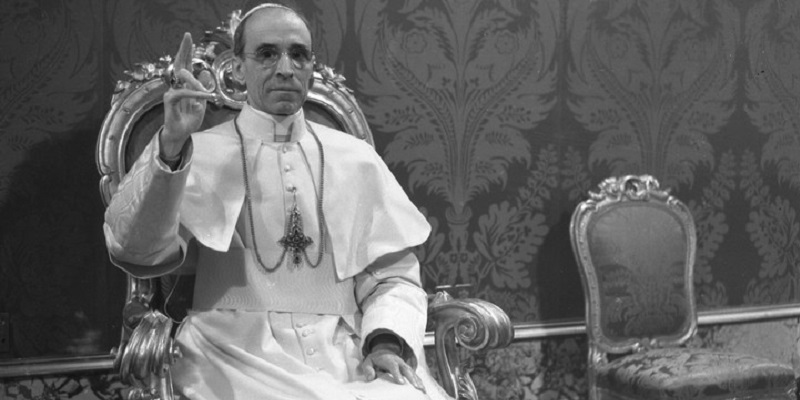
A Jewish historian speaks “My judgment on Pius XII’s conduct toward the Jews is positive”
VATICAN CITY, Oct. 25, 2000 (ZENIT.org).- The meeting of the Judeo-Christian Historical Commission, gathered in Rome behind closed doors since October 23, concludes today. The Commission was established in October 1999 by Cardinal Edward I. Cassidy, president of the Committee for Religious Relations with the Jews, with the specific task of examining the eleven volumes of «Actes et Documents du Saint Siège relatifs à la seconde guerre mondiale», in which all the archival documents relating to the activities of the Holy See during the Second World War are collected.
Matters concerning the life and history of Pius XII have for some years been at the center of great attention. In recent years especially, Pope Pacelli and the Holy See have been accused of not having done enough on behalf of the Jews persecuted by the Nazis.
To try to clarify these events, Zenit interviewed Michael Tagliacozzo, a Jewish historian responsible in Italy for Beth Lohamé Ha-Ghettaoth (Center for Studies on the Shoah and Resistance). “I know that many criticize Pope Pacelli,” Tagliacozzo comments. “I have a folder on my desk in Israel on which I have written ‘Calumnies against Pius XII,’ but my judgment can only be positive. Pope Pacelli was the only one who intervened to prevent the deportation of the Jews on October 16, 1943, and he did a very great deal to hide and save thousands of us. Moreover, he ordered the opening of cloistered convents. Without him, many of our people would not be alive.”
Founded by the fighters of the Warsaw Ghetto, Beth Lohamé Ha-Ghettaoth is located in Western Galilee, in Israel, and is one of the world’s largest Holocaust museums and documentation centers.
–According to some, the Holy See looked on in silence at the deportation of the Roman Jews on October 16, 1943…
–That is not true. The documents clearly prove that, in the first hours of the morning, Pius XII was informed of the facts and immediately had the German ambassador Von Weizsäcker summoned, and ordered the Secretary of State Luigi Maglione to protest energetically against the arrest of the Jews, asking that similar actions be stopped. Otherwise, the Pope would have denounced them publicly. Moreover, on his own initiative he had a letter of protest delivered through Bishop Aloise Hudal to the military commander of Rome, General Rainer Stahel, so that the persecution of the Jews would cease immediately.
Following these protests, the operation that called for two days of arrests and deportations was interrupted at 2 p.m. that same day. And instead of the 8,000 Jews requested by Hitler, 1,259 were arrested. After a meticulous examination of identity papers and other identifying documents, another 259 people were released the following day.
Moreover, after the manhunt of October 16 in Rome, the Germans did not capture a single Jew. Those who were detained were handed over by collaborators. Herbert Kappler said at the trial: “The Jews were being handed over to us.”
–You maintain that in the German army and diplomacy there were people opposed to the persecution…
–From the material in the archive it follows that General Stahel and the German consul Eitel Frederick Moellhausen, as soon as they learned of the top-secret dispatch in which Himmler ordered the arrest of all the Jews of Rome so that they might be transferred to Germany to be liquidated, opposed it harshly. Stahel said he would never take part in such filth. Moellhausen pressured Kappler to raise the matter with the commander-in-chief Albert Kesserling. Moellhausen was a practicing Catholic and considered the deportation of the Jews useless and inhuman; to convince Kesserling, he raised questions concerning the political and military inopportuneness of the deportation. Kesserling, who feared an imminent Allied landing on the Tyrrhenian coast, denied the availability of his soldiers for the arrest of the Jews. In this way, on October 16, 1943, Kappler had to use the 365 members of the SS to carry out the roundup.”
Tagliacozzo’s words are also confirmed by the diaries of Adolf Eichmann, who writes in this regard that “the objections raised, the excessively long delay in the steps necessary for the full achievement of the operation, enabled a large part of the Italian Jews to hide and escape capture.”
–Why was the Roman community so poorly prepared for the Nazi roundup?
–The representatives of Judaism and, with them, the leaders of the Roman Jewish community showed the same defects as the Italian ruling class and failed at the moment of trial.
In the book «Before the Dawn», Zolli recounts that, in mid-September 1943, during a community meeting, he proposed dissolving the community, advancing six months’ salary to the employees and going into hiding. But the president, Ugo Foà, a man of one piece, said that Zolli was an alarmist and that nothing would happen. The minutes of that meeting can no longer be found. Zolli was not the only one who was worried. I have collected the testimony of Amadio Fatucci, who had the courage to stop the president of the community and said to him: “Mr. President, should we be afraid?” Foà replied: “The authorities have no interest against the population, and the population must remain calm. When the population is calm, the authorities do not intervene.” Foà’s behavior on the occasion of the roundup was serious. While on the morning of October 18 the Nazis were making the deportees board the train cars, the president took his children and fled to Livorno. He returned to Rome on November 2 without having done anything to learn the fate of those deportees. On that occasion, the community showed an unconscious lightness and a foolish incomprehension of the dangers and surprises of the new situation.
–Some scholars deny that there were instructions from the Pope to help the Jews…
–In those days there was much confusion,” Tagliacozzo recalls, “but everyone knew that the Pope and the Church would help us. After the action of the Nazis, the Pontiff, who had already ordered convents, schools and churches to be opened to aid the persecuted, lifted the enclosure of convents to allow the persecuted to hide. Monsignor Giovanni Buttinelli, of the parish of the Transfiguration, revealed to me that the Pontiff had recommended spreading the word so that pastors would welcome Jews. I personally know a Jewish family that, already after the Nazis’ demand for 50 kilos of gold, decided to hide the women and children in a cloistered convent on Via Garibaldi. The nuns said they were willing to welcome the mother and the girl, but could not take charge of a little boy. Instead, under the Pope’s order lifting their enclosure, they also hid the boy.
I myself was saved from persecution thanks to the help of the Church. I remember that it was October 16 and it was a rainy day. It was Saturday, the third day of the Jewish Feast of Booths, “Sukkot”; I had taken refuge in Piazza Bologna. When the Germans arrived I managed to flee through the window and found myself in the street in my pajamas. A family helped me and hid me. I sought help from my former Italian teacher, who kept me in her home and approached several priests to find me a safe place. Finally, after about a week, thanks to Father Fagiolo’s recommendations, I was hidden in the Lateran. I remember that they treated me wonderfully. After two days without eating, Father Palazzini obtained for me a meal with all God’s good things: a tureen of soup, bread, cheese, fruit. I had never eaten so well…
–What do you think of John Cornwell’s book «Hitler’s Pope»?
–I have not read it. But I know that much nonsense is written and, being unable to bring forward new arguments, they offer exaggerated interpretations. I am a historian and I do not seek controversies. From the diaries of table conversations it appears that Hitler said: “I hate the Jews because they have given the world that man, Jesus.”
Author: Michael Tagliacozzo.
Source: Center for Studies on the Shoah
