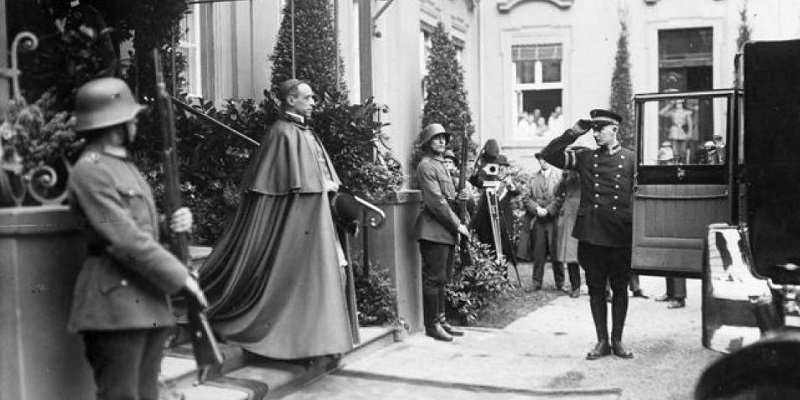
One of the most painful lies.
“Pius XII was a holy and good man, a heroic defender and protector of the Jews during the Second World War.”
The following is an excerpt from “The Defamation of Pius XII” (St. Augustine Press).
Eugenio Pacelli was elected Pope in 1939, took the name Pius XII, and reigned for almost 20 years until his death in 1958. As the Vicar of Christ on earth and the successor of Saint Peter, the Pope’s principal task is to evangelize the world. God so loved the world that he sent his Only Son to save it from its sins: this is the good news that the Church was formed to spread. The Holy Father is primarily a spiritual leader, but just as God became incarnate in Jesus, the Church is in the world, although she does not belong to it. Thus it is no small matter that the papacy of Pius XII took place during the Second World War and continued during the Cold War that grew between the Allies who defeated Hitler and the Axis powers.
It is a simple fact that no political or religious leader emerged from the Second World War with a more heroic and noble record than Pius XII. Vatican City is located in a country that had a fascist dictator, Mussolini, who eventually allied himself with Hitler. Mussolini’s regime may have seemed less threatening than Hitler’s, but it too was totalitarian. When Mussolini was forced to resign in 1943, German troops rushed to fill the vacuum, occupying Rome and surrounding the Vatican. These were the hostile circumstances in which Pius XII reigned until the liberation of Rome by the Allies in 1944. Bombs were dropped on the Vatican; whether they were German or American was never clearly established.
The moral problems provoked by an unlimited war, declared until Hitler’s unconditional surrender, were extensive — the bombing of cities, the vagueness of failing to distinguish between combatants and civilians, the violation of the most elementary precepts of natural law. Added to this were the dreadful racial policies of the Third Reich. Hitler was a satanic figure, driven by growing resentment over Germany’s defeat in the First World War and by the dream of an Aryan race occupying all Europe for thousands of years. Opposing this goal — apart from the military might of the Allies — were two things: Christianity and the Jews.
Hitler declared war on the Church from the beginning. He promised to rid first Germany and then Europe of the “inferior races,” most notably the Jews. The measures taken against German Jews before the outbreak of hostilities were a matter of public knowledge. The brain drain of Jewish intellectuals from Nazi Germany and Austria enriched the universities of Great Britain and the United States. The occupation of Austria and Czechoslovakia was accepted without serious difficulty, but the invasion of Poland brought a declaration of war against Germany by Great Britain and, more reluctantly, France. The Second World War had begun.
Nazi activities in the occupied territories were more difficult to monitor than they had been in Germany in peacetime. But the network of papal diplomacy, and the presence of the Church throughout Europe, brought the astonishing news to the Pope, who condemned what he characterized as the extermination of persons and announced it to the world. Again and again and again.
The identification and condemnation of Nazi atrocities continued throughout the war. And they were accompanied by efforts to protect the innocent victims of the diabolical regime. The Catholic Church, under the leadership of Pius XII, is credited with saving nearly a million Jews from certain death during the war. This is an achievement not remotely equaled by other heroic efforts. It was gratefully known during and after the war by Jewish leaders who knew what the Pope had done.
Saving nearly a million Jews, glorious as it was, was only one of the personal and pontifical achievements of Pius XII. Nevertheless, after his death, complaints within the Church about his defense of the deposit of faith against modernist tendencies became more audible; and with the calling of the Second Vatican Council, the pre-conciliar Church became the bête noire of liberal and progressive Catholics. It has been suggested that this may have been one of the conditions that favored the success of the astonishing assault on Pius XII that was launched in 1963.
The point that marked the change of course was the play The Deputy, by Rolf Hochhuth. In it, Pius XII is portrayed as the dark side of his historical self. Hochhuth’s Pius XII remains silent about the treatment of the Jews, consenting to their deportation from Rome and Italy; perhaps he is a representation of the Nazi that Hochhuth once was — at least he belonged to the Hitler Youth. The play runs contrary to the historical facts and constitutes a slanderous attack on a holy and heroic figure. Hochhuth wrote a similar slanderous play about Winston Churchill, which received the treatment it deserved. But his defamation of Pius XII has passed from the realm of sick fantasy into what has been received as opinion. The latest contribution to the lamentable genre inaugurated by Hochhuth is John Cornwell’s Hitler’s Pope.
For more than three decades, historians have patiently shown that such portrayals of Pius XII lack historical foundation. All the Vatican documents covering the period are now available in 12 volumes; but, far from letting the matter rest, there is a continuing rumor that the Vatican is hiding something and is engaged in an effort to save Pius XII from the truth about his papacy.
Pius XII was a holy and good man, a heroic defender and protector of the Jews during the Second World War. The evidence for this truth is massive, the testimonies are many, the facts cannot be changed. All efforts to show the contrary have been conclusively refuted. The question is not whether Pius XII acted heroically during the Second World War and was instrumental in saving hundreds of thousands of Jews from Nazi extermination. The question is not whether the defamations and calumnies against this holy man can be refuted. The overwhelming question that must be examined is: why is this good man being defamed? Who are those who dedicate themselves to staining the reputation of Pius XII? What are they really? What is their fundamental objective?
The Didache teaches that there are two ways, one of light, the other of darkness. John Paul II spoke of a culture of death and a culture of life. During the Second World War, Pius XII courageously walked the path of life. The Nazis whom he condemned are no more. Their totalitarian twin, the Communists, have withered away. But the culture of death is still among us, stronger than before. Those who opposed Hitler now occupy countries that have adopted, under other names, his genetic atrocities. Western moral relativism and nihilism have allowed the culture of death to flourish, and it recognizes its principal enemy: that enemy is the Catholic Church. Pius XII is merely an opportunity. The watchword of his detractors is to destroy the natural law, which, as Pius XII emphasized from the beginning of the war, was violated by Nazi racial policies. The culture of death is likewise a systematic assault on the natural law, of which the Catholic Church is the chief custodian. This is the true motive behind the defamations and calumnies against the Church.
Author: Ralph McInerny (excerpt from The Defamation of Pius XII)
Translator: Bruno Escárcega (Mexico)
Source: Catholic Dossier, January-February 2001, pp. 5-7.
