QUESTION
Mr. Martín, I would like you to explain something about the Inquisition, because there are many who ask us how we can speak about the Church if it did so much evil through that means.
Is everything one hears said true? or can we answer something?
ANSWER
Of course we can. There are some important and little-known things about the Inquisition that we should know in order to be more objective and not believe exaggerations.
First of all, it must be made clear that it is not our intention, in speaking about this topic, to affirm that the Inquisition was something very good and beautiful in the history of the Church. Nor do we want to revive it or have it established again.
The purpose of this article, rather, is to clarify and remove a series of exaggerations that we very commonly hear from non-Catholics or from pseudo-historians who have never been even minimally concerned with seriously investigating what actually happened.
Most of the information we will use can be consulted by going to any library and spending a few minutes reading it in any encyclopedia you find, even in encyclopedias made by non-Catholic and Protestant brethren. I am not the one saying it; anyone can verify it for himself.
1.- An anti-Catholic and anti-Spanish Black Legend.
When speaking of the Inquisition, it is common for many serious historians to call it by the name “Black Legend,” because much has been distorted and exaggerated about what the Catholic Inquisition really was, especially the one that took place in Spain. In this article you will be surprised to learn how a myth has been created around it, and in honor of the truth it is necessary to mention a few things about this.
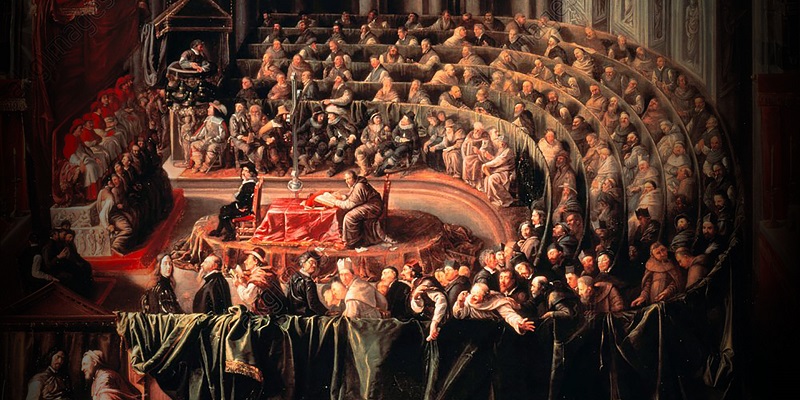
2.- Galileo did not die at the stake, nor was he judged for scientific reasons.
I know that more than one person may already be thinking that he has always heard the opposite, but remain calm for a few moments and read attentively. It is common to hear, even from some teachers or professors, that the Inquisition burned Galileo because he affirmed that the earth moved and that the sun was the center of the universe, but this is False. You need only go to any encyclopedia and you will realize that Galileo did not die burned, nor anything of the sort.
His punishment was to read the 7 penitential psalms for two years. Some time later, he died peacefully in the house of a friend of his who was a bishop, and in fact he continued with his chair and with his writings. Nor was he judged for his scientific theory; proof of this is that he was not the first to state that theory, but Copernicus was.
Even today we call it the Copernican system in honor of his name, and nothing was ever done to Copernicus, who, by the way, was a canon. What happened is that Galileo wanted to base his position on passages from the Bible, an attitude Copernicus did not follow. This was what was rejected, since it was a personal interpretation not in keeping with his time or with the Church. For this reason, and not for scientific reasons, the Inquisition gave him as penance the praying of the penitential psalms. Do you not think this is very different from the stake, as some invented some time later?
3.- Protestants, Muslims, and other religions also had their “inquisitions”.
Surely you had not heard this, had you? I wonder why this is not heard, if history books speak about it. Of course everyone had his own kind of inquisition.
For example, William Cobbet, who was a Protestant writer, in his book “History of the Protestant Reformation” states that Elizabeth of England (a Protestant) made and caused more deaths of Catholics in one year than the Spanish Inquisition in its entire history.
The reason why everyone, even Calvin himself (the Protestant reformer), did this is that they believed in a social principle that existed at that time: “cuyus regio ipsius religio” = the religion belongs to the one who rules the region. So if the prince, king, or ruler was Catholic, the people would mostly be of that faith; if he was Lutheran, likewise; if he was Calvinist or Muslim, the people would be of that faith. To be against the religion was to be against the king.
It is enough to read how Calvin likewise took this position radically against Catholics. There did not exist in society, as there does today, the so-called “religious freedom” on the same level. Everyone walked in the same error, if you wish to see it this way, but not only the Catholic Church but everyone thought that way.
Moreover, judging the Inquisition by present-day criteria is a true anachronism. That is, it is «out of time». It is as if today the Aztecs were accused of damaging the ecosystem and violating ecological laws.
4.- The punishment was given by the civil power, not by the Church.
Another very widespread tale or invention, still appearing in movies and novels, is to present the priest imposing the punishment. That is more false than a three-dollar bill. The punishment was imposed by the so-called “secular arm” or civil power. What the Church did were the ‘acts of faith,’ where it was declared whether the person in question was guilty or not. The civil power was the one that later applied the punishment.
Speaking of this, I was participating in a radio program when a Catholic sister called and said that what I had mentioned was not true, that it was the Church that gave the punishment.
When I asked her how she knew that, she calmly answered that she had just seen it the day before on television while watching the soap opera… that is why things are the way they are. Poor is the Catholic whose source of formation is soap operas. Perhaps that is why they should be called no-watch-operas, meaning do not watch them. In any case, let us explain a little more.
5.- The stake was not the common punishment, but the extraordinary one.
How many novels and Protestants there are speaking about the stake as if a person were burned every day in the Inquisition. I believe that if we want to form ourselves well and seriously, we must watch fewer soap operas and read more history books. The punishments imposed by the Inquisition were often simple things: praying some prayers, doing some penance, carrying some symbol of one’s repentance, etc.
Indeed, many times repentance was enough so that no punishment at all would be given. That is why Galileo was simply ordered to pray the 7 penitential psalms. He did not go to the stake, as many ignorantly affirm.
Even more, what was often burned was not the person, but the ‘effigy’, that is, a doll representing the person. Even in the national archives of Mexico, to give an example, it is recorded how many times in a year this was done: how many in effigy and how many in person.
In this country, in nearly three hundred years, there were 57; the rest were in effigy. Of course it was wrong, but from there to the exaggeration that there were thousands, there is a great difference. Ah, and it must also be mentioned that never was any Indigenous person judged or condemned, because they were protected by the laws of the Catholic monarchs.
6.- The Inquisition was not only for Protestants, Muslims, Jews, and witches. It was also for Catholics.
Where some Protestants may have gotten the absurdity that it was only for them, one cannot get from history.
It is enough to say that two of those whom today we consider great Catholic saints and mystics in spirituality were also called before the Inquisition and nothing happened to them. Nothing. I am referring to Saint Teresa of Ávila and Saint John of the Cross.
In the case of Jews and Muslims, they were not even called or investigated for being of that religion. Rather, it was the Jews who passed themselves off as Catholic converts, called ‘Judaizers,’ and the Muslims who had falsely converted to Catholicism, called ‘Moriscos,’ who were investigated.
No one was forced to be Catholic. It was the opposite, for in countries where Protestants were the majority there was indeed a tremendous persecution of Catholicism. I recommend that you look in any encyclopedia at how Calvin applied the laws, even with his own coreligionists.
In fact, the first founders of the United States, commonly called “Puritans,” were Protestants fleeing persecutions of intolerance from other Protestants.
This is kept silent and ignored by all Protestants; that is why it is important to mention it, in order to recall a little historical memory for those who wish to manipulate it.
7.- Religious tolerance on the part of Catholics in the United States.
To conclude, let us mention that Maryland, the only one of the thirteen colonies with a Catholic majority, at the same time as the Inquisition, in the year 1649, was among the first to proclaim the law for “religious tolerance”.
I hope I have answered your concerns, and take heart.
Author: Martín Zavala, M.P.D.
