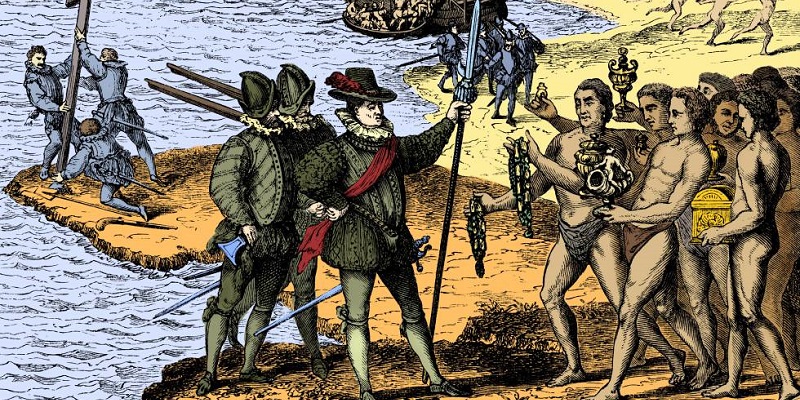
Truths and lies about Spain’s evangelizing work.
The «Black Legend» is at once anti-Catholic and anti-Spanish. It was generated and developed in England and France; first and chiefly in England, in the course of the struggle between Spain and Tudor England.
Anti-Hispanism became an integral part of English thought. Writers and pamphleteers strove to invent a thousand examples of Spanish baseness and perfidy, and spread throughout Europe the idea that Spain was the seat of ignorance and fanaticism, incapable of occupying a place in the concert of modern nations.
Such an idea became widespread in the secularized and smug Europe of «enlightened» and encyclopedist obscurantism, pointing to the Church as the chief cause of such Spanish cultural «degradation».
This idea later spread throughout the Anglo-Saxon world and naturally among the Yankees.
The good North American historian William S. Maltby, among some others, in his well-documented book entitled The Black Legend in England (1982), says this: «Like many other North Americans, I had absorbed anti-Hispanism in films and popular literature long before this prejudice was challenged from a different point of view in the works of serious historians, which was for me quite a surprise; and when I came to know the works of the Hispanists, my curiosity knew no bounds. Hispanists have long attributed this worldwide anti-Spanish prejudice and feeling to the distortions of historical facts committed by the enemies of Spain».
According to many Hispanists, the roots of anti-Hispanism must be sought in documents of the sixteenth century, such as the Apology of William of Orange and many others that constitute what Juderías called «the Protestant tradition», and which portray Spain as a cruel oppressor whose enormous power was at the service of the cause of ignorance and superstition.
The cynical pamphleteering agents of the «Black Legend» — cynical because they accuse Spain of baseness and crimes that only they committed — and their respective peoples, who sheepishly assimilated anti-Spanish fanaticism, particularly the Anglo-Saxon world, not only distorted Spanish history and the greatness of the Spanish enterprise in America, but at the same time kept silent about their colonial systems which, from the seventeenth to the nineteenth century, almost completely exterminated the aboriginal peoples of North America and subjected so many African, Asian and Oceanian peoples to near total slavery. They keep silent about the present permanence of aboriginal races in the countries colonized by Spain, as well as the intense racial and cultural mixing that disproves every racist mentality.
And they also naturally keep silent about the fact that the pontifical interventions in defense of the indigenous peoples responded to petitions from the Spanish Crown, which had already earlier issued humanitarian norms such as that juridical glory of Spain: the Laws of the Indies and the Law of Nations.
There is now a swarm of pseudo-intellectuals docile to the vile ideological currents being sold today, who on the occasion of the commemoration of the Fifth Centenary of America wanted to generate a strange sensation of bad conscience, of troublesome memory, as though of shameful history. An even more twisted intention is the one that seeks to erase any trace of God in this most noble and beautiful event carried out by the Spaniards. Some summoned Spain to ask forgiveness and to «return what was stolen»… At this point in time, it is regrettable that the document issued by the Commission «Justitia et Pax» in November 1988, entitled The Church and Racism, in its point 3, gives room to interpret that Spain invented racism in the great American enterprise. Even high clergy can err and sin! This crude error could help create a false problem of conscience or an unjust and absurd feeling of guilt in the minds of many Spanish-speaking people, who are half of the Catholic people of the world, were it not for the fact that the vice-president himself of the aforementioned Pontifical Commission, Monsignor Jorge Mejía, made a public correction on March 31 in Pamplona, and because all the Popes have had very honorable mentions for Spain’s singular evangelizing and civilizing action in the world. Our present Pope John Paul II has insisted very repeatedly on this beautiful reality; and during his visit to Spain, in Santiago de Compostela on August 19, 1989, he highlighted with great love and clarity the enormous positive spiritual and cultural projection of the Third Council of Toledo, and among other things said: «On more than one occasion I have had the opportunity to acknowledge Spain’s unparalleled missionary feat in the New World». And in his farewell at Covadonga he said: «we thank Divine Providence, through the heart of the Mother of Covadonga, for this great good of Spanish identity, of the fidelity of this great people to its mission. We desire for you, dear sons and daughters of this great Mother, for all Spain, perseverance in this mission that Providence has entrusted to you».
In the colonizing processes carried out by the powers of the West, wherever the Church was present there was no racism. This is the case of Spain and of Spanish America. Where the Protestant world was present there was racism and extermination of the aboriginal peoples.
Another highly significant consideration about the «Black Legend» is appropriate. This one: only Spain has a Black Legend, whereas no nation in the Protestant sphere has one; why? There is only one possible answer. Spain’s importance in the world became enormous during the sixteenth to eighteenth centuries. Its cultural, political and military influence was universal and beneficial for the world because all its actions were inspired and moved by Catholic doctrine and spirit. But afterward heresy and error triumphed in a large part of the economically strong Western world, with its Protestant and rationalist spirit. And naturally this triumphant world of error and anti-humanism was the author of the worldwide, unjust and iniquitous prejudice called the «Black Legend», which is only and at the same time anti-Catholic and anti-Spanish. There is, by contrast, no Black Legend hostile to the Protestant powers. This fact has decisive significance for any honest mind that seeks to assess the historical facts of nations with justice.
There would be no «Black Legend» if Spain had not been so important in the world, or if it had betrayed the Truth as the other powers did, instead of serving it heroically as Spain did.
The Protestant and rationalist revolution, besides proclaiming the destruction of the Church, toward which they professed a growing hatred, showed itself to be a radical enemy of the established order. The spirit of the Protestant Reformation was later transmitted to the public powers, which Luther expressed with the well-known phrase «cuius regio eius religio». Thus he did not place religion before the State but the reverse, and recognized the princes’ right to impose belief on their subjects. The rupture became definitive and irremediable; and with the Peace of Westphalia, in 1648, the Protestant side achieved victory over almost all the central and northern European sphere, Spain and most of the Latin world remaining safe.
Many contemporary historians place in the Protestant revolution the grave crisis that «modern» man suffers in his historical conscience, as well as its thousand disastrous consequences in the diverse forms of materialism that the world today suffers in an evident and tragic way. And since they were the victors, for a long time they wrote history pouring into it their tremendous burden of prejudices and hatreds, with lies and calumnies that in many cases reach the phantasmagorical. The target of all their shooting exercises was, in the first place, the Catholic Church. And also the history of Spain, that is, Spain itself, for having been the generous and heroic champion of the Catholic cause for centuries.
Protestantism separated the spiritual from the temporal. Protestant theology has gone so far as to separate faith completely from history. The natural, it affirmed, has lost its meaning through sin. With Redemption there is no true healing and elevation of man. Nor can there be a Church as a visible society. If human activity is not elevated from within by grace that heals and elevates man, the Gospel remains alien to civil life. Such is the key to Protestant pessimism and to its sad and aberrant world.
For the Protestant mentality, which makes the spirit walk along a path different from the dominion of nature, it is impossible to understand the work of «evangelizing by civilizing and civilizing by evangelizing» as Spain did in America. It was precisely in the Protestant environment that the so-called «Black Legend» was generated; for a time it marked not a few historiographical studies and focused attention predominantly on aspects of violence and exploitation that occurred in civil society during the phase following the Discovery. «Political, ideological and even religious prejudices have also sought to present only negatively the history of the Church on this continent» (John Paul II in Santo Domingo).
The «Black Legend», with an assessment of the facts not enlightened by faith, has left an atmosphere of absurd guilt in some Spaniards, manifested in a desire to distort the grand enterprise in its essential motives of evangelization and civilization, in the loss of the overall perspective of the work, with the consequent trivialization of individual and collective merits, and in the failure to value the depth and breadth of the conversions. This would mean that what Spanish America is has not been grasped. By disposition of Divine Providence, the peoples who were conquered, when they converted to the faith and received Christian culture in the language of Castile, did not remain as such primitive peoples, but gave rise to the Spanish-American nation, which is heir to them as much as it is to Spain.
For this enterprise John Paul II gave the most recent encouragement in that «Thank you, Spain!, because the most numerous portion of the Church today, when it addresses God, does so in Spanish». And among a thousand great things, it gave life to the oldest Universities on the American continent.
Almost all the Popes have at some point offered great praise for the great epic and the glorious mission carried out by Spain in America. Pius XII was the most tireless debunker of the calumnies that the myth of the «Black Legend» hurled at Spain. From his pen came 129 texts about the «universal and Catholic spirit of the great missionary epic (…). The gigantic epic by which Spain broke the old limits of the known world, discovered a new continent and evangelized it for Christ». It has been said that calumny enters as a necessary ingredient in every true glory. And he himself was one of the most calumniated Pontiffs in History.
No less sectarian and false are the judgments that Protestant, Marxist and Masonic historiography has frequently made about the Spanish Inquisition.
The medieval Inquisition was created by Gregory IX in 1231, on the occasion of the first great heresies that came to disturb the religious peace of Christendom. The law then in force contained extremely severe laws against heretics. In 1220 Emperor Frederick II promulgated a law declaring that heresy should be considered a crime of lèse-majesté, which meant the gravest political crime, punished in all current codes by death at the stake.
—«The Pope was frightened, because if the secular authority had in its hands the declaration of such a crime, not only would there have been an intrusion of the State into the functions of the Church, but monarchs could falsely accuse their enemies of deviations in the faith, thus turning political dissent into a religious matter. A canon approved in 1215 by the Fourth Lateran Council ordered bishops to hand over convicted and unrepentant heretics to the “secular arm”. The pope had no authority to modify the Lateran canon, nor did he have the power to prevent the emperor from promulgating laws that made the punishment of heretics more severe. Interpreting the conciliar text correctly, he decided that the lay authorities, in the use of their “potestas”, were in a position to punish heretics, but he withdrew from bishops the direct responsibility of declaring the crime. When heresy or the existence of heretics was declared, the local bishop, and only the bishop, was to appoint a tribunal, composed exclusively of Dominicans, which would be responsible for “inquiring”, that is, verifying whether the aforementioned crime actually existed. From this word, which designated a procedure or office, the name Inquisition was born. The inquisitorial tribunals used procedures in accordance with the customs of the time and, contrary to what has been said, were much more benign and humane than the civil tribunals of their time. The Inquisition was not a tribunal or an organization but only a procedure to be followed in cases of suspected heresy. Logically, in later centuries it aroused great animosity when heresy, triumphant, projected its protests backward: hence the issue has never been posed correctly.
In the kingdoms of Castile, Portugal and England, the medieval Inquisition was not established because of the little interest the kings had. After the first decades of severity had passed, the medieval Inquisition became a mere routine and lost importance. For this reason the kings of Spain, Ferdinand and Isabella, established a “new” Inquisition, with tribunals appointed by the Crown although they were composed of ecclesiastics.
Since in the end the Protestant Reformation would be victorious in a large part of Europe, the impression has been given that only the Spanish Inquisition dealt with these matters; but the most conscientious and recent researchers think that the inquisitorial procedure was much less rigorous and cruel than the apparently civil tribunals that operated elsewhere»—
(Luis Suárez Fernández, Raíces cristianas de Europa, pp. 101 ff.).
The Spanish Inquisition saved many lives of Spanish Jews from the massacres to which they were subjected in their time. The bloody struggles between «Old Christians» and converts or «New Christians» were cut off at the root, thereby saving human lives. Inquisitorial power extended only to the baptized and could do nothing against Jews who publicly kept their religion. It was the most humane of the tribunals of its time and prevented religious struggles, not the existence in Spain of other religions. It should also be borne in mind that the richest and most astonishing doctrinal and literary flowering known in History — the Spanish Golden Age, or the Golden Age as Menéndez Pelayo calls it because it lasted almost two centuries — coincided with the existence of the Inquisition, which did not place any brake on Spanish creative genius. In many essential respects the Inquisition represented authentic social progress.
It is unquestionable that the ecclesiastical Inquisition committed abuses throughout the world and, above all, that it produced a climate of suspicion that made many innocent people suffer, including saints later canonized by the Church. But it is impossible to formulate a judgment that seeks to be minimally equitable if one does not manage to understand what the defense of the faith meant in a society where religious truth was held to be the supreme value. Let us not forget that in Geneva — the Mecca of Protestantism — John Calvin did not hesitate to send to the stake the illustrious discoverer of the circulation of blood, our compatriot Michael Servetus. The fact is that Christian Truth, which saves man, was then held to be the highest good; and heresy, which could ruin men and peoples, the worst of crimes. This is difficult for «modern man» to understand; by contrast, he will not be shocked that the protection of health is today a primary concern of public authority and justifies more than a few inconveniences and restrictions. For the European religious man put into the struggle against heresy the same passionate interest that «modern man» puts into the struggle against cancer, pollution, or the defense of physical health or democracy. And this while he murders millions of innocent unborn human beings.
The truly scientific and increasingly refined investigations of Spaniards and foreigners today pronounce a unanimous verdict favorable to Spain’s positive and magnanimous work in the world, while the last vestiges of the myth of the anti-Spanish «Black Legend», which for a long time was fed by lies and hatred, are extinguished by the pure lights of truth.
Author: Alvaro de Maortua
Source: Revista ARBIL
