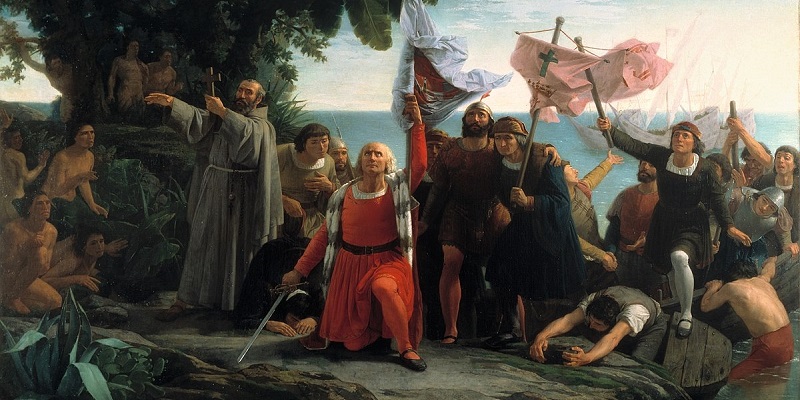
The commemoration of the Fifth Centenary rekindled, as was foreseeable, the stubborn anti-Catholic and anti-Hispanic hatred of old and well-known date. And so much hatred feeds insult, blinds one to justice, and clouds the order of reason, as Saint Thomas explained well in a forgotten teaching. As a result, truth is adulterated and hidden, and resentment and falsehood spread with force. It is not merely, then, a historical or scientific insufficiency that explains the number of impostures thrown into the arena. It is an odium fidei nourished by ideological rancor. A fatal lack of love for everything that bears the sign of the Cross and the Sword.
It would be enough to accept and understand this hidden motive to discard, without more ado, the fallacies that are once again being spread here and there. But an immense and interested power has given them diffusion and a place, and today they are presented as serious arguments of an academic sort. There is nothing of the kind. And as soon as one analyzes the most repeated commonplaces against Spain’s action in America, their inconsistency and weakness become apparent. Let us look briefly at the three inevitable accusations hurled by the left.
The dispossession of the land
It is said, first of all, that Spain appropriated indigenous lands in a typical act of imperialist rapacity.
It is striking that, contrary to Leninist theses, imperialism should be made to arise at the end of the fifteenth century. And the zeal shown in defense of individual private property is likewise surprising. But Marxism has accustomed us to these contradictions and, above all, to its appeal to the Christian conscience in order to obtain solidarity. For, in effect, without the appeal to the Christian conscience — which understands private property as a right inherent in creatures, and only before which the alleged dispossession would be blameworthy — what is the point of so much privatist and possessive eagerness? There is no answer.
The truth is that, before the arrival of the Spaniards, concrete and individual Indians were not owners of any land, but unpaid and punished employees of an idolized State and of despotic caciques regarded as supreme divinities. Lacking any legislation that regulated their labor rights, abuse and exploitation were the norm, and plunder and dispossession the habitual practices. Taxes, burdens, forced payments, violent exactions, and heavy tributes were common currency in indigenous relations prior to the arrival of the Spaniards. The stronger subjected the weaker and held him fast with exemplary punishments and reprisals. Not even the most destitute were excepted, and they often bore, as stigmas of their sad condition, evident mutilations and shameful insignia. A clearly discriminatory “justice” distinguished between the powerful and slaves to the detriment of the latter; and these are not data drawn from Hispanic chronicles, but from the protests of Karl Marx himself in his studies on “Pre-Capitalist Economic Formations and the Primitive Accumulation of Capital.” And from commentators unsuspected of Hispanophilia such as Eric Hobsbawm, Roberto Oliveros Maqueo, or Pierre Chaunu.
The truth is also that the principal owners of the land encountered by the Spaniards — Mayas, Incas, and Aztecs — were such at the expense of other owners whom they had invaded and displaced. And this was the reason why a considerable part of the aboriginal tribes — Carios, Tlaxcalans, Cempoalans, Zapotecs, Otomíes, Cañaris, Huancas, and others — naturally allied themselves with the conquerors, seeking their protection and the consequent restitution.
And the truth, finally, is that only from the Conquest onward did the Indians come to know the personal meaning of private property and the juridical defense of their obligations and rights. It is Spain that raises the question of just titles, with self-demands so solid that they call into question the very authority of the Monarch and of the Pontiff. It is Spain — with that admirable master of the Law of Nations named Francisco de Vitoria — that grounds territorial possession in the highest reasons of the common good and social concord; that insists again and again on the protection owed to the natives as subjects; that guarantees and promotes an equitable distribution of prices; that attends to abuses and disputes; that did not hesitate to punish harshly even its own errant officials; and that distinguished between possession as fact and property as right, because it knew that it was a very different thing to found a city in the desert and make it one’s own than to sack a private granary. For this reason there were repartimientos only on unpopulated lands and encomiendas “on the hereditary lands of the Indians.” For, despite so many ignorant fables, the encomienda was the great institution for the custody of the property and rights of the natives. Silvio Zavala demonstrated this well long ago in an exhaustive study, commissioned not by any “reactionary international,” but by the Jewish Guggenheim Foundation, based in New York. And it is well proven in countless documents that are unknown only to the makers of the black legends.
Through the encomienda, the Indian possessed particular and collective lands without their being taken from him with impunity. Through the encomienda he organized his own local and regional government, under a tribute regime that distinguished incomes and conditions, and that did not reach the King — who renounced them — but the conquerors. For them it did not mean any uncontrolled enrichment; on the contrary, it meant many headaches, as is clear from the testimonies of Antonio de Mendoza or Cristóbal Álvarez de Carvajal and of innumerable judges of the audiencias. As Ramón Carande himself rightly noted in “Charles V and His Bankers,” protection of the Indians was so strict and economic uncertainty for the encomenderos so great that America was not a colony of repopulation where everyone came to enrich himself easily. It was a difficult and arduous enterprise, with lights and shadows, with honest men and rogues, but with a testimony that the indigenist tirades have not been able to overturn to this day: the gratitude of the natives. Whoever has the honesty to verify it and to follow it in its artistic, religious, and cultural expressions will not be able to fail to recognize it objectively.
It is not Spain that dispossessed the Indians of their lands. It is Spain that instilled in them the right of property; that restored to them the hereditary lands seized by the powerful and bloodthirsty tribal states; that kept them under a human and divine justice; that placed them on equal footing with its own children, and even in better conditions than many European peasants and proletarians. And this too has been recognized by non-Hispanist historians. Spain, in short, is the one that rehabilitated Indian authority over its domains; and if one studies how and when this authority was weakened and violated, one will not find behind it the conquest, evangelization, or discovery, but the liberal and Masonic administrations that betrayed the missionary meaning of that glorious deed. One will not find the Catholic Monarchs, nor Charles V, nor Philip II. Nor the conquerors, nor the encomenderos, nor the adelantados, nor the friars. Rather, one will find the enlightened Bourbon apron-wearers and their epigones, who have been uprooting America and reducing it to the colony it never was in the days of the Hispanic Empire.
The thirst for gold
It is said, secondly, that the arrival and presence of the Hispanics had no higher end than an economic one; specifically, the purpose of taking possession of the precious metals of America.
And here Marxism again offers us another aporia. For if we propose the existence of higher motives, we are accused of angelism; but if they see only fallen angels worshiping Mammon, they are scandalized with the blush of cherubim. If economics determines history and the struggle of classes and interests is its internal motor; if men are nothing but transmuted chemical elaborations, set here for earthly enjoyment, without later rewards or punishments, what is the point of this new appeal to philanthropy and charity among nations? Only the Christian conscience can coherently condemn — and does condemn — such outrages. But the complaint has no place in the name of dialectical materialism. We admit it forcefully when looking at time sub specie aeternitatis. It is meaningless in historicism sub lumine oppressionis. It is reproach and protest if we know man to be a “bearer of eternal values,” or homo viator, as the Fathers said. It is cold and irreproachable logic if we never cease to conceive him as homo economicus.
But let us clarify matters a little better.
Let us say, first of all, that there is no reason to hide the economic purposes of the Spanish conquest. Not only because they existed, but because they were lawful. The aim of profit in an enterprise in which one has invested, risked, and worked tirelessly is not at odds with Christian morality or with the natural order of operations. The evil lies precisely in this: when, separated from the Christian sense, persons and nations place financial reasons before all others, exacerbate them to the detriment of honorable goods, and proceed by vile methods to obtain material wealth. But these are, no less, the continuous teachings and warnings of the Catholic Church in Spain. That is why agiotage and usurious practices, lending at interest, the “breeding of money,” and ill-gotten gains were repudiated and admonished. That is why compensation and final reparations were urged — and took place in countless cases; and that is why, above all, stock-market and financial activities were regarded as suspect of anti-Catholicism. We are not the ones who note this. It is materialist historians who have launched this formidable and accurate “accusation”: neither Spain nor the Catholic countries were able to foster capitalism because of their anti-Protestant and anti-rabbinic prejudices. Calvinist and Jewish ethics, by contrast, would have led, as in so many places, to prosperity and development, had the Austrias and Habsburgs set aside their medieval and ultramontane habits.
From this there results a new contradiction. Spain would be very wicked because, while calling itself Catholic, it sought gold and silver. But it would later be even more wicked because of its Catholicism, which incapacitated it from becoming prosperous and led it to an irremediable decline.
Such, in summary, is what Hamilton came to tell us — despite himself — around 1926, with his thesis on “American Treasure and the Rise of Capitalism.” And after him, corroborating or partially correcting him, authors such as Vilar, Simiand, Braudel, Nef, Hobsbawm, Mousnier, or the aforementioned Carande. The gold and silver that left America (it is never said that they did so in payment for goods, products, and structures that came from the Peninsula) did not serve to enrich Spain, but to integrate the European capitalist circuit, chiefly enjoyed by Great Britain.
The makers of black legends, who constantly return to and churn over the thirst for gold as the determining end of the Conquest, should also explain why Spain arrived, remained, and settled not only in mining areas, but in inhospitable and rugged territories. Why the enterprise was not quickly abandoned if the richest mines, such as those of Potosí, Zacatecas, or Guanajuato, were discovered only in the second half of the sixteenth century. Why the condition of the American indigenous peoples was notably superior to that of the European proletariat enslaved by capitalism, as observers in no way Hispanist, such as Humboldt, Dobb, Chaunu, or the English merchant Nehry Hawks — condemned to exile by the Inquisition in 1751 and certainly reluctant to offer Spanish praise — have acknowledged. Why Bravo Duarte could say that all America benefited from mining, but not the Spanish Crown. Why, in short — and we see no argument of greater common sense and therefore of greater metaphysical robustness — if gold alone mattered, the testimony left by Spain’s action in America is not merely a slave market or an enormous financial plaza, but a conglomerate of nations rich in Faith and Spirit. The effect contains and shows the cause: this is the decisive argument. For this reason we do not write these lines from a South American Carthage sheltered by Moloch and Baal, but from the City named for the Most Holy Trinity and the Port of Saint Mary of the Good Airs, by the eminent voices of its founding heroes.
The indigenous genocide
It is said, finally, in keeping with the above, that the Conquest — characterized by plunder and theft — produced an aboriginal genocide, condemnable in the name of the everlasting laws of humanity that govern the destinies of civilized nations.
But such laws, it seems, do not count in two cases: when evaluating the mass crimes committed by dominant Indians against the dominated before the arrival of the Spaniards; nor when evaluating Stalinist purges or the Malthusian initiatives of liberal powers. Of the two cases, the first is truly curious. For the evidence is so undeniable that the indigenist authors themselves cannot keep silent about it. In a single day in the year 1487, 2,000 young people were sacrificed at the inauguration of the great Aztec temple recorded in the Indian Telleriano-Remensis codex. 250,000 annual victims is the number Jan Gehorsam gives for the fifteenth century in his article “Divine Hunger of the Aztecs.” Twenty thousand, in only two years of construction of the great pyramid of Huitzilopochtli, notes Von Hagen; countless numbers swallowed up by the so-called flower wars and cannibalism, according to Halcro Ferguson; and even Jacques Soustelle himself recognizes that the demographic hecatomb was such that, had the Spaniards not arrived, the holocaust would have been inevitable. But what do these unavoidable recorders of pre-Hispanic death statistics say? Something very simple: they were transcendent spirits who thus fulfilled their liturgies and archaic rites. Sacrifices of “a barbarous beauty,” Vaillant will console us. “We must not try to explain this attitude in moral terms,” Von Hagen reassures us; and the theologian Enrique Dussel will offer his liberationist and cosmic reading so that we may all be aggiornati. It is clear: if the Spaniards kill, they are insatiable executioners fattened on the Crusades and the struggle against the Moor; if the Indians kill, they are gentle and simple Las Casas-like sheep expressing the barbarous beauty of their telluric rites. If Spain kills, it is genocide; if the Indians kill, it is called a “threat of demographic imbalance.”
The truth is that Spain neither planned nor executed any genocidal plan; the collapse of the indigenous population — which no one denies — is not linked to armed clashes with the conquerors, but to a variety of causes, among which microbial contagion stands out. The truth is that the accusation of homicide as a cause of depopulation does not withstand the serious investigations of authors such as Nicolás Sánchez Albornoz, José Luis Moreno, Ángel Rosenblat, or Rolando Mellafé, who do not precisely belong to Hispanophile schools. The truth is that “the Indians of America,” says Pierre Chaunu, “did not succumb under the blows of the steel swords of Toledo, but under the microbial and viral shock.” The truth — how many times will it have to be repeated in these times! — is that figures are handled with frivolous lightness, without basic qualitative analyses or the elementary precautions of the statistical disciplines linked to history. The truth even — to say it all — is that even the mitas, repartimientos, and encomiendas, far from being a cause of depopulation, were antidotes applied to prevent it. For here we are not denying that indigenous demography suffered a circumstantial decline. We are denying, yes, and emphatically, that such a decrease was produced by a genocidal plan.
Moreover, if one compares it with Anglo-Saxon America, where the few Indians who remain do not come from the areas colonized by them — where are the Indians of New England? — but are the inhabitants of territories purchased from Spain or usurped from Mexico.
Neither dispossession of territories, nor thirst for gold, nor mass killings. A providential encounter of two worlds. An encounter in which, apart from all the traumatic aspects people may wish to emphasize, one of those worlds, the Old, gloriously embodied by Hispanity, had the enormous merit of bringing to the other notions it did not know concerning the dignity of the creature made in the image and likeness of the Creator. These notions, the patrimony of Christendom spread by eminent sages, were not a dead letter nor the object of constant violation.
They were the true program of life, the genuine salvific plan for which Hispanity struggled through three long centuries of self-sacrificing discovery, evangelization, and civilization.
And if the sword, as Péguy wished, often had to be the one that measured with blood the space upon which the plow could later open the furrow; and if just war had to be the prelude to the song of peace, and the implacable step of the warriors of Christ the painful means necessary to spread the Water of Baptism, it was doing nothing other than ratifying what the apostle announced: without the shedding of blood there is no redemption at all.
The Hispanity of Isabella and Ferdinand did not arrive in these lands with the morbidity of crime and the sadism of outrage. It did not arrive to make victims, but to offer us, amid the worst idolatries, the Immolated Victim, who from the throne of the Cross reigns over the peoples on this side and on the other side of the fearsome ocean.
Source: Revista Arbil
