Protestant denominations during Hitler’s regime
Judeo-Christian Relations
The night of November 9, 1938 left a deep impression on my memory. I was eight years old, and it was the first time I had seen a fire. It was also the first time I consciously perceived a discrepancy between the reassuring and positive Nazi propaganda that we heard and read every day, and a dreadful reality, a reality of death and destruction that would soon reveal itself openly.
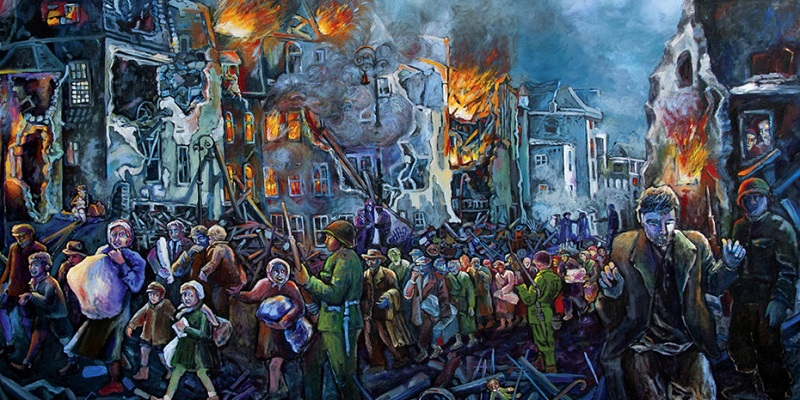
That night I was awakened by the shrill noises that echoed in our narrow one-way street, Georg-Buchholz-Strasse, in Arnswalde, Germany, and I saw the synagogue diagonally across from our house wrapped in flames. In fact, we had never realized that this building was a synagogue, although we attended the church directly opposite it at least three times a week. Perhaps the adults knew it, but they certainly never spoke to us children about it. Did the synagogue have to be set on fire for it to be recognized as the place where Jews worshipped and studied?
When we went out into the street, we saw many people watching the fire. The SA men who had burned the synagogue had already disappeared. But the onlookers knew that the fire had been intentional. The building was attached to a row of small houses. I heard my parents and others commenting indignantly on the fact that the fire department had protected the neighboring buildings, while allowing the fire to destroy the synagogue completely.
My parents also said that the burning of the synagogue was an act of violence against the Jews. I heard them say quietly to one another that the persecution of the Jews was only the beginning. After that they would turn against the “true” Christians. My parents were evangelical, with a Pentecostal orientation, and they believed that only “born again” believers were “true” Christians. They held that people who attended the state churches were Christians only in name. Then the key word that would define that night when synagogues and many Jewish homes and businesses burned began to circulate: “Reichskristallnacht” (Night of Broken Glass). In that context, my parents mentioned another key word for the violent actions that, according to them, would begin against Christians: “Reichssternennacht” (Night of the Stars). I was never able to find out whether the Nazis were really planning such a thing.
Until the burning of the synagogue, I did not know that Jews still existed in our time. In Sunday school and in church they spoke to us only about the Jews of the so-called Old Testament and about those who were supposedly responsible for the death of Jesus and his followers.
My father was a wagon maker in the city of Arnswalde, Pomerania, and, among other things, he made trailers for transporting cattle and horses. After the war I asked him whether he had never had Jewish clients, horse or cattle dealers who needed trailers. Had my parents known any Jews? I never received a direct answer. Only at the end of the 1970s, when my parents were already over seventy, did I once hear my father say, with sorrow: “Why did we not save even a single Jewish life?
Many times after that terrible and memorable night, I recalled the burning synagogue and again saw the books with Hebrew letters amid the flames. Did I ever ask at home what they meant? Would my parents have known anything about the synagogue and its meaning for Judaism, so as to answer my questions? Why did we never learn anything, as Christian children, about the Judaism of our own time? After all, on Sunday mornings we always heard things about the Jews in sermons, children’s stories, and Sunday school. But what kind of Jews were they talking about? Pharisees who opposed Jesus and whom he, in turn, confronted with harsh words; Sadducees and priests who handed him over to the Romans to be crucified. Never a word about the fact that Jesus was and remains a Jew, that the risen Lord of the Church is a Jew, that he himself would have said: “Salvation is from the Jews” (present tense!) (John 4:22).
Here I must include a personal experience from a more recent past: 1984. I was working for the Canadian Council of Christians and Jews, and I was asked to speak at the inauguration of a new synagogue. In those days the so-called “Keegstra case” was being reported in the newspapers. Mr. Keegstra, a secondary-school teacher, had been teaching for fourteen years, without any opposition, that the Jews were conspiring to overthrow the governments of the world, and that the Holocaust was a Jewish invention. I devoted my best efforts to promoting dialogue between Christians and Jews in our city, where we had more than a hundred Jewish Holocaust survivors, many of them camp survivors. The young rabbi of the Orthodox synagogue was a good friend of mine and was actively involved in dialogue at the university and in the rest of the city. Government authorities, the mayor of the city of about 700,000 inhabitants, and representatives of Jewish schools and associations were present and spoke at that event. The place was packed. There was not a single representative of the more than 300 Christian congregations.
When my turn came, I told the story of the burning of the Arnswalde synagogue and described the enormous feeling of gratitude that overwhelmed me at that moment: God had allowed me to attend the inauguration of a new synagogue, which in my subjective experience rose upon the ruins of the synagogue of my memory. “The Germans did not succeed in carrying out the Nazis’ ‘Final Solution.’ In the face of two millennia of anti-Judaism and antisemitism in Christian countries, a new shul stands, a sign of Jewish chutzpah, fidelity, and hope, an invitation for Christians finally to find their elder brother. We are all witnesses to this,” I concluded. The thunderous applause that followed my brief remarks left me stunned and with a mixture of pain and joy. Pain, because a new synagogue built in a free country can never compensate for an annihilated synagogue, and because a small struggling Jewish congregation can only be a faint reminder of the great Jewish communities of Europe that were brutally destroyed. But I also experienced joy. The rabbi embraced me, and the persistent applause seemed to express a spirit of gratitude for the fact that nothing in this world was capable of destroying what God wills and loves. At that moment I felt, for the first time in my life, that it was good to be German, if only to deliver that small message to the Jewish people who had suffered so much in the name and at the hands of the Germans. When I think of the stories some Jewish survivors told me, I wonder how I can survive as a Christian, how Christianity can survive, if it does not repent of its inveterate anti-Judaism.
On the 50th anniversary of Kristallnacht, in November 1988, Jewish students from the university in our city called me to take part in a panel discussion on the events of the Night of Broken Glass. The respectful but probing questions of the younger generations of Jews could be answered at that moment, fifty years after the Holocaust, with a certain academic rigor and objective distance. But behind them there were, and still are, other unavoidable questions. For example: where were Germany’s Christians? Very few of them ever prayed for the Jews. Throughout my childhood, I never heard a single prayer for the Jewish people in the evangelical churches we attended. Did we not see them, first in the streets with their yellow stars on their clothing, and later in rows of emaciated prisoners working to repair the railway tracks and other war damage? And when we stopped seeing them, because they had been sent to their deaths in the camps, why did we not notice? Where were the “true” Christians, the “born again,” and all those who had not fallen into the trap of the so-called “German Christians” who had been “de-Judaized”?
And where was God? Was God in Auschwitz, where Jesus was? If the first councils of the Church and their creeds were right in saying that Jesus Christ is God-man, the risen person with two natures, is not his human nature Jewish? This means that he not only was a Jew, but that Christians confess the risen Christ as a Jew who is seated at the right hand of God today, and as such is the representative of all humanity before God. “What you did to the least of my brothers (the Jewish people), you did to me,” Jesus would have said. But many Christians still continue to accuse the Jews of having killed him. Should we not instead admit that Jesus Christ is mocked in every mistreated Jew? These are questions I ponder as a layman who has never received anything but half-hearted answers from those who ought to know.
The evangelical congregations in which I grew up were not aligned with the State, as the Protestant churches had been from their very beginnings in the Reformation. Nevertheless, despite their attitude against the state churches, they were no less anti-Jewish than those churches. Each individual struggled to attain a personal relationship with God and to obtain his salvation. In that struggle, the only victor had to be God, not the believer; and thus faith was expressed in obedience, an obedience that allowed questioning neither God nor the State. When one became a believer, the struggle ended, and only submission to the will of God remained, manifested, with regard to grace, through the Church, and, with regard to justice, through the State. The Lutheran teaching on the two kingdoms regarded the State as the left hand of God’s justice, and the Church as the right hand of God’s mercy. Faith had to accept these two aspects of divine government without question. For Luther, a revolt of believers against the State would have been unthinkable, even a grave sin against God. Luther firmly opposed the peasant revolt of 1525, although he also condemned the princes against whom the peasants protested, because they were completely corrupt. Luther said that a Christian could be an executioner who expressed God’s judicial wrath upon the criminals of society and, at the same time, a loving and compassionate person in his private life (Paul Althaus: Die Ethik Martin Luthers). These two spheres of the world were to complement each other.
In dialogue with Jews, I discovered that in Judaism faith always remains a trusting struggle with God and a questioning of the Scriptures and of all authority. In the biblical account of Jacob’s struggle, it is Jacob who emerges victorious, not God. “You have struggled with God and with men and have prevailed” (Gen 32:24-32).
For more than 1900 years, Christians described Jews as legalists and diametrically opposed to the Christian gospel. From the second century on, Christian theology defined Jews as anti-Christian, spiritually blind, and theologically irrelevant. Although the Nazis had their own motives for killing the Jews, they undoubtedly made use of the Christian image of Judaism and the Jewish people. During the Holocaust, Christians in general, and especially the more committed believers (that is, those who had a deeper knowledge of Christian teaching), were paralyzed by their own theology and were unable to stand up to the murderous State.
After the war, I read in Pietist, Baptist, and Pentecostal publications from the Nazi period articles written by leaders of those movements exhorting their faithful to be loyal to the German State and its authorities, “in difficult times like these.” They based their exhortations on biblical references (in a way very similar to that of the Lutheran Church), especially on Romans 13:1 ff., although they never went as far as the so-called “German Christians” in glorifying Hitler and the Nazi system.
In the Constitution of the German Pentecostal Church that we attended as children with our parents, there was an article whose revision was carried out in accordance with the Nuremberg Laws of 1936: it referred to the euthanasia of “worthless” life, the sterilization of persons with severe congenital diseases, and the elimination of Jews from Germany. That revision came into force on October 13, 1938, only 27 days before Kristallnacht. Although the evangelical Churches accepted Hitler’s regime as divinely ordained, they still remain very reluctant to admit their guilt.
Article 7
Attitude of the Church toward the people (Volk) and the State (Reich)
Giving thanks to God, we confess that, according to his providence, we are members of the German people. Subordination to God and the spirit of Jesus Christ enable us to stand with our people (Volk) in body and soul, with our possessions and our blood. Energetic support for all public efforts of the People’s Welfare system is for us the duty of our Christian conscience.
We honor and accept the leaders and the government of the nation. We sincerely promise all our loyalty and obedience, which we feel obliged, together with all Christians, to render to our earthly authorities according to the will of God and the word and spirit of our Lord (Mk 12:17; Rom 13:1-7; 1 Tim 2:1-4; 1 Pet 2:13-17).
We recognize that the authorities of the people obey the order of the divine Creator when, with wisdom and justice, they issue suitable laws and regulations to set a limit to incurable congenital diseases and their corresponding miseries, which in the past were visible in the body of the people (Volk). In cases where our superintendents and ministers of the spiritual Word must give information and counsel to those affected, they declare themselves absolutely prepared to do so.
In the racial laws we see a divinely willed and biblically grounded effort to purify and keep the people (Volk) pure from mixture with alien races.
The transfer of the Jews out of the community of our people, as also of other peoples, is for us a process that is in accordance with divine providence and the divine will
It would not be fair to place the weight of guilt for the persecution of the Jews and for other Nazi atrocities on the shoulders of individuals such as my parents. Nevertheless, all of us Germans, and especially all of us Christians, must assume responsibility for the things that were done in our name without opposition from our parents and without any objection on the part of the majority of committed Christians.
Personally, I consciously live, and for the rest of my life, in the shadow of the slaughter of millions of Jews. Every time I evoke that monstrous evil, I cannot help lamenting: My God, my God, we allowed your people to be massacred… More than a million children: Mein Gott, die Kinderchen, die Kinderchen…! (My God, the little children, the little children…!)
Must I give up believing in a God who loves? Should I stop believing in Jesus, because he has been turned into a wall of hostility between Jews and Christians, instead of breaking down that wall (Eph 2:14)? Must I convert to Judaism or give up religion altogether? I have decided to remain faithful to the commitments I made early in my life to God, and to Jesus as God’s way for non-Jews to gain access to the God of Israel. This fidelity requires repentance for the false witness against Jews and Judaism (and other religions), intensive learning, and a rethinking of Christian theology in dialogue with Jews and with other Christians. This is not at all easy for a layman without formal theological training. But who said that life, and especially the life of faith, was easy?
I have also asked myself about my relationship with the Christian Church, with its tradition and its life. I cannot be a Christian without being part of the universal Church in one of its many local manifestations. I repent, I rethink things, I study, I dialogue, and I bear witness as a member of the Church, in the hope of doing my part to reform teaching and attitudes toward Judaism and the Jewish people. The leaders of the official Churches are slowly changing their attitude. But it seems that for most of their members this change will take generations. May God help us hasten our collective transformation. This will be my prayer on November 9, when I remember the destruction of the small synagogue of Arnswalde.
Author: Fritz B. Voll
Translator from English: Silvia Kot
