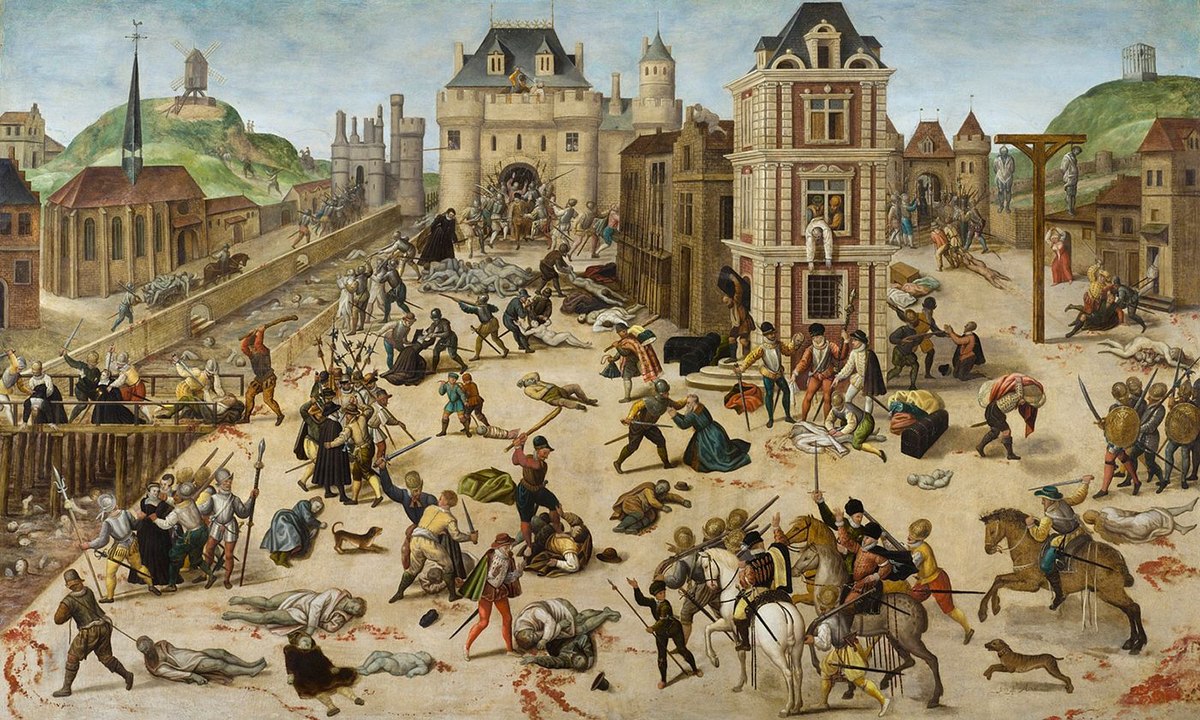
Several wars of religion had strewn the soil of the whole French nation with corpses; nevertheless, a reconciliation, more apparent than real, offered the combatants a truce, which the Calvinist admiral Coligny and other leaders summoned to court used to secure the favor of King Charles IX, while at the same time awakening in him an aversion toward the queen mother, Catherine de’ Medici. From 1571 the influence of Coligny in the councils of the Crown was manifest; and to secure internal peace, the marriage of the Calvinist Henry of Navarre to Margaret of Valois, the king’s sister, was arranged. The wedding, celebrated on August 18, 1572, drew to Paris a great number of Huguenots (heavily armed), whose leader, Coligny, was already on the point of seeing fulfilled his desire to remove Catherine completely from affairs of State.
Imprudent threats escaped from the lips of Coligny, and Catherine, who was not scrupulous in her choice of means, sought to resort to the dagger to rid herself of the admiral. The crime was to be committed on August 12, but it failed; and Catherine, fearful of reprisals from the Huguenots, instigated the French people, in order to avenge the outrages so often received from the Calvinists, to put to the sword in one night all the Huguenots gathered in Paris. This general massacre took place on the night of August 23 to 24, the feast of Saint Bartholomew, from which it took its name. Similar murders took place from August 25 to October 30 in other cities of the kingdom, either at Catherine’s instigation or by following the example of Paris. These are the facts, as they emerge from irrefutable documents.
Number of victims
As for the number of victims, it is almost impossible to state it precisely. Nevertheless, the most exact figure seems to be that of the Calvinist La Popelinière, who raises it to 2,000 and a little more for all France, and to only 1,000 for Paris. Besides, the Protestants have fantasized at will about the number of their co-religionists killed at that time. Some indicate 10,000, others 15,000, others 30,000, others 40,000, others 70,000, and there is no lack of those who make this figure reach 100,000. The Martyrology of the Calvinists, printed by the sect in 1582, speaks of 15,168 victims, but names only 768, and yet the author had every interest in increasing this number.
Religion is foreign to this murder
Whatever, then, may be the more or less exact figure of the wretched victims of so execrable a murder, it is certain that Religion is completely free from responsibility in this fact. The king justified the slaughter of the Huguenots by saying to Parliament on the following day that this bloody deed obeyed the design of stifling a conspiracy plotted against the life of the king and his family, which could only be avoided by the killing of the conspirators. This is what was made known to foreign governments, and in the very court of England, allied with that of France, full credit was given to these rumors. Since the same reports were supplied to the court of Rome by the French ambassador, Gregory XIII ordered the celebration in Rome of a feast of thanksgiving because the royal family had escaped unharmed and because of the preservation of the Catholic religion in France, but he showed himself profoundly displeased not only by the blood shed, but also because the usual judicial procedures had not been employed with the rebels.
In the King’s Councils there intervened, according to the duke of Anjou (later Henry III), the king, the queen, Madame de Nemours, Marshal de Tavannes, the duke of Nevers, Birague, de Retz, etc., but not a single cardinal, nor a bishop, nor even a priest appears here. From this the bad faith of Voltaire is evident, since he introduced into the Council Cardinals Birague and Retz. Marshal de Retz, Albert de Gondi, a councilor in 1572, lived and died a layman. His brother Pierre de Gondi, bishop of Paris, obtained the cardinal’s purple in 1587, but he was not of the Council. Birague, keeper of the seals and councilor in 1572, was a layman and married; and he did not obtain the cardinal’s purple until six years later, in 1578, at the request of Henry III. And since the cardinal of Lorraine was at that time in Rome, how could he bless in Paris the daggers destined for the slaughter of the Huguenots, according to the scene by Chenier in his Charles IX and by Scribe in his Huguenots?
What can be affirmed with truthful and impartial history is that the Catholic clergy, during the massacres, fulfilled the sacred duty of their ministry. There is, for example, the noble conduct of Hennuyer, bishop of Lisieux, who by his firmness saved all the Huguenots of his diocese. The martyrology of the Protestants, in no way suspect of wishing to praise Catholics, cites several facts of this kind: “In Toulouse, it says, the convents served as asylum for the Calvinists; in Bourges some peaceful Catholics hid several; in Romans, of sixty who were imprisoned, they freed forty, and of the other twenty no more than seven died; in Troyes, in Bordeaux, many were likewise saved by the priests”. In Paris, the persecuted Huguenots likewise found protectors among Catholics, and in Nîmes, forgetting the outrages of Saint Michael perpetrated by the Protestants, there were hearts generous enough to defend the Calvinists from a massacre authorized by example, but in no way permitted by Religion.
Finally, that this event, as lamentable as one may wish, had an exclusively political character and was for that very reason wholly foreign to Religion, is proved by a document discovered in 1885 in the Vatican archives, which proves absolutely what we have been saying about this troublesome matter. It is a manuscript account of an assembly of justice held by Parliament, with the king in attendance, on August 26, 1572, that is, two days after the massacre. That account contains a passage that sheds definitive light on the scope of the slaughter of the night of Saint Bartholomew. Here is the translation: “In this assembly King Charles declared that, thanks be to God, he had discovered the snares that Admiral Gaspard de Coligny was laying for the king’s government, going so far as to threaten a catastrophe and death to the whole royal family; and that, having treated both him and his accomplices as they deserved, he wished that in the future this deed should not be imputed as a crime to those who had been the most faithful ministers of so just a vengeance, since they had acted only by the pure will, command and order of the king”.
This same document relates that the executions carried out on August 24 were nothing but just reprisals against the machinations of the Huguenot faction, which two hours later were to make victims of the members of the royal family. It established, secondly, that the executions ordered by Charles IX took on the character of slaughter only through the people of Paris, irritated against the factions. Finally, it mentions the formal prohibition made by the king to this same people of Paris, “of homicides, deeds of blood, pillage and plundering of the goods of the Huguenots”, without the intervention of Parliament and of the public magistrates.
Such were the notifications that were taken to Rome, from which it follows that what Rome intended to celebrate was not the murder of heretics, but the end of the threat to the royal family, the liberation of the kingdom and, without doubt, as a further consequence, the end of a formidable civil war.
Author: Cristiandad.org
