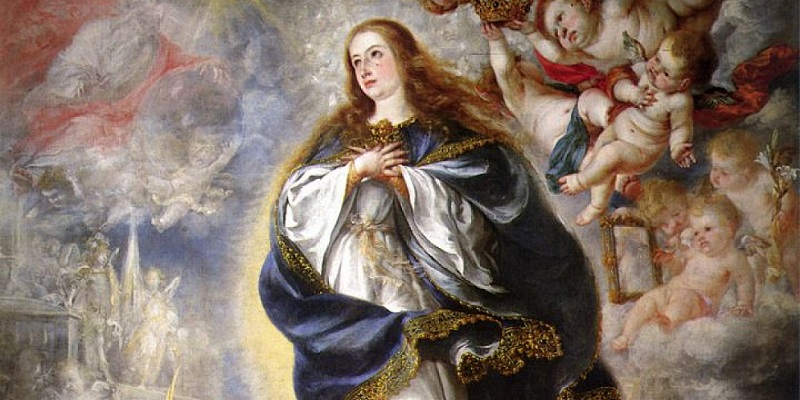
1.- Do the dogmas of the Church evolve? This could be the question that the reader asks himself. Yes and no. They do not evolve in their content, that is, what is true today will not be false tomorrow or in a century; but without evolving in what they affirm or deny, they can and do evolve in the consciousness that the Church itself is acquiring about them. To make a comparison, each dogma (which is worth the same as a truth revealed by God) is a little seed that Christ himself has sown in the fertile field of his Church; seed that germinates, grows and develops when circumstances favor it. But, in our case, the temper is given by the Holy Spirit himself, that spirit of truth of which Christ said to the Apostles: “When I am gone, He will guide you and teach you all truth, reminding you of everything I told you.” Not everything Jesus did or said was written down, nor was everything taught by the Apostles who received the deposit of faith from Him. But nothing was lost. Part of his teachings, the unwritten ones, remained as if in the subconscious of the Church, and emerges when the hour of Providence strikes, in such a clear and patent way that many times it cannot be drowned out even by the authority of the Doctors, as in the case of our dogma.
2.- Because the dogma of the Immaculate Conception of Mary is one of the classics to demonstrate the immanent force that carries all divine doctrine deposited in the plot of God, which is the meeting of the faithful with their Pastors and the Roman Supreme Pontiff, who presides over them.
3.- We are going to verify it in the History of dogma. This being not one of those that Holy Scripture records with absolute clarity, it was necessary, to arrive at its definition, to scrutinize what tradition taught and turn to the common sentiment of the Church.
I.- The Immaculate Conception in the first centuries
In the first centuries of Christianity, the Holy Fathers did not set themselves the problem of the Immaculate Conception of Mary. Remember what we have said in the first chapter of our Treaty, in this regard. But the doctrine about the privilege of Mary is contained, like the tree in the seed, in the teachings of the Fathers themselves when they contrast the figure of Mary with that of Eve in relation to the fall and reparation of the human race; by exalting, with highly commendable words, the admirable purity of the Virgin; and when dealing with the reality of her divine motherhood. Three principles of science about Mary that the first Doctors of the Church left firmly established.
1st The principle of recapitulation
1.- With these words: principle of recapitulation, recirculation or reversal, The patristic doctrine on the divine plan for the salvation of the human race is known.
2.- The ancient Fathers’ attention was powerfully attracted, no less than us, by the beautiful prediction about human Redemption contained in the Protoevangelium. And Saint Paul having written that Christ is the new Adam, they effortlessly completed the parallelism, contrasting Mary with Eve. There will hardly be a Holy Father who does not make use of this resource when speaking of the Redemption. And the doctrine is so constant, the principle so universal, that it is not possible not to admit that it springs from the same apostolic tradition.
3.- Let us quote, for all of us, Saint Irenaeus: «Just as that Eve, having Adam as a man, but still remaining a virgin, disobedient, was the cause of death, so also Mary, already having a predestined man, and yet an obedient virgin, was the cause of salvation for herself and for the entire human race… In this way, the knot of Eve’s disobedience was loosened by Mary’s obedience. “What the virgin Eve bound by her disbelief, the faith of the Virgin Mary loosed.” That is to say, just as a knot is not untied except by passing the ends through the same place, but in reverse, so the redemption was carried out in an identical way, but in reverse of the fall.
4.- This parallelism, which contains two aspects, similarity and contrast, is repeated, as we have just said, as a basic principle when dealing with Mary. And as is easy to understand, it does not reach its full force except by placing the extremes of the contrast in equal circumstances: Eve, virgin and innocent, is the cause of the ruin of the human race; Mary, Virgin and innocent too, cause of his salvation; Eve, adorned with grace from the moment of her existence, claims, in comparison, Mary, also with grace from the first moment of her being.
The legitimacy of the principle of recapitulation has been declared by Pope Pius IX in his dogmatic Bull on the Immaculate Conception.
2nd Exaltation of the purity of Mary
 1.- A unanimous chorus of voices proclaims Mary most pure, without stain, the most sublime of creatures, etc In this universal acclamation of Mary’s purity there must necessarily be a general principle that drives it. The Holy Fathers of ancient times were not much more informed than we are about the life of the Virgin. What moves them, then, to affirm with such emphasis, with such certainty, that Mary does not admit of comparison in her greatness and moral elevation with any creature? Her divine Motherhood. Evidently, his praise stems from the principle that Saint Anselm later formulated: “The Mother of God should shine with such purity that it is not possible to imagine greater than that of God.” Now, to admit their Immaculate Conception, if they asked the question, they did not need to change course. It was enough to draw the consequences of the established and accepted principle.
2.- Let’s read some of these praises dedicated to the Virgin.
Saint Hippolytus, martyr, says: «Certainly the ark of incorruptible wood was the Savior himself. And by this ark, free from rottenness and corruption, is meant his tabernacle, which did not engender the corruption of sin. For the Lord was free from sin and was, as a man, clothed with incorruptible wood, that is, with the Virgin and the Holy Spirit, inside and out, as with the purest gold of the Word of God. And elsewhere he calls Mary, “all holy, always Virgin, holy, immaculate Virgin.”
In the minutes of the martyrdom of Saint Andrew, an apostle, we read these words that the Saint addressed to the Proconsul: “And since the first man was formed from the earth, who through the prevarication of the old tree brought death to the world, it was necessary that, from an Immaculate virgin, the Son of God should be born a perfect man, so that he could restore the eternal life that men lost through Adam.” Although these records, as some believe, are not genuine, that is, contemporary with Saint Andrew, they are of venerable antiquity and attest to what was then thought of the Blessed Virgin.
Saint Ephrem of Syria, surnamed Harp of the Holy Spirit, sings to the Virgin in this way: «Certainly you (Christ) and your Mother are the only ones who have been completely beautiful; For in you, Lord, there is no defect, nor in your Mother any stain. And in other places he calls Mary, Immaculate, incorrupt, holy, removed from all corruption and stain, much more resplendent than the sun, etc.
Saint Ambrose puts it on the lips of the sinner: «Come, then, Lord Jesus, and look for your weary sheep, look for them, not for the servants nor for the mercenaries, but for yourself. Receive me, not in that flesh that fell in Adam. Not of Sarah, but of Mary, incorrupt virgin, complete and clean from every stain of sin.
And Saint Jerome: “Propose as a model the glorious Virgin, whose purity was such that she deserved to be the Mother of the Lord.”
The list could be much longer. The conclusion is the following: the Holy Fathers do not propose the question about the Immaculate Conception, but the praise they direct to the purity of Mary is such that, if the question had been raised, they would have arrived at the truth by the same path they followed. And of course, what drives them to such unanimous and fervent praise of Mary’s purity is the existence of a tradition that can be described as apostolic, derived from the teachings of the Apostles.
II.- The Immaculate Conception until the Middle Ages
From the 4th century onwards, the Western Church did not match the Eastern Church in professing the Immaculate Conception of Mary. The Nestorian heresy that directly attacked, unique in history, the maximum prerogative of the Virgin, her divine motherhood, and that was spreading in the 5th century, offered more frequent occasion and even necessity to exalt the sovereign figure of the Blessed Mother of God; while in the West, at this same time, the heretic Pelagius disfigured the concept of original sin and its disastrous consequences on men, so the Fathers were forced to deal with the universality of sin rather than with the glorious exception that the Virgin represents.
Let’s read some testimonies from both Churches.
1st The Eastern Church
1.- In the Eastern Church we find the strong defender of the divine motherhood of Mary, Saint Cyril, who writes: “When has it ever been heard of an architect building a house and letting his enemy occupy it?” The idea of the Immaculate Conception cannot be expressed more clearly.
And Theodotus of Ancyra: “Innocent virgin, without stain, holy in soul and body, born as a lily among thorns.” And elsewhere: “Mary surpasses the seraphim and cherubim in purity.”
Proclus, secretary of Saint John Chrysostom, in the same 5th century, says of Mary that she is formed “of clean clay”, that is, of human nature, but uncontaminated.
2.- In the 6th century, we read in a hymn composed by Saint James Nisibeno: “If the Son of God had found in Mary a stain, any defect, without a doubt he would choose a mother free of all filth.” And he describes the holiness of Mary as “Justice never broken.”
Saint Theophanes praises Mary like this: “Oh, uncontaminated from every stain.” And elsewhere: “The most pure Son of God, as He found You alone most pure from all stain, or totally immune from sin, begotten from Your womb, cleanses believers from sins.”
Saint Andrew of Crete: “Fear not, you found grace before God, the grace that Eve lost… You found the grace that no other found like You ever did.”
And in the letter to Sergius, approved by the VI Ecumenical Council, Sophronius says of Mary: “Holy, immaculate in soul and body, totally free from all contagion.”
From now on, the word Immaculate, Most Pure, no longer refers directly to the virginity of Mary alone. As the centuries progress, the idea of the Immaculate Conception becomes more precisely outlined.
And so in the 8th century we can read these very clear words of Saint John Damascene: “The serpent (Mary) had no entry into this paradise, by whose desire for false divinity we have been likened to beasts.”
In the 9th and 10th centuries the spotless Conception of Mary is outlined even more clearly. Saint Joseph the Hymnographer: “Immune from every stain and fall, the only Immaculate, without stain, alone without stain,” says of the Virgin.
And Saint John the Geometer in a beautiful verse: «Rejoice, You, who gave Christ the mortal horn; rejoice, You, who were free from the fall of the first man.
It is not necessary to continue because from now on the word Immaculate, among the Orientals, already has a precise and concrete meaning: the exemption of Mary from original sin. Furthermore, since the 7th century the Eastern Church celebrated the feast of the Immaculate Conception, although it was not universally. Regarding the meaning of the festival, let us hear from Saint John of Euboea: «If the dedication of a new temple is celebrated, how can this festival not be celebrated with greater reason when it concerns the building of the temple of God, not with foundations of stone, nor by the hands of man? The conception is celebrated in the womb of Anna, but the Son of God himself built it with the good pleasure of God the Father, and with the cooperation of the most holy and life-giving Spirit. As will be seen, these words mention the creation of Mary and, likewise, her sanctification, as implied by the allusion to the Holy Spirit to whom it is appropriated.
2nd In the Western Church
1.- In the Western Church, the process leading to the clear and clear confession of the Immaculate Conception of Mary was slower due to special circumstances that hindered it. But the concept that the Holy Fathers claim to have of the spiritual and moral greatness of the exalted Mother of God does not detract from or yield in any way to that of the Orientals. The admission of a stain on Mary would have produced in the West, as in the East, a scandal among the faithful, and would have clashed with the idea that was professed about the exemplary sanctity of the Blessed Virgin. And in fact, the heretic Pelagius used this to attack his opponent Saint Augustine, in the discussion about the original sin that he denied. Julian, a disciple of the heretic, wrote to the Bishop of Hippo: “You hand Mary over to the devil by reason of birth”, that is, if you affirm that original sin is transmitted by natural generation, Mary was a subject of the devil, because in this way she descended and in this way she was conceived by her parents.
To this the Holy Doctor replied: “The condition of birth is destroyed by the grace of rebirth.” It is disputed whether, with these words, the holy Bishop admitted the Immaculate Conception. But it is true that our Doctor teaches that current sins They have their origin in original sin. “No one, he says, is without actual sin, because no one was free from the original.” Now, he believes that Mary had no actual sin. “Except the Virgin Mary, of whom I do not want, for the honor due to the Lord, to raise any question when it comes to sin… If we could gather together all the saints… when they lived here, is it not true that they would have unanimously exclaimed: If we said that we had no sin, we deceived ourselves and there is no truth in us?” Thus, according to the principle established by the Holy Doctor himself, we must conclude that Mary lacked original sin.
At this same time, around 400, we find the greatest Christian poet Prudencio who, interpreting the faith of the Church in the spotless purity of Mary, sings in selected verses: «The infernal viper lies, its head crushed, under the feet of the woman. For that virgin, who was worthy of begetting God, the poison is dissolved, and writhing under her soles, she vomits helplessly her poison onto the green grass.
2.- In the 5th century, Saint Maximus writes these words: “Mary, worthy abode of Christ, not because of the beauty of the body, but because of original grace.”
Unlike what happens in the East, in the West, as the centuries progress, people speak with greater caution about this matter. Not that the belief in the Immaculate Conception of Mary is completely clouded, since we know that her feast soon began to be celebrated, but that the ecclesiastical authors, by the authority of Saint Augustine, whose opinion on this mystery is doubtful, and faced with the need to defend the true dogma of the universality of original sin and its consequences, are constrained rather to deal with this point than to establish and illustrate the exception that Mary constitutes to the universal law of sin.
Good proof that faith in this glorious privilege of Mary was not obscured is provided by the Liturgy. It is said that in the 7th century, and by the work of Saint Ildefonso, Archbishop of Toledo, the feast of the Immaculate Conception was already celebrated in Spain. Some, however, doubt the authenticity of the document on which those who defend it rely.
But it was certainly celebrated already in the 9th century, as appears from the marble calendar of Naples, which reads: “December 9, the Conception of the Holy Virgin Mary.” The date of the celebration (the same one that the orientals celebrate it) indicates that the festival transmigrated from the East, with which Naples maintained an intense commercial relationship. This is not the only evidence that remains of the liturgical celebration. From the calendars of the 9th, 10th and 11th centuries we know that it was also celebrated in Ireland and England.
3.- But, despite the liturgical celebration, the meaning of the solemnity was not theologically fixed. And it does not cease to attract attention that it was the Saint perhaps most devoted to Mary who curbed the impulses of the Christian people, provoking the most bitter theological discussion in the history of dogmas. I mean Saint Bernard.
Having heard that the monks of Lyons, in 1140, introduced the festival, the Holy Abbot wrote them a very vehement letter, condemning what he calls an innovation “ignored by the Church, not approved by reason and unknown by ancient tradition.” The letter is one of the best documents to prove the Saint’s great devotion to Mary. Every time he mentions it, his pen oozes unction, and with the inimitable grace of style that characterizes him, he convinces the reader that in all his reasoning there is not even a shred of passion. He challenges the privilege because he believes he should do so.
Despite the enormous prestige of the holy Doctor, his letter did not go unreplied. The first to respond to it, Pedro Comestor, already notes St. Bernard’s confusion on the matter, and distinguishes between conception of the one who conceives, that is, the act of the parents, and the conception of the being conceived, That is, the active and passive conception, which we have already defined before. Nor was there a lack, as in every controversy, of the harsh and fiery phrase on the part of the contradictor: “Twice – wrote Nicholas, a monk of Saint Alban – the soul of Mary was pierced: in the Passion of her Son and in the contradiction of her Conception.”
Although Doctor Melifluo’s letter could not prevent the spread of the festival, which became more popular every day, it projected an unsuspected influence on the theological discussions of subsequent centuries.
III.- Controversy of the Scholastics until Blessed Scotus
1.- The 13th and 14th centuries are those of the maximum splendor of the divine science called Theology. Those who cultivated it are called Scholastics, and there were several important centers, among the most illustrious, the Sorbonne in Paris and the University of Oxford, in England. When the Scholastics commented on the “Book of Sentences” by Pedro Lombardo, which served as a manual and guide to give their lessons, they came across the question of the Conception of Mary. The Doctors of Paris leaned towards the Maculist opinion, and those from Oxford towards the Immaculate one, that is, they excluded Mary from the common fall of the sin of origin. The victory was left to the latter, and specifically to Blessed Scotus, its highest exponent and representative.
2.- In Paris, the Masters pose the question in these terms: When was the Virgin Mary sanctified? Santificada here it is equivalent, as will be seen from the context of the whole question, to purificada. Therefore, in the very statement of the problem something is already given as presupposed and certain: that there was something in Mary that needed purification. The reason for proposing the problem in these terms is the error contained in the “Book of Sentences” that they commented on. The error consisted of affirming that original sin is identified with the lust of the flesh, which corrupts and stains the soul. And they gave an example: As the filth of the container causes the sweet wine to turn into vinegar, so the lust of the flesh, which is transmitted by natural generation, stains the purity of the soul. In his concept, original sin had two elements: one material, which is the lust of the flesh, and another formal, what is properly called sin, which is the lack of grace.
Starting, then, from the principle that the flesh, infected by natural generation, in turn infects the soul, the Doctors of Paris ask themselves: When was Mary sanctified, that is, purified from this infection inherent to the flesh?
3.- The first to raise the question in these terms is Fray Alejandro de Halés. He lays down the principle that “it was given to Mary when it could be given,” but he does not draw all the consequences that follow from it. And following the opinion that we have just expressed about original sin, it is asked if Mary was santificada in their parents, answering no, because although they were very holy, their holiness could not be transfused into the flesh they conceived. He continues to investigate whether Mary’s flesh was purified before her soul entered and was infused into it, and resolves that neither, because the flesh cannot be the subject of any holiness or any grace. He continues by questioning whether it was sanctified at the very moment the soul was infused into the body, and also leans towards the negative. The conclusion is that she was sanctified after conception, although before being born, because if this was granted to Jeremiah and the Baptist, “what was granted to others cannot be denied to such an excellent Virgin.”
4.- Continue along the same path, and with a more energetic conclusion, Doctor Saint Albert the Great. This believes it is by faith that Mary was conceived in original sin, since the Scriptures, in the famous text of Saint Paul, teach “that in Adam all sinned”, and if all, then also She.
5.- The two colossi of theological science, who continued the teaching work of the two already mentioned, continue, although more expeditiously, along the same path. They are St. Thomas and Saint Bonaventure.
The Angelic Doctor, St. Thomas, insistently affirms and repeats in several parts of his works, written at different times, that Mary contracted the sin of origin. Let us only quote what he writes in his greatest work, “The Suma.” “To the first question whether Mary was sanctified before receiving the soul,” he answers no, because guilt can only be erased by grace, whose subject is only the soul. “To the second, that is, if it was at the time of receiving the soul,” he answers that it must be said that “if Mary’s soul had never been stained with original sin, this would derogate from the dignity of Christ which lies in being the universal Savior of all. And thus, under the dependence of Christ, who did not need any salvation, the purity of the Virgin was maximum. Because Christ in no way contracted original sin, but was holy in his very conception, according to that of Saint Luke: “He who is to be born of You, holy, will be called the Son of God.” But the Blessed Virgin certainly contracted original sin, although she was cleansed of it before birth. And elsewhere he asks when she was sanctified, and answers: «Shortly after its conception.
These very clear words have recently been given a different meaning, making a thousand balances so that they mean that St. Thomas did not deny Mary’s privilege, as if denying it then would imply some defect. The Holy and highly praised Doctor would gladly laugh at the intellectual acrobatics of some of his commentators.
Saint Bonaventure timidly hints at the true solution to the question, but explicitly declares himself a supporter of the Maculist opinion. After exposing the common opinion, he writes: “Some say that in the soul of the Blessed Virgin the grace of sanctification was ahead of the stain of original sin… This means, according to them, what Saint Anselm says of the Blessed Virgin: that Mary was pure, with such a high purity that no greater, apart from that of God, can be imagined. This is not repugnant to the Christian faith, because the Virgin herself was freed from original sin by the grace that depended on and had its origin in Christ, like the other graces of the Saints. These were raised after they had fallen, the Virgin was supported in the act of falling so that she would not fall, according to the aforementioned opinion. No one had yet expounded in Paris so clearly, nor intimated with such precision, the arguments in favor of the Immaculate Conception. But Saint Bonaventure leaned towards the opposite. Tyranny of reason that prevailed over the desires of love.
4.- The task of defending Mary’s privilege was not reserved for the Doctors of Paris. When the doctrine contrary to the Immaculate Conception was current among theologians, corroborated by the authority of the great teachers, “the providential Doctor that God sent to the Church for this case came to the fore,” said the ancient Office of the Immaculate: Blessed John Duns Scotus.
IV.- The intervention of Doctor Mariano
1.- Blessed John Duns Scotus was born in Maxton (Scotland), from the noble Duns family. He trained at the University of Oxford, and taught theology there and in Paris. Upon arriving in Paris, the question about the Conception of Mary was definitively aired and resolved in the negative. His doctrine on Mary’s exemption from all sin clashed with the prevailing atmosphere at the University, and, according to the style of the time, he had to defend his opinion in a public dispute with the university’s doctors. The resounding triumph he achieved, measuring his ingenuity and knowledge with the most renowned Masters, made that scientific discussion extremely famous in the annals of the University and even of the Church. Legend and tradition, as usual with transcendental events, have adorned it with a thousand beautiful details. The ecclesiastical chronicles assure that, when the Doctor passed through the cloisters of the University for the discussion, he prostrated himself before an image of Mary, imploring her help, and that the marble image bowed its head. In the main hall of the University, all the Masters were waiting for the Doctor. The Assembly was presided over by the Pope’s Legates, present at the time in Paris to negotiate certain matters with the King. Whatever this may be, tradition tells us that two hundred arguments were opposed to Doctor Mariano, which he refuted and pulverized after reciting them one after another from memory. The number of arguments, even if it did not reach two hundred, was large, because fifty can be collected from the fragments of the dispute that have come down to us. The most noble Assembly rose unanimously acclaiming him the winner. A similar defense of Marian privilege took place in Cologne, where the triumph achieved by the Defender of Mary was such that even children hailed him in the streets: Victor Scotus!
All these details of the legend demonstrate the impression that the Scotist defense made on the imagination of contemporaries who saw the cause as irretrievably lost in the intellectual field. But if the details are legendary, the historicity of the fact known as Sorbonne Dispute, as the mariologist Fr. Carlos Balic, known in all theological centers, has proven with his studies.
2.- Let us present the doctrine of Doctor Mariano. Let us note first of all that Blessed John Duns Scotus poses the question in a completely different way than those who preceded him: “Was Mary conceived in original sin?” This way of asking does not presuppose or prejudge anything, and has a clear and conclusive meaning: Did he or did he not have original sin? This starts from the idea that our Doctor has of sin of origin, common to all theologians today. For Blessed Scotus, original sin consists of nothing more than the denial of the grace that it should be possess. And that is why there is no need to ask anything about the meat, as the previous ones did.
To the question, then, whether Mary was conceived in sin, he answers: No. Reasons? The most perfect Redemption of his Son and the honor and honor of the same. That is to say, he puts forward the difficulty of the opponents as almost the only argument. Let’s summarize it: «It is affirmed that in Adam all sinned and that in Christ and through Christ all were redeemed. And yes everyone, also Ella. And I answer yes, She too, but She differently. As the daughter and descendant of Adam, Mary had to contract the sin of origin, but, perfectly redeemed by Christ, she did not incur it. Who acts more exemplarily, the doctor who heals the wound of the child who has fallen, or the one who, knowing that his child has to pass through a certain place, goes ahead and removes the stone that would cause the trip? Without a doubt the second. Christ would not be a most perfect redeemer, if at least in one case he did not redeem in the most perfect way possible. Now, it is possible to prevent someone from falling into original sin. And if he had to do it in one case, he did it in his Mother.
Blessed Scotus applies the argument now from the point of view of the most perfect Christ the Redeemer, now from the point of view of sin, now from the angle of Mary, always arriving at the same conclusion. His argument was summarized for posterity with those four famous words: Potuit, decuit, ergo fecit, He could, he agreed, then he did it. I could make his Mother Immaculate, it suited He did it for his own honor, then he did.
From all of which it follows, writes Doctor Alastruey, in his well-known “Mariology”:
1. That Doctor Mariano distinguishes perfectly between the universal law of original sin, into which Mary enters, and the real fall. That is, between the debit, as the theologians say, and the contraction of sin. Maria should contract it because he is a descendant of Adam, but he didn’t get it because it was preserved. Therefore, its preservation is called privilege.
2. That Doctor Mariano perfectly reconciles the preservation of Mary and her dependence on the Redemption of Christ. He achieves this by distinguishing between curative and preservative Redemption. The latter is, in his opinion and before the testimony of reason, the most perfect redemption. Therefore, Mary, in her privilege, far from undermining the honor of Christ by escaping his influence, as the ancients feared, depends on Him in a more brilliant and more effective way.
3. Finally, Scotus managed to pulverize the main arguments of the contrary opinion and make it clear that nothing could be deduced from the dogmas of faith that was contrary to the Immaculate Conception of Mary.
The pages of Doctor Mariano became the arsenal in which the defenders of Mary’s privilege collected weapons and arguments; and after so many centuries of scientific disquisitions, the dogmatic definition was reached without being able to add to its pages not one idea, not one argument, not one more distinction.
And so that the fierce defender of the Virgin would not lack testimony of the contrary opinion, Father Gerardo Renier gave it to him, who went from a doctrinal enemy, like many throughout the history of Dogma, to a personal adversary of Blessed Scotus, writing regarding his teachings in Paris: “The first sower of this heretical evil (the Immaculate Conception) was Juan Duns Escotus, of the Franciscan Order. Theological qualification that, as is evident, was prophetic. It had never been seen before that a handful of mud thrown at an opponent turned into a bunch of roses and lilies along the way.
V.- Until the dogmatic definition
1.- Blessed Scotus was followed, as is easy to suppose, by all the Franciscans, who adopted him as their Master, and among his disciples we can mention such illustrious names as Francisco Mayrón, Andrés de Neuchateu, Juan Basols, etc. The entire Franciscan Order in general, writes Campana in Mary in Catholic Dogma, accepted the doctrine of his Master so that, shortly after, the Immaculate Conception was called the Franciscan opinion, name by which it was designated until the dogmatic definition.
2.- Having already lost prestige at the University of Paris, the opposing opinion appealed to Pope John XXII at his court in Avignon. And although the Pontiff was in serious dissension with the Franciscan Order because of controversies over poverty, after a dispute between a Franciscan and a Dominican, the Pope leaned towards the immaculist opinion, and in conclusion ordered the celebration of the feast in the papal chapel. The determination of John XXII meant a decisive step for the triumph of the Immaculate Conception. And we are in 1325, that is, only about twenty years from the Defense of Scotus.
2.- An incident that reveals the feelings and actions of an entire generation occurred in 1335. Juan de Monzón received the investiture of Doctor. In his first master class he held four propositions against the Immaculate Conception. The University disapproved them and entrusted the Franciscan Juan Vital to refute them, as he did in his “Defensórium pro I. M. Conceptione.” Once the sentence or qualification of the University was confirmed by the Bishop of Paris, the Dominican appealed to the Pope, before whom the immaculist opinion triumphed again. But the struggle, writes Father Sola, S.J., in his book “The Immaculate Conception”, had reached its climax. As Scotus had dragged his entire school behind him, Monzón also dragged the entire Thomist school. And if the disciples of Scotus formulated the vow to defend the privilege to the point of blood, the opponents also formulated the vow to defend the doctrine of St. Thomas on this subject.
3.- It is no longer necessary to follow the course of scientific discussions, because from now on the Maculist opinion is noticeably losing ground, and its actions are losing interest. It is already known that at the Council of Basel there was a long debate between Maculists and Immaculates with the latter’s triumph, but the Council’s decision was rendered worthless because, upon taking it, the Council was no longer canonical.
Before Sixtus IV, and we are in the 15th century, another dispute arose between the Dominican Bandelli and the Franciscan Francis of Brescia; His victory was so resounding that the Assembly rose up hailing him. Samson, name by which he is known in history.
And from triumph to triumph, we arrive at the Council of Trent which, when speaking of the universality of original sin, although it did not define the dogma of the exception of Mary, expressed its opinion with these words: “This holy Council declares, however, that, when speaking of original sin, it does not attempt to understand the blessed and immaculate Virgin Mary, but rather it is necessary to observe in this regard what was established by Sixtus IV.”
4.- The words of the Council were decisive for the extension of the immaculist doctrine and it did not take long for them to become universal opinion.
There will hardly be a religious Order that cannot present illustrious names of great theologians who favored the prerogative of the Virgin, contributing to her triumph. The Society of Jesus can present Diego Laínez, Alfonso Salmerón, Toledo, Suárez, San Pedro Canisio, San Roberto Belarmino and many others. The glorious Dominican Order, the famous Ambrosio Catarino, Tomás Campanella, Juan de Santo Tomás, San Vicente Ferrer, San Luis Beltrán and San Pio V, Pope, etc. The Carmelite Order, already in 1306, decided to celebrate the feast in the General Chapter held in France, and the Augustinians also defended the prerogative of the Virgin as early as 1350.
5.- The contribution of our Homeland [Spain] to the triumph of the Dogma of the Immaculate Conception deserves a separate chapter, and certainly well nourished and glorious, but this would separate us from the purely doctrinal character of these brief historical notes. Let us only remember, as so significant, the legations of our kings to the Supreme Pontiffs asking for the definition of dogma. That is why Pius IX wanted the monument to the Immaculate Conception, after her definitive oracle, to be erected in the Roman Plaza de España.
VI.- The dogmatic definition of the Immaculate Conception
1.- Pope Pius IX, of happy memory, decided to take the last step towards the supreme exaltation of the Virgin, defining the dogma of her Immaculate Conception. It is said that in the very sad circumstances that the Church was going through, on a day of great depression, the Pontiff said to Cardinal Lambruschini: “I cannot find a human solution to this situation.” And the Cardinal responded: «Well, let’s look for a divine solution. Define Your Holiness the dogma of the Immaculate Conception.
But to take this step, the Pontiff wanted to know the opinion and opinions of all the Bishops, but at the same time it seemed impossible for him to gather a Council for consultation. Providence came to him with the solution. A simple, but effective and definitive solution. Saint Leonard of Porto Maurizio had written a letter to Pope Benedict Soon he learned the opinion of the entire hierarchy. By the way, a bishop from Latin America was able to respond: “We Americans, with the Catholic faith, have received the belief in the preservation of Mary.” Beautiful praise for the action and zeal of our country.
2.- And on December 8, 1854, surrounded by the solemn crown of 92 Bishops, 54 Archbishops, 43 Cardinals and a huge crowd of people, he defined the great privilege of the Virgin as a dogma of faith:
“The doctrine that teaches that the blessed Virgin Mary was preserved immune from all stain of original sin in the first instant of her Conception by the singular grace and privilege of omnipotent God, in attention to the merits of Jesus Christ, Savior of the human race, is revealed by God, and for the same reason it must be firmly and constantly believed by all the faithful.”
These words, seemingly so simple and simple, are selected one by one and have resonance for centuries. They are an authoritative and definitive echo of the solo voice that sang the common sentiment of the Church among the noise of the disputes of the theologians of the Middle Ages.
Popular treatise on the Blessed Virgin;
Part III, Chap. V: History of the dogma of the Immaculate Conception.
Barcelona, Ed. Vilamala, 1954, pp. 192-210
Author: Pascual Rambla O.F.M.
