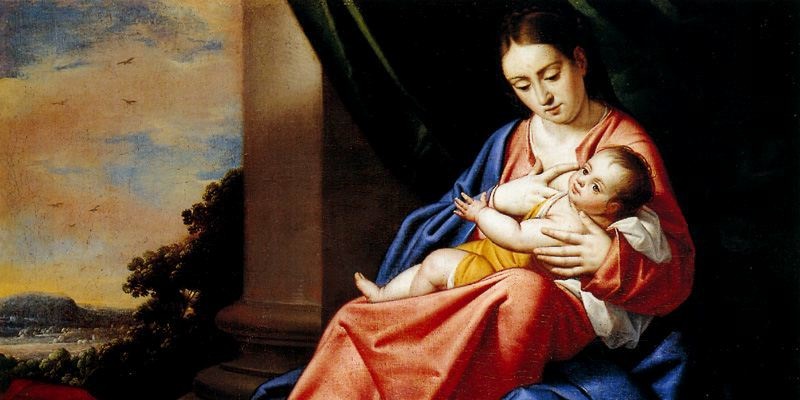
Mary Is Truly Mother of God
Question:
“How can Mary be the mother of God, if God already existed before she was born?”.
Answer:
In the dictionary we find that “mother” is the woman who begets. She is said to be the mother of the one whom she begot. If we accept that Mary is the mother of Jesus and that He is God, then Mary is Mother of God.
Time and eternity must not be confused. Mary, obviously, was not mother of the Son eternally. She begins to be Mother of God when the Eternal Son wished to enter time and become man like us. In order to become man, He wished to have a mother. Galatians 4:4: “when the fullness of time had come, God sent his Son, born of a woman.” God became man without ceasing to be God; therefore Mary is the mother of Jesus, true God and true man.
Thus, Mary is Mother of God, not because she begot Him in eternity, but because she begot Him 2000 years ago in the Incarnation. God did not need a mother, but He wished to have one in order to draw near to us with infinite love. God is the only one who could choose his mother and, to the consternation of some and the joy of others, He chose the Blessed Virgin Mary, who is and always will be the Mother of God.
When the Virgin Mary visited her cousin Elizabeth, Elizabeth, moved by the Holy Spirit, called her “Mother of my Lord.” The Lord to whom she refers can be none other than God. (Cf. Luke 1:39-45).
The truth that Mary is Mother of God is part of the faith of all orthodox Christians (of right doctrine). It was dogmatically proclaimed at the Council of Ephesus in the year 431 and is the first Marian dogma.
Background of the controversy over the divine motherhood of Mary Most Holy:
The errors of Nestorius
In the fifth century, Nestorius, Patriarch of Constantinople, affirmed the following errors:
That there are two distinct persons in Jesus, one divine and the other human.
His two natures were not united.
Therefore, Mary is not the Mother of God, for she is only the Mother of the man Jesus.
Jesus was born of Mary only as man and later “assumed” divinity, and for that reason we say that Jesus is God.
We see that these errors of Nestorius, by denying that Mary is Mother of God, also deny that Jesus was a divine person.
The doctrine concerning Mary is totally linked to the doctrine concerning Christ. To confuse one is to confuse the other. When the Church defends the divine motherhood of Mary, she is defending the truth that her Son, Jesus Christ, is a divine person.
In this doctrinal battle, Saint Cyril, Bishop of Alexandria, played a very important role in clarifying the position of our faith against the heresy of Nestorius. In the year 430, Pope Celestine I, at a council in Rome, condemned the doctrine of Nestorius and commissioned St. Cyril to begin a series of letters in which the truth would be presented.
Council of Ephesus
In the year 431, the Council of Ephesus was held, where it was officially proclaimed that Mary is Mother of God. (See: Theotokos).
“From the beginning the Church teaches that in Christ there is one single person, the second person of the Most Holy Trinity. Mary is not only mother of the nature, of the body, but also of the person who is God from all eternity. When Mary gave birth to Jesus, she gave birth in time to the one who from all eternity was God. Just as every human mother is not only mother of the human body but of the person, so Mary gave birth to a person, Jesus Christ, who is both God and man; therefore She is the Mother of God” — Council of Ephesus
Orthodoxy (right doctrine) teaches:
-Jesus is a divine person (not two persons)
-Jesus has two natures: He is truly God and truly Man.
-Mary is mother of a divine person and therefore is Mother of God.
Mary is Mother of God. This is the principal of all Marian dogmas, and the root and foundation of the most singular dignity of the Virgin Mary.
Mary is the Mother of God, not from all eternity, but in time.
The dogma of Mary Mother of God contains two truths:
1) Mary is truly mother: This means that she contributed in every way to the formation of Christ’s human nature, as every mother contributes to the formation of the child of her womb.
2) Mary is truly mother of God: She conceived and gave birth to the second person of the Trinity, according to the human nature that He assumed.
Christ’s divine origin does not come to Him from Mary. But since Christ is one person with divine and human natures, Mary is both mother of the man and Mother of God. Mary is Mother of God because she is Mother of Christ, who is the God-man.
Mary’s maternal mission is mentioned from the earliest creeds of the Church. In the Apostles’ Creed: “I believe in God the Father almighty, and in Jesus Christ, his only Son, our Lord, who was born of the Virgin Mary.”
The title Mother of God was used from the earliest Christian prayers. At the Council of Ephesus, the title Theotokos, meaning Mother of God, was canonized. From that moment the divine motherhood constituted a unique title of lordship and glory for the Mother of God incarnate. The Theotokos is considered, represented, and invoked as queen and lady because she is Mother of the King and of the Lord.
Later it was also proclaimed and deepened by other universal councils, such as Chalcedon (451) and the Second Council of Constantinople (553).
In the fourteenth century, the second part was introduced into the Hail Mary, where it says: “Holy Mary, Mother of God.” In the eighteenth century, its official recitation was extended to the whole Church.
Pope Pius XI reaffirmed the dogma in the Encyclical Lux Veritatis (1931).
The Mother of God in Vatican II: this council presents anew the full scope of its theological richness in the most important of its documents, the Dogmatic Constitution on the Church (Lumen Gentium). In this document, the divine motherhood of Mary is seen in two aspects:
1) Divine motherhood in the mystery of Christ.
2) Divine motherhood in the mystery of the Church.
“And indeed, from most ancient times, the Blessed Virgin is venerated under the title of Mother of God, under whose protection the faithful, as suppliants, take refuge in all their dangers and needs…. And the various forms of piety toward the Mother of God, which the Church has approved within the limits of sound doctrine, bring it about that, while the Mother is honored, the Son, on account of whom all things exist, may be better known, loved and glorified, and that his commandments may at the same time be better observed” (LG #66)
In the Credo of the People of God of Paul VI (1968): “We believe that the Blessed Mary, who remained ever Virgin, was the Mother of the Incarnate Word, our God and Savior”
In 1984 John Paul II consecrated the whole world to the Immaculate Heart of Mary; throughout the prayer of consecration he repeats: “We have recourse to your protection, Holy Mother of God”
Mary, because she is Mother of God, transcends in dignity all creatures, men and angels, since the dignity of a creature lies in its closeness to God. And Mary is the closest to the Trinity: Mother of the Son, Daughter of the Father, and Spouse of the Spirit.
“Knowledge of the true Catholic doctrine regarding Mary will always be the exact key to understanding the mystery of Christ and of the Church”
And the Mother of God is mine, because Christ is mine (St. John of the Cross)
Source: Corazones.org
