Responses to the Most Frequent Objections.
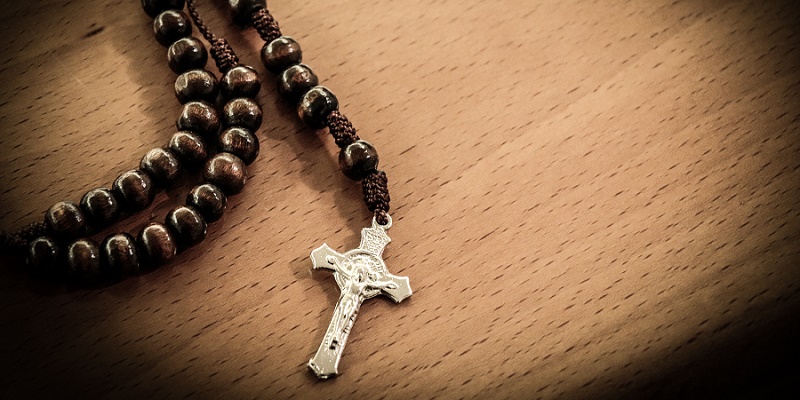
Perhaps the most emblematic sacramental in Catholicism is the Rosary, that string of beads with a crucifix at the end. The famous televangelist Jimmy Swaggart explained it in his own way on the dusty jacket of his anti-Catholic book “Catholicism and Christianity” [1]. Swaggart wrote: “The Rosary (or prayer of ‘beads’) was introduced by Peter the Hermit in A.D. 1090. It was copied from the Hindus and the Mohammedans (sic). Reciting prayers repetitively is a pagan practice and is explicitly condemned by Christ” (Mt 6:5-7) [2].
Apart from the assertion that each Rosary bead is associated with a prayer, Swaggart misses the mark entirely in everything else. And that is regrettable, since such grossly distorted portrayals frighten unformed Christians away from a powerful weapon of prayer and contemplation.
Tradition associates the Rosary not with Peter the Hermit but with St. Dominic de Guzmán (1170-1221), who is said to have received it from the Virgin Mary in order to combat the Albigensian heresy. This legend seems to come from the writings of Alan de la Roche (1428-1475), that indefatigable Dominican preacher of the Rosary. More modern critical studies carried out by Dominicans and other scholars of the subject reveal that the history is considerably more complicated, though certainly without any connection to Hindus or Muslims.
Medieval monks had the custom of praying the 150 psalms daily. Since the lay brothers of the orders were illiterate and could not read them, the practice arose among them of reciting the Our Father 150 times.
They used beads to keep count. This practice spread among the laity, and so other easy-to-remember prayers were added. During the fifteenth and sixteenth centuries the Rosary became established as we know it today, consisting of the Apostles’ Creed, the Our Father, the Hail Mary, and the Glory Be.
The Apostles’ Creed first appeared as a baptismal creed in Rome in the second century, and took its present form in the fifth century. Although it was not written by the Apostles, it is generally accepted that it may very well have been of apostolic origin.
The Our Father corresponds to the beads that appear by themselves,
separated from the groups of 10 beads (the “decades”). Every Christian recognizes that prayer: it is the one found, in its longer version, in Mt 6:9-13. Curiously, it is in the very same passage of Scripture in which Jesus says, “But when you pray, do not use vain repetitions as the pagans do, for they think they will be heard for their many words” (Mt 6:7). This is the verse Jimmy Swaggart says condemns the “pagan practice” of “reciting prayers.” Although Jesus himself gave us the Our Father, some fundamentalist Christians try to dissuade other Christians from using it as anything more than a model prayer, since they believe that praying it would constitute a “vain repetition.”
But let us look at the context of the verse in question. Matthew 6:5-6 deals with the prayer practices of the Jews themselves. Jesus brands them as hypocritical. He does not condemn Jewish repetitive prayers, of which there were many. For example, the book of Psalms is a collection of hymns and prayers used repeatedly in Jewish celebrations in which Jesus himself took part. One of the psalms, Psalm 136, is itself a repetitive prayer, in the form of a litany. The Passover, celebrated by Jesus before his crucifixion, included fixed prayers that were repeated annually, among them Psalms 113 to 118. After the Last Supper, Jesus went to the Garden of Gethsemane and prayed the same prayer three times in succession (Mt 26:39-44). Thus he too made use of repetitive prayer.
In the next pair of verses (Mt 6:7-8), Jesus warns us against the prayer practices of the pagans, who had a magical view of prayer and whose repetitive prayers he condemned. Verse 7 says, in the Protestant King James translation, “Use not vain repetitions” (the original Greek word is “battalogeo”) as the pagans do. Battalogeo is better translated as “babble” or use many words, and that is how it is translated in the “New International Version” (NIV). The “Revised Standard Version” (RSV) translates it as “empty phrases” [3]. Jesus does not condemn mere repetition—something he himself did, as did other good Jews—but the babbling of the pagans.
What kind of babbling did the pagans practice? Let us look at 1 Kings 18:26-29, where the pagan prophets on Mount Carmel tried to invoke Baal all day long, repeatedly calling on his name and carrying out ritual dances: “They took the bull, prepared it, and called from morning until noon, saying: «Baal, answer us.» But there was neither voice nor answer, and they danced beside the altar they had made… They cried out louder and, according to their custom, began to cut themselves with knives until the blood flowed. After midday they fell into a trance until the time when the evening sacrifice is offered, but there was no one who answered, no one who responded, no sign of acceptance.” Once the pagan prophets gave up, Elijah called upon the God of Israel, and his prayer was answered immediately.
The prayers of the pagan prophets were “vain” because, after spending the whole day desperately calling on Baal, he never answered them. He was not a real god, unlike the God of Israel, who always answers sincere prayer. Jesus’ point in Mt 6:7 is that we do not need to spend the whole day leaping over altars, cutting ourselves with knives, or raving in order to be heard by our Father in Heaven. He hears our prayers regardless of what kind of prayer they are—long or short, composed or improvised, in a group or individual, repetitive or unique—provided, of course, that they are heartfelt and understood, and not rattled off mechanically, in which case they are “vain,” empty, reduced to mere verbiage.
And so Jesus says in the following verse: “Therefore do not be like them [the pagans], for your Father knows what you need before you ask him” (Mt 6:8). This does not mean that, because God already knows our needs, we do not have to pray to him. As Jesus teaches in the parable of the persistent widow (Lk 18:1-8), we must be tenacious in prayer—free or repeated (repetitive)—bringing our petition before God. Moreover, when we persistently ask for the intercession of someone “righteous” like Mary, she will also pray persistently for us, which before God has “great power” (Jas 5:16). And what easier way is there to make a persevering prayer than by repeating it? Some argue that if our prayer is the same, it must at least be spaced out over time so that it is not repetitive. Yet God is above time; it makes no difference to him whether we ask him the same thing every fifteen seconds or after a long interval. Therefore, in the first case we can persevere much more than in the latter, since in a reasonable amount of time we present our prayer more often, whereas praying a Hail Mary only at long intervals would hardly allow us to pray the whole Rosary in a day, besides constantly interrupting our activities.
Saint Paul says that we must “pray constantly” (1 Thess 5:17); he does not say “pray in moderation, lest we repeat ourselves” (which is inevitable in continuous prayer). One of the benefits of the Rosary is that it leads us naturally into continuous prayer and meditation, which Scripture commands us to do.
In case any doubt still remains as to whether God accepts repetition in prayer, we can also see in Rev 4:8-11 how the four living creatures make use of it: “The four Living Creatures each have six wings, are full of eyes all around and within, and day and night they never cease to repeat: «Holy, Holy, Holy, Lord God Almighty, ‘He who was, who is, and who is to come’»,” followed by repetitive antiphons of the Elders.
The Hail Mary is the heart of the Rosary and is said ten times, once for each of the beads grouped into decades, fifteen in all, thus totaling 150 Hail Marys, as many as the psalms in the Psalter. The first part of the prayer is composed of two biblical verses: “Hail, Mary, full of grace, the Lord is with you” (Lk 1:28) and “blessed are you among women, and blessed is the fruit of your womb, Jesus” (Lk 1:42).
The rest of the prayer is: “Holy Mary, Mother of God, pray for us sinners, now and at the hour of our death. Amen.” Just as she was called on earth the object of Divine Grace (Lk 1:28) and is now glorified in Heaven, Mary is called “Holy.”
The title “Mother of God” (which comes from “Theotokos” in the original Greek, or “God-bearer”) is very ancient. It appears in a papyrus found in Egypt and dated between the years 250 and 270 (therefore it is not an “invention” of the Council of Nicaea in the year 431, as many Protestants maintain) and invokes the intercession of the “Theotokos” [4]. Catholics maintain that the person born of the Virgin Mary is the Second Person of the Most Holy Trinity, the Word of God (in Greek, Logos), and therefore is God (Jn 1:1,14). Since Jesus is God, humanity and divinity fully united in one Person, the mother of Jesus is therefore the mother (not the creator) of God; the Theotokos [5].
Many non-Catholics object to the practice of asking the saints in Heaven, including Mary, to pray for us. They often cite 1 Tim 2:5: “For there is one God, and there is also one mediator between God and men, the man Christ Jesus.” Since Jesus is the only mediator, they argue that Mary (or any other saint) should not be invoked to ask on our behalf. By praying “Holy Mary, Mother of God, pray for us sinners, now and at the hour of our death,” Catholics intrude upon the unique mediation of Christ. But this idea can be maintained only if one believes that death creates an abyss between Christians on earth and those in Heaven.
Catholics believe that Christians are not separated from Christ or from one another after death (Rom 8:38-39). The Body of Christ is one though it has many members (1 Cor 12:12), and Christians are not amputated from the Body when they go to Heaven. Nor are there two Churches, one in Heaven and another on earth, separated by death and therefore without communion with each other. The Church is the Bride of Christ (Rev 21:9 ff.) and Jesus is a strict monogamist. Therefore we reject any idea that separates us from one another and thereby destroys the unity of the Church.
As stated in the Apostles’ Creed, Catholics believe in the “communion of saints.” This means that, since we are all one in Christ, we can ask the saints in Heaven to pray for us just as we can ask our brothers and sisters in Christ who are still on earth (as Saint Paul did in Rom 15:30). Since we have been commanded to ask for one another (1 Tim 2:1, Eph 2:1, Heb 4:16), and since the word of the Lord “stands firm in the heavens” as well as on earth (Ps 119:89), we do not go against Scripture if we ask the saints in Heaven for prayers. It is precisely through the mediation of Christ that Christians in Heaven can pray for those on earth. And this is how it is understood that, although Saint Paul proclaims the unique mediation of Christ in 1 Tim 2:5, four verses earlier he asks Christians for “intercessions” for “all men.”
We know that the saints in Heaven are attentive to what happens to us (Heb 12:1, Lk 15:7, Rev 19:2-3) and that they offer prayers (Rev 5:8-10, 8:3), even asking God to intervene on earth (Rev 6:9-10). Hebrews 12:22-24 tells us to approach not only Jesus, the “mediator of the new covenant,” but also the heavenly Jerusalem and the “assembly of the firstborn who are enrolled in Heaven” and the “spirits of the righteous made perfect.” We do not hesitate to ask them for their prayers for us because “the persevering prayer of the righteous has great power” (Jas 5:16b). It is true that we can ask God directly, but surely he is more pleased if, generously, we intercede for others or, trustingly, ask for their intercession, thus strengthening the family bond he has created among us and that we so often find hard to recognize. Therefore, if we do this, we give him joy; will he not then listen with greater favor to our prayer or to the prayer of those who intercede for us? Moreover, it was thanks to Mary’s intercession that Jesus acted on behalf of the bride and groom at Cana, since he himself refused (Jn 2:4), arguing that his hour had not yet come, that is, that it was not his Father’s will (since his mission was entrusted by the Father (Jn 3:16-17; 10:36)). Here we see how, although “Jesus’ food is to do the will of his Father” (Jn 4:34), Jesus ends up doing the will of his mother (certainly it must have been with the Father’s final approval). Does Mary’s intercession have power, or not?
Some object that the saints are dead and that the Bible forbids communication with the dead (Lev 19:31, 20:6,27) through mediums and other occult practices (necromancy).
But Catholics do not seek to obtain information from spirits, as is done in séances. The Church condemns occultism. In reality, the saints in Heaven are not “dead”; they are more alive than we are. “I am the God of Abraham, the God of Isaac, and the God of Jacob,” says Jesus, quoting Exodus. “He is not God of the dead, but of the living, for to him all are alive” (Mk 12:26-27 or Lk 20:38). If Jesus had not intended the saints on earth to communicate with those in Heaven, he would have chosen a poor example by appearing to Peter, James, and John on Mount Tabor (Mt 17:1-8).
At times, fundamentalists like Jimmy Swaggart say that praying ten Hail Marys for every Our Father confirms their worst suspicions about Catholicism: Catholics prefer Mary over God by a ratio of 10 to 1. Such an assertion is not only offensive to Catholics but also logically absurd. In the Protestant King James Version of the Bible, the name of Saint Paul appears in the Acts of the Apostles 126 times, while Jesus’ name appears only 68. Does this imply that the author of Acts gave Saint Paul twice as much importance as Jesus? And does the fact that the Protestant translation of the book of Esther does not contain the word “God” or “Lord” even once mean that the author of that book was an atheist? Such statistical “proofs” prove absolutely nothing. The Rosary is a devotion in honor of the Blessed Virgin Mary who, under divine inspiration, prophesied that all generations would call her blessed (Lk 1:48). In such devotions, Catholics happily fulfill the prophecy, remembering that God blesses us when we bless those whom he has especially favored (Gen 12:3, 27:29, Num 24:9).
After the ten Hail Marys, the corresponding Glory Be is said on the bead that appears by itself immediately after the previous ten and just before the next decade. It is a “doxology” (final acclamation) used since the times of the early Church, when there were controversies about the Trinity. “Glory be to the Father, and to the Son, and to the Holy Spirit, as it was in the beginning, is now, and ever shall be, world without end. Amen.” It is also found, like the Apostles’ Creed and the Our Father, in most of the principal Protestant churches.
But there is more to the Rosary than simply reciting prayers. The Rosary is a contemplation of the Gospels. With each decade a “mystery” is associated, an episode of the Gospel that is meditated upon, the word “mystery” being used in the sense of “divine revelation.” There are fifteen mysteries divided into three groups of five: the joyful, the sorrowful, and the glorious.
The joyful mysteries are the Annunciation (Lk 1:26-38), Mary’s visitation to her relative Elizabeth (Lk 1:39-56), the Birth of Jesus (Lk 2:1-20), the Presentation of Jesus in the Temple (Lk 2:22-38), and the Finding of the Child Jesus in the Temple (Lk 2:41-52).
The sorrowful mysteries are Jesus’ agony in the Garden of Gethsemane (Lk 22:39-53), the scourging (Jn 19:1, Is 53:5), the crowning with thorns (Mk 15:17-20), Jesus carrying the cross (Mk 15:20-22), and the crucifixion (Jn 19:18-30).
The glorious mysteries comprise: the resurrection (Jn 20:1-29), the ascension (Acts 1:6-12), the coming of the Holy Spirit upon the apostles (Acts 2:1-13), the Assumption of Mary (Rev 12:1), and the coronation of Mary in Heaven (Rev 12:1-2,5).
Except for the last two, all the others are explicitly detailed in the Bible. Let us examine more closely those two that are only implicit.
Mary’s assumption body and soul into Heaven at the end of her life is neither explicitly shown nor contradicted by the Bible, although there are precedents (Heb 11:5 mentions the assumption of Enoch; 2 Kings 2:11 attests that of Elijah; Saint Paul admits the possibility of his own bodily assumption in 2 Cor 12:2-4). There is no indication that Mary’s remains were venerated as relics (a common practice in the early Church), and belief in her assumption is maintained both in the East (Orthodox) and in the West (Catholics).
Mary is perceived in Catholic thought as the proto-Christian and the symbol of the Church as a whole. Hence her assumption is seen as a sign of the Church’s final destiny. Christ will come at the end to take his Bride into the kingdom and glorify her (2 Thess 4:16-17). Belief in the assumption is reaffirmed by all Christian communities that have links with the primitive Church—to which our Lord promised to lead into the fullness of truth (Jn 16:12-13, cf. Mt 16:18 and 28:20). The belief is very ancient and widespread, and those who deny this teaching do so without biblical basis, since Christians are called to follow all apostolic traditions, whether written or not in the New Testament (2 Thess 2:15).
The coronation of Mary in heaven must be understood in light of the Jewish background of primitive Christianity. In Judah, due in part to the fourth Commandment (Ex 20:12), the mother of the one anointed as king played a role of considerable importance, and her name was, with only two exceptions, associated with the king’s inclusion in the official annals [6]. The king’s mother bore the prestigious title of Gebirah [7], which conferred great powers upon her, and she received honors of the first rank. She had an official place in the court, was mistress of the harem, had enough power to seize absolute control of the nation in the event of the king’s death (as Athaliah did in 842 B.C., 2 Kings 11:1-3), was sent into exile together with the king (as Nehushta was in 597 B.C., Jer 29:2), and could be deposed (as was the idolatrous grandmother of King Asa, Maacah, who had first been queen mother during the reign of her son Abijam, 1 Kings 15:2,10,13; 2 Chr 15:16). The Gebirah was a monarchical institution and had a throne and a crown [8].
Since Jesus is the final and definitive King of the Jews, fulfilling the messianic prophecy of 2 Sam 7:10-17, it would be truly strange if Mary did not have her crown as the final and definitive queen mother. The monarchical nature of the kingdom of God, complete with the queen mother, may be difficult to appreciate for those who live in a democratic culture, but it was accepted as natural in primitive Christianity, as art and literature attest.
In 1 Kings 1:16,31 we see Queen Bathsheba pleading with King David, her husband, “kneeling and prostrating herself at his feet” and saying to him, “May my lord King David live forever.” This was the usual protocol in the court of an eastern monarch, although the queen’s position seems to have been somewhat higher in other nearby eastern countries than it was in Judah and Israel (compare, even so, with Jezebel in 1 Kings 21:7-11).
Let us contrast this first chapter of 1 Kings with the next. In it (verses 13 to 20), Solomon, the son of David, is invested as king. Adonijah approaches “Bathsheba, the mother of Solomon” with a request: “Please speak to King Solomon, for he will not refuse you.” Bathsheba promises him (v. 18) to intercede before Solomon on his behalf (compare with Jn 2:1-11, where Mary intercedes before Jesus), unaware of Adonijah’s plans to seize the throne. “Bathsheba went to King Solomon to speak to him about Adonijah” (v. 19). The use of the title “King Solomon” indicates that Solomon is acting in his official rank as king (cf. v. 23)
Instead of prostrating herself before Solomon as she had previously done before King David, “the king rose, went to meet her, and bowed down before her; then he sat on his throne; a throne was set for the king’s mother, and she sat at his right hand. She said: «I have one small request to make of you; do not refuse me.» The king said: «Ask, my mother, for I will not refuse you»” (vv. 19 and 20). Solomon was not simply being a good son; rather, throughout the ancient world the seat at the right hand was a place of honor and delegated authority, which is why the New Testament speaks of Jesus as seated at the right hand of the Father. Bathsheba’s status in society had changed: she had become the “queen mother.”
The Bible teaches that Old Testament prototypes (such as the paschal lamb, the Flood, Hagar, or Sarah) find the fullness of their fulfillment in the New Testament (Jn 1:29, 1 Pet 3:18-21, Gal 4:21-31). Just as Christ is superior to the paschal lamb that prefigures him, the fulfillment of the prototype in question is always greater than the prototype. Christians recognize that Jesus Christ, the Son of David and King of Israel par excellence, is the perfect fulfillment of King Solomon, the original son of David. In the same way, Christians also recognize that the Virgin Mary perfectly fulfills the role of Solomon’s mother, the original Gebirah, who prefigures the mother of the Messiah.
Catholics believe that Jesus rose from his throne in heaven and, like Solomon, humbled himself to meet his mother and raise her up to be with him (the assumption). Then he brought her to a throne prepared for her at his right hand, in a position of authority and honor (the coronation). From there, like Bathsheba, she intercedes on our behalf as the queen mother of the Church, spiritual Israel (Rom 11:17 ff., 1 Pet 2:9). From humble handmaid of the Lord to Gebirah of the kingdom of God: “for he has looked upon the humility of his handmaid. From now on all generations will call me blessed, for the Mighty One has done great things for me… he has cast down the mighty from their thrones and has exalted the lowly” (Lk 1:48-49,52).
Epictetus, in the second century, said that “if your heart fits in a crown, put roses on it and it will have a better appearance.” “Rosary” comes from the Latin “rosarium,” which means “rose garden,” suggesting that we offer a crown of roses to Our Lady.
This is the coronation of the Mother of the King (Rev 12:1) and, more importantly, that of the King of Kings himself (Rev 6:2). It is by persevering in faith that we hope to receive our own crowns (Rev 2:10), and no other devotion surpasses the Rosary in obtaining the strength and Grace necessary for this end. “Athletes deny themselves everything; and that for a corruptible crown! We, however, do it for an incorruptible one” (1 Cor 9:25).
The author writes from the Los Angeles area, where he prays the Rosary regularly.
Author: T. L. Frazier, This Rock 1994.
Translator: Fernando Sales-Mayor
Source: Apologetica.org
Notes
1. Jimmy Swaggart, <Catholicism and Christianity> (Baton Rouge: Jimmy Swaggart Ministries, 1986).
2. Ibid., 160-161.
3. Battalogeo, a Greek word used very rarely except in New Testament writings; it may be connected with the Aramaic word “battal” (worthless, trivial, useless). Battal appears in an Aramaic papyrus from Qumran with the meaning “without effect.” The Sinaitic Syriac manuscript of Matthew translates this verse as “do not start saying meaningless things.”
4. Papyrus 470, John Rylands Library, Manchester, England. (C. H. Roberts (ed.), Catalogue of Greek and Latin Papyri in the John Rylands Library, Manchester vol. III, Theological and Literary Texts (Nos. 457 – 551) (1938) no. 470.
5. If we look for a biblical text to support the use of the title Theotokos, we can look to Mary’s visitation to her relative Elizabeth, who looks at Mary and exclaims: “And why is this granted to me, that the mother of my Lord (ha mater tou kyriou mou, in the original Greek) should come to me?” (Lk 1:43). Anyone with some familiarity with the Bible will know that the title “Lord” (kyrios) is practically synonymous with the God of Israel (Ps 110:1-4). In fact, the Greek translation of the Old Testament (the Septuagint) uses that word to translate the tetragrammaton, YHWH (Yahweh), although kyrios is really the Greek translation of “Adonai,” Lord, in Hebrew. Thus what Elizabeth said can be rewritten as: “And why is this granted to me, that the mother of my God should come to me?”
6. See 1 Kings 14:21; 15:2,10; 22:42; 2 Kings 8:26; 9:6-7,22; 12:1; 14:2; 15:2,33; 18:2; 22:1; 23:31,36; 24:18
7. Literally, “lady” or “mistress,” used six times in the Bible and always as a title of a queen, either as wife (1 Kings 11:19) or mother of the king (1 Kings 15:13, 2 Kings 10:13, 2 Chr 15:16, Jer 13:18, 29:2). This title is used only once in reference to the wife of a king, and even there it refers to Tahpenes, queen of Egypt, not of Judah, where the title is associated with the queen mother.
8. Compare with Jeremiah 13:18, where the prophet proclaims to the 18-year-old King Jehoiachin and to the queen mother, Nehushta, “Say to the king and to the queen mother, ‘Humble yourselves, sit down, for your beautiful crown has fallen from your heads.’”
