
The evangelical Ralph Woodrow formerly held the position that Mary was a pagan goddess and wrote a popular book connecting Catholicism with paganism, relying on an 1857 book by Alexander Hislop called “The Two Babylons”. After the integrity of Hislop’s research was questioned, Woodrow decided to investigate the matter for himself. He was stunned to discover that Hislop’s research was at least defective, if not scandalous. He therefore withdrew his first book from circulation and published another in its place, called “The Babylon Connection”. In that book, on pages 33-38, Woodrow discusses Hislop’s arguments against Mary in detail. He is ashamed that his evangelical brothers use this approach to condemn the Catholic Church’s relationship with Mary, and he apologizes for having spread those views. He remains an evangelical, but no longer associates the Catholic Church with paganism.
Problems with the claim of syncretism
A careful and honest study of the pagan goddess cults will reveal that, apart from a few superficial symbols (for example, the goddess may be regarded as virgin or mother), they have nothing in common with the Catholic relationship with Mary. The Catholic relationship with Mary cannot be compared with the profane and corrupt worship offered to goddesses. The goddess Gaia (Mother Earth) is a symbol of everything that opposes what we believe about Mary. Mary does not force us to worship the earth, nor does she make us exalt sexual pleasure outside marriage; Mary would never allow us to profane the name of her Son Jesus. Mary does not nourish the cult of other religions to the detriment of her Son’s message. Mary is about one thing and one thing only: her Son Jesus.
…every Roman Catholic I have known sees Mary as a blameless woman, a virgin, totally dedicated to God and to the practice of virtue. None of these attributes can be assigned to the pagan goddess Semiramis. Her lifestyle is exactly the opposite. (Woodrow, p. 35)
The first Christians, converts from paganism, abandoned the darkness and superstition of their former faith. Many of them became martyrs, giving up their lives rather than offer incense to an image of Caesar. They would never have worshiped Gaia, Isis, or Cybele, even under the cloak of the Mother of Jesus.
To accuse the early Church of doubting the sincerity of the conversion of pagans! These converts were thrown to the lions for their faith in Jesus. Why would they have continued to support their former pagan gods? Christians consider pagan deities to be demons, and the formula of Baptism involved (and still involves) renouncing Satan. Therefore, in order to receive Baptism, catechumens had to renounce their former gods. How could they continue worshiping demons after having renounced them? And how could they identify the Mother of the Savior with impostor demons? I feel that the people who promote this theory do not sound practical, rational, or serious in their research.
Mary is a “born again” Christian who received the Holy Spirit at Pentecost and spoke in tongues 2,000 years before Pentecostals received this gift (Acts 1:14–2:3). She knows how to pray (yes, even in tongues).
Collyridians?
This was the name of a small fourth-century sect in Arabia, composed mostly of women who openly worshiped the Blessed Virgin by offering her cakes during their religious ceremonies. Some point to this and proclaim that it is an example of ancient pagans worshiping Mary as a “goddess”.
The Collyridians were not Catholics; they were a syncretic cult which, like the Gnostics and other groups of that time, mixed practices from various religious traditions. They were heretical. They took the figure of Mary from Catholicism and offered sacrifices to her (a relic of the sacrifices offered to certain pagan goddesses; see Jer 44:18-19). It was a strange mixture of contradictory beliefs and was in fact condemned by the Catholic Church. The only reason we know of this small sect is that Saint Epiphanius, one of the Fathers of the Church, condemned them in one of his writings called the Panarion.
Mother of God?
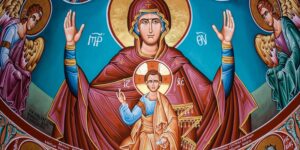 I received an e-mail saying: “Mary needed a savior.” Catholics agree that Mary needed a Savior. She was saved by her Son. And at the same time she was his mother.
Luke 1:46-49
My soul glorifies the Lord, and my spirit rejoices in God my Savior, because he has looked upon the lowliness of his handmaid. Henceforth all generations will call me blessed.
Mary needed a Savior and all generations will call her blessed.
Some evangelicals feel that Mary is a “Catholic goddess” because of the Marian title “Mother of God”. Apparently they think Catholics call her this because they believe she gave Jesus his divinity.
Jesus was born of Mary in order to become man. If she had been some kind of divine being, how would he have derived his human nature from her?
Most Christians would say that it is impossible to separate Jesus’ divinity from his humanity. He is at the same time fully God and fully man. There is an inseparable union of these two natures, God and man, in Jesus Christ. We call Mary Mother of God because Jesus is God and she is his mother. Since Jesus’ two natures (divine and human) are inseparable, Catholics believe it is appropriate to call her Mother of God. Elizabeth said: “And why is this granted me, that the Mother of my Lord should come to me?” (Lk 1:43). This is not a pagan title, but a biblical title.
Here I transcribe what Martin Luther, the founder of the Reformation, says about the Marian title “Mother of God”.
“Saint Paul said: ‘God sent his Son, born of woman.’ These words, which I hold to be true, really uphold with all firmness that Mary is the Mother of God.” (Martin Luther, Martin Luther’s Works, vol. 7, p. 592)
“This article of faith—that Mary is the Mother of God—has been present in the Church from the beginning, and is not a new creation of the council, but the presentation of the Gospel and of the Scriptures.” (Martin Luther, Martin Luther’s Works, vol. 7, p. 572)
“It is certain that Mary is the Mother of the real and true God.” (Martin Luther, Martin Luther’s Works, vol. 24, p. 107)
“. . . she is rightly called not only the mother of the man, but also the Mother of God… it is certain that Mary is the Mother of the real and true God.”
Ref: Sermon on John 14. 16: Luther’s Works (St. Louis, ed. Jaroslav Pelikan, Concordia. vol. 24. p. 107)
Is Mary the pagan goddess Ishtar?
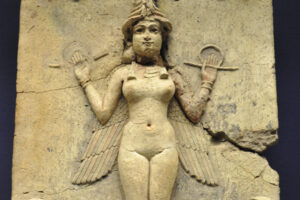 The statement “Queen of the Universe” in Lumen Gentium (the Catholic constitution of 1964) led some people to think that the Catholic Church was placing her as head of heaven. They noted that “Queen of Heaven” was once a title applied to the goddess Ishtar by her devotees in Babylon (Jer 44:18-19). Some have even come to think that in some way this proves that Mary and Ishtar refer to the same being and that Catholics are really worshiping Ishtar when they honor Mary.
First let us look at the Scripture used against the Catholic Church in this matter:
“Do you not see what they are doing in the cities of Judah and in the streets of Jerusalem? The children gather wood, the fathers kindle the fire, and the women knead dough to make cakes for the Queen of Heaven; and they pour out libations to other gods, in order to provoke me to anger.” (Jer 7:17-18)
The Catholic Church has never offered cakes (or any other sacrifice) to Mary. Moreover, the passage says: “and they pour out libations to other gods.” Catholics have never presented any offering to anyone other than the one true God described in the Trinity (Father, Son, and Holy Spirit).
The purpose given to Mary is outlined in Scripture: “My soul glorifies the Lord and my spirit rejoices in God my Savior” (Lk 1:46).
Many kings of different nations are called “Your Majesty” by their subjects, but that does not prove they are the same person! Numerous pagans called their gods “Father”, such as Zeus (“father of gods and men”) and Odin (“the All-Father”). Yet this does not mean that Zeus and Odin are identical with God the Father.
My name is David. There have been many murderers called David and also magnificent leaders called David. Obviously I am none of them; I am myself. And Mary, the mother of Jesus, is Mary, the Mother of Jesus.
Perhaps it is understandable that evangelicals were alarmed by the declaration of Mary as “Queen”, given the cultural context of this generation. We live at a time when the Queen of England is the highest authority of the Commonwealth. There is no king. She wears the trousers; she is the center; we all speak of the queen and sing “God save the queen”. So it is natural that our contemporary understanding of the role of the queen is that of someone with supreme authority. But what happens to the queen when there is a king? Who has authority? In Commonwealth law, when there is a king, the queen has no authority except what she may whisper in his ear to influence some decision.
JESUS IS THE KING; he is. Mary is the Queen; that means she has no authority except what she may whisper in his ear (Jn 3:3). Therefore, I do not think that calling Mary Queen of the Universe diminishes the authority of King Jesus in the least. In fact, it strengthens it. What respectable king does not have a queen?
Catholics support Mary’s Queenship with Scripture. Revelation 11:19 says:
“Then God’s temple in heaven was opened, and the Ark of the Covenant was seen in his temple… a great sign appeared in heaven: a woman clothed with the sun, with the moon under her feet and a crown of twelve stars on her head. She was pregnant… and gave birth to a male child who will rule all the nations with a rod of iron… But the child was caught up to God and to his throne…”
This passage presents Jesus as King. It also presents his Mother wearing a crown in Heaven. Catholics feel that Scripture is very clear.
Lumen Gentium
Here I present some paragraphs from Lumen Gentium, an official document of the Church from the Second Vatican Council, which is frequently cited by evangelicals in their “Queen of Heaven” document. I think Lumen Gentium clearly affirms the authority of Jesus over heaven and earth:
60. There is but one Mediator, as we know from the words of the Apostle: “For there is one God and one mediator between God and men, the man Christ Jesus, who gave himself as a ransom for all” (1 Tim 2:5-6). But Mary’s maternal function toward men in no way obscures or diminishes this unique mediation of Christ, but rather shows its power. For all the salvific influence of the Blessed Virgin on men does not arise from any necessity, but from the divine pleasure; it flows from the superabundance of the merits of Christ, rests on his mediation, depends entirely on it, and draws all its power from it. Far from hindering it, it fosters the immediate union of believers with Christ.
62. …For no creature could ever be counted as equal with the Incarnate Word and Redeemer. But just as the priesthood of Christ is shared in various ways by both ministers and the faithful, and just as the one goodness of God is really communicated in different ways to his creatures, so also the unique mediation of the Redeemer does not exclude, but rather gives rise among creatures to a manifold cooperation which shares in this one source. The Church does not hesitate to profess this subordinate role of Mary; she knows it through unfailing experience and recommends it to the hearts of the faithful, so that, sustained by this maternal help, they may be more intimately united with the Mediator and Savior.
66. …According to her own prophetic words: “Henceforth all generations will call me blessed, because he who is mighty has done great things for me” (cf. Lk 1:48-49)… while the Mother is honored, the Son, through whom all things were created (cf. Col 1:15-16) and in whom the Father was pleased that all fullness should dwell (cf. Col 1:19), is rightly known, loved and glorified, and his commandments are observed.
67. …It strongly urges theologians and preachers of the divine word to abstain carefully both from all false exaggeration and from excessive narrowness of mind in considering the singular dignity of the Mother of God. Under the guidance of the Magisterium, by studying Sacred Scripture, the Holy Fathers and doctors, and the liturgies of the Church, they should rightly illustrate the gifts and privileges of the Blessed Virgin, which are always referred to Christ, the source of all truth, holiness and devotion.
(23) Cf. Pius XII, radio message, 24 Oct. 1954: AAS 46 (1954), p. 679. Encyclical Letter Ad coeli Reginam, 11 Oct. 1954: AAS 46 (1954), p. 637.
Statues of the Mother and Child
 Some claim that images of Mary with the Child Jesus in her arms were copied from statues of Isis holding Horus in her arms, or from some other goddess carrying her respective child.
Motherhood is common to all cultures throughout the world; it is not difficult, then, to understand why images referring to motherhood resemble one another in different religions.
Catholics depict Mary with the Child because that is what she did when he was a baby. Most mothers carry their children in their arms, and Mary carried her Son when he was little. This does not make her a pagan goddess! We could accuse any painter or sculptor who depicts a mother with her child of the same thing, but it would not be legitimate.
“And going into the house they found the child with Mary his Mother, and they fell down and worshiped him” (Mt 2:11). Did the Magi commit idolatry by reverencing the Child in his Mother’s arms? Would you be capable of refusing to adore Christ if you saw him in his mother’s arms?
The true origin of Marian devotion
When and how did Marian devotion begin? With the holy angel Gabriel, when he said to Mary: “Hail, full of grace, the Lord is with you” (Lk 1:27). When her cousin Elizabeth, inspired by the Holy Spirit, cried out to her: “Blessed are you among women… blessed are you because you have believed” (Lk 1:41-45). God himself inspired these first honors paid to Mary! He even inspires Mary with a prophecy about herself: “From now on all generations will call me blessed” (Lk 1:47). These are the biblical foundations for Marian devotion.
The Catholic relationship with Mary does not originate in the worship of pagan goddesses, but with the first Christians, who had abandoned paganism and never again adopted its practices.
The Vatican’s condemnation of New Age goddesses
The Vatican has published its position in a document on the New Age. This document explains how New Age theories about Mother Earth (the pagan goddess Gaia or her equivalents) go against the Catholic faith and the faith of all Christians. This is a link to that document. Below you can read some extracts from it discussing Gaia, Mother Earth.
James Lovelock’s book “The Gaia Hypothesis” wrongly declares that “all living matter on earth, from whales to viruses, and from oaks to algae, could be regarded as constituting a single living entity, capable of manipulating the Earth’s atmosphere to suit its overall needs and endowed with faculties and powers far beyond those of its constituent parts” (38). For some, the “Gaia Hypothesis” is a “strange synthesis of individualism and collectivism. Like everything to do with New Age, having plucked people out of different political fragments, it cannot wait to throw them into the great cauldron of the global mind.” The global brain needs institutions to regulate it—in other words, a world government. “To deal with today’s problems, New Age dreams of a spiritual aristocracy in the style of Plato’s Republic, governed by secret societies…” (39). This may be an exaggerated statement of the case, but there is much evidence that a gnostic elitism and “global government” coincide at many points with international politics.
This can be seen in the promotion of world government from early in the twentieth century. The consciousness of the unity of humanity fits perfectly with the Gaia hypothesis… “positive” thinking: the conviction that people can change physical reality or external circumstances by altering their mental attitude, by thinking positively and constructively…
What has been successful is the generalization of ecology as a fascination with nature and the resacralization of the earth, Mother Earth or Gaia, with the missionary zeal characteristic of green politics. The manager of the Earth is the human race as a whole, and harmony and understanding are required for responsible government, which is increasingly understood as needing to be a global movement supported by an ethical structure. The warming of (Mother) Earth, whose divinity is diffused throughout the whole of creation, is raised up as a bridge to close the gap between creation and the transcendent Judeo-Christian God the Father, thus avoiding being judged as “Being”.
In such a vision of a closed universe containing “God” and other spiritual beings together with us, we recognize the implicit reappearance of pantheism. This is a fundamental point running through New Age practice and thought in all its forms, and it conditions every other aspect, even those that may be positive, of its spirituality. As Christians, on the contrary, we believe that “man is essentially a creature and remains so for all eternity, so that an ‘absorption’ of the human ‘into the divine’ will never be possible”… (31)
In any case, it is enough to clarify that the New Age shares with a number of internationally influential groups the goal of replacing or transcending particular religions in order to make room for a universal “religion” that could unify humanity. Closely related to this is the concerted effort by many institutions to invent a Global Ethic, an ethical framework reflecting the global nature of contemporary culture, economy and politics. Moreover, the politicization of ecological questions certainly adds color to the whole issue of the Gaia hypothesis or worship of Mother Earth… The Holy Father notes the great interest in spirituality that can be found today in the secular world and how other religions are responding to these demands in exciting ways. He develops this point by challenging Christians with these words: “But we who have received the grace of faith in Christ, the one who reveals the Father and is the Savior of the world, have the duty to show to what depths the relationship with Christ can lead” (n. 33). To all who shop around for religious proposals in this world’s fair, the appeal of Christianity will be felt first of all through the witness of the members of the Church: in their confidence, calm, patience and affection, in their concrete love of neighbor, all the fruit of their faith nourished by authentic personal prayer.
(The Catholic Church wants nothing to do with “Gaia” or with the pagan goddesses worshiped by New Age followers, who also have nothing to do with Mary, the Mother of Jesus.)
A personal note about Mary
I hope I have not caused animosity with this article. Many would like everything about Mary to be set aside by the Church in order to achieve greater unity with other Christians. I only wish to help build a bridge between Catholics and Protestants. I do not believe that avoiding Mary would help build it. It seems that most of the harshest feelings against Mary have arisen within the Protestant movement in the last hundred years. Many of the Fathers of the Reformation had strong positive feelings about Mary, including C. S. Lewis, Calvin, Heinrich Bullinger and John Wesley. Even Martin Luther himself spoke of her in the first person, saying:
“No woman is like you. You are more than Eve or Sarah, blessed above all nobility, wisdom and holiness.” (Sermon, Feast of the Visitation, 1537).
Some Christians feel there would be greater unity within the Church if we all stopped talking about Mary. However, Mary is not going to leave my life (or yours) unless I ask her to. And quite frankly, that would be like telling my mother to go away and never think of me again. I once did that with my (biological) mother, and it was very painful for her. Mary corrected me. It would wound Mary immensely if I asked her to go away, but it would harm me even more. Therefore I cannot put aside what has to do with her, at least in my own life, as I know is also true in the lives of millions of Christians who live in the spirit of Christ and have been enriched by their relationship with Mary.
I would like to conclude with an invitation that may be very difficult, and perhaps impossible, for some. I would like to ask you to forget everything you have heard about Mary, everything you have read about her, including what I have said here.
I want to invite you to pray to Jesus. Most Christians will accept that it is totally safe to pray to Jesus about anything. I want to invite you to pray to Jesus about Mary. Simply ask Jesus to show you the truth about his mother. Ask him to guide your thoughts about her. Ask Jesus whether his mother is alive with him. Ask him whether Mary is praying for us. Simply pray to Jesus about her. Try it every night for six weeks. I am sure he will lead you to the truth about his mother.
Author: David McDonald
Source: Davidmacd.com
FOOTNOTES:
Part of this article has been taken and adapted from http://Home.nyc.rr.com/mysticalrose/index.html (with some additional notes by David MacDonald).
1 Ralph Woodrow, The Babylon Connection (Palm Springs, CA: Ralph Woodrow Evangelistic Association, 1997), 34.
In any case, The Babylon Connection is for the most part a strong refutation of the charges of “paganism” that have been raised against the Catholic Church. The paragraphs quoted above are a good example of this.
2 Means “Godbearer” or Mother of God. This title came into Christian use very early.
Spanish translation: Margot Zunino
Copyright Notice
This article is the property of David MacDonald. We have reproduced it here with the author’s consent. It may not be reproduced without written permission. If anyone wishes to use this material for reprinting or to publish it on another site, please contact the author directly.
The author generally allows it to be reprinted for use in Catechism classes, RCIA programs, or to pass on to evangelical friends, but he would like to know how it is being used. However, it is not permitted to lift the information from this website to another without David McDonald’s prior permission.
