A reader asks:
Dear Missionaries of the Word: I only want to know the following: Is it true that the Bible says Mary had more children and that she was not a virgin? I have many Protestant friends and relatives who constantly tell me this.
How can I answer them?
Answer:
Greetings, Rosario, and thank you for calling us. Here is the answer to your question about “the Virgin Mary”.
Let us study the Bible carefully on this subject and answer from the simplest point to the deepest.
1. In the Bible the words “children of Mary” do not exist.
It is amazing how easily many people say this, when no Bible, in any language or version, uses the plural “children of Mary”. Always, in all the Bibles of the world, it speaks in the singular: “the Son of Mary”. To claim that the Bible says “children of Mary” is a tremendous error, born of ignorance of Sacred Scripture or of trying to draw from the Word of God things it does not teach. There are many “brothers” who read the Bible a great deal but know it very little.
Many times, when someone writes to us, calls us by telephone or on the radio, we ask whether they can give us one single passage where it says “children of Mary”, and they can never answer. Nor will they be able to, because it does not exist. If someone does not think this way, we respect his belief, but the Bible is clear on this point. So, if the Word of God does not say that, where do some people get the idea that she had more children? Let us explain it in the next point.
2. The word “brother” could mean uncle, cousin, wife, bride, countryman, nephew, etc.
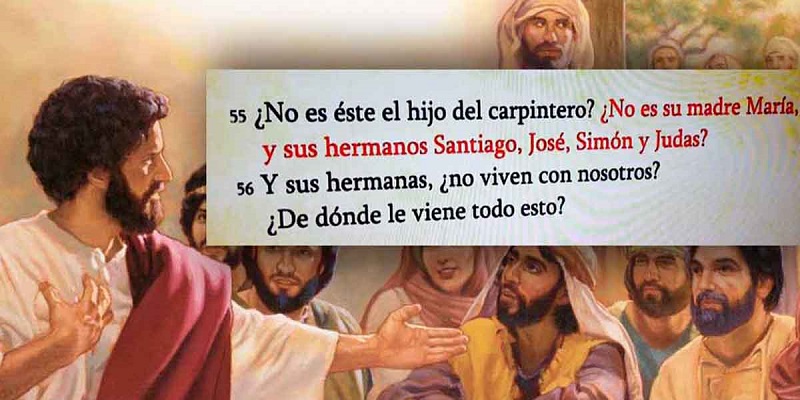
In reality, the error comes from the fact that Protestants, when they read that the Bible speaks of the “brothers of Jesus” (Mk 6:1ff.), interpret it literally and think: ah… if Jesus had brothers, then the Virgin Mary had more children.
This is a bad interpretation, because the Bible itself teaches us that, at that time and in those languages, the word “brother” = ah, or “sister” = ahot in Hebrew, and adelphos in Greek, did not mean only a blood brother. It was a very common word and was also used to refer to:
+ an uncle and a nephew (Gen 12:5 and Gen 13:8)
+ a wife and a bride (Song 4:9)
+ a fellow countryman (Acts 7:1-2)
+ a fellow believer (1 Chr 15:4-5), etc.
The root of the mistaken interpretation is that many Protestants begin reading the Bible and think that words written 2,000 or 3,000 years ago, in other languages and other cultures, must always mean exactly the same thing they mean today. This can cause much confusion.
When we made a study with the Bible on a computer CD-ROM, we found the following: in a matter of seconds we could know how many times the words uncle, nephew, mother-in-law, cousin, wife, grandfather, and so on appear in the Bible. You will be surprised and will confirm that most of them appear 40, 70 or 90 times; by contrast, the word brother appears at least 1,187 times.
Remember this. They did use those words for kinship, but the most common thing was to call all of them “brothers”.
That is why in Sacred Scripture there are occasions when Jesus is told that his “brothers” are looking for him, when in reality they were only relatives.
But… is there anything more we can explain about this? Of course there is.
3. The father of the supposed “brother of Jesus” was not Joseph, but Alphaeus or Zebedee.
If James were Jesus’ bodily or blood brother, as Protestants understand it (Mk 6:1-3), then his father should have been Joseph. Well, when we read the Word of God we find that James, “the brother of the Lord”, was an apostle (Gal 1:19), and when we look at the list of the twelve apostles it does not say that his father was Joseph, but someone else. Let us read it directly from the Bible:
“James, the son of Zebedee… James, the son of Alphaeus” Mt 10:2-3
So neither of the two men named James was a son of Joseph; and if they are not sons of Joseph, neither are they sons of Mary. And if they are not sons of Mary, why go around saying something that is not in the Bible? As you see, Sister Rosario, and as we mentioned above, they were rather relatives of Jesus.
4. Joseph cannot be the son of Joseph.
When we read the Gospel of Saint Mark, we find that the second supposed brother, after James, is Joseph.
The Protestant will quickly say that this is so, but it is completely false for the following reason. From those times, and still today, in countries of Semitic culture (Israel, Arabia, Egypt, etc.), they do the opposite of what we do. In our time it is common that, if the father is named John, he gives that same name to one of his children; or if he is named Peter, he names one of them Peter. That is what we do today.
The Jews did, and still do, exactly the opposite: they never give a son the identical name. They change something — any letter, comma or apostrophe — but never exactly the same name. In simpler words, in the Bible there are no “juniors”. That is why Joseph cannot be Joseph’s son.
They did not even give the son of Zechariah the same name, although they tried to when they saw something miraculous happening around him. They ended up naming him John.
Sometimes, when we are invited to radio programs, we tell our Protestant brothers to call us and give us the name of just one Jew, in the Bible, who gave his son exactly the same name — and they never call. Nor will they call, because such a case does not exist.
5. On the cross, since there were no brothers, Jesus had to entrust his mother Mary to a disciple.
When the moment came to die on the cross, our Lord Jesus Christ knew that he had to leave his mother Mary with someone, because Joseph had died and it was also considered wrong for a woman to be left alone. Therefore, since there was no brother, he had to entrust her to one of his disciples, John:
“… He said to the disciple: Behold your mother; and then to his mother: Behold your son” Jn 19:26
Have many Protestant brothers who claim that he did have brothers not read this? If Jesus had to do this, it was precisely because there were none.
6. The word “firstborn” has a cultic meaning, not a mathematical one.
This is another “warhorse” of some sects, for they say that if Jesus was the firstborn, then there must have been a second. They give a modern mathematical meaning to a word that had rather a relationship with worship. We can verify this in the Word of God:
“They did this because it is written in the Law of the Lord: every firstborn male shall be consecrated to the Lord” Lk 2:22
When the Bible says that Jesus is the firstborn, it is not affirming that there was a second and a third. That is too much imagination. Rather, it is saying that, according to the religious laws of the Jews, he had to be consecrated. The Jews were not concerned with knowing whether they would have another child or not.
What mattered to them was fulfilling the law of worship that established that every firstborn male would be consecrated to God.
Some time ago I was speaking with an evangelical brother and he told me that he did not know how to answer the previous points and had to consult his pastor. Surely he will have much to consult…
That is why now many say: “Well, fine, she did not have more children; but since Mary and Joseph lived as spouses, then she was no longer a virgin, and the Bible does say that.” Let us answer this in the next section.
7. The word “until” does not mean that something happened afterward.
Well, no. It turns out that nowhere does Sacred Scripture say that Mary and Joseph lived conjugal life. The closest and only biblical passage they use to try to affirm that is where it says that Joseph did not “know her until Jesus was born” (Mt 1:25). And since the word “know” was also used to speak of marital relations, Protestants say: “You see? That means not before, but afterward something did happen, because it says he did not know her ‘until’ Jesus was born.”
With a little knowledge of the Bible this is easy to answer. First, it is true that the word “know” had that meaning; but the error is that the word “until” does not mean that something did happen afterward — neither in contemporary Spanish nor in the biblical languages.
For example, if someone asks me whether earthquakes occurred in the city where I was born, I can answer: “until I lived there, nothing happened.” By this I am not affirming that after I left something did happen, and yet I used the word “until”.
Likewise, the Bible says:
“Michal, daughter of Saul, had no children until the day of her death” 2 Sam 6:23
Did she have children after she died? Of course not, and the word “until” was used. Without a doubt, many separated brothers have too much imagination.
8. The proof from History.
The Church has always taught Mary’s perpetual virginity. This is one more proof for Protestant brothers who, much later, invented the idea of the supposed children:
a) Saint Ignatius of Antioch already bears witness to this:
“The prince of this world was ignorant of Mary’s virginity and her childbearing, as well as of the Lord’s death: three resounding mysteries accomplished in the silence of God.” Around the year 110.
c) From the first centuries the liturgy of the Church celebrates Mary as Aeiparthenos, the “ever-virgin Mary”.
d) Mary “was Virgin in conceiving her Son, Virgin during pregnancy, Virgin in childbirth, Virgin after childbirth, Virgin always” — Saint Augustine, around the year 450.
e) The Magisterium of the Church has reaffirmed this on many occasions, proclaiming Mary’s perpetual virginity (Fourth Lateran Council, 1215), and in modern times the Second Vatican Council. For this reason, and through two thousand years of history, we have always believed in, spoken of, and loved the ever-Virgin Mary.
9. A logical detail from History.
If Mary had had more children, it would be logical that they would have married and had children. These latter would have been Mary’s grandchildren. By the year 60 there should already have been some of them.
Yet it turns out that in that time not even the greatest heretics thought of saying such a thing. Of course, they NEVER dared to say such a huge absurdity, because people would immediately have asked them: “And where did you come from?” They knew one another, and they would quickly have been refuted.
Since there were no other children, there were no grandchildren either. Unless they had been cloned… but cloning did not exist.
That is why, in two thousand years of history and with the Bible in hand, we have always believed and professed the ever-Virgin Mary.
P.S. Even Martin Luther, already a Protestant, called her that in his catechism: the Ever-Virgin Mary.
Author: Martin Zavala M.P.D.
Source: Defiendetufe.org
