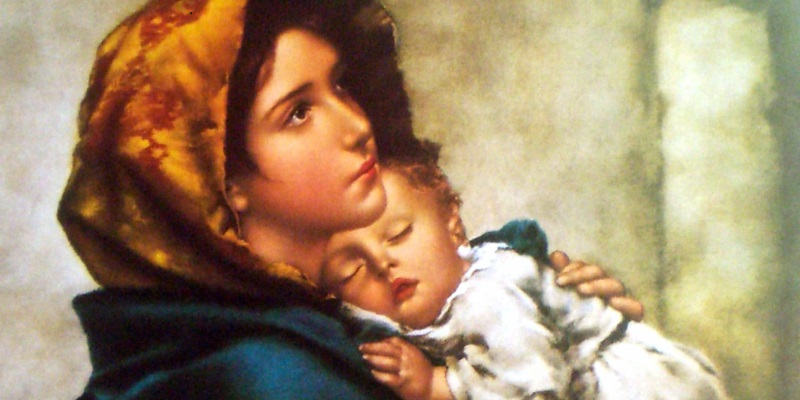
The Blessed Virgin Mary is the mother of Jesus Christ, the mother of God.
In general, the theology and history of Mary the Mother of God follow the chronological order of their respective sources, that is, the Old Testament, the New Testament, the early Christians, and the Jewish witnesses.
MARY PROPHESIZED IN THE OLD TESTAMENT
The Old Testament refers to Our Lady both in its prophecies and in its types or figures.
Genesis 3:15
The first prophecy concerning Mary is found in the opening chapters of the Book of Genesis (3:15): “I will put enmity between you and the woman, and between your lineage and hers; she will crush your head, and you will lie in wait for her heel.” This version appears to differ in two aspects from the original Hebrew text:
First, the Hebrew text uses the same verb for both versions translated “she will crush you” and “you will lie in wait”; the Septuagint translates the verb in both cases as terein, to lie in wait; Aquila, Symmachus and the Syrian and Samaritan translators translate the Hebrew verb by expressions that mean to crush, bruise; The Itala translates the terein used in the Septuagint with the Latin term “servare”, to watch; St. Jerome (1) maintains that the Hebrew verb has the meaning of “crushing” or “bruising” rather than “lying in wait,” “watching.” However in his own work, which became the Latin Vulgate, the saint uses the term “to crush” (conterere) first, and “to lie in wait” (insidiari) second. Therefore the punishment inflicted on the serpent and its revenge are expressed with the same verb: but the wound suffered by the serpent is mortal, since it affects the head, while the wound caused by it is not mortal, since it is inflicted on the heel.
The second point of difference between the Hebrew text and our version refers to the agent who is going to inflict the fatal wound on the serpent: our version coincides with the current Vulgate text in translating “she” (ipsa) which refers to the woman, while the Hebrew text translates hu’ (autos, ipse) which refers to the woman’s offspring. According to our version and the Vulgate translation, it will be the woman who wins; according to the Hebrew text, she will conquer through her descendants. It is in this sense that the Bull “Ineffabilis” attributes the victory to Our Lady. The “she” version (ipsa) is neither an intentional corruption of the original text nor an accidental error, but is an explanatory version that explicitly expresses the fact of Our Lady’s participation in the victory over the serpent, which is implicitly contained in the Hebrew original. The strength of the Christian tradition regarding Mary’s participation in this victory can be deduced from the fact that St. Jerome retained “she” in his version despite his familiarity with the original text and with the translation “he” (ipse) in the old Latin version.
Since it is commonly admitted that divine judgment is directed not so much against the serpent as against the causer of sin, the offspring of the serpent refers to the followers of the serpent, the “brood of vipers,” the “generation of vipers,” those whose father is the Devil, the children of evil, imitating, non nascendo (Augustine) (2). There may be a temptation to understand the descent of women in an analogous collective sense, encompassing all those born of God. But offspring can not only refer to a particular person, but generally has such a meaning, if the context allows it. St. Paul (Galatians 3:16) gives this explanation of the word “offspring” as it appears in the promises of the patriarchs: “To Abraham and his offspring the promises were made. It is not said to his offspring, as of many, but to one, ‘And to your offspring,’ which is Christ.” Finally the expression “the woman” in the phrase “I will put enmity between you and the woman” is a literal translation of the Hebrew text. Gesenius-Kautzsch’s Hebrew Grammar (3) sets the standard: it is a peculiar feature of Hebrew to use the article to indicate a person or thing as yet unknown or yet to be clearly described, whether it is present or has to be considered under the conditions of the context. Since our indefinite article serves this purpose, it could be translated: “I will put enmity between you and a woman.” Therefore the prophecy promises a woman, Our Lady, who will be the enemy of the serpent to an outstanding degree; Furthermore, the same woman will emerge victorious over the Devil, at least through her son. The finality of the victory is underlined by the contextual phrase “you will eat dirt”, which is according to Winckler (4) an ancient and common Eastern expression denoting the ultimate humiliation (5).
Isaiah 7:1-17
The second prophecy regarding Mary is found in Isaiah 7:1-17. Critics have insisted on representing this passage as a combination of events and words of the prophet written by an unknown author (6). The credibility of the content is not necessarily affected by this theory, since prophetic traditions can be recorded by any writer without losing their credibility. But even Duhm regards the theory as an apparent attempt by critics to find out how far readers are willing to patiently endure; He believes that it is a real disgrace for criticism as such that it has found a mere compendium in a passage that so graphically describes the hour of the birth of faith.
According to II Kings 16:1-4, and II Paralipomena 27:1-8, Ahaz, who began his reign in 736 BC. of J.C., he openly professed idolatry, so that God left him at the mercy of the kings of Syria and Israel. Apparently an alliance had been established between Pekah, king of Israel, and Rasin, king of Damascus, for the purpose of offering resistance to Assyrian aggression. Ahaz, a supporter of the Assyrians, did not join the coalition; The allies invaded his territory, intending to replace Ahaz with a more accommodating ruler, a certain son of Tabeel. While Rasin was busy reconquering the coastal city of Elath, Pekah proceeded alone against Judah, “but they could not prevail.” Once Elat had fallen, Rasin joined his forces with those of Pecah; “Syria and Ephraim had confederated” and “his (Ahaz’s) heart and the heart of the people trembled, as the trees of the mountain tremble at the impulse of the wind.” Immediate preparations had to be made for a prolonged siege, and Ahaz was busily engaged in the vicinity of the upper pool, from which the city received most of its water supply. Hence God tells Isaiah: “Then go out to meet Ahaz… at the end of the aqueduct of the upper pool.” The prophet’s charge is of an extremely consoling nature: “Look carefully, do not worry, do not fear anything and have a firm heart before those two pieces of smoking brands.” The enemies’ plan will not succeed: “it will not hold and this will not happen.” What will be the specific fate of the enemies?
· Syria will gain nothing, it will remain as it had been in the past: “the head of Syria is Damascus, and the head of Damascus is Rasin.”
· Ephraim will also remain in the immediate future as it had been until that moment: “the head of Ephraim is Samaria, and the head of Samaria is the son of Romelia”; but after sixty-five years it will be destroyed, “within sixty-five years Ephraim will have ceased to be a people.”
Ahaz had abandoned the Lord for Molech, and had placed his trust in an alliance with Assyria; hence the conditional prophecy concerning Judah “if you do not believe, you will not continue.” The test of faith follows immediately below: “Ask the Lord your God for a sign, either from below in the depths or from above on high.” Ahaz responds with hypocrisy: “I will not ask for it, I will not tempt the Lord”, thus refusing to declare his faith in God and preferring Assyrian politics. The king prefers Assyria to God, and Assyria will come upon him: “The Lord will bring upon you and upon your people, and upon your father’s house, days such as have not come since Ephraim separated from Judah with the king of the Assyrians.” The house of David had offended not only men, but also God with their unbelief; Therefore, “it will not continue”, and, by an irony of divine punishment, it will be destroyed by those same people whom it preferred before God.
However, the messianic promises made to the house of David cannot be frustrated: “The Lord himself will give you a sign. Behold, a virgin will conceive and give birth to a son, and he will be called Immanuel. And he will feed on butter and honey, until he knows how to reject evil and choose good. For before the child knows how to reject evil and choose good, the land for which you fear those two kings will be devastated.” Leaving aside a number of questions related to the explanation of the prophecy, we must limit ourselves here to the evident proof that the virgin mentioned by the prophet is Mary, the Mother of Christ. The argument is based on the premises that the virgin mentioned by the prophet is the mother of Emmanuel, and that Emmanuel is Christ. The relationship of the virgin with Emmanuel is clearly expressed in the inspired words; They also indicate the identity of Emmanuel with Christ.
Emmanuel’s relationship with the extraordinary divine sign that was to be granted to Ahaz predisposes us to see in the creature someone more than an ordinary child. In 8:8, the prophet attributes ownership of the land of Judah to him: “And they will stretch out their arms and cover all your land, O Emmanuel!” In 9:6, the rule of the house of David is said to rest on his shoulders, and he is described as possessing more than human qualities: “to us a child has been born, to us a son has been given, who has sovereignty on his shoulder, and who will be called a wonderful counselor, a mighty God, an everlasting Father, a Prince of Peace.” Finally, the prophet calls Emmanuel “a rod from the trunk of Jesse,” blessed with “the spirit of the Lord, the spirit of wisdom and understanding, the spirit of counsel and might, the spirit of understanding and the fear of God”; His coming will be followed by the general signs of the messianic era, and those who remain of the chosen people will again be the people of God (11:1-16).
Any obscurity or ambiguity that may exist in the prophetic text is eliminated by St. Matthew (1:18-25). After narrating Saint Joseph’s doubts and the angel’s reaffirmation that “what was conceived in her is the work of the Holy Spirit,” the evangelist continues: “All this happened so that what the Lord had announced through the prophet might be fulfilled, which says: Behold, a virgin will conceive and give birth to a son, and will name him Immanuel.” We need not repeat the explanation of the passage given by Catholic commentators in response to the objections that have been raised against the obvious meaning of the evangelist. From all of the above it can be deduced that Mary is mentioned in the prophecy of Isaiah as the mother of Jesus Christ; In light of the reference to the prophecy made by St. Matthew, it can be added that it also predicted the virginity of Mary, intact in the conception of Emmanuel (7).
Micah 5:2-3
A third prophecy regarding Our Lady is found in Micah 5:2-3: “And you, Bethlehem of Ephrathah, small to be counted among the families of Judah, from you will come to me one who will rule over Israel, whose origins come from the beginning, from the days of eternity. He will deliver them until the time when she who is to give birth will give birth, and the rest of her brothers will return to the children of Israel.” Although the prophet (approximately 750-660 BC) was a contemporary of Isaiah, his prophetic activity began a little later and ended a little earlier than that of Isaiah. There is no doubt that the Jews considered the above predictions to refer to the Messiah. According to St. Matthew (2:6), when Herod asked the chief priests and scribes where the Messiah was going to be born, they answered him with the words of prophecy, “And you Bethlehem, land of Judah,…”. According to St. John (7:42), the Jewish populace gathered in Jerusalem for the celebration of the festival asked the rhetorical question: “Does not the Scripture say that from the lineage of David and from the village of Bethlehem, where David was, the Messiah will come?” The Chaldean paraphrase of Micah 5:2 confirms the same view: “Out of you will come me the Messiah, who will rule over Israel.” The very words of the prophecy practically admit of no other explanation; for “its origins are from the beginning, from the days of eternity.”
But how does the prophecy refer to the Virgin Mary? Our Lady is mentioned with the phrase “until the time when she who is to give birth will give birth.” It is true that “she who will give birth” has also referred to the Church (S. Jerome, Theodoret), or to the group of Gentiles who joined Christ (Ribera, Mariana), or also to Babylon (Calmet); but, on the one hand, there is hardly a sufficient relationship between any of these events and the promised redeemer; On the other hand, the passage should read “until the time when she who is barren will give birth” if the prophet had been referring to any of those events. Nor can “she who is to bear” refer to Zion: Zion is mentioned without metaphorical meaning before and after this passage, so the prophet cannot be expected to suddenly resort to figurative language. Furthermore, if the prophecy is explained in this way, it would not make complete sense. The contextual phrases “the lord of Israel,” “his origins,” which in Hebrew implies birth, and “his brothers” refer to an individual, not a nation; It follows that the birth must refer to that same person. It has been shown that the person who will rule is the Messiah; Therefore, “she who is to give birth” must refer to the mother of Christ, Our Lady. Explained in this way, the entire passage appears clear: the Messiah is to be born in Bethlehem, an insignificant town in Judah; his family must be reduced to poverty and obscurity before the moment of his birth; Since this cannot happen if the theocracy remains intact, if the house of David continues to flourish, “therefore he will hand them over until the time when she who is to give birth will give birth” to the Messiah. (8)
Jeremiah 21:22
A fourth prophecy regarding Mary is found in Jeremiah 21:22: “The Lord has created something new on the earth: a woman will get a man.” The text of the prophet Jeremiah offers many difficulties for the scientific interpreter; we will follow the Latin Vulgate version of the Hebrew original. But even this translation has been explained in many different ways: Rosenmuller and many conservative Protestant interpreters defend the “a woman will protect a man” version, but such an argument could hardly induce the men of Israel to return to God. The explanation “a woman will seek a man” hardly agrees with the text; Furthermore, such a reversal of the natural order is presented in Isaiah 4:1 as a sign of utter catastrophe. Ewald’s version “a woman will become a man” is very unfaithful to the original text. Other commentators see in the woman a simile of the Synagogue or the Church, in the man a simile of God, so that they can explain the prophecy “God will dwell again in the midst of the Synagogue (or the people of Israel)” or “the Church will protect the land with its brave men.” But the Hebrew text hardly evokes that meaning; Furthermore, that explanation would turn that passage into a tautology: “Israel will return to its God, since Israel will love its God.” Some recent authors translate the original Hebrew as: “God creates something new on earth: the woman (wife) returns to the man (her husband).” According to the old law (Deuteronomy 24:1-4; Jeremiah 3:1), a husband could not take back his wife once he had divorced her; but the Lord will introduce a novelty by allowing the unfaithful woman, or what is the same, the guilty nation, to return to friendship with God. This explanation is based on a risky correction of the text; furthermore, it does not necessarily imply the expected messianic meaning of the passage.
The Greek Fathers generally follow the Septuagint version, “The Lord has created salvation in a new plantation, men will walk in safety”; but St. Athanasius (9) combines Aquila’s version twice “God has created something new in the woman” with that of the Septuagint, saying that the new plantation is Jesus Christ, and that the new thing created in the woman is the body of the Lord, conceived in the virgin woman without the participation of man. St. Jerome (10) also understands the prophetic text of the virgin who conceives the Messiah. This explanation of the passage agrees with the text and the context. Since the Incarnate Word possessed from the first moment of its conception all its perfections, except those related to its bodily development, it is correct to affirm that its mother “will obtain a man.” It is hardly necessary to point out that such a condition in a newly conceived creature is rightly called “something new on earth.” The context of the prophecy describes, after a brief general introduction (30:1-3), Israel’s future freedom and restoration in four rooms: 30:4-11, 12-22; 30:23; 31:14, 15-26; The first three stays end with the hope of the messianic time. The fourth should also be expected to have a similar ending. Furthermore, Jeremiah’s prophecy, spoken around 589 BC. of C. and understood in the sense just referred to, agrees with contemporary messianic expectations based on Isaiah 7:14; 9:6; Micah 5:3. According to Jeremiah, the mother of Christ differs from other mothers in that her Son, even while still in her womb, has all the properties that constitute true human nature (11). The Old Testament refers indirectly to Mary in those prophecies that predict the incarnation of the Word of God.
TYPES AND FIGURES OF MARY IN THE OLD TESTAMENT
To be sure of the meaning of a type, this meaning must be revealed, that is, it must have been transmitted to us through Holy Scripture or tradition. Some pious writers have on their own developed numerous analogies between certain data in the Old Testament and corresponding data in the New Testament; However, however ingenious these correlations may be, they do not demonstrate that God actually intended to convey in the inspired texts of the Old Testament the truths of the established correspondence. On the other hand, it must be kept in mind that not all truths contained either in Scripture or in tradition have been explicitly proposed to believers as truths of faith by the express definition of the Church. According to the principle “Lex orandi est lex credenti” we must treat at least with reverence the innumerable suggestions contained in the official liturgy and prayers of the Church. This is how we must consider many of the treatments given to Our Lady in the litany and in the “Ave maris stella.” The Antiphons and Responses found in the Offices recited on the various festivities of Our Lady suggest a number of types referring to Our Lady which would hardly have been so vividly shown otherwise to the ministers of the Church. The third Lauds antiphon of the Feast of the Circumcision contemplates in “the bush that burns without being consumed” (Exodus 3:2) the figure of Mary in the conception of her Son without losing her virginity. The second Lauds antiphon of the same Office contemplates in Gideon’s wool fleece, moist with dew while the earth around him had remained dry (Judges 6:37-38), a type of Mary receiving the Incarnate Word in her womb (12). The Office of the Blessed Virgin applies to Mary many of the passages referring to the wife of the Song of Songs (13) and also those referring to wisdom from the Book of Proverbs 8:22-31 (14). A “closed garden, a sealed fountain” mentioned in Song of Solomon 4:12 applied to Mary is just a concrete example of everything referred to above (15). Furthermore, Sarah, Deborah, Judith and Esther are used as types of Mary; The Ark of the Covenant, on which the very presence of God is manifested, is used as the figure of Mary carrying the Incarnate Word in her womb. But it is especially Eve, the mother of all living (Genesis 3:20), who is considered a type of Mary, who is the mother of all living in the order of grace (16).
MARY IN THE GOSPELS
The reader of the Gospels is at first surprised to find so little about Mary; but this obscurity of Mary in the Gospels has been exhaustively studied by Blessed Peter Canisius (17), Augustus Nicholas (18), Cardinal Newman (19) and the Very Reverend J. Spencer Northcote (20). In the commentary on the “Magnificat” published in 1518, even Luther expresses his conviction that the Gospels sufficiently praise Mary by calling her (eight times) the Mother of Jesus. In the following paragraphs we will briefly group what is known about the life of Our Lady before the birth of her divine Son, during the hidden life of Our Lord, during his public life and after his resurrection.
Davidic Ancestry of Mary
St. Luke (2:4) narrates that Saint Joseph traveled from Nazareth to Bethlehem to register, “because he was from the house and family of David.” As if to remove any doubt regarding Mary’s Davidic ancestry, the evangelist (1:32,69) states that the child born to Mary without the intervention of a man will be given “the throne of David, her father,” and that the Lord God has “raised up for us a horn of salvation in the house of David, his servant.” (21) St. Paul also attests that Jesus Christ “born of the seed of David according to the flesh” (Romans 1:3). If Mary had not been a descendant of David, her Son conceived by the Holy Spirit could not have been considered “of the descendants of David.” For this reason the commentators tell us that in the text “In the sixth month the angel Gabriel was sent… to a virgin betrothed to a man named Joseph, of the house of David” (Luke 1:26-27); the last phrase “of the house of David” refers not to Joseph, but to the virgin maiden who is the main character of the narrative; thus we have a direct inspired testimony of Mary’s Davidic ancestry. (22)
While commentators generally agree that the genealogy found at the beginning of the first Gospel is that of St. Joseph, Annius of Viterbo proposes his opinion, already referred to by St. Augustine, that the genealogy of St. Luke describes the ancestry of Mary. The text of the third Gospel (3:23) can be explained in such a way that Heli is the father of Mary: “Jesus… was, it was believed, the son of Joseph, the son of Heli” (23). In these explanations the name of Mary is not explicitly mentioned, but it is implicit; since Jesus is the son of Heli through Mary.
Her parents
Although few commentators agree with this view regarding St. Luke’s genealogy, the name of Mary’s father, Heli, coincides with the name of Our Lady’s father according to a tradition based on the narrative of the Protoevangelium of James, an apocryphal Gospel dating from the late 2nd century. According to this document, Mary’s parents were Joachim and Anna. Now, Joachim’s name is only a variant of Heli or Eliachim, replacing one divine name (Yahweh) with another (Eli, Elohim). The tradition regarding Mary’s parents, according to the Gospel of James, is reproduced by St. John Damascene (24), St. Gregory of Nyssa (25), St. Germanus of Constantinople (26), Pseudo-Epiphanius (27), pseudo-Hilary (28) and St. Fulbert of Chartres (29). Some of these writers add that the birth of Mary was achieved thanks to the fervent prayers of Joachim and Anne when they were already of advanced age. Just as Joachim belonged to the royal family of David, so Hannah is supposed to have been a descendant of the priestly family of Aaron; Therefore, Christ, the Eternal King and Priest, descended from a royal and priestly family (30).
The city of Mary’s parents
According to Luke 1:26, Mary was living in Nazareth, a city in Galilee, at the time of the Annunciation. A certain tradition maintains that she was conceived and born in the same house in which the Word became flesh (31). Another tradition, based on the Gospel of James, considers Sepphoris to be the first home of Joachim and Anna, although it is said that they later lived in Jerusalem, in a house called Probatica by St. Sophronius of Jerusalem (32). Probatica, a name that probably came from a pool called Probatica or Betzata in St. John 5:2, near the sanctuary. This was where Mary was born. About a century later, around 750 AD. of J.C., S. Juan Damasceno (33) affirms again that Mary was born in Probatica.
It is said that, already in the 5th century, the Empress Eudoxia built a church in the place where Mary was born, and where her parents lived in their old age. The present St. Anne’s Church is located at a distance of less than 100 feet from the Probatic Pool. On March 18, 1889, a crypt was discovered enclosing the site where St. Anne was supposedly buried. This place was probably originally a garden in which Joaquín and Ana were buried. In his time it was still located outside the city walls, about 400 feet north of the Temple. Another crypt near the tomb of St. Anne is believed to be the place where the Blessed Virgin was born; For this reason, in the early days that church was called Sta. María de la Natividad (34). In the Kidron valley, near the road leading to the church of the Assumption, there is a small sanctuary containing two altars, believed to be built over the tombs of St. Joachim and St. Anne; However, these tombs belong to the time of the Crusades (35). Also in Sepphoris the crusaders replaced an ancient sanctuary situated above the legendary house of St. Joachim and St. Anne with a large church. After 1788 part of this church was restored by the Franciscan Fathers.
Her Immaculate Conception
The Immaculate Conception of Our Lady has been treated in a special article.
The birth of Mary
When it comes to Our Lady’s birthplace, there are three different traditions to consider.
First, the event has been located in Bethlehem. This opinion is based on the authority of the following witnesses: it has been expressed in a document entitled “De nativ. S. Mariae” (36) included after the works of S. Jerome; It is a more or less vague assumption of the Pilgrim of Piacenza, mistakenly called Antoninus Martyr, who wrote around 580 AD. by J.C. (37); Finally, Popes Paul II (1471), Julius II (1507), Leo X (1519), Paul III (1535), Pius IV (1565), Sixtus V (1586) and Innocent However, these pontiffs did not really wish to decide on a historical question; they simply express the opinion of their respective times.
A second tradition placed the birth of Our Lady at Sepphoris, about three miles north of Bethlehem, the Roman Diocaesarea, and the residence of Herod Antipas well into Our Lord’s life. The antiquity of this opinion may be deduced from the fact that under the reign of Constantine a church was erected at Sepphoris to commemorate the residence of Joachim and Anna there (38). St. Epiphanius speaks of this sanctuary (39). But this only shows that Our Lady must have lived for some time in Sepphoris with her parents, without us having to believe that she was born there.
The third tradition, that Mary was born in Jerusalem, is the most probable of the three. We have seen that it is based on the testimony of St. Sophronius, of St. John Damascene and on the evidence of recent findings in the Probatica. The Feast of the Nativity of Our Lady was not celebrated in Rome until the end of the 7th century; However, two sermons found among the writings of St. Andrew of Crete (d. 680) imply the existence of this festival and lead us to suppose that it was introduced at an earlier date in other churches (40). In 1799, the tenth canon of the Synod of Salzburg indicates four festivals in honor of the Mother of God: the Purification, on February 2; the Annunciation, March 25; the Assumption, on August 15 and the Nativity, on September 8.
The Presentation of Mary
According to Exodus 13:2 and 13:12, every Hebrew firstborn had to be presented in the Temple. Such a law would lead pious Jewish parents to observe the same religious rite with other favorite children. This suggests that Joachim and Anna presented their daughter, obtained after long and fervent prayers, in the Temple.
As for Mary, St. Luke (1:34) tells us that she responded to the angel who announced the birth of Jesus Christ: “how can this be, since I do not know a man.” These words can hardly be understood, unless we suppose that Mary had taken a vow of virginity, since when she pronounced them she was espoused to St. Joseph (41). The most appropriate occasion for such a vow was its presentation in the Temple. In the same way that some Fathers admit that the faculties of St. John the Baptist were developed prematurely by a special intervention of divine power, the existence of a similar grace towards the daughter of Joachim and Anna can be admitted (42).
However, everything mentioned above does not exceed the certainty of the probability of some pious conjectures. The consideration that Our Lord could not refuse his blessed Mother any favor that depended exclusively on her magnificence, has no greater value than that of an a priori argument. Certainty on this question must depend on external testimonies and the teachings of the Church.
Now, the Protoevangelium of James (7-8) and the document entitled “De nativit. Mariae” (7-8), (43) affirm that Joachim and Anna, fulfilling a vow they had made, presented the little Mary in the Temple when she was three years old; that the creature climbed the steps of the Temple alone, and that she made her vow of virginity on that occasion. St. Gregory of Nyssa (44) and St. Germanus of Constantinople (45) accepted this testimony, which was also followed by pseudo-Gregory of Naz. in his “Christus patiens” (46). In addition, the Church celebrates the Feast of the Presentation, although it does not specify at what age little Mary was presented in the Temple, when she took her vow of virginity, and what special natural and supernatural gifts God granted her. The festival is mentioned for the first time in a document by Manuel Commenus, in 1166; From Constantinople, the holiday must have been introduced into the Western Church, where we can find it in the papal court of Avignon in 1371; About a century later, Pope Sixtus IV introduced the Office of the Presentation, and in 1585 Pope Sixtus V extended the Feast of the Presentation to the entire Church.
Her betrothal to Joseph
The apocryphal writings we referred to in the previous paragraph state that Mary remained in the Temple after her presentation to be educated with other Jewish children. There she enjoyed ecstatic visions and daily visitations from holy angels.
When she was fourteen years old, the high priest wanted to send her home to get married. Mary reminded him of his vow of virginity, and confused, the high priest consulted the Lord. Then he called all the young men of David’s line and promised Mary in marriage to the one whose rod would bud and become the resting place of the Holy Spirit in the form of a dove. José was the lucky one in this extraordinary process.
We have already seen that St. Gregory of Nyssa, St. Germanus of Constantinople and pseudo-Gregory of Nazianzus seem to admit these legends. Furthermore, Emperor Justinian allowed a basilica to be built on the platform of the ancient Temple, in memory of Our Lady’s stay in the sanctuary; The church was called the New Saint Mary, to distinguish it from the Church of the Nativity. It is believed to be the modern Al-Aqsa Mosque (47).
On the other hand, the Church does not take a position regarding Mary’s stay in the Temple. St. Ambrose (48), when describing Mary’s life before the Annunciation, expressly assumes that she lived in her parents’ house. All descriptions of the Jewish Temple that may have any scientific value leave us in the dark as to the existence of places where young girls might have received their education. Joash’s stay in the Temple until the age of seven does not support the assumption that young girls were educated within the sacred precincts, since Joash was the king, and was forced by circumstances to remain in the Temple (cf. IV Kings 11:3). The allusion in II Maccabees 3:19, when it says “the maidens, gathered together” does not demonstrate that any of them were retained in the Temple buildings. If it is said of the prophetess Anna (Luke 2:37) that she “did not depart from the temple, serving with fasting and prayers night and day,” we do not suppose that she actually lived in one of the rooms of the temple. (49) As the house of Joachim and Anna was not far from the Temple, we can assume that the holy child Mary was often allowed to visit the sacred buildings so that she could satisfy her devotion.
Jewish maidens were considered to have reached the age of marriage when they turned twelve years and six months, although the age of the bride varied depending on circumstances. Marriage was preceded by betrothal, after which the bride legally belonged to the groom, although she did not live with him until a year later, which was when the marriage usually took place. All this coincides with the language of the evangelists. St. Luke (1:27) calls Mary “a virgin espoused to a man named Joseph”; St. Matthew (1:18) says “When his mother Mary was espoused to Joseph, before they lived together, Mary was found to have conceived by the Holy Spirit.” Since we do not know of any brother of Mary, we must assume that she was an heiress, and was obliged by the law of Numbers 36:3 to marry a member of her tribe. The law itself prohibited marriage between certain degrees of kinship, so that even the marriage of an heiress was more or less left to her choice.
According to Jewish custom, the union of Joseph and Mary had to be arranged by Joseph’s parents. One may wonder why Mary agreed to his betrothal, when she was bound by her vow of virginity. Just as she had obeyed divine inspiration in making her vow, she also obeyed it in becoming Joseph’s promised bride. Furthermore, it would have been a singular case among the Jews to refuse betrothal or marriage, since all Jewish maidens aspired to marriage as the fulfillment of a natural duty. Mary implicitly trusted in God’s guidance, and therefore was sure that her vow would be respected even in her married state.
The Annunciation
According to Luke 1:36, the angel Gabriel said to Mary at the time of the Annunciation, “Elizabeth, your relative, has also conceived a son in her old age, and this is now the sixth month of her who was barren.” Without doubting the truth of the angel’s words, Mary immediately decided to contribute to the joy of her pious relative. (50) Therefore, the evangelist continues (1:39): “In those days Mary set out and quickly went to the mountain, to a city of Judah, and entered the house of Zechariah and greeted Elizabeth.” Although Mary must have informed Joseph of her intention to make that visit, it is difficult to determine whether he accompanied her; If the time of the visit happened to coincide with one of the holiday seasons when the Israelites had to go to the Temple, there would be few difficulties about the company.
Elizabeth’s house has been located in various locations according to different writers: it has been located in Machaerus, about ten miles east of the Dead Sea, or in Hebron, or again in the ancient priestly city of Jutta, about seven miles south of Hebron, or finally in Ain-Karim, the traditional St. John-on-the-Mountain, about four miles west of Jerusalem. (51) However, the first three sites do not have any monument commemorating the birth or life of St. John; furthermore, Machaerus was not situated in the mountains of Judah; Hebron and Jutta belonged to Idumea, after the Babylonian captivity, while Ain-Karim is situated in the “mountains” mentioned in the inspired text of St. Luke.
After a journey of about thirty hours, Mary “entered Zechariah’s house and greeted Elizabeth” (Luke 1:40). According to tradition, at the time of the visitation Isabel did not live in her house in the city but in her villa, about ten minutes from the city; In ancient times this place was marked by an upper and a lower church. In 1861 the current small church of the Visitation was built on the old foundations.
“When Elizabeth heard Mary’s greeting, the child in her womb exulted.” It was at this time that God fulfilled the promise made by the angel to Zechariah (Luke 1:15), “from his mother’s womb he will be filled with the Holy Spirit”; In other words, the child Elizabeth carried in her womb was purified from the stain of original sin. The fullness of the Holy Spirit overflowed into her mother’s soul, “and Elizabeth was filled with the Holy Spirit” (Luke 1:41). Thus, both mother and son were sanctified by the presence of Mary and the Incarnate Word (53); Filled as she was with the Holy Spirit, Elizabeth “cried with a loud voice: Blessed are you among women and blessed is the fruit of your womb! Whence is it that the mother of my Lord comes to me? For as soon as the voice of your greeting sounded in my ears, the child in my womb exulted for joy. Blessed is she who has believed that what was spoken to her from the Lord will be fulfilled” (Luke 1:42-45). Let us leave the complete explanation of the preceding passage to the commentators, and focus our attention on only two points:
Elizabeth begins her greeting with the same words with which the angel had ended his greeting, thus showing that both were speaking by inspiration of the Holy Spirit.
Elizabeth is the first to call Mary by her most honorable title “Mother of God.”
Mary’s response is the song of praise commonly called Magnificat, after the first word of its Latin text; the “Magnificat” has been discussed in a separate article.
The evangelist ends his account of the Visitation with the words: “Mary remained with her about three months and returned home” (Luke 1:56). Many see in this brief phrase from the Third Gospel an implicit suggestion that Mary remained in Zechariah’s house until the birth of John the Baptist, while others deny such an implication. Since the Feast of the Visitation was set on July 2 by the forty-third canon of the Council of Basel (AD 1441), the day following the octave of the Feast of St. John the Baptist, it has been deduced that Mary possibly remained with Elizabeth until after the circumcision of the child; but there is no further evidence to corroborate this assumption. Although the Visitation is described with such precision in the third gospel, its festival does not appear to have been celebrated until the 13th century, when it was introduced through the influence of the Franciscans; It was officially established in 1389 by Urban VI.
Mary’s pregnancy comes to Joseph’s attention
After Elizabeth’s return from home, “Mary was found to have conceived by the Holy Spirit” (Matthew 1:18). Since among the Jews the betrothal constituted a true marriage, the use of marriage after the time of the betrothal was not at all strange among them. Therefore, Mary’s pregnancy could not surprise anyone other than Saint Joseph himself. The situation must have been extremely painful for both him and Mary, since he did not know the mystery of the Incarnation. The evangelist says: “Joseph, her husband, being just, did not want to denounce her and decided to divorce her secretly” (Matthew 1:19). Mary left the solution to this difficulty in the hands of God, and God at the time informed the astonished husband of Mary’s true condition. While Joseph “reflected on this, behold, an angel of the Lord appeared to him in a dream and said, ‘Joseph, son of David, do not be afraid to take Mary your wife home, for what was conceived in her is the work of the Holy Spirit. She will give birth to a son, whom you will name Jesus, for he will save his people from their sins'” (Matthew 1:20-21).
Not long after this revelation, Joseph concluded the ritual of the marriage contract with Mary. The Gospel says simply: “When Joseph woke up from his sleep, he did as the angel of the Lord had commanded him, taking his wife home” (Matthew 1:24). While it is true that at least three months must have passed between the betrothal and the marriage, during which Mary remained with Elizabeth, it is impossible to determine exactly the amount of time that elapsed between the two ceremonies. We do not know how long after the betrothal the angel announced to Mary the mystery of the Incarnation, and we do not know how long St. Joseph’s doubt lasted before he was enlightened by the angel’s visit. Taking into account the age at which Jewish maidens became marriageable, it is possible that Mary gave birth to her Son when she was around thirteen or fourteen years old. No historical document tells us how old he really was at the time of the Nativity.
The trip to Bethlehem
Luke (2:1-5) explains how Joseph and Mary traveled from Nazareth to Bethlehem obeying a decree from Caesar Augustus ordering a general census. The issues related to this decree have been discussed in the article BIBLICAL CHRONOLOGY. Several reasons are given why Mary must have accompanied Joseph on this journey: it is possible that she did not wish to lose Joseph’s protection during this critical period of her pregnancy, or she may have followed a special divine inspiration that prompted her to go so that the prophecies regarding her divine Son would be fulfilled, or she may also have been forced to go due to civil law, either as an heir or to satisfy the personal tax that had to be paid by women over twelve years of age. (54)
Since the registration had attracted a multitude of foreigners to Bethlehem, Mary and Joseph could not find room in the caravan inn and had to stay in a grotto that served as a refuge for the animals. (55)
Mary gives birth to Our Lord
“While she was there, the days of her delivery were fulfilled” (Luke 2:6); This language does not make it clear whether Our Lord’s birth occurred immediately after Joseph and Mary had stayed in the grotto, or several days later. What is narrated about the shepherds “keeping night watches over their flock” (Luke 2:8) shows that Christ was born during the night.
After giving birth to her Son, Mary “wrapped him in swaddling clothes and laid him in a manger” (Luke 2:7), a sign that she suffered no pain or weakness in childbirth. This deduction coincides with the teachings of some of the leading Fathers and theologians: St. Ambrose (56), St. Gregory of Nyssa (57), St. John Damascene (58), the author of Christus patiens (59), Sto. Tomás (60), etc. It was not appropriate for the mother of God to be subject to the punishment pronounced in Genesis 3:16 against Eve and her sinful daughters.
Shortly after the birth of the child, the shepherds, obedient to the angel’s invitation, came to the grotto “and found Mary and Joseph and the Child lying in a manger” (Luke 2:16). We may suppose that the shepherds spread the happy news which they had received during the night among their friends in Bethlehem, and that the Holy Family was received by some of its pious inhabitants into more suitable lodgings.
The Circumcision of Our Lord
“When the eight days were completed to circumcise the Child, they gave Him the name Jesus” (Luke 2:21). The rite of circumcision was carried out either in the synagogue or in the child’s home; It is impossible to determine where the circumcision of Our Lord took place. Anyway, his Blessed Mother must have been present during the ceremony.
The Presentation
According to the law of Leviticus 12:-8, every Jewish mother of a Hebrew male had to appear forty days after his birth for legal purification; according to Exodus 13:2 and Numbers 18:15, the firstborn had to be presented on that same occasion. Whatever reasons Mary and the Child might have had for claiming an exception, the fact is that they followed the law. However, instead of offering a lamb, they presented the poor man’s sacrifice, which consisted of a pair of turtledoves or pigeons. In II Corinthians 8:9, St. Paul tells the Corinthians that Jesus Christ “though he was rich, became poor for our sake, so that you might be rich because of his poverty.” Even more pleasing to God than Mary’s poverty was the readiness with which she offered her divine Son for the pleasure of her Heavenly Father.
After the ceremonial rites had been performed, the holy Simeon took the Child in his arms and gave thanks to God for the fulfillment of his promises; He called attention to the universality of salvation that was to come through the messianic redemption “which you have prepared before the face of all people, a light for the illumination of the nations and the glory of your people Israel” (Luke 2:31 sq.). Mary and Joseph now began to know their divine Son more fully; They “were amazed at the things that were said of Him” (Luke 2:33). As if to prepare his Blessed Mother for the mystery of the cross, holy Simeon told her: “It is prepared for the fall and rising of many in Israel and for the target of contradiction; and a sword will pierce your soul so that the thoughts of many hearts may be revealed” (Luke 2:34-35). Mary had suffered her first great pain when Joseph had hesitated to take her as his wife; His second great pain was experienced when he heard the words of Saint Simeon.
Although the prophetess Anna’s incident had had a more general bearing, as she “spoke of Him to those who were waiting for the redemption of Jerusalem” (Luke 2:38), it must have greatly increased the astonishment of Joseph and Mary. The evangelist’s final comment, “When all things were fulfilled according to the law of the Lord, they returned to Galilee, to the city of Nazareth” (Luke 2:39), has been interpreted in various ways by commentators; Regarding the order of events, consult the article CHRONOLOGY OF THE LIFE OF JESUS CHRIST.
The visit of the Magi
After the Presentation, the Holy Family either returned directly to Bethlehem, or went first to Nazareth and from there to the city of David. In any case, after “the wise men from the East” had been guided to Bethlehem by God, “entering the house, they saw the Child with Mary his mother, and they knelt down and worshiped him, and opening their bags, they offered him gifts, gold, frankincense, and myrrh” (Matthew 2:11). The evangelist does not mention Joseph; not because she was not present, but because Mary occupies the main place next to the Child. The evangelists have not told how Mary and Joseph disposed of the gifts offered by their wealthy visitors.
The flight to Egypt
Shortly after the departure of the wise men, Joseph received the message from the angel of the Lord to flee to Egypt with the Child and his mother, due to the evil purposes of Herod; The ready obedience of the holy man is briefly described by the evangelist in the words: “Rising in the night, he took the child and the mother and departed for Egypt” (Matthew 2:14). Persecuted Jews had always sought refuge in Egypt (cf. III Kings 11:40; IV Kings 25:26); in the time of Christ, Jewish settlers were especially numerous in the land of the Nile (61); according to Philo (62) there were at least a million. At Leontopolis, in the district of Heliopolis, the Jews had a temple (160 BC-AD 73) that rivaled in splendor the temple in Jerusalem. (63) For all this, the Holy Family could hope to find a certain help and protection in Egypt.
Furthermore, a journey of at least ten days from Bethlehem was necessary to reach the nearest inhabited districts of Egypt. We do not know what path the Holy Family took in their escape; they could have taken the ordinary road through Hebron; either they could have marched via Eleutheropolis and Gaza or they could also have headed west from Jerusalem towards the great military highway of Joppa.
There is hardly any historical document that can help us determine where the Holy Family lived in Egypt, and we do not know how long this forced exile lasted. (64)
When Joseph received the news of Herod’s death from the angel and the order to return to the land of Israel, he, “rising, took the child and the mother and departed for the land of Israel” (Matthew 2:21). The news that Archelaus reigned in Judea prevented Joseph from settling in Bethlehem, as had been his intention; “Warned in a dream, he withdrew to the region of Galilee, going to live in a city called Nazareth” (Matthew 2:22-23). In all these details, Mary simply allowed herself to be guided by Joseph, who in turn received the divine manifestations as head of the Holy Family. It is not necessary to point out Mary’s intense pain at the early persecution of the Child.
The Holy Family in Nazareth
The life of the Holy Family in Nazareth was that of a normal poor merchant. According to Matthew 13:55, the townspeople asked, “Is this not the carpenter’s son?” The question, as expressed in the second gospel (Mark 6:3), shows a slight variation, “Is it not the carpenter?” While Joseph earned a living for the Holy Family with his daily work, Mary attended to the household chores. St. Luke (2:40) briefly says of Jesus: “The Child grew and became strong, full of wisdom, and the grace of God was in Him.” The weekly Sabbath and annual great festivals interrupted the daily routine of life in Nazareth.
Our Lord is found in the Temple
According to the law of Exodus 23:17, only men were required to visit the temple on the three solemn festivals of the year; but women often joined men to satisfy their devotion. St. Luke (2:41) informs us that “His (the Child’s) parents went to Jerusalem every year for the Passover festival.” They probably left the baby Jesus at the home of friends or relatives during the days that Mary was absent. According to the opinion of some writers, the Child gave no sign of his divinity during the years of his childhood, for the purpose of increasing the merits of the faith of Joseph and Mary, based on what they had seen and heard at the time of the Incarnation and the birth of Jesus. The Jewish Doctors of the Law held that a boy became a child of the law at the age of twelve years and one day; After this, he was bound by legal precepts.
The evangelist here provides us with the information that “when he was twelve years old, when his parents came up, according to the festive rite, and they returned at the end of his days, the child Jesus remained in Jerusalem, without his parents noticing him.” (Luke 2:42-43). This probably occurred after the second day of the feast, when Joseph and Mary were returning with other Galilean pilgrims; the law did not require a longer stay in the Holy City. On the first day, the caravan generally made a four-hour journey, spending the night at Beroth, on the northern border of the ancient kingdom of Judah. The crusaders built a beautiful Gothic church in this place to commemorate the pain of Our Lady when “they searched for him among relatives and acquaintances, and when they did not find him, they returned to Jerusalem in search of him” (Luke 2:44-45). The Child was not found among the pilgrims who had come to Beroth on the first day of their journey; Nor did they find him on the second day, when Joseph and Mary returned to Jerusalem; It was not until the third day when “they found him in the temple, sitting in the midst of the doctors, listening to them and asking them… When his parents saw him, they were amazed, and his mother said to him, ‘Son, why have you done this to us? See, your father and I, grieving, were looking for you'” (Luke 2:40-48). Mary’s faith did not allow her to fear that even the slightest accident would happen to her divine Son; but he perceived that his usual behavior of docility and submission had completely changed. This feeling was the cause of the question, why Jesus had treated his parents that way. Jesus answered simply: “Why were you looking for me? Did you not know that I must attend to my Father’s things?” (Luke 2:49). Neither Joseph nor Mary took these words as a reprimand; “They did not understand what he said to them” (Luke 2:50). A recent writer has suggested that the meaning of the last phrase is to be understood “they (i.e., those who were present) did not understand what he said to them (i.e., to Joseph and Mary).”
The rest of Our Lord’s youth
After this, Jesus “went down with them, and came to Nazareth,” where he began a life of toil and poverty, of which eighteen years are summed up by the evangelist in these few words, “and he was subject to them,…he increased in wisdom and age and favor with God and men” (Luke 2:51-52). The inner life of Mary is briefly indicated by the writer’s inspired expression “and his mother kept all these things in her heart” (Luke 2:51). An analogous expression had been used in 2:19, “Mary kept all this and pondered it in her heart.” Thus, Mary observed the daily life of her divine Son, and grew in her knowledge and love through meditation on what she saw and heard. Certain writers have pointed out that the evangelist indicates here the last source from which he obtained the material contained in his first two chapters.
The perpetual virginity of Mary
Related to the study of Mary during the hidden life of Our Lord, we find aspects relating to her perpetual virginity, her divine motherhood and her personal holiness. Her unblemished virginity has been sufficiently considered in the article on the Birth of the Virgin. The authorities cited then maintain that Mary remained a virgin when she conceived and gave birth to her divine Son, and also after the birth of Jesus. Mary’s question (Luke 1:34), the angel’s response (Luke 1:35,37), Joseph’s manner during his doubt (Matthew 1:19-25), Christ’s words addressed to the Jews (John 8:19), show that Mary preserved her virginity during the conception of her divine Son.
As for Mary’s virginity after childbirth, it is not denied either by the expressions of St. Matthew “before they lived together” (1:18), “her firstborn” (1:25), nor by the fact that the books of the New Testament repeatedly refer to the brothers of Jesus. (66) The words “before they lived together” probably mean “before they lived in the same house,” referring to the time when they were only married; but even if these words were understood as marital life, they only affirm that the Incarnation took place before such a relationship was established, and without implying that it took place after the Incarnation of the Son of God.
The same must be said of the expression “He did not know her until she gave birth to her firstborn” (Matthew 1:25); The evangelist tells us what did not happen before the birth of Jesus, without suggesting that it happened after his birth. (68) The name “firstborn” applies to Jesus whether his mother remained a virgin or gave birth to other children after Jesus; among the Jews it was a legal name (69), so its appearance in the Gospel cannot surprise us.
Finally, “the brothers of Jesus” are neither the children of Mary nor the brothers of Our Lord, in a strict sense of the term, but rather his cousins or more or less close relatives. (70) The Church insists that with his birth the Son of God did not diminish but consecrated the virginal integrity of his mother (secret prayer at the Mass of Purification). The Fathers also express themselves in similar language regarding this privilege of Mary. (71)
The divine motherhood of Mary
The divine motherhood of Mary is based on the teachings of the Gospels, the writings of the Fathers and the express definition of the Church. St. Matthew (1:25) testifies that Mary “gave birth to her firstborn” and that He was called Jesus. According to St. John (1:15) Jesus is the Word made flesh, the Word that assumed human nature in the womb of Mary. Since Mary was truly the mother of Jesus, and Jesus was truly God from the first moment of his conception, Mary is truly the mother of God. Even the most ancient Fathers did not hesitate to draw this conclusion, as can be seen in the writings of St. Ignatius (72), St. Irenaeus (73), and Tertullian (74). Nestorius’ conflict denying Mary the title “Mother of God” (75) was followed by the teachings of the Council of Ephesus, which proclaimed Mary to be Theotokos in the true sense of the word. (76)
The perfect holiness of Mary
A few patristic writers expressed doubts about the presence of minor moral defects in Our Lady. (77) St. Basil, for example, suggests that Mary succumbed to doubt upon hearing the words of the holy Simeon and upon witnessing the crucifixion. (78) St. John Chrysostom is of the opinion that Mary would have felt fear and worry if the angel had not explained to her the mystery of the Incarnation, and that she showed a little vainglory at the wedding feasts of Cana and when visiting her Son during her public life accompanied by the brothers of the Lord. (79) St. Cyril of Alexandria (80) speaks of Mary’s doubt and her despair at the foot of the cross. But it cannot be said that these Greek writers express an apostolic tradition, when what they express are their singular and private opinions. Scripture and tradition agree in attributing to Mary the greatest personal holiness; it is conceived without the stain of original sin; shows the greatest humility and patience in his daily life (Luke 1:38, 48); He demonstrates heroic patience in the most difficult circumstances (Luke 2:7,35,48; John 19:25-27). When considering the question of sin, Mary is always an exception. (81) Mary’s total exclusion from sin is confirmed by the Council of Trent (Session VI, Canon 23): “If anyone says that a man once justified can during his entire life avoid all sin, even venial, as the Church maintains that the Virgin Mary did by a special privilege of God, let him be guilty of anathema.” Theologians affirm that Mary was immaculate, not because of the essential perfection of her nature, but because of a special divine privilege. Furthermore, the Fathers, at least since the 5th century, maintain almost unanimously that the Blessed Virgin never experienced the impulses of concupiscence.
The miracle of Cana
The evangelists relate the name of Mary with three different events in the public life of Our Lord: with the miracle of Cana, with his preaching and with his passion. The first of these incidents is recounted in John 2:1-10.
…there was a wedding in Cana of Galilee, and the mother of Jesus was there. Jesus was also invited with his disciples to the wedding. They had no wine, because the wedding wine was gone. At this Jesus’ mother said to him: They have no wine. Jesus said to her: Woman, what is it with me and you? My time has not yet come.
It is naturally assumed that one of the bride and groom was related to Mary, and that Jesus had been invited because of his mother’s relationship. The couple must have been quite poor, as the wine was indeed running out. Mary wishes to save her friends from the shame of not being able to properly entertain her guests, and she turns to her divine Son. She simply states her need, without adding any request. When addressing women, Jesus consistently uses the word “woman” (Matthew 15:28; Luke 13:12; John 4:21; 8:10; 19:26; 20:15), an expression used by classical writers as a respectful and honorable address. (82)
The passages cited above show that in the language of Jesus the treatment “woman” has an extremely respectful meaning. The phrase “what’s up with me and you” translates into Greek ti emoi kai soi, which in turn corresponds to the Hebrew phrase mah li walakh. The latter happens in Judges 11:12; II Kings 16:10; 19:23, III Kings 17:18; IV Kings 3:13; 9:18; II Paralipomena 35:21. The New Testament shows equivalent expressions in Matthew 8:29; Mark 1:24; Luke 4:34; 8:28; Matthew 27:19. The meaning of the phrase varies depending on the character of the speaker, ranging from very pronounced opposition to polite compliance. Such a variable meaning makes it difficult for the translator to find an equally variable equivalent. “What do I have to do with you”, “this is neither my business nor yours”, “why are you giving me so much trouble”, “let me attend this”, are some of the suggested translations. In general, the words seem to refer to a greater or lesser opportunity that they are trying to eliminate. The last part of Our Lord’s response presents fewer difficulties for the interpreter: “My hour is not yet come” cannot refer to the precise moment when the need for wine will require the miraculous intervention of the Lord, since in the language of St. John “my hour” or “the hour” refers to the time predestined for some important event (John 4:21,23; 5:25,28; 7:30; 8:29; 12:23; 13:1; 16:21; Therefore, the meaning of Our Lord’s response is: “Why do you bother me by asking me for such an intervention? The moment appointed by God for such an intervention has not yet arrived”; or “why are you worried? hasn’t the time come to manifest my power?” The first of these meanings implies that thanks to Mary’s intercession, Jesus brought forward the moment set for the manifestation of his miraculous power (83); the second meaning is obtained by taking the second part of Our Lord’s words as a question, as did St. Gregory of Nyssa (84), and also as the Arabic version of Tatian’s “Diatessaron” (Rome, 1888). (85) Mary understood the words of her divine Son in their correct sense; She simply warned the waiters, “Do whatever He tells you” (John 2:5). There is no possibility of explaining Jesus’ response as a denial of the request.
Mary during the apostolic life of Our Lord
During the apostolic life of Our Lord, Mary managed to go almost completely unnoticed. Not being called to directly help her Son in his ministry, she did not want to interfere in his work with an inopportune presence. In Nazareth she was considered an ordinary Jewish mother; St. Matthew (3:55-56; cf. Mark 6:3) introduces the townspeople as saying: “Is not this the carpenter’s son? Is not his mother called Mary, and his brothers James and Joseph, Simon and Judas? Are not his sisters all among us?” Since the people wished, by their language, to lower the regard of Our Lord, we must deduce that Mary belonged to the lower social order of the townspeople. The parallel passage in St. Mark says, “Is not this the carpenter?” instead of “Is not this the carpenter’s son?” Since both evangelists omit the name of St. Joseph, we must assume that he had already died before this episode occurred.
At first glance, it might seem that Jesus despised the dignity of his Blessed Mother. When they said to him, “Your mother and your brothers are outside and wish to speak to you. He answered and said to the one who spoke to him, Who is my mother and who are my brothers? And stretching out his hand over his disciples, he said, Behold, my mother and my brothers. For whoever does the will of my Father who is in heaven, the same is my brother, and my sister, and my mother.” (Matthew 12:47-50; cf. Mark 3:31-35; Luke 8:19-21). On another occasion “a woman in the crowd raised her voice and said, Blessed is the breast that bore you and the breasts that you suckled. But He said, Rather, blessed are those who hear the word of God and keep it” (Luke 11:27-28).
In fact, in both passages Jesus places the bond that unites the soul with God above the natural bond of kinship that unites the Mother of God with her divine Son. This last dignity is not belittled; It is used by Our Lord as a means to show the real value of holiness, since obviously men appreciate it more easily. Therefore, in reality Jesus exalts his Mother in the most emphatic way, since she surpassed the rest of men in holiness no less than in dignity. (86) Most likely Mary was also among the holy women who ministered to Jesus and his apostles during their ministry in Galilee (cf. Luke 8:2-3); The evangelist does not mention any other public appearance of Mary during Jesus’ travels through Galilee or Judea. However, we must remember that when the sun appears, even the brightest stars become invisible.
Mary during the Passion of Our Lord
Since the Passion of Jesus Christ took place during the Easter week, it is naturally expected to find Mary in Jerusalem. Simeon’s prophecy was fulfilled in its fullness mainly during Our Lord’s moments of suffering. According to one tradition, his Blessed Mother met Jesus when he was carrying the cross on the way to Golgotha. The Bordeaux Pilgrim’s Itinerarium describes the memorable places the writer visited in 333 AD. of J.C., but does not mention any locality consecrated to this meeting between Mary and her divine Son. (87) The same silence dominates in the so-called Peregrinatio Silviae that used to be located in 385 AD. of J.C., but which has recently been located in 533-540 AD. by J.C. (88) But a map of Jerusalem dating from the year 1308 shows the church of St. John the Baptist with the inscription “Pasm. Vgis”, Spasmus Virginis, the fainting of the Virgin. During the course of the 14th century, Christians began to locate sites consecrated to the Passion of Christ, and among them was the place where Mary is said to have fainted when she saw her Son suffering. (89) Since the 15th century, “Sancta Maria de Spasmo” has always been found among the stations of the Way of the Cross, erected in various parts of Europe in imitation of the Via Dolorosa in Jerusalem. (90) The fact that Our Lady should have fainted at the sight of her Son’s sufferings does not quite agree with her heroic behavior at the foot of the cross; Despite this, we must consider her quality as a woman and mother in her encounter with her Son on the way to Golgotha, while she is the Mother of God at the foot of the cross.
The spiritual motherhood of Mary
While Jesus was hanging on the cross, “His Mother and his mother’s sister, Mary of Cleopas and Mary Magdalene, were standing by the cross of Jesus. Jesus, seeing his Mother and the disciple whom he loved standing there, said to the Mother, Woman, behold your son. Then he said to the disciple, Behold your mother. And from that hour the disciple received her into his house.” (John 19:25-27). The darkening of the sun and the other extraordinary natural phenomena must have frightened the Lord’s enemies enough so that they did not interfere with his mother and the few friends who remained at the foot of the cross. Meanwhile, Jesus had prayed for his enemies and had promised forgiveness to the good thief; When that moment arrived, He had compassion on his desolate mother, and assured her future. If St. Joseph had been alive, or if Mary had been the mother of those who are called brothers or sisters of Our Lord in the Gospels, such a measure would not have been necessary. Jesus uses the same respectful title with which he had addressed his mother at the wedding feasts of Cana. Now He entrusts Mary to John as her mother, and wants Mary to consider John as her son.
Among the earliest writers, Origen is the only one who considers the motherhood of Mary above all believers in this sense. According to him, Christ lives in all who follow him with perfection, and just as Mary is the Mother of Christ, she is also the mother of the one in whom Christ lives. Therefore, according to Origen, man has an indirect right to claim Mary as his mother, to the extent that he identifies with Jesus through the life of grace. (91) In the 9th century, George of Nicomedia (92) explains the words of Our Lord on the cross in such a way that John is entrusted to Mary, and with John all the disciples, making her the mother and mistress of all of John’s companions. In the 12th century Rupert of Deutz explains the words of Our Lord establishing the spiritual motherhood of Mary over men, although St. Bernard, Rupert’s illustrious contemporary, does not cite this privilege among the numerous titles of Our Lady. (93) Later, Rupert’s explanation of Our Lord’s words on the cross became more and more common, so much so that today it can be found in practically all books of piety. (94)
The doctrine of the spiritual motherhood of Mary is contained in the fact that she is the antithesis of Eve: Eve is our natural mother since she is the origin of our natural life; Therefore, Mary is our spiritual mother since she is the origin of our spiritual life. Once again, Mary’s spiritual motherhood is based on the fact that Jesus is our brother, since he is “the firstborn among many brothers” (Romans 8:29). She became our mother from the moment she accessed the Incarnation of the Word, the Head of the mystical body whose members we are; and she sealed her motherhood by consenting to the bloody sacrifice on the cross that is the source of our supernatural life. Mary and the holy women (Matthew 17:56; Mark 15:40; Luke 23:49; John 19:25) witnessed Jesus’ death on the cross; Probably, she remained during the descent of his sacred Body and during his funeral.
The following Sabbath was a time of pain and hope for her. The eleventh canon of a council that took place in Cologne, in 1423, instituted against the Hussites the festival of the Sorrows of Our Lady, placing it on the Friday following the third Sunday after Easter. In 1725 Benedict XIV extended the festival to the entire Church, and placed it on the Friday of Passion Week. “And from that hour the disciple received her into his house” (John 19:27). Whether they lived in Jerusalem or elsewhere cannot be determined from the Gospels.
Mary and the Resurrection of Our Lord
The inspired narrative of the incidents connected with the Resurrection of Christ does not mention Mary; But neither do they claim to offer a complete account of everything Jesus did or said. The Fathers are also silent regarding Mary’s participation in the joys of her Son’s triumph over death. However, St. Ambrose (95) expressly states: “Mary therefore saw the Resurrection of the Lord; she was the first to see it and believe. Mary Magdalene also saw it, although she still doubted.” George of Nicomedia (96) deduces from Mary’s participation in the sufferings of Our Lord that, before all the others and more than all of them, she must have participated in the triumph of her Son. In the 12th century, an apparition of the resurrected Savior to his Blessed Mother is admitted by Rupert of Deutz (97), and also by Eadmer (98), St. Bernardino of Siena (99), St. Ignatius of Loyola (100), Suárez (101), Maldon. (102) etc. (103). The fact that the risen Christ appeared first to his Blessed Mother coincides at least with our pious expectations.
Although the Gospels do not tell us expressly, we can assume that Mary was present when Jesus appeared to several of his disciples in Galilee and at the time of his Ascension (cf. Matthew 28:7, 10, 16; Mark 16:7). Furthermore, it is not improbable that Jesus repeatedly visited his Blessed Mother during the forty days after his Resurrection.
MARY IN OTHER BOOKS OF THE NEW TESTAMENT
Acts 1:14-2:4
According to the Book of Acts (1:14), after Christ’s Ascension to heaven the apostles “went up to the upper floor” and “all of these continued with one accord in prayer with some women, with Mary, the Mother of Jesus, and with his brothers.” Despite his exalted dignity, it was not Mary, but Peter who acted as head of the assembly (1:15). Mary behaved in the upper room in Jerusalem as she had behaved in the Bethlehem grotto; In Bethlehem she had given birth to the Child Jesus, in Jerusalem she raised the nascent Church. Jesus’ friends remained in the upper room until “the day of Pentecost,” when “suddenly there was a noise like a rushing wind… Tongues of fire appeared, as if divided, and rested on each of them, and they were all filled with the Holy Spirit” (Acts 2:1-4). Although the Holy Spirit had descended upon Mary in a special way at the moment of the Incarnation, he now communicated to her a new degree of grace. Perhaps, this Pentecostal grace gave Mary the strength to properly fulfill her duties to the nascent Church and her spiritual children.
Revelation 12:1-6
In the Apocalypse (12:1-6) a passage uniquely applicable to Our Blessed Mother is developed:
A great sign appeared in the sky, a woman wrapped in the sun, with the moon under her feet, and on her head a crown of twelve stars, and being pregnant, she screamed with labor pains and the desire to give birth. Another sign appeared in heaven, and I saw a great dragon of the color of fire, having seven heads and ten horns, and on the heads seven crowns. With its tail it dragged a third of the stars in the sky and threw them to the earth. The dragon stood in front of the woman who was about to give birth, to swallow her son as soon as she gave birth to him. She gave birth to a man, who was to feed all nations with a rod of iron, but the Son was taken away from God and his throne. The woman fled to the desert, where she had a place prepared by God, so that there she would be fed for one thousand two hundred and sixty days.
The possibility that this paragraph can be applied to María is based on the following considerations:
At least part of the verses refer to the mother whose son is going to rule the nations with a rod of iron; According to Psalm 2:9, this is the Son of God, Jesus Christ, whose mother is Mary.
It was Mary’s son who “was taken before God, and to his throne” at the time of his Ascension to heaven.
The dragon, or the demon of the earthly paradise (cf. Revelation 12:9; 20:2), strives to devour the Son of Mary from the first moment of his birth, arousing the envy of Herod and, later, the enmity of the Jews.
Because of her unspeakable privileges, Mary can be perfectly described as “wrapped in the sun, with the moon under her feet, and on her head a crown of twelve stars.”
It is true that commentators generally understand the entire passage to apply literally to the Church, and that some of the verses agree better with the Church than with Mary. But it must be kept in mind that Mary is both a figure of the Church and its most conspicuous member. What is said about the Church, in a certain way can also be said about Mary. Therefore the passage from Revelation (12:5-6) does not refer to Mary as a mere adaptation (108), but is applied to her in a truly literal sense that seems to be partially limited to her and partially extended to the entire Church. Mary’s relationship with the Church is well summarized in the expression “collum corporis mystici” applied to Our Lady by St. Bernardino of Siena. (109)
Cardinal Newman (110) considers two difficulties contrary to the above interpretation of the view of woman and child: first, it is said to be poorly supported by the Fathers; Second, it is an anachronism to attribute such a painting of the Madonna to the apostolic era. Regarding the first objection, the eminent writer says:
Christians never went to the Scriptures for proofs of their doctrines, until that real need arose, due to the pressure of controversies; If in those times the dignity of the Blessed Virgin was undoubted by all, as a matter of doctrine, the Scriptures would continue to be a closed book to them as regards the argumentation of the matter.
After developing this response in depth, the cardinal continues:
As for the second objection that I have considered, far from admitting it, it seems to me that it is based on a simple imaginary fact, and that the truth of the matter lies just on the opposite side. The Virgin and Child is not just a modern idea; On the contrary, it has been depicted again and again, as anyone who has visited Rome knows, in the paintings of the catacombs. Mary is there drawn with the divine Child on her lap, she with her hands extended in prayer, he with his hands in an attitude of blessing.
MARY IN THE DOCUMENTS OF THE FIRST CHRISTIANS
Until now we have turned to the writings and church tradition left by the first Christians in order to complement and explain the teachings of the Old or New Testament regarding the Blessed Virgin. In the following paragraphs we will have to draw attention to the fact that these same sources, to a certain extent, complement the doctrine of the Scriptures. In this respect, they constitute the basis of tradition; Whether the evidence they provide is sufficient, in a given case, to guarantee its content as a genuine part of Divine revelation, is a fact that must be determined in accordance with the ordinary scientific criteria followed by theologians. Without entering into these purely theological questions, we will present this traditional material, first of all, which sheds light on the life of Mary after the day of Pentecost; secondly, in that it provides us with evidence of the attitude of the first Christians towards the Mother of God.
POST-PENTECOSTAL LIFE OF MARY
On the day of Pentecost, the Holy Spirit had descended upon Mary when he came upon the Apostles and disciples gathered in the upper room of Jerusalem. Without a doubt, the words of St. John (19:27) “and from that hour the disciple received her into his house,” refer not only to the time between Easter and Pentecost, but extend to the entire subsequent life of Mary. However, Mary’s care did not interfere with John’s apostolic ministry. Even the inspired documents (Acts 8:14-17; Galatians 1:18-19; Acts 21:18) show that the apostle was absent from Jerusalem on numerous occasions, although he must have participated in the Council of Jerusalem, in 51 or 52 AD. by J.C. We must also assume that in Mary the words of Acts 2:42 were fulfilled: “they continued to hear the teaching of the apostles and to join together, to break bread and to pray.” In this way, Mary was an example and a source of encouragement for the community of early Christians. At the same time, we must confess that we do not possess any authentic documents that speak directly of Mary’s post-Pentecostal life.
Location of her life, death and burial
As for tradition, there is some testimony for Mary’s temporary residence in or near Ephesus, but the evidence for her permanent home in Jerusalem is much stronger.
Arguments in favor of Ephesus
Mary’s residence in Ephesus is based on the following evidence:
In a passage from the synodal letter of the Council of Ephesus (111) one can read: “For this reason also Nestorius, the instigator of the impious heresy, when he had arrived at the city of the Ephesus, where John the Theologian and the Virgin Mother of God St. Mary, departing of his own will from the meeting of the holy Fathers and Bishops…” Since St. John had lived in Ephesus and had been buried there (112), It has been deduced that the ellipsis of the synodal letter means either “where John…and the Virgin…Mary lived” or “where John…and the Virgin…Mary lived and are buried.”
Bar-Hebraeus or Abulpharagius, a Jacobite bishop of the 13th century, relates that St. John took the Blessed Virgin with him to Patmos, then founded the Church of Ephesus and buried Mary in an unknown place (113).
Benedict XIV (114) states that Mary followed St. John to Ephesus and died there. He also intended to eliminate from the breviary those lessons where the death of Mary in Jerusalem was mentioned, but he died before carrying it out.
Mary’s temporary residence and death in Ephesus are supported by writers such as Tillemont (116), Calmet (117), etc.
At Panaguia Kapoli, on a hill about nine or ten miles from Ephesus, a house, or rather its remains, was discovered in which Mary is supposed to have lived. The house was searched and found following the indications provided by Catharine Emmerich in her life of the Blessed Virgin.
Arguments against Ephesus
These arguments in favor of Mary’s residence or burial in Ephesus are not unanswerable, if examined more closely.
The ellipsis of the synodal letter of the Council of Ephesus can be completed in a way that does not imply assuming that Our Lady lived or died in Ephesus. Since there was a double church in the city dedicated to the Virgin Mary and St. John, the incomplete sentence of the synodal letter can be finished to read, “where John the Theologian and the Virgin…Mary have a sanctuary.” This explanation of said ambiguous phrase is one of two suggested outside the Collect. Council de Labbe (1.c) (118).
Bar-Hebraeus’s words contain two inaccurate statements: St. John did not found the Church of Ephesus, nor did he take Mary with him to Patmos. St. Paul founded the Church of Ephesus, and Mary had died before John’s exile on Patmos. It would not be surprising, therefore, if the writer was wrong in what he said about Mary’s burial. Furthermore, Bar-Hebraeus lived in the 13th century; the older writers would have been more concerned about the sacred places of Ephesus; They mention the tomb of St. John and that of a daughter of Philip (119), but they say nothing about the place where Mary is buried.
As for Benedict XIV, this great pontiff does not place as much emphasis on the death and burial of Mary in Ephesus when he speaks of her Assumption into heaven.
Neither Benedict XIV nor other authorities supporting the arguments in favor of Ephesus propose any reason that has been considered conclusive by other scientific students of this matter.
The house found in Panaguia-Kapouli has some value in that it is related to the visions of Catharine Emmerich. The distance to the city of Ephesus gives rise to a contrary assumption that it was the house of the apostle St. John. The historical value of Catharine’s visions is not universally admitted. Monsignor Timoni, Archbishop of Izmir, writes, referring to Panaguia-Kapouli: “Everyone is completely free to have his own opinion.” Finally, the agreement between the conditions of Panaguia-Kapouli’s ruined house and Catharine’s description does not necessarily prove the truth of her statement regarding the history of the building. (120)
Arguments against Jerusalem
Two considerations are put forward contrary to the permanent residence of Our Lady in Jerusalem: first, it has already been pointed out that St. John did not remain permanently in the Holy City; Second, Jewish Christians are said to have left Jerusalem during periods of Jewish persecution (cf. Acts 8:1; 12:1). But since we cannot assume that St. John took Our Lady with him on his apostolic expeditions, we must believe that he left her in the care of his friends or relatives during the periods of his absence. And there is little doubt that many Christians returned to Jerusalem when the dangers of persecution ceased.
Arguments in favor of Jerusalem
Regardless of these considerations, the following reasons can be appealed to in support of Mary’s death and burial in Jerusalem:
In 451, Juvenal, Bishop of Jerusalem, testified to the presence of Mary’s tomb in Jerusalem. It is strange that neither St. Jerome, nor the Pilgrim of Bordeaux nor pseudo-Silvia provide any evidence about such a sacred place. However, when Emperor Marcion and Empress Pulcheria asked Juvenal to send the sacred remains of the Virgin Mary from her tomb in Gethsemane to Constantinople, where they intended to dedicate a new church to Our Lady, the bishop cited an ancient tradition that the sacred body had been consecrated to heaven, and sent only the coffin and shroud to Constantinople. This narrative is based on the authority of a certain Euthymius, whose story was included in a homily by St. John Damascene (121) that is currently read in the second Nocturne of the fourth day of the octave of the Assumption. Scheeben (12) is of the opinion that Eutimio’s words are a later interpolation: they do not fit the context; they contain an appeal to pseudo-Dionysius (123) which, on the other hand, is not mentioned before the 6th century; and they are unreliable in their connection with the name of Bishop Juvenal, who was accused of falsifying documents by Pope St. Leo. (124) In his letter, the pontiff reminds the bishop of the sacred places before his eyes, but does not mention Mary’s tomb. (125) If this silence is considered purely fortuitous, the main question remains, how much historical truth is there in Euthymius’s account of Juvenal’s words?
Mention should be made here of the apocryphal “Historia dormitionis et assumptionis B.M.V.”, which claims St. John as author. (126) Tischendorf believes that the most important parts of the work date back to the 4th century, perhaps even the 2nd century. (127) Variations of the original text appeared in Arabic, Syrian and other languages; Among these variations we must highlight a work called “De transitu Mariae Virg.”, which appeared under the signature of S. Melitón de Sardes. (128) Pope Gelasius includes this work among the prohibited works. (129) The extraordinary incidents which these works relate to Mary’s death are of no importance here; However, they place his last moments and burial in or near Jerusalem.
Another evidence in favor of the existence of a tradition that places Mary’s tomb in Gethsemane is the basilica that was erected on the sacred place, towards the end of the 4th or beginning of the 5th century. The current church was built by the Latins in the same place where the old building had been built. (130)
In the early part of the 7th century, Modesto, Bishop of Jerusalem, located the transit of Our Lady on Mount Zion, in the house that contained the Cenacle and the upper Pentecost room. (131) At this time, a single church covered the localities consecrated by these various mysteries. The late evidence of a tradition that became so widespread from the 7th century onwards is astonishing.
Another tradition is preserved in the “Commemoratorium of Casis Dei” addressed to Charlemagne. (132) It places the death of Mary on the Mount of Olives, where a church is built that is said to commemorate this event. It is possible that the writer was trying to relate the transit of Mary with the church of the Assumption, in the same way that the twin tradition connected it with the cenacle. In any case, it can be concluded that around the beginning of the 5th century there was a fairly widespread tradition that Mary had died in Jerusalem and had been buried in Gethsemane. This tradition seems to rest on more solid foundations than the version that Our Lady died and was buried at or near Ephesus. Since we lack historical documentation at this point, it would be difficult to establish the relationship of either tradition to apostolic times. (133)
Conclusion
We have seen that there is no absolute certainty about where Mary lived after the day of Pentecost. Although it is more likely that he remained continuously in or near Jerusalem, he may have resided for a time in the vicinity of Ephesus, and this may have given rise to the tradition of his death and burial in Ephesus. There is even less historical information concerning the particular incidents of his life. St. Epiphanius (134) even doubts the reality of Mary’s death; but the universal belief of the Church does not coincide with the private opinion of St. Epiphanius. Mary’s death was not necessarily a consequence of violence; nor was it an atonement or a punishment, nor the result of an illness from which, like her divine Son, she was exempted. Since the Middle Ages, the opinion has prevailed that she died of love, since her great desire was to be reunited with her Son, either by dissolving the ties between body and soul or by praying to God to dissolve them. His death was a sacrifice of love that completed the painful sacrifice of his life. It is death with the kiss of the Lord (in osculo Domini), from which the righteous die. There is no certain tradition about the year in which Mary died. Baronius in his Annals relies on a passage from Eusebius’ Chronicon to assume that Mary died in 48 AD. by J.C. Today it is believed that this Chronicon passage is a later interpolation. (135) Nirschl draws on a tradition found in Clement of Alexandria (136) and Apollonius (137) that refers to Our Lord’s command to the Apostles to preach for twelve years in Jerusalem and Palestine before spreading to the nations of the world; From this, he also concludes that Mary died in 48 AD. by J.C.
Her Assumption into heaven
The Assumption of Our Lady into heaven has been discussed in a special article. (138) The festival of the Assumption is probably the oldest of all the festivals of Mary proper. (139) In terms of art, the Assumption has been a favorite theme of the Sienese School, generally depicting Mary being lifted to heaven on a mandorla.
THE ATTITUDE OF THE FIRST CHRISTIANS TOWARDS THE MOTHER OF GOD
Your image and your name
Representation of your image
No painting has preserved for us the true appearance of Mary. The Byzantine representations, which are said to have been painted by St. Luke, already belong to the 6th century, and reproduce a conventional image. There are twenty-seven copies, of which ten are in Rome. (140) Even St. Augustine expresses the opinion that the real external appearance of Mary is unknown to us, and that in this respect we know and believe nothing. (141) The oldest painting of Mary is the one found in Priscilla’s cemetery; It represents the Virgin as if she were going to breastfeed the Child Jesus, and near her is the image of a prophet, Isaiah or perhaps Micah. The painting belongs to the beginning of the 2nd century, and stands up favorably to comparison with the works of art found in Pompeii. From the 3rd century we have paintings of Our Lady present during the Adoration of the Magi; They were found in the cemeteries of Domitila and Calixto. The paintings belonging to the 4th century were found in the cemeteries of S. Pedro and Marcelino; In one of these she appears with her head bare, in another with her arms half extended as if in an attitude of supplication, and with the Child standing in front of her. In the tombs of the first Christians, saints appeared as intercessors for their souls, and among these saints, Mary always occupied a place of honor. In addition to the frescoes and paintings on the sarcophagi, the catacombs also provide paintings of Mary painted on golden glass discs sealed by another glass disc welded to the previous one. (142) These paintings generally belong to the 3rd or 4th centuries. The legend MARIA or MARA frequently accompanies these paintings.
Use of your name
By the end of the 4th century the name Mary had become very common among Christians; This shows another sign of the veneration they felt for the Mother of God. (143)
Conclusion
No one can suspect idolatry among the first Christians, as if they had paid supreme worship to the pictures of Mary or to her name; However, how can we explain the phenomena listed, unless we suppose that the first Christians venerated Mary in a special way? (144)
Nor can it be said that this veneration is a corruption introduced later. It has been proven that the oldest paintings date from the beginning of the 2nd century, so this proves that during the first fifty years after the death of St. John the veneration of Mary had prospered in the Church of Rome.
First documents
Regarding the attitude of the Churches of Asia Minor and Lyons we can resort to the words of St. Irenaeus, a student of Polycarp, (145) disciple of St. John; he calls Mary our most eminent lawyer. St. Ignatius of Antioch, part of whose life took place in apostolic times, wrote to the Ephesians (c. 18-19) in such a way as to more closely relate the mysteries of the life of Our Lord to those of the Virgin Mary. For example, Mary’s virginity and her birth are enumerated with the death of Christ, as constituting three mysteries unknown to the devil. The sub-apostolic author of the Epistle to Diognetus, when writing about the Christian mysteries to an inquiring pagan, describes Mary as the greatest antithesis of Eve, and this idea of Our Lady appears repeatedly in other writers even before the Council of Ephesus. We have drawn attention several times to the words of St. Justin and Tertullian, both of whom wrote before the end of the second century.
Since it is accepted that the praises of Mary grow as the Christian community grows, we can conclude in summary that veneration and devotion to Mary began even in the time of the Apostles.
Author: Michael T. Barrett
Translator: by Aurora Marín López
Fountain: Catholic Encyclopedia
NOTES
[1] Quaest. Hebrew in Gen., P.L., XXIII, col. 943
[2] cf. Wis., ii, 25; Matt., iii, 7; xxiii, 33; John, viii, 44; I, John, iii, 8-12. [3] Hebräische Grammatik, 26th edition, 402
[4] Der alte Orient und die Geschichtsforschung, 30
[5] cf. Jeremias, Das Alte Testament im Lichte des alten Orients, 2nd ed., Leipzig, 1906, 216; Himpel, Messianische Weissagungen im Pentateuch, Tubinger theologische Quartalschrift, 1859; Maas, Christ in Type and Prophecy, I, 199 sqq., New York, 1893; Flunck, Zeitschrift für katholische Theologie, 1904, 641 sqq.; St. Justin, dial. c. Tryph., 100 (P.G., VI, 712); St. Iren., adv. haer., III, 23 (P.G., VII,, 964); St. Cypr., test. c. Jud., II, 9 (P.L., IV, 704); St. Epiph., haer., III, ii, 18 (P.G., XLII, 729). [6] Lagarde, Guthe, Giesebrecht, Cheyne, Wilke. [7] cf. Knabenbauer, Comment. in Isaiam, Paris, 1887; Schegg, Der Prophet Isaiah, Munchen, 1850; Rohling, Der Prophet Isaia, Munster, 1872; Neteler, Das Bush Isaias, Munster, 1876; Condamin, Le livre d’Isaie, Paris, 1905; Maas, Christ in Type and Prophecy, New York, 1893, I, 333 sqq.; Lagrange, La Vierge et Emmaneul, in Revue biblique, Paris, 1892, pp. 481-497; Lémann, La Vierge et l’Emmanuel, Paris, 1904; St. Ignat., ad Eph., cc. 7, 19, 19; St. Justin, Dial., P.G., VI, 144, 195; St. Iren., adv. haer., IV, xxxiii, 11. [8] Cf. the principal Catholic commentaries on Micheas; also Maas, “Christ in Type and Prophecy, New York, 1893, I, pp. 271 sqq. [9] P.G., XXV, col. 205; XXVI, 12 76
[10] In Jer., P.L., XXIV, 880
[11] cf. Scholz, Kommentar zum Propheten Jeremias, Würzburg, 1880; Knabenbauer, Das Buch Jeremias, des Propheten Klagelieder, und das Buch Baruch, Vienna, 1903; Conamin, Le texte de Jeremie, xxxi, 22, est-il messianique? in Revue biblique, 1897, 393-404; Maas, Christ in Type and Prophecy, New York, 1893, I, 378 sqq.. [12] cf. St. Ambrose, by Spirit. Sanct., I, 8-9, P.L., XVI, 705; St. Jerome, Epist., cviii, 10; P.L., XXII, 886. [13] cf. Gietmann, In Eccles. et Cant. cant., Paris, 1890, 417 sq. [14] cf. Bull “Ineffabilis”, fourth Lesson of the Office for 10 Dec.. [15] Response of seventh Nocturn in the Office of the Immaculate Conception. [16] cf. St. Justin, dial. c. Tryph., 100; P.G., VI, 709-711; St. Iren., adv. haer., III, 22; V, 19; P.G., VII, 958, 1175; Tert., of meat Christi, 17; P.L., II, 782; St. Cyril., catech., XII, 15; P.G., XXXIII, 741; St. Jerome, ep. XXII ad Eustoch., 21; P.L., XXII, 408; St. Augustine, of agone Christi, 22; P.L., XL, 303; Terrien, La Mère de Dien et la mère des hommes, Paris, 1902, I, 120-121; II, 117-118; III, pp. 8-13; Newman, Anglican Difficulties, London, 1885, II, pp. 26 sqq.; Lecanu, Histoire de la Sainte Vierge, Paris, 1860, pp. 51-82. [17] by B. Virg., l. IV, c. 24
[18] La Vierge Marie d’apres l’Evangile et dans l’Eglise
[19] Letter to Dr. Pusey
[20] Mary in the Gospels, London and New York, 1885, Lecture I. [21] cf. Tertul., from carne Christi, 22; P.L., II, 789; St. Aug., of cons. Evangel., II, 2, 4; P.L., XXXIV, 1072. [22] Cf. St. Ignat., ad Ephes, 187; St. Justin, c. Taryph., 100; St. Aug., c. Faust, xxiii, 5-9; Bardenhewer, Maria Verkundigung, Freiburg, 1896, 74-82; Friedrich, Die Mariologie des hl. Augustinus, Cöln, 1907, 19 sqq. [23] Jans., Hardin., etc. [24] hom. I. of nativ. B.V., 2, P.G., XCVI, 664
[25] P.G., XLVII, 1137
[26] de praesent., 2, P.G., XCVIII, 313
[27] of laud. Deipar., P.G., XLIII, 488
[28] P.L., XCVI, 278
[29] in Nativit. Deipar., P.L., CLI, 324
[30] cf. Aug., Consensus. Evangel., l. II, c. 2
[31] Schuster and Holzammer, Handbuch zur biblischen Geschichte, Freiburg, 1910, II, 87, note 6
[32] Anacreont., XX, 81-94, P.G., LXXXVII, 3822
[33] hom. I in Nativ. B.M.V., 6, II, P.G., CCXVI, 670, 678
[34] cf. Guérin, Jérusalem, Paris, 1889, pp. 284, 351-357, 430; Socin-Benzinger, Palästina und Syrien, Leipzig, 1891, p. 80; Revue biblique, 1893, pp. 245 sqq.; 1904, pp. 228 sqq.; Gariador, Les Bénédictins, I, Abbaye de Ste-Anne, V, 1908, 49 sq. [35] cf. de Vogue, Les églises de la Terre-Sainte, Paris, 1850, p. 310
[36] 2, 4, P.L., XXX, 298, 301
[37] Itiner., 5, P.L., LXXII, 901
[38] cf. Lievin de Hamme, Guide de la Terre-Sainte, Jerusalem, 1887, III, 183
[39] haer., XXX, iv, II, P.G., XLI, 410, 426
[40] P.G., XCVII, 806
[41] cf. Aug., of Santa Virginit., I, 4, P.L., XL, 398
[42] cf. Luke, i, 41; Tertullian, de carne Christi, 21, P.L., II, 788; St. Ambr., de fide, IV, 9, 113, P.L., XVI, 639; St. Cyril of Jerus., Catech., III, 6, P.G., XXXIII, 436
[43] Tischendorf, Evangelia apocraphya, 2nd ed., Leipzig, 1876, pp. 14-17, 117-179
[44] P.G., XLVII, 1137
[45] P.G., XCVIII, 313
[46] P.G., XXXVCIII, 244
[47] cf. Guérin, Jerusalem, 362; Liévin, Guide de la Terre-Sainte, I, 447
[48] of virgin., II, ii, 9, 10, P.L., XVI, 209 sq. [49] cf. Corn. Jans., Tetrateuch. in Evangel., Louvain, 1699, p. 484; Knabenbauer, Evang. sec. Luc., Paris, 1896, p. 138
[50] cf. St. Ambrose, Expos. Evang. sec. Luc., II, 19, P.L., XV, 1560
[51] cf. Schick, Der Geburtsort Johannes’ des Täufers, Zeitschrift des Deutschen Palästina-Vereins, 1809, 81; Barnabé Meistermann, La patrie de saint Jean-Baptiste, Paris, 1904; Idem, Noveau Guide de Terre-Sainte, Paris, 1907, 294 sqq. [52] cf. Plinius, Histor. natural., V, 14, 70
[53] cf. Aug., ep. XLCCCVII, ad Dardan., VII, 23 sq., P.L., XXXIII, 840; Ambr. Expos. Evang. sec. Luc., II, 23, P.L., XV, 1561
[54] cf. Knabenbauer, Evang. sec. Luc., Paris, 1896, 104-114; Schürer, Geschichte des Jüdischen Volkes im Zeitalter Jesu Christi, 4th edition, I, 508 sqq.; Pfaffrath, Theologie und Glaube, 1905, 119
[55] cf. St. Justin, dial. c. Tryph., 78, P.G., VI, 657; Origin, c. Cels., I, 51, P.G., XI, 756; Euseb., vita Constant., III, 43; Demonstr. evang., VII, 2, P.G., XX, 1101; St. Jerome, ep. ad Marcell., XLVI [al. XVII]. 12; ad Eustoch., XVCIII [al. XXVII], 10, P.L., XXII, 490, 884
[56] in Ps. XLVII, II, P.L., XIV, 1150; [57] orat. I, from resurrect., P.G., XLVI, 604; [58] de fide orth., IV, 14, P.G., XLIV, 1160; Fortun., VIII, 7, P.L., LXXXVIII, 282; [59] 63, 64, 70, P.L., XXXVIII, 142; [60] Summa theol., III, q. 35, a. 6; [61] cf. Joseph., Bell. Jud., II, xviii, 8
[62] In Flaccum, 6, Mangey’s edit., II, p. 523
[63] cf. Schurer, Geschichte des Judischen Volkes im Zeitalter Jesu Christi, Leipzig, 1898, III, 19-25, 99
[64] The legends and traditions concerning these points may be found in Jullien’s “L’Egypte” (Lille, 1891), pp. 241-251, and in the same author’s work entitled “L’arbre de la Vierge a Matarich”, 4th edition. (Cairo, 1904). [65] As to Mary’s virginity in her childbirth we may consult St. Iren., haer. IV, 33, P.G., VII, 1080; St. Ambr., ep. XLII, 5, P.L., XVI, 1125; St. Aug., ep CXXXVII, 8, P.L., XXXIII, 519; serm. LI, 18, P.L., XXXVIII, 343; Enchir. 34, P.L., XL, 249; St. Leo, serm., XXI, 2, P.L., LIV, 192; St. Fulgent., de fide ad Petr., 17, P.L., XL, 758; Gennad., from eccl. dogm., 36, P.G., XLII, 1219; St. Cyril of Alex., hom. XI, P.G., LXXVII, 1021; St. John Damasc., de fide orthod., IV, 14, P.G., XCIV, 1161; Pasch. Radb., de partu Virg., P.L., CXX, 1367; etc As to the passing doubts concerning Mary’s virginity during her childbirth, see Orig., in Luc., hom. XIV, P.G., XIII, 1834; Tertul., adv. Marc., III, 11, P.L., IV, 21; de carne Christi, 23, P.L., II, 336, 411, 412, 790. [66] Matt., xii, 46-47; xiii, 55-56; Mark, iii, 31-32; iii, 3; Luke, viii, 19-20; John, ii, 12; vii, 3, 5, 10; Acts, i, 14; I Cor., ix, 5; Gal., i, 19; Jude, 1
[67] cf. St. Jerome, in Matt., i, 2 (P.L., XXVI, 24-25)
[68] cf. St. John Chrys., in Matt., v, 3, P.G., LVII, 58; St. Jerome, of perpetual virgin. B.M., 6, P.L., XXIII, 183-206; St. Ambrose, de institut. virgin., 38, 43, P.L., XVI, 315, 317; St. Thomas, Summa theol., III, q. 28, a. 3; Petav., from incarn., XIC, iii, 11; etc [69] cf. Exod., xxxiv, 19; Num., xciii, 15; St. Epiphan., haer. lxxcviii, 17, P.G., XLII, 728
[70] cf. Revue biblique, 1895, pp. 173-183
[71] St. Peter Chrysol., serm., CXLII, in Annunt. B.M. V., P.G., LII, 581; Hesych., hom. V of S. M. Deip., P.G., XCIII, 1461; St. Ildeph., of virgin. perpet. S.M., P.L., XCVI, 95; St. Bernard, from XII praer. B.V.M., 9, P.L., CLXXXIII, 434, etc. [72] ad Ephes., 7, P.G., V, 652
[73] adv. haer., III, 19, P.G., VIII, 940, 941
[74] adv. Prax. 27, P.L., II, 190
[75] Serm. I, 6, 7, P.G., XLVIII, 760-761
[76] Cf. Ambr., in Luc. II, 25, P.L., XV, 1521; St. Cyril of Alex., Apol. pro XII cap.; c. Julian., VIII; ep. ad Acac., 14; P.G., LXXVI, 320, 901; LXXVII, 97; John of Antioch, ep. ad Nestor., 4, P.G., LXXVII, 1456; Theodoret, haer. fab., IV, 2, P.G., LXXXIII, 436; St. Gregory Nazianzen, ep. ad Cledon., I, P.G., XXXVII, 177; Proclus, hom. of Matre Dei, P.G., LXV, 680; etc Among recent writers must be noticed Terrien, La mère de Dieu et la mere des hommes, Paris, 1902, I, 3-14; Turnel, Histoire de la théologie positive, Paris, 1904, 210-211. [77] cf. Petav., from incarnat., XIV, i, 3-7
[78] ep. CCLX, P.G., XXXII, 965-968
[79] hom. IV, in Matt., P.G., LVII, 45; hom. XLIV, in Matt. P.G., XLVII, 464 sq.; hom. XXI, in Jo., P.G., LIX, 130
[80] in Jo., P.G., LXXIV, 661-664
[81] St. Ambrose, in Luc. II, 16-22; P.L., XV, 1558-1560; of virgin. I, 15; ep. LXIII, 110; of obit. Val., 39, P.L., XVI, 210, 1218, 1371; St. Augustin, of nat. et grat., XXXVI, 42, P.L., XLIV, 267; St. Bede, in Luc. II, 35, P.L., XCII, 346; St. Thomas, Summa theol., III. Q. XXVII, a. 4; Terrien, La mere de Dieu et la mere des hommes, Paris, 1902, I, 3-14; II, 67-84; Turmel, Histoire de la théologie positive, Paris, 1904, 72-77; Newman, Anglican Difficulties, II, 128-152, London, 1885
[82] cf. Iliad, III, 204; Xenoph., Cyrop., V, I, 6; Dio Cassius, Hist., LI, 12; etc [83] cf. St. Irenaeus, c. haer., III, xvi, 7, P.G., VII, 926
[84] P.G., XLIV, 1308
[85] See Knabenbauer, Evang. sec. Joan., Paris, 1898, pp. 118-122; Hoberg, Jesus Christ. Vorträge, Freiburg, 1908, 31, Anm. 2; Theologie und Glaube, 1909, 564, 808. [86] cf. St. Augustin, of virgin., 3, P.L., XL, 398; pseudo-Justin, quaest. et respons. ad orthod., I, q. 136, P.G., VI, 1389
[87] cf. Geyer, Itinera Hiersolymitana saeculi IV-VIII, Vienna, 1898, 1-33; Mommert, Das Jerusalem des Pilgers von Bordeaux, Leipzig, 1907
[88] Meister, Rhein. Mus., 1909, LXIV, 337-392; Bludau, Katholik, 1904, 61 sqq., 81 sqq., 164 sqq.; Revue Bénédictine, 1908, 458; Geyer, l. c.; Cabrol, Etude sur la Peregrinatio Silviae, Paris, 1895
[89] cf. de Vogüé, Les Eglises de la Terre-Sainte, Paris, 1869, p. 438; Liévin, Guide de la Terre-Sainte, Jerusalem, 1887, I, 175
[90] cf. Thurston, in The Month for 1900, July-September, pp. 1-12; 153-166; 282-293; Boudinhon in Revue du clergé français, Nov. 1, 1901, 449-463
[91] Praef. in Jo., 6, P.G., XIV, 32
[92] Orat. VIII in Mar. assist. cruci, P.G., C, 1476
[93] cf. Sermo dom. infr. oct. Assumpt., 15, P.L., XLXXXIII, 438
[94] cf. Terrien, La mere de Dieu et la mere des hommes, Paris, 1902, III, 247-274; Knabenbauer, Evang. sec. Joan., Paris, 1898, 544-547; Bellarmin, Sept. verb. Christi, I, 12, Cologne, 1618, 105-113
[95] de Virginit., III, 14, P.L., XVI, 283
[96] Or. IX, P.G., C, 1500
[97] of div. offici., VII, 25, P.L., CLIX, 306
[98] from excel. V.M., 6, P.L., CLIX, 568
[99] Quadrages. I, in Resurrect., serm. LII, 3
[100] Exercit. spirit. of resurrect., I apparit. [101] of myster. Vit. Christi, XLIX, I
[102] In IV Evangel., ad XXVIII Matth. [103] See Terrien, La mere de Dieu et la mere des hommes, Paris, 1902, I, 322-325. [104] cf. Photius, ad Amphiloch., q. 228, P.G., CI, 1024
[105] in Luc. XI, 27, P.L., XCII, 408
[106] de carne Christi, 20, P.L., II, 786
[107] Cf. Tertullian, from virgin. vel., 6, P.L., II, 897; St. Cyril of Jerus., Catech., XII, 31, P.G., XXXIII, 766; St. Jerome, in ep. ad Gal. II, 4, P.L., XXVI, 372. [108] cf. Drach, Apcal., Pris, 1873, 114
[109] Cf. pseudo-Augustin, serm. IV of symbol. ad catechum., I, P.L., XL, 661; pseudo-Ambrose, expos, in Apoc., P.L., XVII, 876; Haymo of Halberstadt, in Apoc. III, 12, P.L., CXVII, 1080; Alcuin, Comment. in Apoc., V, 12, P.L., C, 1152; Cassiodor., Complexion. in Apoc., ad XII, 7, P.L., LXX, 1411; Richard of St. Victor, Explained. in Cant., 39, P.L., VII, 12, P.L., CLXIX, 1039; St. Bernard, serm. from XII praerog. B.V.M., 3, P.L., CLXXXIII, 430; de la Broise, Mulier amicta sole, in Etudes, April-June, 1897; Terrien, La mère de Dieu et la mere des hommes, Paris, 1902, IV, 59-84. [110] Anglican Difficulties, London, 1885, II, 54 sqq. [111] Labbe, Collect. Councilor, III, 573
[112] Eusebius, Hist. Eccl., III, 31; V, 24, P.G., XX, 280, 493
[113] cf. Assemani, Biblioth. orient., Rome, 1719-1728, III, 318
[114] of festival. D.N.J.X., I, vii, 101
[115] cf. Arnaldi, super transitu B.M.V., Genes 1879, I, c. I
[116] Mem. pour serve à l’histoire ecclés., I, 467-471
[117] Dict. of the Bible, art. Jean, Marie, Paris, 1846, II, 902; III, 975-976
[118] cf. Le Camus, Les sept Eglises de l’Apocalypse, Paris, 1896, 131-133. [119] cf. Polycrates, in Eusebius’s Hist. Eccl., XIII, 31, P.G., XX, 280
[120] In connection with this controversy, see Le Camus, Les sept Eglises de l’Apocalypse, Paris, 1896, pp. 133-135; Nirschl, Das Grab der hl. Jungfrau, Mainz, 1900; P. Barnabé, Le tombeau de la Sainte Vierge a Jérusalem, Jerusalem, 1903; Gabriélovich, Le tombeau de la Sainte Vierge à Ephése, réponse au P. Barnabé, Paris, 1905. [121] hom. II in dormit. B.V.M., 18 P.G., XCVI, 748
[122] Handb. der Kath. Dogmat., Freiburg, 1875, III, 572
[123] de divinis Nomin., III, 2, P.G., III, 690
[124] et. XXIX, 4, P.L., LIV, 1044
[125] ep. CXXXIX, 1, 2, P.L., LIV, 1103, 1105
[126] cf. Assemani, Biblioth. orient., III, 287
[127] Apoc. apocr., Mariae dormitio, Leipzig, 1856, p. XXXIV
[128] P.G., V, 1231-1240; cf. Le Hir, Etudes bibliques, Paris, 1869, LI, 131-185
[129] P.L., LIX, 152
[130] Guerin, Jerusalem, Paris, 1889, 346-350; Socin-Benzinger, Palastina und Syrien, Leipzig, 1891, pp. 90-91; Le Camus, Notre voyage aux pays bibliqes, Paris, 1894, I, 253
[131] P.G., LXXXVI, 3288-3300
[132] Tobler, Itiner, Terr. sanct., Leipzig, 1867, I, 302
[133] Cf. Zahn, Die Dormitio Sanctae Virginis und das Haus des Johannes Marcus, in Neue Kirchl. Zeitschr., Leipzig, 1898, X, 5; Mommert, Die Dormitio, Leipzig, 1899; Séjourné, Le lieu de la dormition de la T.S. Vierge, in Revue biblique, 1899, pp.141-144; Lagrange, La dormition de la Sainte Vierge et la maison de Jean Marc, ibid., pp. 589, 600. [134] haer. LXXVIII, 11, P.G., XL, 716
[135] cf. Nirschl, Das Grab der hl. Jungfrau Maria, Mainz, 1896, 48
[136] Stromat. vi, 5
[137] in Eus., Hist. eccl., I, 21
[138] The reader may consult also an article in the “Zeitschrift fur katholische Theologie”, 1906, pp. 201 sqq. [139]; cf. “Zeitschrift fur katholische Theologie”, 1878, 213. [140] cf. Martigny, Dict. des antiq. chrét., Paris, 1877, p. 792
[141] of Trinit. VIII, 5, P.L., XLII, 952
[142] cf. Garucci, Vetri ornati di figures in oro, Rome, 1858
[143] cf. Martigny, Dict. ancient days chret., Paris, 1877, p. 515
[144] cf. Marucchi, Elem. d’archaeol. chret., Paris and Rome, 1899, I, 321; De Rossi, Imagini scelte della B.V. Maria, tratte dalle Catacombe Romane, Rome, 1863
[145] adv. haer., V, 17, P.G. VIII, 1175
BOURASSE, Summa aurea de laudibus B. Mariae Virginis, omnia complectens quae de gloriosa Virgine Deipara reperiuntur (13 vols., Paris, 1866); KURZ, Mariologie oder Lehre der katholischen Kirche uber die allerseligste Jungfrau Maria (Ratisbon, 1881); MARACCI, Bibliotheca Mariana (Rome, 1648); IDEM, Polyanthea Mariana, republished in Summa Aurea, vols IX and LEHNER, Die Marienerehrung in den ersten Jahrhunderten (2nd ed., Stuttgart, 1886).
A.J. MAAS
