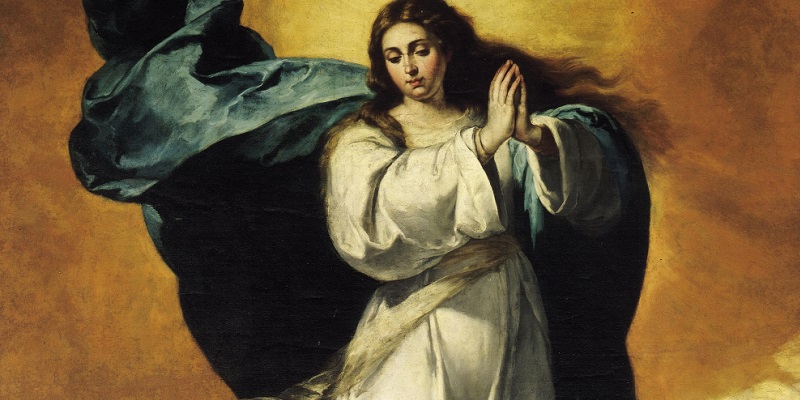
1. The doctrine of Mary’s perfect holiness from the first instant of her conception met with some resistance in the West, and this was due to consideration of Saint Paul’s statements about original sin and the universality of sin, taken up and expounded with special vigor by Saint Augustine.
The great Doctor of the Church undoubtedly realized that Mary’s condition as mother of a completely holy Son required total purity and extraordinary holiness. For this reason, in the controversy with Pelagius, he declared that Mary’s holiness constitutes an exceptional gift of grace, and stated in this regard: “Except the holy Virgin Mary, concerning whom, for the honor due to our Lord, when sins are treated, I wish to raise absolutely no question; for we know that more grace was conferred on her to conquer sin on every side, since she merited to conceive and give birth to him who we know had no sin at all” (De natura et gratia, 42).
Saint Augustine reaffirmed Mary’s perfect holiness and the absence in her of every personal sin because of the exalted dignity of being the Mother of the Lord. Nevertheless, he did not manage to understand how the assertion of a total absence of sin at the moment of conception could be reconciled with the doctrine of the universality of original sin and of the need for redemption for all the descendants of Adam. The increasingly penetrating understanding of the Church’s faith would later arrive at that consequence, clarifying how Mary benefited from Christ’s redemptive grace already from her conception.
2. In the ninth century the feast of the Conception of Mary was also introduced in the West, first in southern Italy, in Naples, and then in England.
Around the year 1128, a monk of Canterbury, Eadmer, writing the first treatise on the Immaculate Conception, lamented that the related liturgical celebration, dear above all to those “in whom there was a pure simplicity and a humbler devotion to God” (Tract. de conc. B.M.V., 1-2), had been forgotten or suppressed. Wishing to promote the restoration of the feast, the pious monk rejects Saint Augustine’s objection against the privilege of the Immaculate Conception, founded on the doctrine of the transmission of original sin in human generation. He fittingly uses the image of the chestnut “which is conceived, nourished and formed under thorns, but nevertheless remains protected from their pricks” (ibid., 10). Even under the thorns of a generation which, of itself, should transmit original sin — Eadmer argues — Mary remained free from every stain, by the explicit will of God, who “clearly was able to do it and willed it. Therefore, if he willed it, he did it” (ibid.).
Despite Eadmer, the great theologians of the thirteenth century made Saint Augustine’s difficulties their own, arguing as follows: the redemption wrought by Christ would not be universal if the condition of sin were not common to all human beings. And if Mary had not contracted original guilt, she could not have been redeemed. Indeed, redemption consists in freeing one who is in a state of sin.
3. Duns Scotus, following some theologians of the twelfth century, provided the key for overcoming these objections against the doctrine of Mary’s Immaculate Conception. He maintained that Christ, the perfect mediator, accomplished precisely in Mary the most excellent act of mediation by preserving her from original sin.
In this way, he introduced into theology the concept of preservative redemption, according to which Mary was redeemed in an even more admirable way: not by liberation from sin, but by preservation from sin.
The insight of Blessed John Duns Scotus, later called the “Doctor of the Immaculate,” was well received, already from the beginning of the fourteenth century, by theologians, especially Franciscans. After Pope Sixtus IV approved the Mass of the Conception in 1477, this doctrine became increasingly accepted in the schools of theology.
This providential development of liturgy and doctrine prepared the definition of the Marian privilege by the supreme Magisterium. It took place only after many centuries, under the impulse of a fundamental insight of faith: the Mother of Christ had to be perfectly holy from the very beginning of her life.
4. The affirmation of the exceptional privilege granted to Mary clearly shows that Christ’s redemptive action not only frees, but also preserves from sin. This dimension of preservation, which is total in Mary, is present in the redemptive intervention through which Christ, by freeing from sin, also gives man the grace and strength to overcome its influence in his life.
In this way, the dogma of Mary’s Immaculate Conception does not obscure, but rather contributes admirably to highlighting more clearly the effects of Christ’s redemptive grace in human nature.
Christians look to Mary, the first redeemed by Christ, who had the privilege of not being subjected even for an instant to the power of evil and sin, as the perfect model and the image of the holiness (cf. Lumen gentium, 65) which they are called to attain, with the help of the Lord’s grace, in their lives.
Author: His Holiness John Paul II
Source: L’Osservatore Romano, Spanish-language weekly edition, 7-VI-96
