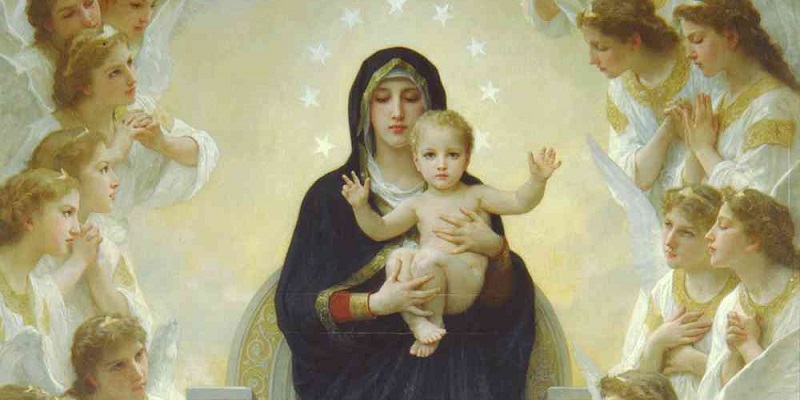
1. In the line of the Bull Munificentissimus Deus, of my venerable predecessor Pius XII, the Second Vatican Council affirms that the Immaculate Virgin, “having completed the course of her earthly life, was taken up body and soul into heavenly glory” (Lumen gentium, 59).
The Council Fathers wished to reaffirm that Mary, unlike other Christians who die in the grace of God, was raised to the glory of Paradise also with her body. This is a millennial belief, also expressed in a long iconographic tradition, which represents Mary as she “enters” heaven with her body.
The dogma of the Assumption affirms that Mary’s body was glorified after her death. Indeed, while for other human beings the resurrection of the body will take place at the end of the world, for Mary the glorification of her body was anticipated by singular privilege.
2. On 1 November 1950, when defining the dogma of the Assumption, Pius XII did not wish to use the term “resurrection” or to take a position on the question of the Virgin’s death as a truth of faith. The Bull Munificentissimus Deus limits itself to affirming the elevation of Mary’s body to heavenly glory, declaring this truth a “dogma divinely revealed”.
How can we fail to notice here that the Assumption of the Virgin has always formed part of the faith of the Christian people, who, by affirming Mary’s entrance into heavenly glory, wished to proclaim the glorification of her body?
The first testimony to faith in the Assumption of the Virgin appears in the apocryphal accounts entitled “Transitus Mariae”, whose original nucleus dates back to the second and third centuries. These are popular representations, sometimes fictionalized, but in this case they reflect an intuition of faith of the People of God.
Subsequently, a long reflection developed concerning Mary’s destiny in the hereafter. This gradually led believers to faith in the glorious elevation of the Mother of Jesus in soul and body, and to the institution in the East of the liturgical feasts of the Dormition and the Assumption of Mary.
Faith in the glorious destiny of the soul and body of the Mother of the Lord, after her death, spread from East to West with great rapidity and, from the fourteenth century onward, became general. In our century, on the eve of the definition of the dogma, it constituted a truth almost universally accepted and professed by the Christian community throughout the world.
3. Thus, in May 1946, with the Encyclical Deiparae Virginis Mariae, Pius XII promoted a broad consultation, asking the bishops and, through them, the priests and the People of God, about the possibility and opportuneness of defining the bodily Assumption of Mary as a dogma of faith. The result was widely positive: only six responses, among 1,181, expressed some reservation about the revealed character of this truth.
Citing this datum, the Bull Munificentissimus Deus states: “The universal agreement of the Church’s ordinary Magisterium provides a certain and solid argument to prove that the bodily Assumption of the Blessed Virgin Mary into heaven (…) is a truth revealed by God and therefore must be firmly and faithfully believed by all the children of the Church” (AAS 42 [1950], 757).
The definition of the dogma, in accordance with the universal faith of the People of God, definitively excludes every doubt and requires the express assent of all Christians.
After having underlined the Church’s present faith in the Assumption, the Bull recalls the scriptural basis of this truth.
The New Testament, although it does not explicitly affirm Mary’s Assumption, offers its foundation, because it very clearly highlights the perfect union of the Blessed Virgin with the destiny of Jesus. This union, which is manifested already from the wondrous conception of the Savior, in the Mother’s participation in her Son’s mission and, above all, in her association with the redeeming sacrifice, necessarily requires a continuation after death. Mary, perfectly united to the life and saving work of Jesus, shared his heavenly destiny in soul and body.
4. The aforementioned Bull Munificentissimus Deus, referring to the participation of the woman of the Protoevangelium in the struggle against the serpent and recognizing Mary as the new Eve, presents the Assumption as a consequence of Mary’s union with the redemptive work of Christ. In this regard it states: “For this reason, just as the glorious resurrection of Christ was an essential part and the final trophy of this victory, so the struggle of the Blessed Virgin, common with her Son, had to conclude with the glorification of her virginal body” (AAS 42 [1950], 768).
The Assumption is, therefore, the point of arrival of the struggle that engaged Mary’s generous love in the redemption of humanity and is the fruit of her unique participation in the victory of the Cross.
Author: His Holiness John Paul II
___________________________________________________________________________________
The electronic version of this document was produced by VE Multimedios. All rights reserved (©) VE Multimedios™.
The electronic text may be reproduced without any modification and while preserving the integrity of its meaning, provided that it is mentioned that it was produced by VE Multimedios™.
