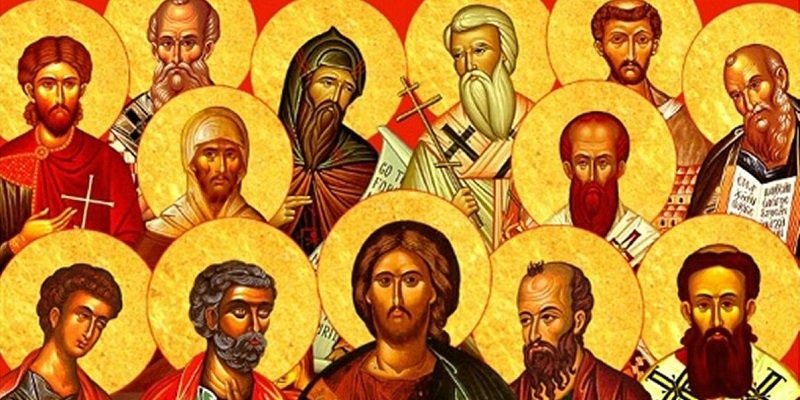
Purgatory has been one of the doctrines most rejected by Protestants. They frequently claim, with no historical rigour whatsoever, that it was an invention of Saint Gregory the Great in the Middle Ages. Among the examples I have taken from various articles on the internet is that of the well-known anti-Catholic writer Dave Hunt:
“In Catholicism, the ‘purging’ occurs in a place called purgatory, invented by Pope Gregory the Great in 593 AD.”[1]
A similar comment is made by Daniel Sapia, who cites the former quite frequently:
“The idea of Purgatory, a fictitious place of final purification, was invented by Pope Gregory the Great in 593. There was such reluctance to accept the idea (since it was contrary to Scripture) that Purgatory did not become an official Catholic dogma for nearly 850 years, at the Council of Florence in 1439.”[2]
Is it true that purgatory was invented by Saint Gregory the Great in the Middle Ages, as Hunt claims? Is it true that there was such reluctance to accept the doctrine of purgatory that it did not become a dogma of faith until the Council of Florence? Before answering these questions it is necessary to examine the doctrine of purgatory.
How Does the Catechism of the Church and the Ecumenical Councils Define Purgatory?
The Catechism of the Catholic Church explains it as follows:
1030 All who die in God’s grace and friendship, but still imperfectly purified, are indeed assured of their eternal salvation; but after death they undergo purification, so as to achieve the holiness necessary to enter the joy of heaven.
1031 The Church gives the name Purgatory to this final purification of the elect, which is entirely different from the punishment of the damned. The Church formulated her doctrine of faith on Purgatory especially at the Councils of Florence (cf. DS 1304) and Trent (cf. DS 1820; 1580). The tradition of the Church, by reference to certain texts of Scripture (e.g. 1 Cor 3:15; 1 Pet 1:7), speaks of a cleansing fire: As for certain lesser faults, we must believe that, before the Final Judgment, there is a purifying fire. He who is truth says that whoever utters blasphemy against the Holy Spirit will be pardoned neither in this age nor in the age to come (Mt 12:31). From this sentence we understand that certain offenses can be forgiven in this age, but certain others in the age to come (St. Gregory the Great, Dial. 4, 39).
It is fitting to begin by correcting a first inaccuracy in Sapia’s account, for already before the Ecumenical Council of Florence two Ecumenical Councils had defined purgatory with perfect clarity: the First and Second Ecumenical Councils of Lyons in 1245 and 1274 respectively:
“…Finally, the Truth affirming in the Gospel that if anyone speaks blasphemy against the Holy Spirit, it shall not be forgiven him, neither in this world nor in the future [Mt. 12:32], by which it is understood that some sins are pardoned in the present age and others in the future, and since the Apostle also says that fire shall test the work of each one; and: He whose work is burned shall suffer loss; but he himself shall be saved, yet as through fire [1 Cor. 3:13, 15]; and since the Greeks themselves are said to believe and affirm truly and without doubt that the souls of those who die, having received penance but without having fulfilled it, or without mortal sin but with venial and minor sins, are purified after death and can be aided by the suffrages of the Church; but since they say that the place of this purgation has not been indicated to them by their teachers with a certain and proper name, we, who according to the traditions and authorities of the Holy Fathers call it Purgatory, desire that henceforth this name be used also among them. For through that transitory fire sins are certainly purged — not criminal or capital ones that have not previously been forgiven through penance, but small and minor ones that still weigh upon the soul after death, although they were forgiven during life…”[3]
“…Moreover, on account of the various errors that some through ignorance and others through malice have introduced, it declares and preaches that those who fall into sin after baptism must not be rebaptized, but obtain forgiveness of their sins through true penance. And if, truly repentant, they die in charity before having satisfied by worthy fruits of penance for their commissions and omissions, their souls are purified after death with purgatorial punishments or cathartic ones, as Brother John has explained to us; and to relieve those punishments, the suffrages of the living faithful profit them, namely the sacrifices of masses, prayers and alms, and other offices of piety, which the faithful are accustomed to perform for other faithful according to the institutions of the Church. But those souls who, after receiving holy baptism, have incurred no stain of sin whatsoever, and also those who, after contracting such stain, have been purged — either while remaining in their bodies or after being divested of them, as was said above — are immediately received into heaven.”[4]
The Council of Florence simply reaffirmed what these ecumenical councils had already defined centuries earlier:
“…Likewise, if those who are truly penitent depart from this world before having satisfied by worthy fruits of penance for their commissions and omissions, their souls are purged by purgatorial punishments after death, and to be relieved of those punishments the suffrages of the living faithful profit them — such as the sacrifice of the Mass, prayers and alms, and other works of piety which the faithful are accustomed to perform for other faithful according to the institutions of the Church. And the souls of those who, after receiving baptism, have incurred absolutely no stain of sin, and also those who, after contracting the stain of sin, have purged it — either while living in their bodies or after departing from them, as was said above — are immediately received into heaven…”[5]
The Council of Trent (1545–1563) reaffirms the same:
“The Catholic Church, instructed by the Holy Spirit, according to the teaching of sacred Scripture and the ancient tradition of the Fathers, has taught in the sacred councils, and most recently in this general council of Trent, that there is a Purgatory, and that the souls detained there are aided by the suffrages of the faithful, and especially by the acceptable sacrifice of the Mass. The holy Council commands the bishops to take diligent care that the sound doctrine of Purgatory, received from the Holy Fathers and the sacred councils, be believed, maintained, and taught everywhere by the faithful of Christ. But let the more difficult and subtle questions — those which do not make for edification and from which there is generally no increase of piety — be excluded from popular discourses to uneducated people. Likewise, let them not permit uncertain matters, or those that have the appearance of falsehood, to be spread abroad and discussed. But those things that tend to a certain curiosity or superstition, or that savor of filthy lucre, let them prohibit as scandals and stumbling-blocks to the faithful. Let the bishops take care that the suffrages of the faithful who are alive — namely the sacrifices of Masses, prayers, alms, and other works of piety — be performed piously and devoutly for the faithful who have died, as the Church has ordained; and that whatever is due to be done for them according to the foundations of testators or other causes, be discharged diligently and accurately by priests and ministers of the Church and others who are bound by this obligation.”[6]
But long before these conciliar definitions, the doctrine of Purgatory was widely known, as the following patristic evidence demonstrates.
Perpetua (181 – 203 A.D.)
While in prison, she has a double vision in which she sees her brother, who died at the age of seven, emerging from a dark place where he was suffering. Saint Perpetua prays for the eternal rest of his soul, and after being heard by the Lord she has a second vision in which she sees her brother healed and at peace.
“Without delay, that very night, this was shown to me in a vision. I saw Dinocrates coming forth from a dark place, where there were also many others, and he was parched and very thirsty, with a filthy countenance and pallid color, and the wound on his face which he had when he died. This Dinocrates had been my brother in the flesh, seven years of age, who had died miserably from a disease…But I trusted that my prayer would bring help to his suffering, and I prayed for him every day until we passed over to the prison of the camp… I made my prayer for my brother day and night, groaning and weeping that he might be granted to me. Then on a day when we were staying in the stocks, this was shown to me. I saw that the place I had before observed to be in darkness was now bright; and Dinocrates, his body clean, well dressed, was finding refreshment. Where there had been a wound, I now saw a scar; and that pool which I had before seen had its brim lowered to the level of the boy’s navel. And one drew water from the pool incessantly, and above the rim was a golden vessel full of water; and Dinocrates drew near and began to drink from it, and the goblet failed not. And when he was satisfied, he went away from the water to play joyfully, after the manner of children, and I awoke. Then I understood that he had been translated from the place of punishment.”[7]
Abercius of Hierapolis (? – 200 A.D.)
Before dying he composed his own epitaph, dated to the end of the second century or the beginning of the third, in which he asks that prayers be offered for him.
“The citizen of a prominent city, I erected this tomb while I lived, that I might have a resting-place for my body. Abercius is my name, a disciple of the chaste Shepherd who feeds his sheep on mountains and plains, whose great eyes watch over all, who taught me the faithful writings of life. Standing ready, I, Abercius, ordered this to be inscribed, in my seventy-second year. Whoever understands this and agrees with it, let him pray for Abercius.”[8]
Acts of Paul and Thecla (160 A.D.)
The Acts of Paul and Thecla was a work written in the second century (c. 160 A.D.) that narrates the story of a woman who converted to Christianity after hearing the preaching of Saint Paul. She subsequently broke off her engagement and devoted herself to assisting him in evangelization. In it we read a prayer of intercession that a deceased Christian woman be transferred to the place of the just.
“And after the exhibition, Tryphena again receives her. For her daughter Falconilla had died, and said to her in a dream: Mother, thou shalt have this stranger Thecla in my place, in order that she may pray concerning me, and that I may be transferred to the place of the just.”[9]
Clement of Alexandria (150 – 215 A.D.)
In the Stromata or Miscellanies (Στρωματεις) he speaks of the purification by “fire” that the soul undergoes after death when it has not attained complete holiness.
“The believer, through great discipline, divesting himself of the passions, passes to the mansion which is better than the former one, passing through the greatest of torments, taking upon himself the repentance for the faults he may have committed after baptism. He is tortured then still more, seeing that he has not yet attained what others have already acquired. The greatest torments are assigned to the believer, for the Justice of God is good, and His goodness is just, and these punishments complete the course of the expiation and purification of each one.”[10]
“But we say that the fire sanctifies not the flesh, but sinful souls; referring not to the vulgar fire, but to the fire of wisdom, which pervades the soul that passes through the fire.”[11]
Tertullian (160 – 220 A.D.)
In the writings of Tertullian there are numerous and clear references to Purgatory. Among them one might mention De anima (On the Soul), where he speaks of the purification of the soul after death; De carnis resurrectione, where he goes so far as to affirm that only martyrs go directly to live in the presence of God; De monogamia (On Monogamy), where he speaks of how prayers for the dead can help them; and De corona (The Crown), where he mentions the custom of the Church of celebrating the Eucharist for the eternal rest of the departed.
“For this reason, it is perfectly fitting that the soul, without waiting for the flesh, should be punished for what it committed without the complicity of the flesh. So too it is just that, as a recompense for the holy and pious thoughts it has entertained without any cooperation of the flesh, it should receive its consolations without the flesh. But even more: those very deeds accomplished with the flesh — it is the soul that first conceives them, arranges them, orders them, and puts them into execution. And even in cases where it does not consent to carrying them out, it is still the first to examine what the body will subsequently perform. In short, conscience will never be subsequent to the act. Therefore, from this standpoint as well, it is fitting that the substance which was first to merit the recompense should also be first to receive it. In a word, since by this prison which the Gospel sets before us we understand the underworld, and since by “this debt, which must be paid to the last farthing,” we understand that it is necessary to be purified, in those same places, from the lighter faults, in the interval that lies before the Resurrection, no one will doubt that the soul already undergoes some punishment in the underworld, without prejudice to the fullness of the Resurrection, when it will receive its recompense together with the flesh.”[12]
“On the departure of the soul from the body, no one goes immediately to live in the presence of the Lord, except by the prerogative of martyrdom, whereby he wins a place in paradise, not in the lower regions.”[13]
“Indeed, she prays for the soul of her husband. She asks that during this interval he may find rest and that he may share in the first resurrection. And she offers the sacrifice each year on the anniversary of his falling asleep.”[14]
“The sacrament of the Eucharist, entrusted by the Lord at the time of supper and to all alike, we receive in assemblies before daybreak, and from no hands but those of those who preside. We make oblations for the dead on their anniversary days each year.”[15]
Of course, Tertullian wrote all of this several centuries before the birth of Saint Gregory the Great.
Cyprian of Carthage (200 – 258 A.D.)
With Saint Cyprian we likewise have, as with those before him, references to Purgatory centuries before Saint Gregory the Great.
“It is one thing to stand for pardon, another thing to attain to glory: it is one thing, when cast into prison, not to go out thence until the last farthing is paid; another thing at once to receive the wages of faith and courage. It is one thing, tortured by long suffering for sins, to be cleansed and long purged by fire; another to have purged all sins by suffering. It is one thing, finally, to be in suspense till the sentence of God at the Day of Judgment; another to be at once crowned by the Lord.”[16]
He also attests the common custom of Christians to offer prayers and the Eucharist for the eternal rest of the departed, which would be pointless if prayers could not benefit them.
“…We offer sacrifices for them, as you remember, as often as we celebrate the days of the passion of the martyrs in the annual commemoration.”[17]
In the following text we can also see Saint Cyprian attesting the custom of offering the Eucharist for the dead. He denies it in the particular case of Victor on account of his violation of conciliar decisions by illegitimately appointing the presbyter Geminius Faustinus as his executor.
“…And therefore, since Victor, contrary to the prescribed form recently enacted in council by the priests, has dared to constitute the presbyter Geminius Faustinus as his executor, there is no reason why an oblation should be made for him on his death, or any prayer offered for him in the Church, so that we may observe the decree of the priests made religiously and of necessity, and at the same time give an example to the other brethren, that no one should call the priests and ministers of God, who are dedicated to divine service and the altar of the Church, to be entangled with worldly encumbrances.”[18]
Other similar texts:
“Finally, note down also the days on which they depart this life, that we may celebrate their commemoration among the memorials of the martyrs: although Tertullus, our most faithful and devoted brother, with that solicitude and attention which he shows in distributing his labours for the brethren, and who is remiss in no care for the bodies there, has already written and writes, and informs me among other matters of the days on which our blessed brethren in prison have passed to immortality by the end of a glorious death, and we here celebrate oblations and sacrifices in commemoration of them, which things we shall soon celebrate with you with the help of God.”[19]
Origen (185 – 254 A.D.)
He sees in 1 Corinthians 3 an allusion to Purgatory:
“For if upon the foundation of Christ, you have built not only gold and silver and precious stones, but also wood, hay, or straw, what do you expect when the soul is separated from the body? Would you enter heaven with your wood, hay, and straw, and thereby defile the kingdom of God? Or on account of these obstacles, would you remain without receiving a reward for your gold, silver, and precious stones? Neither of these outcomes is just. It remains, then, that you shall be subjected to the fire that shall burn the lighter materials; for our God, to those who can comprehend the things of heaven, is called a purifying fire.
But this fire does not consume the creature, but what the creature has built — wood, hay, or straw. It is manifest that the fire destroys the wood of our transgressions, and then returns to us the reward of our great works.”[20]
Lactantius (250 – 317 A.D.)
In Book VII of his Divine Institutes, Lactantius sees in 1 Corinthians 3, like Origen, a reference to Purgatory:
“But when He will judge the righteous, He will also try them with fire. Then they whose sins shall exceed either in weight or in number, shall be scorched by the fire and burnt; but they whom full justice and maturity of virtue has imbued will not feel that fire, for they have something of God in themselves which repels and rejects the violence of the flame.”[21]
Ephrem the Syrian (306 – 373 A.D.)
In his testament he requests that prayers be offered for him, and cites the book of Maccabees as evidence that the prayers of the living can help expiate the sins of the deceased.
“When the thirtieth day [after my death] comes, remember me, brethren. The dead indeed receive help through the offering made by the living […] If, as is written, the men of Mattathias, charged with liturgy for the army, with their offerings expiated the faults of those who had perished and who were impious in their ways, how much more will the priests of Christ with their holy offerings and their prayers expiate the sins of the departed.”[22]
Basil of Caesarea (329 – 379 A.D.)
Saint Basil speaks of how those athletes of God, after having died, may be “detained” if they still retain some stains of sin.
“I think that the valiant athletes of God, who throughout their whole life struggled frequently against invisible enemies, after overcoming all their assaults at the end of life, will be examined by the prince of this age — so that if, as a consequence of those struggles, they bear certain wounds or certain stains and traces of sin, they will be detained; but if they are found unharmed and uncontaminated, they shall rest in Christ as unconquered and free.”[23]
Cyril of Jerusalem (315 – 386 A.D.)
In his catecheses he reaffirms the immemorial tradition of the Church of praying for the departed for their eternal rest:
“We also commemorate those who have already fallen asleep — first, the Patriarchs, Prophets, Apostles, and Martyrs — that God may, through their prayers and intercessions, receive our petition. Then also on behalf of the holy Fathers and Bishops who have already fallen asleep, and in general of all those who have previously fallen asleep among us, believing that it will be a very great benefit to the souls of those for whom supplication is offered.
I wish to explain this to you by an illustration. For I know that many say, what is a soul benefited, which departs from this world either with sins, or without sins, if it be commemorated in the prayer? Now surely if a king were to banish certain persons who had given him offence, and then those who belonged to them were to plait a crown and offer it to him on behalf of those under his vengeance, would he not grant a remission of their penalties? In the same way we, when we offer to God our supplications for those who have fallen asleep, though they be sinners, weave no crown, but offer up Christ sacrificed for our sins, propitiating our merciful God both for them and for ourselves.”[24]
Epiphanius of Salamis (315 – 403 A.D.)
He likewise attests, as do those before him, the usefulness of prayers for the departed in obtaining God’s forgiveness for their sins.
“As for the recitation of the names of the dead, what can be more useful, more seasonable, and more worthy of praise, so that those present may realize that the departed still live and have not been reduced to nothing, but continue to exist and live with the Lord, and so that the hope of those who pray for their deceased brethren, as if they had gone to another country, may be confirmed? For prayers made on their behalf are useful, even if they cannot remove all their sins.”[25]
Gregory of Nyssa (331 – 394 A.D.)
The following text is so clear a reference to Purgatory that it requires no commentary:
“When one renounces his body and the difference between virtue and vice is recognized, he cannot approach God until the cleansing fire has purged the stains with which his soul is infected. The same fire in others will cancel the corruption of matter and the propensity to evil.”[26]
John Chrysostom (347 – 407 A.D.)
He attests that it was the Apostles themselves who instituted the celebration of the Eucharist for the eternal rest of the departed, and he exhorts us not to cease helping the dead with our prayers, since through them the departed receive consolation.
“It was not without reason that it was determined, by laws established by the Apostles, that in the celebration of the sacred and awe-inspiring mysteries remembrance should be made of those who have already departed this life. They knew, indeed, that from this the departed obtain much fruit and gain great benefit. When the whole people and the priests stand with hands extended and the holy sacrifice is being celebrated, how shall God not show himself propitious to those on whose behalf we implore him? This refers to those who have died preserving the faith.”[27]
“If the children of Job were purified by the sacrifice of their father, why should we doubt that when we also offer for those who have departed, some consolation accrues to them? God is wont to grant the petitions of those who ask for others… Let us not then be weary of helping the departed, both by offering on their behalf and by praying for them.”[28]
Augustine of Hippo (354 – 430 A.D.)
Saint Augustine’s descriptions of Purgatory, also long predating Saint Gregory the Great, are so clear that they likewise require no explanation:
“Lord, rebuke me not in Thine indignation. Let me not be found among those to whom Thou shalt say: Depart into everlasting fire, which is prepared for the devil and his angels. Nor correct me in Thy fury, but purify me in this life and make me such that I no longer need the correcting fire, which is for those who are to be saved, though even so, as through fire. Why does this happen, if not because they build here upon the foundation with wood, straw, hay? If they had built upon gold, silver, precious stones, they would be free of both kinds of fire: not only of that everlasting fire which will torment the ungodly forever, but also of that which will correct those who are to be saved through fire.”[29]
“When anyone suffers harm through the perverseness or the error of another, the man who causes the injury through ignorance or injustice sins, certainly; but God does not sin, since He allows this to happen by a just, albeit hidden, design… There are temporal punishments, some of which are suffered only in this life, others after death, others both here and then. But all are suffered before that most severe and ultimate judgment. Yet not all who suffer temporal punishments after death will endure the eternal punishments which will follow after that judgment. For to some, what is not forgiven in this world will be forgiven in the world to come — that is to say, they will not be punished with the eternal punishment of that world to come, as we have already stated above.”[30]
“The greater part [of persons], once they know the obligation of the law, are overcome first by the vices which have come to dominate them; thus they become transgressors of the law. Then they seek refuge and help in grace, whereby they may recover the victory, through bitter penitence and more vigorous struggle, first submitting the spirit to God and thereafter gaining dominion over the flesh. Whoever would avoid eternal punishments must not only be baptized; he must also be sanctified, following Christ. This is how one passes from the devil to Christ. As for the expiatory punishments, let no one suppose they exist except before the last and dreadful judgment.”[31]
“That the souls of the dead are benefited by the piety of their living friends, who offer the sacrifice of the Mediator, or give alms in the church on their behalf, is not to be doubted. But these services are of advantage only to those who during their lives have earned such merit that services of this kind can help them. For there is a manner of life which is neither so good as not to require these services after death, nor so bad that such services are of no avail after death; while there is such a goodness of life that these services are not needed, and again such badness that when one has passed from this life, they render no help. Therefore it is here that all the merit or lack of merit is acquired, by which one can afterwards be relieved or oppressed. Let no one hope to obtain from God after death what he neglected to merit during life.”[32]
“We read in the Books of Maccabees that sacrifice was offered for the dead. But although it is read in no other place of the Old Testament, the authority of the Universal Church on this point is of no small weight, where in the prayers of the priest poured forth to the Lord God at His altar, the commendation of the dead has its own place.”[33]
“In our fatherland there will be no place for prayer, but only for praise. Why no place for prayer? Because there will be nothing lacking. What here is an object of faith, there will be an object of sight; what here is an object of hope, there will be possessed; what here is asked, will there be received. And yet, in this life there exists a certain perfection, attained by the holy martyrs. For this reason the ecclesiastical custom, known to the faithful, is to mention the names of martyrs at the altar of God, not to pray for them, but rather for the rest of the departed who are commemorated. It would be an insult to pray for a martyr, to whose prayers we ourselves should commend ourselves. He fought against sin to the shedding of his blood. To some who are still imperfect, though doubtless partially justified, the Apostle says in the Epistle to the Hebrews: “You have not yet resisted unto blood, striving against sin.””[34]
Gregory I the Great (540 – 604 A.D.)
He sees in Matthew 12:32 an implicit reference to Purgatory:
“As one leaves this world, so one presents oneself for judgment. But it must be believed that there is a purifying fire for expiating minor sins before judgment. The reason for this is that Truth affirms that if one speaks blasphemy against the Holy Spirit, it shall not be forgiven him, neither in this world nor in the next. In this sentence it is given to understand that some sins can be forgiven in this world and some in the next; for what is denied with respect to some must be understood as affirmed with respect to others. Nevertheless, as I have already said, it must be believed that this refers to light and trifling sins.”[35]
This is only a partial selection of the patristic texts referring to Purgatory. It is truly difficult, in light of the foregoing, to understand how anyone persists in claiming that Purgatory was an invention of the Middle Ages. I pray to God that it is through ignorance and not through malice. Fortunately, these texts are within everyone’s reach and leave indisputable evidence of the faith of the early Church…
…Our Church.
Notes
- Dave Hunt, “Justice, Forgiveness, and Restoration”, March 31, 2008. ↩
- Daniel Sapia, El Purgatorio ¿Verdad de Dios? ↩
- First Ecumenical Council of Lyon, XIII. ↩
- Second Ecumenical Council of Lyon, XIV. ↩
- Ecumenical Council of Florence, XVII. ↩
- Ecumenical Council of Trent, Session XXV, Decree on Purgatory. ↩
- The Passion of Perpetua and Felicitas, 2:3–4. ANF, vol. 3. Early Church Fathers, http://www.ccel.org/print/schaff/anf03/vi.vi.iv. ↩
- Epitaph of Abercius. Early Church Fathers, http://www.ccel.org/ccel/wace/biodict.txt. ↩
- Acts of Paul and Thecla. ANF, vol. 8. Early Church Fathers, http://www.ccel.org/print/schaff/anf08/vii.xxvi. ↩
- Clement of Alexandria, Stromata VI, 14. Early Church Fathers, http://www.ccel.org/print/schaff/anf02/vi.iv.vi.xiv. ↩
- Clement of Alexandria, Stromata VII, 6. ↩
- Tertullian, On the Soul, 58: PL 2,751. Johannes Quasten, Patrología I, Biblioteca de Autores Cristianos 206, 5th ed., Madrid 1995, pp. 633–634. ↩
- Tertullian, On the Resurrection of the Flesh, 43. Ibid. ↩
- Tertullian, On Monogamy, 10. Ibid. ↩
- Tertullian, On the Crown, 3; PL 2:79. Cited in Guillermo Pons, El más allá en los Padres de la Iglesia (Madrid: Editorial Ciudad Nueva, 2001), p. 69. ↩
- Cyprian, Letter 51, 20. ANF, vol. 5. New Advent, Fathers of the Church, http://www.newadvent.org/fathers/050651.htm. ↩
- Cyprian of Carthage, Letter 33, 3. New Advent, Fathers of the Church, http://www.newadvent.org/fathers/050633.htm. ↩
- Cyprian of Carthage, Letter 65, 2. New Advent, Fathers of the Church, http://www.newadvent.org/fathers/050665.htm. ↩
- Cyprian of Carthage, Letter 36, 2. New Advent, Fathers of the Church, http://www.newadvent.org/fathers/050636.htm. ↩
- P. G., XIII, col. 445, 448; Catholic Encyclopedia, Purgatory ↩
- Lactantius, Divine Institutes, VII, 21. ANF, vol. VII. Early Church Fathers, http://www.ccel.org/print/schaff/anf07/iii.ii.vii.xxi. ↩
- Ephrem, Testament, 72-28. M. J. Rouet de Journel, Enchiridion Patristicum (Barcelona: Herder, 1981), n. 741. Cf. Guillermo Pons, El más allá en los Padres de la Iglesia, p. 69. ↩
- Basil of Caesarea, Homilies on the Psalms, 7, 2; PG 29:232. Ibid., p. 70. ↩
- Cyril of Jerusalem, Catechetical Lecture XXIII, 9–10. NPNF2, vol. VII. Early Church Fathers, http://www.ccel.org/print/schaff/npnf207/ii.xxvii. ↩
- Epiphanius of Salamis, Panarion, 75, 8; PG 42:513. Cited in Guillermo Pons, El más allá en los Padres de la Iglesia, pp. 70–71. ↩
- Gregory of Nyssa, Sermon on the Dead, II, 58. Cited in Jurgens, The Faith of the Early Fathers, vol. II, 58. ↩
- John Chrysostom, Homilies on the Letter to the Philippians 3,4; Migne, Patrologia Graeca, 161 vols., Paris 1875ss, 62, 203; Guillermo Pons, El más allá en los Padres de la Iglesia, Editorial Ciudad Nueva, Madrid 2001, p. 71. ↩
- Homilies on the First Epistle to the Corinthians 41,8; Early Church Fathers, http://www.ccel.org/print/schaff/npnf112/iv.xlii; New Advent, Fathers of the Church, http://www.newadvent.org/fathers/220141.htm ↩
- Augustine of Hippo, Expositions on the Psalms 37,3: Biblioteca de Autores Cristianos 235, 654; Guillermo Pons, El más allá en los Padres de la Iglesia, Editorial Ciudad Nueva, Madrid 2001, pp. 71-72. ↩
- Augustine of Hippo, The City of God XXI,13: Biblioteca de Autores Cristianos 172, 791-792; Ibid., p. 72. ↩
- Augustine of Hippo, The City of God XXI,16: Biblioteca de Autores Cristianos 172, 798; Ibid., pp. 72-73. ↩
- Augustine of Hippo, Eight Questions of Dulcitius 2,4: Biblioteca de Autores Cristianos 551, 389; Ibid., p. 73. ↩
- Augustine of Hippo, The Care to Be Had for the Dead 1,3: Biblioteca de Autores Cristianos 551, 439; Ibid., pp. 73-74. ↩
- Augustine of Hippo, Sermon 159, 1: Biblioteca de Autores Cristianos 443, 498; Ibid., p. 74. ↩
- Gregory the Great, Dialogues 4,39: PL 77,396; Ibid., pp. 74-75. ↩
