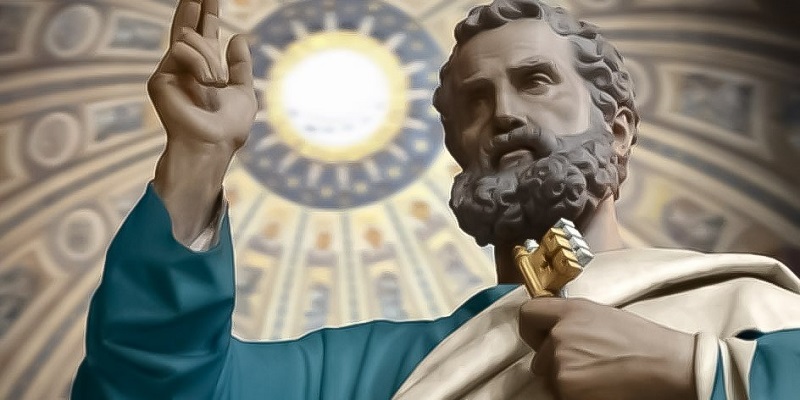
I wanted to do this study to analyze one of the arguments that is often heard as an argument against the Papacy, and that is that St. Peter was not in Rome.
One would ask: Why attack the Petrine primacy from this angle? Since the origin of the Papacy dates back to the apostle St. Peter, and the bishop of Rome is his legitimate successor, some Protestants think that if they can prove that St. Peter was not in Rome, they would undermine the claim that he was the first Pope, or that the current Pope has succeeded him.
They have not noticed that the matter is somewhat inconsequential, since even if St. Peter had not been in Rome, one of his successors could well have moved to Rome and exercised his ministry there (St. Peter was not always in Rome therefore the Papacy did not always have to be related to Rome in its beginnings). Despite this, they make great efforts to deny his presence in Rome, thinking to take advantage of it. (Currently, since the evidence is so compelling, some have come to accept that if St. Peter may well have been in Rome, he was not bishop there.)
What do we know about the life of St. Peter from the Bible?
We should not expect to find in the Bible a complete itinerary of the travels of each of the apostles (that was not the purpose for which it was written). We can, however, obtain some data from it, which can give us certain clues about the life and travels of the apostle St. Peter, which in this case is what we are interested in studying. (Those who know this thoroughly can skip this section and go directly to the second part, which although long I consider instructive for the topic at hand)
Approximately from the year 36 AD:
 After the resurrection of Christ, we know that the apostles made a great deal of travel in their ministry. Approximately in the year 36 AD. St. Peter and St. John are going to organize the Church of Samaria after they accepted the word of God there.
“When the apostles who were in Jerusalem learned that Samaria had accepted the Word of God, they sent Peter and John to them.” Acts 8:14
On that date, St. Paul converted on the way to Damascus (Acts 9:1-8) while St. Peter made numerous missionary trips. We cannot know exactly all the cities he may have visited, since the Bible specifies that he was traveling through many places:
“Peter, who was traveling through all the places, also went down to visit the saints who lived in Lydda” Acts 9:32
However, it is known with certainty that he was at least in Lydda, Joppa and Caesarea. (In Lydda he heals the paralytic Aeneas, in Joppa he resurrects Tabitha and in Caesarea he baptizes the first non-Jews:
“Peter, who was traveling through all the places, also went down to visit the saints who lived in Lydda. Peter said to him: “Aeneas, Jesus Christ heals you; get up and make your bed.” And immediately he stood up.” Acts 9:32-34
“There was a disciple in Joppa named Tabitha, which means Dorcas. She was rich in good works and in the alms she did. Around those days she fell ill and died. They washed her and put her in the upper room. Lydda is near Joppa, and the disciples, hearing that Peter was there, sent two men with this request: “Do not delay in coming to us.”” Acts 9:36-38
“There was a man in Caesarea, named Cornelius, a centurion of the Italic cohort,… He saw clearly in vision, about the ninth hour of the day, that the Angel of God entered his house and said to him: “Cornelius.”… Now send men to Joppa and bring for a certain Simon, whom they call Peter… The next day [Peter] entered Caesarea. Cornelius was waiting for them. He had gathered his relatives and close friends. ” Acts 10,1.3.5.24
Note: Some Protestant apologists (such as Fernando Saraví) have tried to support the hypothesis that St. Peter could not have been in Rome on this date because he was in these three places. Although we do not intend to affirm that he was in Rome during this date, it is enough to note that the statement lacks solidity since Acts 9:32 itself says that Peter was traveling through all the places, and narrates important events in these three places, never that his travels were limited only to them.
Approximately from the year 40 AD:
Approximately on this date we know that St. Peter was in Jerusalem due to the visit that St. Paul makes to him. (Element that denotes a clear recognition by St. Paul of the authority of St. Peter, especially due to his explicit mention of the reason that his trip was expressly to visit him, and the indirect reference that Santiago was seen as a minor event)
“Then, three years later, I went up to Jerusalem to meet Cephas and remained in his company for fifteen days. And I did not see any other apostle, but I did see James, the brother of the Lord.” Galatians 1:18-19
On that date, St. Paul meets Barnabas and flees from the Hellenistic Jews, taking refuge in Tarsus. Later St. Paul goes with Barnabas to Antioch.
Approximately from the Year 42 – 44 AD:
 Around this date Herod begins a persecution where he captures and kills several Christians. James “of Zebedee” dies (Acts 12:2) and imprisons St. Peter who is miraculously released by God:
“When he saw that the Jews liked this, he also came to arrest Peter. These were the days of the Unleavened Bread… Suddenly the Angel of the Lord appeared and the cell was filled with light. The angel struck Peter on the side, woke him up and said to him: “Get up quickly.” And the chains fell from their hands.” Acts 12:3.7
Later the Scripture says that St. Peter left for “another place”:
“He made signs with his hand to keep them quiet and told them how the Lord had brought him out of prison. And he added: “Communicate this to James and the brothers.” “He left and went to another place.” Acts 12:17
Here tradition testifies that Peter left for Rome (we will study this later) and established a Church there, but regarding what is recorded by the Bible there is no specific mention of the place where Peter went. Thus we can make two clear statements without fear of being wrong: It cannot be stated that here St. Peter did not go to Rome, but neither can it be stated with certainty that he did (It is important to note this because some of the apologetic attempts of Protestants try, based on assumptions, to demonstrate that there is no possible period in which St. Peter went to Rome, but as we have seen, this is one of the points where their hypotheses fail).
Approximately from 46 AD:
From here St. Paul makes several apostolic trips and there is no news of St. Peter (Therefore Peter could have been anywhere including Rome).
Approximately from 48 AD:
St. Paul returns to Jerusalem.
Approximately from the year 50 AD:
The council of Jerusalem takes place against the Judaizers who wanted to impose circumcision on the Gentiles, so St. Peter during this period returns to Jerusalem where he presides over the council and takes a decisive role in the result (Acts 15)
“Some people from Judea came down and taught the brothers: “Unless you are circumcised according to the Mosaic custom, you cannot be saved.” Thereupon ensued no small agitation and argument between Paul and Barnabas against them; and they decided that Paul and Barnabas and some of them should go up to Jerusalem, to the apostles and presbyters, to discuss this matter…. After a long discussion, Peter stood up and said to them: “Brothers, you know that from the first days God chose me among you so that through my mouth the Gentiles might hear the Word of the Good News and believe. And God, knowing the hearts, bore witness in their favor by communicating the Holy Spirit to them as he did to us; and he made no distinction between them and us, for he purified their hearts with faith. Why then do you now tempt God by wanting to put a yoke on the necks of the disciples that neither our fathers nor we could bear? We believe rather that we are saved by the grace of the Lord Jesus, in the same way as they.”” Acts 15:1-2.7-11
From here on we have no news of St. Peter and the places he visited. However:
Approximately from 51 AD:
 By this date on which St. Paul writes the letter to the Thessalonians, we can assume that St. Peter visited Antioch, and may have returned there several times. We know this from the account of the discussion between St. Peter and St. Paul narrated in the letter to the Galatians, which although it cannot be precisely located as having occurred before or after the council of Jerusalem, it is very likely that it occurred afterwards:
“But when Cephas came to Antioch, I confronted him face to face, because he was worthy of rebuke. For before some of James’s group arrived, he ate in the company of the Gentiles; but once they arrived, he was seen to shy away and separate himself for fear of the circumcised. And the other Jews imitated him in his pretense, to the point that Barnabas himself was carried away by their pretense.” Galatians 2:11-13
Approximately from the year 54 AD:
Around this date, St. Paul writes the letter to the Corinthians from Ephesus where he records that at some point St. Peter could have visited them (very possibly in past years) since he refers to some supporters of the apostle there:
“I mean that each one of you says: “I am of Paul,” “I am of Apollo,” “I am of Cephas,” “I am of Christ.”” 1 Corinthians 1:12
“whether Paul, Apollo, Cephas, the world, life, death, the present, the future, all is yours;” 1 Corinthians 3:22
Approximately from the Year 57-58 AD:
Around this date St. Paul writes 2 Corinthians, Philippians and Galatians.
Then he writes the Letter to the Romans from Corinth to prepare his trip to Rome (It is important to note that when Paul traveled to Rome the community already existed) and he sends it with Phoebe (Romans 16:1). We can also accept that when St. Paul writes the letter, he knew that St. Peter was not in Rome at that time because in his greeting to the members of the church he mentions 28 people from the Church and does not mention St. Peter.
Approximately from 58-60 AD:
On this date St. Paul returns to Jerusalem. The Jews of Antioch accuse him and try to kill him. The Roman court prevents him from being killed and imprisons him. The Roman prosecutor Antonio Felix detains him for 2 years (Acts 23,23 and 25). It is estimated that around this time he wrote the letter to Filemón.
Approximately from the Year 61-62 AD:
For this year, St. Paul was sent as a prisoner to Rome where he wrote the letter to the Colossians (62 AD). From this date or a short time later it is very possible that he was in Rome, we know this because in this letter St. Paul makes a mention that Saint Mark was with him (in Rome) (Colossians 4:10) and St. Peter writes his letter from the place where Saint Mark was (1 Peter 5:13) and gives its location as “Babylon” (The early Christians referred to pagan Rome symbolically as Babylon).
“Aristarchus, my companion in captivity, and Mark, Barnabas’ cousin, about whom you already received instructions, greet you. If he comes to you, give him a good welcome.” Colossians 4:10
“She who is in Babylon greets you, chosen like you, as well as my son Mark.” 1 Peter 5:13
We would then have 2 biblical evidence to think that St. Peter was already in Rome: The greeting from Babylon (symbolically designating Rome) and the presence of Saint Mark with St. Peter who we already know was in that city. Despite this, the Protestant brothers usually maintain the thesis that the Babylon to which Peter refers is Babylon (on the Euphrates), the New Babylon (Seleucida) on the Tigres, or the Egyptian Babylon (near Memphis), ultimately Jerusalem. However, this thesis cannot be sustained and only demonstrates an absolute ignorance of ancient Christian literature. The early Christians associated the pagan Roman nation as the new oppressor of their people (which in other times was literally Babylon but which by then was no threat to anyone, but the Roman Empire, power of the time, with emperors such as Nero, Caligula and later Vespasian among others).
We have biblical references that the first Christians used Rome symbolically as Babylon in the Apocalypse:
“And a second Angel followed him saying: = «Great Babylon is fallen, fallen, which gave all nations the wine of wrath to drink.» =” Revelation 14,8
The same in Revelation 16,19; 17,15; 18.2; 18,10; 18,21.
Some anti-Catholic Protestant denominations often use the thesis that the above passages are a reference to the Catholic Church as the Great Whore of Babylon, and paradoxically use as one of the arguments that it is in Rome (A city on seven hills) (see the article “Hunting the Whore of Babylon”). Although the statement is absurd, and the references are directed rather to the pagan Rome that persecuted Christianity, and not to the later Christian Rome, it is curious that in these cases they have no difficulty in accepting a symbolic relationship between Babylon and Rome, while in our case they do.
Additional extra-biblical evidence that demonstrates that it was common for the first Christians to designate pagan Rome symbolically as “Babylon” that supports this interpretation is found in the Sibylline Oracles (5,159f), the Apocalypse of Baruch (2,1), 4 Esdras (3,1). We also have evidence of this in “The Chronicle, (composed around 303 AD) where it is noted “It is said that the first epistle of Peter, in which he mentions Mark, was composed in Rome itself; and that he himself indicates this, figuratively referring to the city as Babylon.”
From now on in the Bible we have no records about the life of St. Peter.
What do we know about Peter’s life from historians and writings of the Early Church?
 It is impossible to ignore the written testimonies left by those Christians who were in direct or indirect contact with the apostolic era, since they are indisputable witnesses of the time. If anyone can know about the apostolic activity after the resurrection of Christ, it is them. And it is precisely they who unanimously give us testimony of the ministry of St. Peter from Rome and his subsequent death along with St. Paul in the persecution of Nero.
St. Clement of Rome:
St. Clement of Rome was the third successor of St. Peter, and a direct witness of the apostolic era. He was evangelized by him and St. Paul and is mentioned in the Bible (Philippians 4:3) as a close collaborator of the latter in evangelization.
Contemporaneous with the Gospel of St. John, he wrote his letter to the Corinthians to put order in a rebellion that had occurred in that community where some faithful did not recognize the authority of the presbyters (a solid proof that by then the successor of the Bishop of Rome had authority over the rest of the Churches). The Protestant translation of said letter, taken from the book “The Apostolic Fathers, by J.B. Lighfoot, by Editorial CLIE, can be consulted at http://escrituras.tripod.com/Textos/EpClemente1.htm
In this letter he appears familiar with the events that occurred during the persecution of Nero (64 AD) that was unleashed as a result of the great fire that reduced ten of the fourteen neighborhoods or districts of Rome to ashes. There he tells us about the martyrdom of Peter along with another group of faithful:
St. Clement of Rome. Letter to the Corinthians.
Taken from Apostolic Fathers, 5th Edition. Daniel Ruiz Bueno. B.A.C. Page 182
V. But let us leave the ancient examples and come to the fighters who have lived closest to us: let us take the noble examples of our generation. 2. Out of emulation and envy, those who were the greatest and most just columns of the Church were persecuted and fought to the death. 3. Let us put before our eyes the holy apostles. 4. To Peter, who, out of wicked emulation, had to endure not one or two, but many more hardships. And after thus giving his testimony, he marched to the place of glory that was his due. 5. Through envy and rivalry Paul showed the reward of patience. 6. Six times he was loaded with chains; He was banished, stoned, made a herald of Christ in the East and the West, he achieved the noble fame of his faith; 7. And after having taught everyone justice and having reached the borders of the West and given his testimony before the princes, he thus left this world and marched to the holy place, leaving us the highest example of patience. VI. These men who led a conduct of holiness came to join a multitude of chosen ones, who, after suffering many insults and torments out of envy, became the most beautiful example among us.
St. Ignatius of Antioch (wrote his letters around 110 AD)
Bishop of Antioch, martyred in Rome (devoured by lions) during the time of Emperor Trajan (98-117). The seven letters he wrote on the way to martyrdom are preserved. You can consult the Protestant translation of the letters of St. Ignatius directly from http://escrituras.tripod.com/Textos/EpIgnacio.htm which is also based on the book “The Apostolic Fathers, by J. B. Lightfoot. CLIE Editorial.
In the letter that St. Ignatius writes to the Romans he makes a clear mention of the authority that St. Peter and St. Paul held in Rome and testifies that he does not command them as they did (a statement that would be absurd if St. Peter had not been in Rome and had exercised leadership there).
St. Ignatius of Antioch. Letter to the Romans. IV.3
Taken from Apostolic Fathers, 5th Edition. Daniel Ruiz Bueno. B.A.C. Page 477
IV.3. I do not give you commands like Peter and Paul. They were Apostles; I am nothing more than a man condemned to death; they were free; I, until now, am a slave. But if I manage to suffer martyrdom, I will be freed from Jesus Christ and will rise free in Him. And now is when I learn, chained as I am, to have no desire.
St. Irenaeus of Lyon (130AD – 202AD)
St. Irenaeus (bishop and martyr). He was a disciple of Saint Polycarp who in turn was a disciple of the apostle St. John, so his contact with the apostolic era through the holy bishop is indisputable. Celebrated for his treatise Against Heretics where he combats the heresies of his time. Although many other of his writings were lost and only fragments remain, Demonstration of Apostolic Teaching is also preserved in its entirety.
For those of us who are interested now, his testimony is very important, since it testifies to being able to list the bishops appointed by the apostles and the series of those who have succeeded them until their time. He observes that it would be too long to establish the succession list of the bishops of all the Churches founded by the apostles, and he limits himself to giving us the episcopal succession of the main churches, testifying that Peter and Paul founded and established the Church of Rome.
St. Irenaeus. Adversus haereses (Against heretics). (3,3,2)
Taken from Patrologia I. 5th Edition. Johannes Quasten B.A.C. Page 303
But it would be very long, in a volume like this, to enumerate the successions of all the Churches, we will limit ourselves to the largest, oldest and best known Church by all, founded and established in Rome by the two most glorious apostles Peter and Paul, demonstrating that the tradition that it received from the apostles and the faith that it announced to men have come down to us through successions of bishops. This will serve to confuse all those who in one way or another, whether out of satisfaction or vainglory, whether through blindness or mistake, hold unauthorized meetings…
Here follows a very important statement but of which the Greek text is not preserved but rather its Latin translation that says:
Ad hanc enim ecclesiam propter potentiorem principalitatem necesse est omnem convenire ecclesiam, hoc est omnes qui sunt undique fideles, in qua semper ab his qui sunt undique, conservata este ea quae est ab apostolis traditio
A possible translation would be:
…Because, because of its more effective leadership, it is necessary that all the Churches agree with this Church, that is, the faithful who are everywhere, since in it the apostolic tradition has always been preserved by the (faithful) who are everywhere.
Later St. Irenaeus immediately lists the Roman bishops in 3,3,3, continuing with Linus, Anacletus, Clement until Eleutherius, after previously in 3,1,1 he had stated that Peter and Paul founded the Church of Rome:
St. Irenaeus. Adversus haereses (Against heretics). (3,3,3)
Taken from Congregation for the Clergy, Patristic Library,.
After having founded and built the Church, the blessed Apostles handed over the service of the episcopate to Linus: Paul remembers this Linus in his letters to Timothy (2 Tim 4:21). Anacleto succeeded him. After him, third from the Apostles, Clement inherited the episcopacy, which saw the blessed Apostles and conferred with them, and had before his eyes the preaching and Tradition of the Apostles that still resounded; and not he alone, because there were still living then many who had received the doctrine from the Apostles. In the time of this same Clement, when no small dissension arose among the brothers who were in Corinth, the Church of Rome wrote the most authoritative letter to the Corinthians, to gather them in peace and repair their faith, and to announce to them the Tradition that it had received shortly before from the Apostles…
St. Irenaeus. Adversus haereses (Against heretics). (3,3,1)
Taken from Congregation for the Clergy, Patristic Library, Against Heretics.
Matthew, (who preached) to the Hebrews in their own language, also wrote down the Gospel, when Peter and Paul were evangelizing and founding the Church. Once they died, Mark, Peter’s disciple and interpreter, also transmitted Peter’s preaching to us in writing. Likewise, Luke, a follower of Paul, recorded in a book “the Gospel that he preached” (1 Thes 2:9; Gal 2:2; 2 Tim 2:8). Finally John, the disciple of the Lord “who had leaned on his chest” (Jn 21:20; 13:23), wrote the Gospel when he lived in Ephesus.
Tertullian (160 AD – 220 AD)
Although Tertullian is not considered a father of the Church, but rather an apologist and ecclesiastical writer, and at the end of his life he fell into heresy by embracing Montanism, he was widely read before leaving the Catholic Church and his testimony is very important because he belonged to the early Church.
In one of his most famous works (Prescriptions against all heresies) he fights heretics on many sides. In one of them he notes that their heresies are recent and do not come from the traditional apostolic faith (chapter XXX), then he challenges them to prove their apostolic origin and that their Churches were founded by one of the apostles (chapter XXXII). We are especially interested in this story, due to the mention that Tertullian makes of the Church of Rome, and that St. Clement presided over it by order of St. Peter.
Tertullian. Prescriptions against all heresies. Chapter XXXII.
Taken from Patristic Sources 14. Tertullian. “Prescriptions against all heresies.” Salvador Vicastillo. Editorial Ciudad Nueva. Page 253
XXXII.1. For the rest, if some [heresies] dare to insert themselves into the apostolic age to seem transmitted by the Apostles because they existed in the time of the Apostles, we can say: publish, then, the origins of your churches, display the list of your bishops, so that, through the succession that runs from the beginning, that first bishop has had as guarantor and ancestor one of the Apostles or one of the men apostolic, but who has persevered with the Apostles.
2. In fact, in this way the apostolic churches make their origins known: like the church of the Smiornites it says that Polycarp was ordained by John, like that of the Romans that Clement was ordained by Peter. 3. In the same way, certainly, the other churches also show that they have offspring of apostolic seed destined for the episcopacy by the apostles. 4. Let heretics invent something similar. Well, after so much blasphemy, what is illegal for them?
Although St. Clement may appear here as the immediate successor of St. Peter, and other writers such as St. Irenaeus (who we have just seen) give a different order placing Saint Linus first, this apparent contradiction has received various explanations. Saint Epiphanius explains the difference because St. Clement, already bishop of Rome, See, for the sake of peace his place to Saint Linus, reoccupies it after the latter’s death. However, the most logical explanation is that Tertullian simply states that St. Clement was ordained by St. Peter, not that he was his immediate successor. What we need now is not to analyze these apparent differences, but rather Tertullian’s testimony that St. Peter was in Rome and ordained St. Clement.
Another testimony that Tertullian now gives us about the death of St. Peter in Rome in the same work is this;
Tertullian. Prescriptions against all heresies. Chapter XXXVI.2-3.
Taken from Patristic Sources 14. Tertullian. “Prescriptions against all heresies.” Salvador Vicastillo. Editorial Ciudad Nueva. Page 271
XXXVI.2..But if you are near Italy, you have Rome, from where the authority [of the apostles] is also ready for us. 3 How happy is this Church to which the Apostles gave, with their blood, all the doctrine, where Peter is Equated with the passion of the Lord, where Paul is crowned with the death of John [Baptist], where the apostle John, after being cast in rosy oil, suffered no harm, is relegated to an island.
Clement of Alexandria (150 AD – 215 AD)
He was born around the year 150, probably in Athens, of pagan parents; After becoming a Christian, he traveled through southern Italy and through Syria and Palestine, in search of Christian teachers, until he reached Alexandria; Pantheus’s teachings made him stay there. Around the year 202, the persecution of Septimius Severus forced him to leave Egypt, and he took refuge in Cappadocia, where he died shortly before 215.
His knowledge of pagan writings and Christian literature is notable (In his works there are some 360 quotes from the classics, 1500 from the Old Testament and 2000 from the New).
In one of the lost works of Clement of Alexandria entitled Hypotyposeis (Sketches or schemes), a very revealing fragment is preserved, thanks to the historian Eusebius of Caesarea in Ecclesiastical History (of which we will speak later). In it, Clement affirms that the apostle St. Peter preached in Rome while Saint Mark collected his preaching in what would later become the Gospel according to Saint Mark.
Ecclesiastical History, by Eusebius of Caesarea. Book VI.14. Fragment of the lost work Hypotyposeis by Clement of Alexandria
Taken from Eusebius. History of the Church. Paul L. Maier. Page 217
VI.14. In the same books, Clement has included a tradition from the older elders concerning the order of the Gospels, that is, that those giving the genealogies were written first, and that that of Mark originated in the following manner. When by the Spirit Peter had publicly proclaimed the gospel in Rome, his many hearers urged Mark, as one who had followed him for years and who remembered what had been said, to record it in writing. So he did and gave copies to everyone who asked…
Eusebius of Caesarea (260 AD – 339 AD)
Eusebius of Caesarea is one of the most notable Christian historians. He was the first to undertake the task of recording in detail the events during the first three Christian centuries (from Christ to Constantine). As no other ancient author has attempted to cover the same period, Eusebius is an exceptional primary source for early Christianity.
Eusebius gives us a lot of information regarding St. Peter’s stay in Rome. He tells us the story when he confronts Simon the magician (mentioned in Acts 8) and how he then flees to Rome where the Romans considered him as God. According to Eusebius, his luck did not last long, since God sent St. Peter to Rome and Simon was extinguished and destroyed.
Ecclesiastical History, by Eusebius of Caesarea. Book II.14. Simon the magician and Peter
Taken from Eusebius. History of the Church. Paul L. Maier. Page 72
II.14. Simon [the magician] was the father of all this evil. However, the inspired apostles of our Savior quickly extinguished the flames of the Evil One before they could spread, and in those days of the apostles no plot of Simon or any of his contemporaries prospered. After the impostor’s crimes were exposed in Judea by the apostle Peter, he quickly fled from east to west so he could live as he saw fit. Upon arriving in Rome he achieved such success that the citizens raised this statue and honored him as a god. But this success was short-lived. Hot on his heels in the same reign of Claudius, a gracious Providence sent to Rome the great and powerful Peter, chosen for his merits as guide of the other apostles. As a noble captain of God, he 15. Proclaimed the Gospel of light and the Word that saves souls. With this divine Word, Simon’s power was immediately quenched and destroyed, along with the man himself. Peter’s listeners, not satisfied with hearing him only once, nor with the unwritten teaching of the divine message, begged Mark, whose gospel we possess, to leave them a written summary of the teaching they had received verbally, since he was a follower of Peter. And they did not stop insisting until they persuaded him and thus led to the writing of what is called the Gospel according to Saint Mark. The apostle is said to have rejoiced in their enthusiasm and to have approved of the reading of the book in the churches. Clement cites the story in Outlines, book 6, and Bishop Papias of Hierapolis corroborates it. The latter also observes that Peter mentions Mark in his first epistle, and that he wrote it in Rome, which they say, he himself indicates when he refers to the city in a figurative sense as Babylon with those words: “Your sister Church in Babylon, chosen together with you, greets you; and also my son Mark [1 Peter 5,13]
Eusebius also testifies that St. Paul was beheaded in Rome and St. Peter crucified. He states that the cemeteries there designated by the names of St. Peter and St. Paul confirm this record, and that it is also confirmed by a clergyman from Caius:
Ecclesiastical History, by Eusebius of Caesarea. Book II.25. The persecution of Nero in which Peter and Paul died
Taken from Eusebius. History of the Church. Paul L. Maier. Page 85
II.25…It is said that during his [Nero’s] reign Paul was beheaded in Rome itself, and that Peter was also crucified, and the cemeteries there designated by the names of Peter and Paul confirm this record. It is also confirmed by a clergyman named Gaius, who lived when Cepherinus was bishop of Rome. In a dispute against Proclus, leader of the Phrygian sect [montanists], Gaius says the following about the places where the sacred remains of the apostles in question lie:
“I can point out the trophies of the apostles. If you go to the Vatican or the Via di Ostia, you will find the trophies of those who founded this Church.”
And that they were both martyred at the same time is stated by Dionysius, bishop of Corinth, in a letter written to the Romans.
“By your great counsel you have united what has grown from the seed that Peter and Paul sowed between the Romans and the Corinthians. For both of them sowed in our Corinth and taught us together; also in Italy they taught together in the same place and were martyred at the same time.
In his book III in 1-2 he also mentions the stay of St. Peter in Rome and his crucifixion upside down. He then mentions how Lino succeeded him as bishop of Rome. He does the same in III.21. Also important is Origen’s review of Peter’s death in Rome in his commentary on Genesis.
Ecclesiastical History, by Eusebius of Caesarea. Book III.1-2. Destinies and apostolic writings.
Taken from Eusebius. History of the Church. Paul L. Maier. Page 93
“…Peter appears to have preached to the Diaspora Jews in Pontus, Galatia, Bithynia, Cappadocia, and Asia. Finally, he came to Rome and was crucified upside down at his own request. What more needs to be said of Paul, who proclaimed the Gospel from Jerusalem to Illyricum, and who was subsequently martyred in Rome under Nero? This is specifically said by Origen in volume 3 of his Commentary on Genesis.
2. After the martyrdoms of Paul and Peter, the first to be appointed bishop of Rome was Linus. Paul mentions it when writing to Timothy from Rome, in the greeting he gives at the end of the epistle [2 Timothy 4:21].
Ecclesiastical History, by Eusebius of Caesarea. Book III.21. Destinies and apostolic writings.
Taken from Eusebius. History of the Church. Paul L. Maier. Page 109
…At this time, Clement was still the leader of the Church in Rome, also the third in the list of bishops in Rome who were after Paul and Peter: Linus the first, and Anacletus the second.
In his book IV he mentions the death of Alexander (bishop of Rome) and how he had succeeded Sixtus. In V.8 he reproduces the quote from St. Irenaeus in “Against the Heretics” that we mentioned previously.
In V.28 Eusebius mentions a treatise where Paul of Samosata, refuting the heresy of Artemon and Theodore, mentions as a reference Victor, as the thirteenth bishop of Rome after St. Peter.
Ecclesiastical History, by Eusebius of Caesarea. Book V.28. The heresies of Artemon and Theodotus.
Taken from Eusebius. History of the Church. Paul L. Maier. Page 201
…They claim that all their predecessors and the apostles themselves taught as they did and that the true teaching was preserved until the time of Victor, the thirteenth bishop of Rome after Peter…
There are many other references, however we could not mention them all. Let us conclude by briefly mentioning the testimonies of:
Peter of Alexandria (306 AD) in “Penance”, Canon 9 “Peter, the first chosen from among the Apostles, having been taken and imprisoned many times, being treated with great ignominy, was finally crucified in Rome.”
Lactantius (316-320 AD) in “The Death of the Persecutors” wrote: “He [Nero] being a despicable and perverse tyrant, he hastened to carry out the work of destroying the heavenly temple [the Church] and destroying justice. He was the first to persecute the servants of God. He nailed Peter to a cross, he beheaded Paul.”
St. Jerome (395 AD) in “Lives of Illustrious Men I” wrote: “[From the hands of Nero, Peter] received the crown of martyrdom, being nailed to the cross, with his head towards the ground and his feet upward, ensuring that he was not worthy of being crucified in the same way as his Lord had been.”
I think that with these references there is more than enough evidence.
Conclusion
After having studied the topic fairly in-depth, let’s see how the denials that fundamentalist Protestants object to the presence of St. Peter in Rome are heard:
(Talking about Peter and his stay in Rome):
Loraine Boettner (writer of the anti-Catholic book “Roman Catholicism”)
“There is no historical evidence of any kind”
“Everything is based on legend.”
Fernando Saraví (Protestant apologist and writer):
“…from the historical point of view the claim of the Roman bishop to be the “successor of Peter”, together with primacy, infallibility and all other singular prerogatives, completely lacks solid foundation. It is a gigantic edifice built on sand.
Daniel Sapia (Protestant apologist):
“Given this argument presented, it would not be strange to receive as a response that “although the apostle Paul does not name Peter, bishop of Rome, he could have equally been in office, since Paul’s silence should not mean a guarantee of the non-exercise of the primacy by Peter in Rome.” Nor does Paul mention the existence in Rome of green dogs, and this does not authorize “per se” to suppose that perhaps there were… Jokes aside, although Paul’s silence is not infallibly decisive, it powerfully draws the attention that, if true, the Roman bishopric of Peter at that time, his companion in the Good Battle (and subordinate of the Primate) completely ignored him.
As you can see, when Loraine Boettner states that “there is no historical evidence of any kind” has not the slightest idea what he is talking about (It is possible to verify the evidence presented even by the translations that Protestants have made of the patristic writings).
For Fernando Saraví, it would simply be enough to point out that he is the one who has built a gigantic building on the sand, basing his arguments on assumptions and speculations, while the historical evidence is unanimous and solid.
Daniel Sapia could be responded to in his usual tone this way:
Given this argument, it would not be strange to receive in response that “Although the patristic and historical writings demonstrate absolutely unanimously that the Apostle Peter was in Rome, he was considered by the Romans as a figure of authentic authority, and the list of his successors is narrated by no less number of historians, we who are governed exclusively by the Bible do not have to give any heed to such evidence.” Nor does the Bible mention that characters like Napoleon Bonaparte and Adolph Hitler ever existed, and this does not authorize “per se” to deny that they existed… Jokes aside, everyone has the right to deny what they want. However, let the reader decide whether the testimony of so many early Christians who were in direct contact with the apostles, receiving preaching directly from them, or the speculations of some of the Protestant pseudo-historians of the 20th century is more valid.
Author: José Miguel Arraiz
Literature
Biblical passages taken from the Jerusalem Bible.
Patrology I, Johannes Quasten. 5th Edition. B.A.C.
Apostolic Fathers. Complete bilingual edition. 5th Edition. Daniel Ruiz Bueno. B.A.C.
Eusebius, History of the Church, by Paul L. Maier. Editorial Portavoz
Patristic sources 14. Tertullian. Ciudad Nueva Editorial, by Salvador Vicastillo.
Was the Apostle Peter in Rome?, by Catholic Answers
St. Peter the Prince of the Apostles, Catholic Encyclopedia
Was Peter Ever in Rome? by Bob Stanley
The Apostle Peter, Was he in Rome?, by Guido Rojas M.P.D.
