Lots of documents. Lots of quotations. No one is going to read this.
Well, well, we’ll see. But if the usual number of visitors to this blog decreased, when I offer you a wonderful anthology of biblical, conciliar and liturgical texts on grace and freedom, this decrease would seem inexcusable and shameful to me. That would be going too far.
Please enter this precious garden, where the divine Word, in all the splendor of its truth and beauty, is manifested on the theme of grace and freedom in texts of sacred Scripture, the Apostolic Magisterium and the Liturgy. I only present them and comment.
Sacred Scripture
 –The mystery of the divine indwelling in man makes each of us four: the Father, the Son, the Holy Spirit and I. And of course, it is the triune God who continually takes the initiative of our lives, illuminating our minds and moving our will towards good works well accomplished by his providence. God is, therefore, the ontological and dynamic principle of all our spiritual life: it is the soul of our soul,As Saint Augustine says: “what the soul is in our body, is the Holy Spirit in the Body of Christ, which is the Church” (Serm.187, temp. cf. Vat. II, LG 7, in note). And he also says: God “is more intimate to me than I am myself (intimior intimo meo)» (Confessions III,6,11). Therefore, just as the body moves moved by the soul, so the Christian always moves moved by his new soul, which is God.
«In Christ dwells all the fullness of divinity bodily, and you are full of Him» (Col 2:9-10). “If anyone loves me, my Father will love him, and we will come to him and make our home with him” (Jn 14:23). “I will be with you always, until the end of the ages” (Mt 28:20). “I will not leave you orphans, I will come to you” (Jn 14:15-26)… “You will receive the strength of the Holy Spirit” (Acts 1:8), “which the Father will send in my name” (Jn 14:26). “It is no longer I who live, it is Christ who lives in me” (Gal 2:20). “You do not live according to the flesh, but according to the Spirit, if indeed the Spirit of God dwells in you” (Rom 8:9). «Those who are moved by the Spirit of God, these are the children of God” (8:14). Therefore, although in the Body of Christ “there are diversity of operations, It is God who works all things in everyone» (1Cor 12:6).
–«It is God who works in you to will and to actaccording to his good pleasure” (Phil 2:13). Pay attention to this: we have not been reborn in Christ, by the work of the Holy Spirit, simply to do good in general, without more, according to the teachings of the Gospel. On the contrary,
“We are God’s creation, we were created in Christ Jesus, to make those good works, which God prepared in advance for us to practice” (Eph 2:8-10). We have not been re-created to do the good works that, according to our greater or lesser generosity, occur to us, or that are requested of us by others: but rather “those concrete works” that the provident God wants to do in us and with us. «Thank God I am what I am, and the grace he granted me has not been sterile, before I have worked more than all of them [the other apostles], but not I, but the grace of God with me» (1Cor 15:10). Let no one, therefore, boast of his good works. Let us not be like that donkey carrying relics, who, upon seeing the people’s signs of veneration, thought they were directed at him. Or like that little brush, who felt like he was the author of a beautiful painting. «Who is it that makes you preferable? What do you have that you have not received? (1Cor 4:7).
The Holy Councils
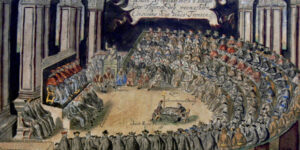 He Indices It is a collection of propositions about grace, apparently collected by Saint Prosper of Aquitaine in the years 435-442. Confirmed the document in 500 by the Holy See (Denz238-249), offers a luminous doctrine of grace, totally opposed to naturalistic voluntarism:
«God works on free will in the hearts of men, in such a way that the holy thought, the good decision and every movement of good will comes from God, since through Him we can do some good, and “without Him we can do nothing” (Jn 15:5)» (ch. 6). Therefore, “we confess God as the author of all the good effects and works and of all the efforts and virtues by which, from the beginning of faith, one reaches out to God, and we do not doubt that all the merits of man are prevented by grace of Him by whom it happens that we begin both to want and to do some good (cf. Phil 2,13). Now, by this help and gift of God, free will is not taken away, but freed… [And so God] effectively works in us so that what He wants, we will and do, and He does not allow what He gave us [free will] to remain idle in us to be exercised, and not to be neglected, so that let us also be cooperators of the grace of God” (chap. 9).
He Second Synod of Orange (529), confirmed by Pope Boniface II (531) – I have already transcribed his main canons (61) –, especially considered in Trent against the Lutherans, gives the same doctrine. “If anyone says that mercy [grace] is divinely conferred upon us when without grace we believe, we want, we desire, we strive, we work, we pray, we watch, we study, we ask, we seek, we call, and it does not confess that by the infusion and inspiration of the Holy Spirit it is given in us that we believe and want or that we can do all these things, as we should; and conditions [part and part] the help of grace to human humility and obedience, and does not recognize that it is a gift of the same grace that we are obedient and humble, he resists the Apostle, who says: “what do you have that you have not received?” (1Cor 4:7). “By the grace of God I am what I am” (15:10)» (canon 6). «It is the gift of God that we think rightly, that we restrain our feet from falsehood and injustice; because As many times as we do good, God, so that we may work, works in us and with us.» (c. 9). Whenever we do some good, we move towards it moved by the grace of God. He is the main author. Like the illiterate child who writes moved by his father’s hand. But then, some will object, is it that man does not do nothing and grace does all?
He Council of Trent, in the decree on justification (1547), clearly answers that question, in which he accuses the Catholic doctrine on grace, as if it left man’s free action inert:
«…without there being any merit in them [in sinners]… God by grace excites them and helps them to convert, and to prepare for their own justification, freely assenting and cooperating to the same grace; so that, as God touches the heart of man by the illumination of the Holy Spirit, nor can it be said that man himself does nothing at all upon receiving that inspiration, since you can also reject it; nor [can it be said that], without the grace of God, can he move by his free will to be righteous before Him… [When we pray] “convert us, Lord, and we will be converted” (Lam 5:21), we are confessing that we are preceded by the grace of God» (Denz 1525).
He Catechism of the Catholic Church makes a precious synthesis of the doctrine taught by the Church for twenty centuries on justification and grace (1987-2029). But I do not reproduce their texts, because you already have the book at hand. (And if you don’t have it, you can go buy it as soon as possible). You can also consult his teaching on freedom (1730-1748). I transcribe only one number: “Divine initiative in the work of grace precedes, prepares and elicits man’s free response” (2022).
Sacred Liturgy
 The Liturgy is the best and most universal school of the Catholic doctrine of grace. Constantly teaches of grace in his prayers, and permanently communicate in the Eucharist and the sacraments. The absolute primacy of God’s grace, the permanent need for his help, his constant action, his gratuity, are instilled in the faithful in many liturgical prayers, many of which were precisely composed in the Sacraments of the 5th and 6th centuries, when the Church celebrated the main Synods and Councils on divine grace.
First I transcribe some sentences Sunday collections in ordinary time:
1.– Lord, give us “light to know your will and the strength necessary to fulfill it.”
10.– “O God, source of all good, grant us, inspired by you, to think what is right and to fulfill it with your help.”
28.– «Lord, may your grace continuously “May he precede and accompany us, so that we are always willing to do good.”
32.– “Put away all evils from us, so that our body and spirit are well-disposed, and we can freely carry out your will.”
34.– «Move“Lord, the hearts of your children, so that by generously corresponding to your grace, they may receive the help of your goodness with greater abundance.”… “Generously” is a matter for the translator. In the original, “ut divini operis fructum propensius exequentes”, it is said “with greater intensity, with greater force.” Which is not the same.
I also remember these other prayers:
“Grant us the grace, Lord, to always think and practice good, and since without you we can neither exist nor be good, make us always live according to your will” (Thursday I of Lent).
«Lord, may your grace inspire, sustain and accompany our works, so that our work begins in you, as at its source, and always tends towards you, as to its end. Through our Lord Jesus Christ” (lauds I Monday T. Ord.). «Actiones nostras, quæsumus, Domine, aspirando præveni et adiuvando prosequere, ut cuncta [so that all] nostra operatio a te semper incipiat et per te coepta finiatur». The translator omitted that the Church asks in that prayer for the help of divine grace to all our good works. And that omission is not a grain of anise, nor a snail’s yawn.
In accordance with these truths of faith proclaimed in the liturgical prayer, the Church solemnly recognizes in the Preface I of the Saints that the Lord, “by crowning his merits, crowns his own work.”
Liturgical spirituality, as always maintained in Scripture, in Tradition, in the Apostolic Magisterium, is characterized by the safe orthodoxy of his features. Pius XI affirmed that the liturgy “is the most important organ of the ordinary Magisterium of the Church” (to Abbot Capelle 12-XII-1935; cf. Pius XII, enc. Mediator Dei 1947, 14). It is, according to Paul VI, “the first school of our spiritual life” (Closing II session. Second Vat. Council, 4-XII-1963). Therefore, specifically in these questions of grace, as in all, the liturgy is the best teacher of the Catholic faith. Lex orandi, lex credendi.
The Holy Fathers
 Those of us who receive from God the immense grace of listening to the voice of the Fathers of the Church, in the office of reading the Liturgy of the Hours, are daily taught in these great truths about grace. And although before the Councils on grace one can find, very rarely, some imprecision in his words, they never reflect in the whole of his teaching the errors that I have already characterized. I will have to limit myself to quoting a few phrases from Doctor of grace :
Saint Augustine: «Do not think that you can bear even the smallest fruit. Christ does not say: “without me bit you will not be able to do.” He says: “without me, you cannot do nothing“Therefore, whether you do a little or a lot, you cannot do it without Christ. No, without his help you cannot do any good thing (Tract. in Ioannis evang. 81,1-3). “If it is the grace of God that works in you, the good you do is due to it and not to your own strength” (Enarrat. in Psalmos 65.5. Lord, “make me enter my heart and sincerely confess to you: There is nothing in me that can please you apart from what I have received from you.» (Sermo 13.3).
Author: Fr. José María Iraburu
