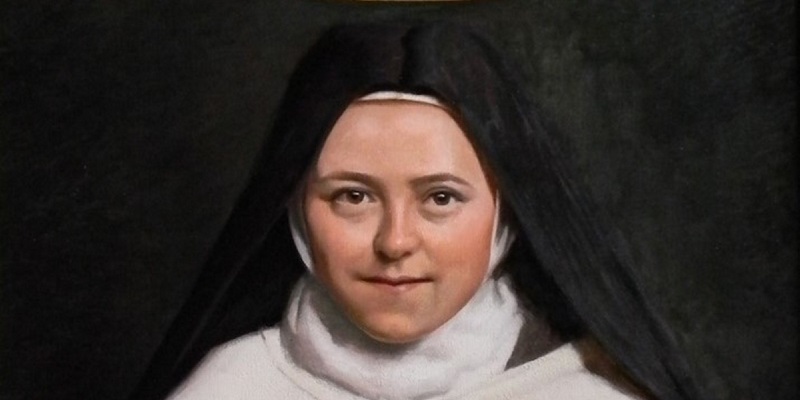
Saint Thérèse of Lisieux…
Better to say Saint Thérèse of the Child Jesus and the Holy Face, which is her proper name.
We continue to contemplate the mysterious union of grace and freedom in this saint.
The apostolic action. We have seen well how Saint Thérèse believed in the absolute necessity of grace to personal sanctification, declaring that without it she could do nothing. She had this same conviction in reference to the sanctification of others through apostolic action. She was able to verify it experimentally when she was appointed assistant to the Mistress of Novices.
She confesses, “she has understood for a long time that God doesn’t need anyone, and less than others, to do good on earth” (X,3r). She therefore devotes herself to her new office in the community with all hope. «Since I understood that I could do nothing by myself, the task you entrusted to me no longer seemed difficult to me. I saw that the only thing I needed was to unite more and more with Jesus, and that “the rest would be given to me in addition” [Mt 6:33]. In fact, my hope never failed. God deigned to fill my hand as many times as necessary to feed the souls of my Sisters. I confess to you, dearest Mother, that if I had relied in the slightest on my own strength, I would very soon have surrendered my weapons to you. From afar it seems easy and rosy to do good to souls, to teach them to love God more, to model them according to one’s own points of view and personal thoughts. Up close it is quite the opposite: the pink color disappears… and it is found that doing good [to people] is as impossible without God’s help as making the sun shine in the middle of the night. It is proven that it is absolutely necessary to forget personal tastes, renounce one’s own ideas and guide souls along the path that Jesus has laid out for them, without attempting to make them follow ours” (XI,22v).
The recognition of the primacy of grace – contrary to semi-Pelagian approaches – carries with it this absolute delicacy in the service of souls: “how different are the paths along which the Lord leads souls!” (X,2r). «God made me understand that there are souls for whom his mercy never tires of waiting, for whom he does not give his light except by degrees. For this reason, I was very careful about pass God’s hour, and waited patiently for Jesus to see it come” (XI,20v-21r).
The Lord acts in Thérèse, and she works with absolute humility and confidence. «I am a little brush that Jesus has chosen to paint his image on the souls that you have entrusted to me»(XI,20r). Prayer and apostolic action must always go together: “I begged God to put sweet and convincing words on my lips, or better yet, to he himself spoke for me» (XI,21r). «Prayer and sacrifice constitute all my strength; They are the invincible weapons that Jesus has given me. They can, much better than words, touch hearts. I have verified it many times» (XI,24v). Thus trusting in God, and without trusting anything in herself, Thérèse did good to her sisters, and sometimes she had inexplicable successes.
On one occasion, a Sister, who was suffering a great interior pain, approached Sister Teresa smiling, and she told her with complete certainty: «“you have a pain.” If I had made the moon fall at his feet, I don’t think he would have looked at me with greater astonishment. It was so great that a kind of astonishment also took hold of me, and for a moment I experienced a supernatural fear. I was sure that I did not possess the gift of reading souls; and that is why I was all the more astonished the more accurately I had hit the mark. I felt the presence of God very close to me. I knew that I had repeated without realizing it, like a child, words that did not come from me but from God.…On the other hand, none of that would certainly be capable of inspiring vanity in me, since I keep constantly present in my memory the memory of what I am» (XI,26r).
Heroic victories in minimal things. Saint Thérèse always moves moved by the grace of God, which gives his actions a supernatural ease: “my yoke is easy and my burden is light” (Mt 11:30). But by no means is this collaboration with divine grace always without pain and effort. I already said that grace, for good work, always helps the understanding and the will, but not always the feeling. That’s why docility to grace sometimes costs heroic efforts, that the will works with the help of grace. Thérèse, with these expirations, performs very intense acts of virtue, and achieves great spiritual growth. I remember some examples. Self-love, specifically, at least as a temptation, lasted in her for many years.
While in the Convent, «I tried very hard not to apologize, which was very difficult for me… I will tell you about my first victory; It wasn’t big, but it cost me a lot. A pot that had been left behind a window was found broken. Our Mother, believing it was me, showed it to me, telling me to be more careful again. Immediately, without replying, I kissed the ground, promising to be more careful in the future. These small practices [of humility] cost me a lot because of my little virtue, and I had to help myself by thinking that at the Final Judgment everything would be known” (VII,74v).
scenes of expirations There are many like this in the life of the Saint. But I will quote one that I find especially moving. Teresa, the Little Queen, the youngest sister, the ninth, had always been very loved in her family, both by her sisters and by her father, and in the solitude and silence of Carmel she sometimes had a very hard time.
She confesses in her writings to the Mother Superior: «I remember that when I was a postulant, I sometimes had such violent temptations to enter your cell to please myself, to find a few drops of consolation, that I was forced to quickly pass in front of the office and grab the handrail of the stairs.. I had a multitude of permissions to ask for, I found a thousand reasons to please my nature. How glad I am now of the resignations that I imposed on myself in the principles of religious life! At present I already enjoy the reward promised to those who fight generously” (XI,21v-r).
Fraternal charity also sometimes cost her great efforts, always carried out with the motion of the Lord’s grace. An unbearable old woman, Sister Saint-Pierre, half-invalid, needed help for everything. “It was very difficult for me to offer myself to provide that service… It is incredible what it cost me.” But with the grace of God she carried out her service, and when he finished it, “before leaving, I gave him the most gracious of my smiles” (XI, 28v-29r). Other times, in choir, she had to be near a Sister who made a strange noise, similar to what would be made by rubbing two shells against each other…
It is impossible for me, my God, to tell you how much that little noise bothered me. I felt a great desire to turn my head and look at the culprit, who most certainly did not notice the annoying sound she was making. Looking back would have been the only way to make him notice it. But In the depths of his heart he understood that it was better to suffer it for the love of God and not to cause pain to Sister. So I remained quiet, trying to unite with God and forget the little noise. But everything was useless; I felt that sweat was flooding me, and I was forced to simply say a prayer of suffering. Even then, I tried suffer without irritation, with joy and peace, at least in the depths of the soul. I tried hard to find pleasure in that sound, or I did my best not to hear it. All in vain! (XI,30v).
He narrates something similar when in the laundry room a careless Sister splashed her face again and again with dirty water: «My first impulse was to lean back and wipe my face, in order to make the Sister who was sprinkling me see the great favor she would do me by acting more gently. But I immediately thought that I was very foolish to refuse some treasures that were so generously given to me., and I kept very careful from expressing my inner struggle. I forced myself to feel the desire to receive a lot of dirty water in the face, so that I ended up liking it that new type of sprinkling» (XI,30v-31r).
This is how the Lord made Thérèse a great saint. “Five loaves and two fish”, very little, is what that young man in the Gospel put in the hands of Jesus, but with his minimal offering he came to feed a large crowd. The miracle probably would not have occurred if he had offered only four loaves and one fish. But he, moved by grace, made the Master an offering of all he had. In a similar way, Teresa, docile to the action of grace, gives herself completely to God, knowing herself to be very small, and reaches a very high personal holiness. She also became one of the most sanctifying Saints for Christians of her time, to this day, helped by her example and her writings: three school notebooks.
Perfect in humility. The merciful Lord, “because I was small and weak, stooped down to me and secretly instructed me in the things of his love” (V,49r). On the path of perfection “the further one advances, the further one believes oneself from the terminus. That’s why, “Now I resign myself to always seeing myself as imperfect, and I find my joy in that.” (VII,74r). Perfect in humility, there is no longer any self-love in her that suffers when she sees herself as defective:
«I do not feel any pain when I see that I am weakness itself; On the contrary, I glory in it[2Cor 12,5), and I count on discovering new imperfections in me every day» (X,15r). “I always know how to find a way to be happy and take advantage of my miseries” (VIII,80r). «How sweet is the path of love! Certainly, one can fall, one can commit infidelities; But love, knowing how to take advantage of everything, quickly consumes what may displease Jesus, leaving nothing but humility and deep peace in the depths of the heart” (VIII,83r).
Saint Thérèse keep peace in your absolute humility, always open to grace. And it does not bother her too much to be sometimes misunderstood and judged: “I say with Saint Paul: “I care little about being judged by any human tribunal. I do not judge myself. It is the Lord who judges me” [1Cor 4,3-4]” (X,13v). She has the full humility of a beggar who asks, but demands nothing, and that she is satisfied with what is given to her. It is perfect in humility.
Not ashamed of exercise only in small things and small virtues, recognizing that it is not worth more. Lord, «I have no other way to prove my love to you…; that is, not waste any sacrifice, any look, any words; take advantage of the little things, even the most insignificant, doing them for love” (IX,4r-v).
Not ashamed of confess your limitations: «I should feel sorry for him fall asleep, for seven years, during prayer and thanksgiving. And yet, none of this makes me sad. I think that little children please their sleeping parents just as much as they do when they are awake” (VIII,75v). She also states simply: «Pray the rosary alone – I’m ashamed to say it – it costs me more than putting on an instrument of penance… I know I pray it so badly! No matter how much I try to meditate on the mysteries of the rosary, I cannot focus my attention” (XI,25v).
She is not ashamed to confess that many of his riches are nothing but his miseries filled by the mercy of God. Thus, p. e.g., when she explains her prayer because of her inability to deal with people. At the Abbey boarding school she was not an attractive girl either to the teachers or to her classmates: “no one took care of me. Therefore, I would go up to the gallery of the chapel, and there I would remain in front of the Blessed Sacrament until Dad came to look for me. That was my only consolation. Wasn’t Jesus my only friend? I didn’t know how to talk to anyone but him. Conversations with creatures, even pious conversations, made my soul tired. I was sure that it was preferable to talk to God than to talk about God, since there is a lot of self-love that is mixed in spiritual conversations” (IV,40v).
She is not even ashamed in her humility confess the exceptional graces that the Lord has given you. She knows well that they are nothing but free gifts from God. Her spiritual wisdom, p. e.g. It is so great, she declares, that scholars “would certainly have been surprised to see a fourteen-year-old girl penetrate the secrets of perfection, secrets that all their science would never be able to reveal to them” (V,49r).
Doctor of grace. The Church has always known that all Christians are called to holiness, since he has always instilled that all Christians comply with the first commandment, “love God with all your heart”; and that is precisely what holiness consists of. But Saint Thérèse rediscovers this truth, showing in her writings how simple the path to holiness is, and how possible it is, with the grace of God, to advance day by day, whether the Christian is religious or lay, strong or weak, educated or illiterate, healthy or sick, and whether this or the other is the family and work circumstance in which one lives.
Thérèse’s spirituality differs greatly from the voluntarism current in her time.. Therefore, although the formula God asks us less It was perhaps then the most frequent in the spiritual language about grace, she uses it on very rare occasions (I,10v; V,49v. 52r; 53r; VI,64r; IX,4r; Act 57,1v; 96,2r; 108,1v), and she always uses it in the context of grace: p. For example, “we must know how to recognize what God asks of souls and support the action of his grace, without ever accelerating it or slowing it down” (V,53r).
In the autobiographical manuscripts is always Jesus who, with immense generous love, strengthens Saint Thérèse, guides her, corrects her, shows her, grants her, gives her, works in her and with her… –And I point out, in passing, that in her writings she almost always talks about “Jesus” to refer to Jesus Christ, the Lord, God, the Holy Trinity. She, then, understands her entire life as a free gift of God’s love.. And because she is convinced that everything is grace, that’s why hopes to become a great saint, even looking so miserable and weak. There is nothing in her, she recognizes, that deserves the excellent graces with which God has wanted to privilege her since she was a child. Jesus dwells in her heart working good in her sometimes alone, but usually in her and with her. Without Jesus, who assists her moment by moment, she can do nothing on her own. But with Him you can do everything.
When Saint Thérèse expressed this path of spiritual childhood, confesses in a precious synthesis all the great truths of the Bible and the Fathers, of the Councils and the apostolic Magisterium about the sublime mystery of divine grace. That is why this young Doctor of the Church can be for Christians today, as Pius XII says, “a reunion with the Gospel, with the very heart of the Gospel” (radiom. 11-VII-1954).
Author: Pbro. José María Iraburu
