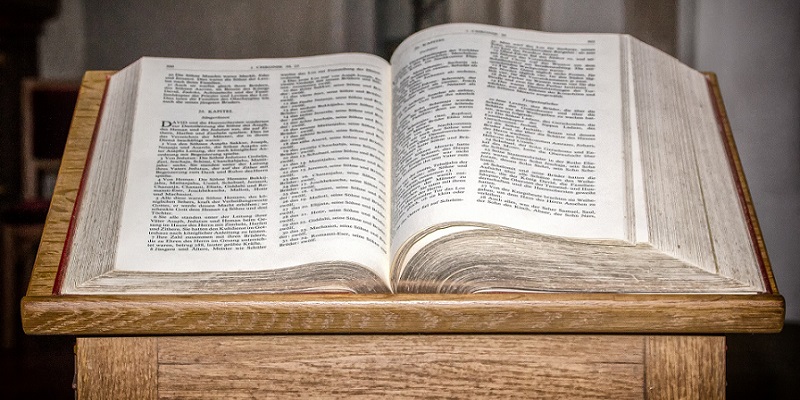
The Bible: a “Disputed Banner” (Cf. Lk 2:35)
The mysterious words of the aged Simeon to the Most Holy Virgin Mary, concerning her Son Jesus, remain valid, after more than two thousand years, referring not only to the person of Jesus himself, but also to the whole body of Scriptures that have him as their center and that are the fundamental written testimony of his life, work, and message: the Bible.
This “banner” has always been raised to justify many doctrines and “churches,” especially from the 16th century onward, when Martin Luther leaned on it to justify his separation from the Catholic Church, thus giving rise to the Protestant movement. From that moment on, the recourse of relying on Sacred Scripture continues to be used by all those who, starting from supposed divine “revelations,” have brought forth thousands of “churches” or “Christian” denominations (in the USA alone, and up until a few years ago, more than thirty thousand (!)). Each one of them claims to be based “on the Bible.” Some claim to be the only ones who in two thousand years have understood what the Bible “really teaches”[1]. Almost all of these denominations offer Bible Courses and printed materials with eye-catching illustrations, and popular editions of Sacred Scripture with a reduced catalogue (canon) of 66 books.
But let us ask ourselves: Is it possible that for more than 1,500 years (until the appearance of Protestantism) all of Christendom was mistaken in reading the content of the sacred book? Is it true that all the denominations born of the Protestant Reformation—and, more recently, of so many “enlightened ones”—are based “solely” on the Bible? Why, then, is there so much difference in the interpretation of certain passages of Sacred Scripture among the various denominations that claim to rely on it?
Most Catholics find serious difficulties when it comes to “dialoguing” with brethren—former Catholics—who are members of various Christian denominations. The difficulty, most say, lies in the closed attitude on the part of the members of those churches. And in part this is true: the closed attitude (which is why such groups are called “sects”) already prevents all dialogue. That closed attitude is the fruit of another attitude called “fanaticism”: the impassioned absolutizing of a particular truth, point of view, opinion, etc., which excludes—a priori—the possibility that one’s interlocutor may also be right, or partly right. This “fanatical” attitude may be the fruit of immaturity or of a certain psychological imbalance…
But apart from the closed attitude, the difficulty in “reaching an understanding,” regarding the same texts, with these brethren who are admirers of the Sacred Scriptures, is due above all to two “capital” failings when approaching the sacred text: 1) a “theological” error, and 2) a “methodological” error.
On the “theological approach” of Catholics to Sacred Scripture, and on the differences of approach concerning Sacred Scripture in the various Protestant denominations, I would like to continue reflecting in the coming articles.
A “Theological” Error in the Interpretation of Sacred Scripture (I): Separating the Bible from the Church
The main difficulty in “reaching an understanding” with brethren of other Christian denominations concerning Sacred Scripture is, undoubtedly, due to a “theological error” that these groups commit: separating the Sacred Scriptures from their interpretive context: the Church.
When, in the 16th century, M. Luther formulated the principle of “SCRIPTURE ALONE,” he stripped it of its “interpretive context,” thus leaving it without its base, without its foundation, and therefore without the “vital current” that gave it its existence and that is indispensable for knowing what its authentic message is. By severing the Bible from the Church, he left it alone and defenseless against all the “manipulations” that would come upon it—which is precisely what we are seeing: a multitude of isolated groups claim to base themselves on it in order to justify their beliefs, always against the Catholic Church and, in many cases, mutually antagonistic.
Indeed, the Bible is not self-sufficient. The Bible did not arise by spontaneous generation but in the midst of a people of believers (Israel), a people to whom God went on revealing himself for many centuries before it was put into writing. A people that preserved the memory (Cf. Ex 13:14; Dt 4:9) and the interpretation of those events (many psalms reinterpret the Exodus, the Covenant: 80; 104; 105, etc.). A people that was not in the habit of writing but of “keeping in memory.” This gave rise to a long “oral tradition” before those “memories” were written down (Cf. Jer 36: the prophet writes down his oracles twenty years later (!)). A people that flowed into the Church as its mature continuation (Cf. Mt 16:18-19). Jesus himself—a son of his people—wrote nothing and commanded nothing to be written. Let us recall that the Gospels began to be written approximately twenty years after the death of the Lord (the first “book” of the NT, the 1st Letter to the Thessalonians, was written around the year 52).
All of this confirms for us that the Bible cannot be “absolutized”: first came the community of believers in whose midst it was born—Israel/the Catholic Church—and then came “the book.” Moreover: it was this first community of believers, founded by the Lord Jesus, that received the whole body of the OT writings (the Greek Septuagint version: LXX) as inspired Word of God (2 Tim 3:16) in order to understand the plan of God contained in the ancient prophecies concerning Jesus. It was this Church that wrote the books that would form part of the canon of the NT and that “discerned” among other writings (60 “apocrypha,” according to the Encyclopedic Dictionary of the Bible) that were then in circulation and that claimed to be inspired as well. Also with respect to the OT, the Church had to make its “discernment” (67 “apocryphal” books were then in circulation, according to the Enc. Dict. of the Bible). Remember that the Bible itself does not state the number of books (canon) that ought to form part of it. Here the inconsistency of the various Christian denominations is manifested, in that they consider “inspired,” at the very least, all the books of the NT while at the same time denying the “inspiration”—that is, the assistance of the Holy Spirit—of that Church which wrote and discerned the canon. In the Apostolic Exhortation Verbum Domini, Pope Benedict XVI tells us: “…the authentic hermeneutic of the Bible is possible only within the faith of the Church, which has its paradigm in Mary’s ‘yes.’” (29). (Later on we shall speak of Benedict XVI’s “ecclesial exegesis.”)
Thus it becomes possible to understand why it is almost impossible to reach an understanding with those who claim to understand and interpret Sacred Scripture starting from an error as obvious as separating it from its interpretive context: the Church founded by Jesus. They are starting from a diametrically anti-ecclesial point of view. One understands, then, why there is so much manipulation of the sacred book and the ever-increasing emergence of “churches.”
A “Theological” Error in the Interpretation of Sacred Scripture (II): Identifying “Word” and “Scripture”
This error—common in the various Protestant denominations—is a “reductionism.” That is: reducing the Word of God to its written testimony: Sacred Scripture, or the Bible.
Although they may seem equivalent, it is not the same thing to say “the Word,” “Word of God,” or “Sacred Scripture” (= the Bible). They are terms closely related to one another, but not necessarily equivalent. From identifying them without further ado there arises a “misunderstanding” when our evangelical friends (or “Christians,” as they call themselves), Jehovah’s Witnesses, etc., speak of the Bible: they reduce the Word to its written testimony, as we said at the beginning. And yet the Word is broader than Scripture.
As we know, “Word of God” is everything that God has revealed to us for our salvation: his work (creation), his designs (plans), his teachings, what we are, our destiny, etc. God went on revealing all of this to his people (Israel) from the beginning, from his election of Abraham. And all this revelation ended with the death of the last of the apostles: St. John. “Word of God” is also everything that he continues to reveal to us when—in the light of the Holy Spirit—we read the sacred book; when, also with the assistance of this Spirit, the Church teaches us, corrects us, and points out to us the way throughout the centuries. (Cf. “…he will teach you all truth…” Jn 16:13)
Sacred Scripture itself bears witness that the “Word of God” is broader than its written testimony:
· Psalm 8 tells us that all of creation “speaks to us” of God, of his power, of his perfection and wisdom. That is to say, creation is also “Word of God.”
· That same psalm tells us that, within God’s creation, man (the human being) is, in a particular way, “word of God,” since the divine image is engraved in the very nature of man and woman: “Let us make man to our image and likeness…” (Gen 1:26)
· In the NT, St. John tells us that the Word is also the Son of God, the Second Person of the Most Holy Trinity (the Verbum, as other versions translated it): “In the beginning was the Word… and the Word was God… and dwelt among us” (Jn 1:1-14)
· Finally, let us recall that St. John himself tells us that NOT EVERYTHING was written down: “And Jesus also performed, in the presence of his disciples, many other ‘signs’ that have not been written down in this book…” (20:30) “There are also many other things that Jesus did, which, if they were written one by one, I think that not even the whole world would have room for the books that would have to be written” (21:25)
Pope Benedict XVI speaks to us, in the Apostolic Exhortation Verbum Domini, of the term “Word of God.” And he gives us six (6) meanings of this expression within the Bible itself: “…the various ways in which the expression ‘Word of God’ is used. We have rightly spoken of a symphony of the word, of a single word expressed in diverse ways: ‘a song with many voices.’ In this regard, the Synod Fathers spoke of an analogical use of human language in relation to the Word of God.” (7 Read this entire section)
Let us recall, finally, that the Church, in the year 1965, promulgated the Dogmatic Constitution Dei Verbum (= the Word of God), in which she speaks to us of DIVINE REVELATION (Documents of the Second Vatican Council). The Catholic Church, aware of the greatness and breadth of the Word of God, tells us: “…the Church does not draw her certainty about all revealed truths from Scripture alone.”(Vatican II, D.V. 9)
A “Methodological” Error: Believing That One Can Read Sacred Scripture in a “Neutral,” “Unprejudiced,” or “from-Scratch” Way.
Many times we have seen and heard how the persons belonging to the various “Christian” denominations popularly known as “evangelicals” or Protestants, Jehovah’s Witnesses, etc., claim, in presenting their beliefs, to be based “solely” on what the Bible or Sacred Scripture “really” says. To make this more evident, they go about “with the Bible in hand.” The tactic lately used by Jehovah’s Witnesses, on their house-to-house visits, is to ask the Catholic faithful, when he opens his door to them, to lend them his Catholic Bible so that, with it in hand, they may read above all certain passages that interest them and say to him: “Do you not see? Even your own Bible is saying that we are right and that you—Catholics—are mistaken.” They also write on the sides of highways, on walls, etc., slogans that say: “Read the Bible,” “The Bible is the truth,” etc., etc. These brethren who claim to base themselves on the Bible believe they can read and interpret it in a neutral way, that is, “without prejudices.”
But let us think: is this possible? In the foregoing approach two things are hidden:
1—A grave error (an unconscious one?) of methodology, since—as is known—no one who approaches a written text can do so in a “neutral” way. And still less in the case of Sacred Scripture.
2— A conscious anti-Catholic prejudice, which they then formulate in the following way: the Catholic Church “does not tell the truth” or “is deceiving them” (“has kept them deceived all along”).
The philosophy of language has shown that whenever we approach a written text, a “pre-understanding” precedes us. That is to say, each time we approach the text of Sacred Scripture we do so from a certain prior position or point of view (and often an unconscious one): the non-believer will approach it out of curiosity, or literary, historical, cultural interest, etc. The atheist or materialist will approach it perhaps with the conviction of finding myths, legends, fables—that is, accounts devoid of all historical and real character. The believer approaches it with the conviction that he is reading a “sacred” or “religious” book that bears a message for his life. In the case that concerns us, there is a very different “pre-understanding” or expectation between the Catholic and the member of some Protestant denomination when approaching the sacred text: the Catholic approaches the text within a faith received in the great, centuries-old tradition of the Church. The evangelical/Protestant/Jehovah’s Witness generally approaches it from an “anti-Catholic” attitude. This “pre-understanding,” then, determines what we “read” in the text. And even the very selection we make of the texts. One of the “discoveries” of the North American former Presbyterian pastor Scott Hahn, upon his conversion to Catholicism (as he publicly stated in an interview on EWTN), was his realization that during the whole time he was a Presbyterian believer and minister, he had been reading the Sacred Scriptures from a very particular perspective that led him not only to interpret them in a certain direction but also to select some passages and ignore others, which became evident when he looked at the texts he had underlined in his Bible. When we hear an evangelical or a Jehovah’s Witness interpret Sacred Scripture, we realize that they are interpreting the text “as they have been taught” by their pastors, who in turn follow the outlook of their founder: Martin Luther, William Miller, Ellen G. White, Charles T. Russell, etc. In conclusion, they do not read it as they claim: neutrally.
The Catholic Church, on the contrary, is aware that when she reads Sacred Scripture she does so from a “pre-understanding,” that is, from a determined outlook. Only that this “outlook,” this “determined manner,” or approach has its foundation in Sacred Scripture itself: we read it and interpret it following a dynamic internal to Sacred Scripture itself. An interpretive dynamic followed also by the community of faith that transmitted it to us: the people of Israel, in the first place, and the primitive community of believers founded by the Lord: the Church. The authors of the New Testament, guided by the Holy Spirit (Jn 16:13), interpreted the OT in the light of the Lord’s resurrection and wrote what we have in the NT. This is why Pope Benedict XVI has insistently repeated that Sacred Scripture must be interpreted “within the faith of the Church.” It is what he calls an “ecclesial hermeneutic.” “Ecclesial” because it is the fruit of that same Spirit who acted at the origin and in the life of the nascent Church itself. (V.D. 29-30) Only by reading Sacred Scripture within this interpretive current (the living tradition of the Church) is it possible to be faithful to the biblical text without deforming or betraying it. Scott Hahn said, in the interview indicated above, that if Sacred Scripture is interpreted “as the writers of the NT interpreted the OT,” one necessarily arrives at the Catholic faith.
Author: Fr. Arturo G. (prarturogap@gmail.com)
Notes
- Cf. “What Does the Bible Really Teach?” (by Jehovah’s Witnesses), 2005 ↩
