A reader asks:
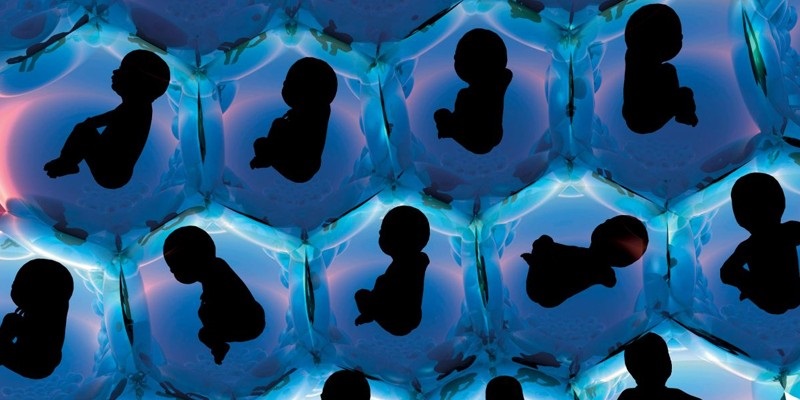
Is it licit to eliminate some embryos when a multiple fertilization has occurred? Might it not be considered that, since they are condemned to die because not all of them can continue the process of gestation, reducing their number would be an attempt to save some of them?
Answer:
I reply with a declaration of the Pontifical Council for the Family, drawn up after consulting the Congregation for the Doctrine of the Faith.
Cases of multiple pregnancy—that is, situations in which the maternal womb harbors many embryos—are less common nowadays. These cases normally occur either because of the stimulation of the ovaries in cases of infertility, or because of recourse to artificial fertilization, on which the Magisterium has already pronounced itself (Congregation for the Doctrine of the Faith, Instruction “Donum vitae”, II).
First of all, it is a duty to become aware of the difficult and even dramatic situations that these techniques can give rise to. For this reason, it is necessary to appeal to the responsibility of the physicians who, by practicing hyperstimulation without due skill and caution or by applying the techniques of artificial fertilization, bring about situations in which the life of the mother and of the children conceived is endangered.
With regard to multiple pregnancies, some assert that they cannot come to term, whether because of the spontaneous death of the embryos in the womb or because of the premature birth of the fetuses with no hope of life. They add, moreover, that in the event that all the unborn children reach delivery, the obstetric difficulty (and the consequent danger to the mother) is greater. On the basis of these arguments, the conclusion is reached that the selection and elimination of some embryos could be justified in order to save the rest or, at least, one of them. For this reason, the technique known as “embryo reduction” has been introduced.
In this regard, it is necessary to affirm the following: since every embryo must be considered and treated as a human person in respect of its eminent dignity (Congregation for the Doctrine of the Faith, Instruction “Donum vitae”, I, 1), all the fundamental human rights must be recognized in the unborn child from the first moment of its conception and, first and foremost, the right to life, which may in no way be violated. Beyond all confusion and ambiguity, it must therefore be affirmed that “embryo reduction” constitutes a selective abortion: in fact, it consists in the direct and voluntary killing of an innocent human being (John Paul II, encyclical “Evangelium vitae”, 57). And so, whether willed as an end or as a means, it is always a grave moral disorder (John Paul II, encyclical “Evangelium vitae”, 62).
Since this is a truth that can be reached by simple reason, the unlawfulness of this conduct constitutes a norm valid for all, even for non-believers (John Paul II, encyclical “Evangelium vitae”, 101). The moral prohibition still stands even when continuing the pregnancy entails a risk to the life or health of the mother and of the other twin siblings. It is not licit to do evil even in order to attain a good (John Paul II, encyclical “Evangelium vitae”, 58).
Man’s life comes from God; it is always a gift of his, a sharing in his life-giving breath (John Paul II, encyclical “Evangelium vitae”, 39). The selection of embryos, since it entails the voluntary elimination of a human life, cannot be justified either by virtue of the so-called principle of the lesser evil or by virtue of the principle known by the name of “double effect”: neither of these two principles applies in this case.
Nor should one underestimate the possibility that the adoption of the technique of embryo reduction may lead to a eugenic mentality, by virtue of which, through techniques of prenatal diagnosis, one comes to measure the value of a human life solely according to parameters of normality and of “physical well-being” (John Paul II, encyclical “Evangelium vitae”, 63), in the light of a reductive concept of “quality of life”.
May the Lord of life accompany parents in fulfilling their lofty task and sustain them in the commitment to respect the unborn child’s right to existence. May he likewise guide those who are at the service of life to do everything possible to save the mother and the children. Thanks to the significant scientific advances made in these years, many cases of multiple pregnancy have been able to reach a happy outcome.
It is certain, in any case, that although it is part of human limitations sometimes to have to assist helplessly at the premature death of innocent creatures, it can never be morally licit to bring about death in a voluntary manner.
From the Vatican, 12 July 2000
Cardinal Alfonso López Trujillo, President
H.E. Monsignor Francisco Gil Hellín, Secretary.
Author: Fr. Miguel Ángel Fuentes
Source: El teólogo responde
