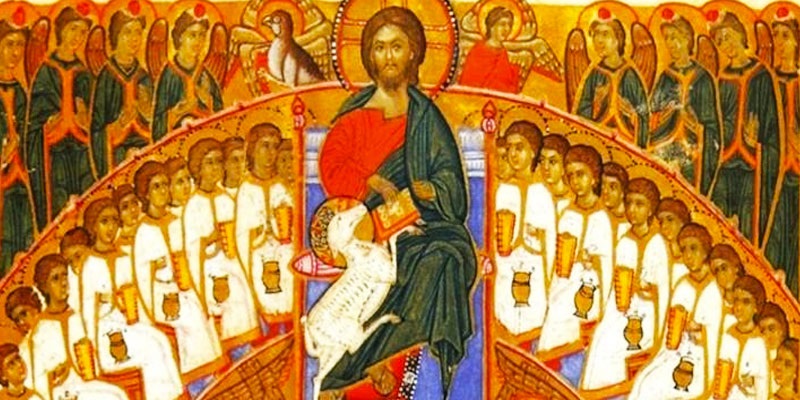
One of the dogmas of the Catholic Church is the Communion of Saints. We believe that the Church is the mystical body of Christ and is composed of the Church Triumphant, the Church Suffering, and the Church Militant.
The Church Triumphant consists of all those who have died, have been saved, and, fully purified, are in complete communion with God. The Church Suffering consists of all those who, although they have died and are saved and destined for heaven, have not yet been fully purified. And the Church Militant consists of all of us who are alive serving our Lord here on earth.
The Catechism tells us:
954 “The three states of the Church. ‘Until the Lord shall come in His majesty, and all the angels with him, and death being destroyed, all things are subject to him’, some of his disciples are exiles on earth, some have died and are being purified, while others are in glory, contemplating ‘in full light, God Himself triune and one, exactly as he is.’”
The Intercession of the Saints
We believe that those who belong to the Church Triumphant can intercede for us before God, that He may grant us His timely assistance and help us on our journey toward Him. The angels, who are also in communion with God and constantly behold His face, can also intercede for us. The Catechism on this point tells us:
956 “Being more closely united to Christ, those who dwell in heaven fix the whole Church more firmly in holiness… They do not cease to intercede with the Father for us, as they proffer the merits which they acquired on earth through the one mediator between God and men, Christ Jesus… So by their fraternal concern is our weakness greatly helped.”
It is common to encounter strong opposition to this doctrine from Protestants: “Catholics worship the Virgin and the saints”, they frequently object, and they claim that one should not ask them for intercession before God. Their arguments are as follows:
Protestant arguments against the intercession of the Saints.
Argument 1: It is a sin of idolatry to ask anyone other than Christ to intercede for us, since He is the only mediator between God the Father and men. This claim is based on what Scripture says:
“For there is one God, and there is one mediator between God and men, the man Christ Jesus.”[1]
The sin of idolatry involves giving to something or someone the place of God, without being God. Once this is understood, this argument immediately gets off on the wrong foot. How could it be possible to give the saints the place of God merely by asking them to intercede before Him?
If the objection is meant to argue that we give the saints the place of Christ as mediator between God and men (based on the text above), the argument also fails. Hence it is important to address the definition of mediator, which etymologically comes from the Latin mediator, from mediare, to stand or divide in the middle. A simple definition would be:
Mediator: “to intercede or plead on someone’s behalf. To interpose between two or more parties who quarrel or contend, seeking to reconcile them and unite them in friendship. To exist or stand between other things.”
The term itself does not present great difficulty and is generally understood from the outset: a “mediator” is one who stands between two or more persons, offering himself as a bridge between them, especially when they are in conflict.
The text in question emphasizes that Christ is mediator because He has paid the debt that the offender (we) owed to the offended party (God). In this way only Christ can mediate for us, because He, being true God and true Man, has died to pay for our sins, and no one else. In that sense, no one else — not the Virgin, not the Saints, not the angels — can mediate.
But interceding by beseeching the offended party (God) to forgive the offender (us), and by imploring the Almighty to send special assistance to those in need: in this second form of mediation, the Virgin, the Saints, and even we ourselves can be mediators, because we are all members of the body of Christ which is the Church.
In the Bible we can find several examples. When God was displeased with four men who had attributed to the Patriarch Job what he had not done, He said to them:
“Now therefore take seven bulls and seven rams, and go to my servant Job, and offer up for yourselves a burnt offering; and my servant Job shall pray for you, for I will accept his prayer not to deal with you according to your folly; for you have not spoken of me what is right, as my servant Job has.”[2]
In this case Job appears as an intercessor between the men and God, not to pay the debts they owed to the Lord, but to plead on their behalf. And the Lord heeded his petition and forgave them.
Moses also was an intercessor for the people of God:
“Pardon the iniquity of this people, I pray thee, according to the greatness of thy steadfast love, and according as thou hast forgiven this people, from Egypt even until now.” Then the LORD said, “I have pardoned, according to your word.”[3]
“And the people came to Moses, and said, “We have sinned, for we have spoken against the LORD and against you; pray to the LORD, that he take away the serpents from us.” So Moses prayed for the people.”[4]
“Now therefore let me alone, that my wrath may burn hot against them and I may consume them; but of you I will make a great nation.” But Moses besought the LORD his God, and said, “O LORD, why does thy wrath burn hot against thy people, whom thou hast brought forth out of the land of Egypt with great power and with a mighty hand?”[5]
Here again we see Moses appearing as an intercessor, not paying for the sins of others — for that was something only Jesus Christ could do and did — but pleading on their behalf.
Abraham interceded for Sodom and Gomorrah:
“Then the LORD said, “Because the outcry against Sodom and Gomorrah is great and their sin is very grave, I will go down to see whether they have done altogether according to the outcry which has come to me; and if not, I will know.” Then Abraham drew near, and said, “Wilt thou indeed destroy the righteous with the wicked? Suppose there are fifty righteous within the city; wilt thou then destroy the place and not spare it for the fifty righteous who are in it?””[6]
The unique mediator who pays the debt is Christ, but intercessors can indeed be the Blessed Virgin Mary, the saints, and we ourselves, praying on behalf of others.
We even see how the angels themselves intercede with their petitions on our behalf:
“Then the angel of the LORD said, “O LORD of hosts, how long wilt thou have no mercy on Jerusalem and the cities of Judah, against which thou hast had indignation these seventy years?” And the LORD answered gracious and comforting words to the angel who talked with me.”[7]
An example of this powerful intercession based on petition is found in the New Testament in the account of the wedding at Cana:
“Jesus also was invited to the marriage, with his disciples. When the wine failed, the mother of Jesus said to him, “They have no wine.” And Jesus said to her, “O woman, what have you to do with me? My hour has not yet come.” His mother said to the servants, “Do whatever he tells you.” Now six stone jars were standing there, for the Jewish rites of purification, each holding twenty or thirty gallons. Jesus said to them, “Fill the jars with water.” And they filled them up to the brim. He said to them, “Now draw some out, and take it to the steward of the feast.” So they took it. When the steward of the feast tasted the water now become wine, and did not know where it came from (though the servants who had drawn the water knew), the steward of the feast called the bridegroom and said to him, “Every man serves the good wine first; and when men have drunk freely, then the poor wine; but you have kept the good wine until now.” This, the first of his signs, Jesus did at Cana in Galilee, and manifested his glory; and his disciples believed in him.”[8]
In the episode of the wedding at Cana, a remarkable thing occurs: Jesus advances the hour in which He began His signs and manifested His glory by virtue of His mother’s petition: (“O woman, what have you to do with me? My hour has not yet come.”). Indeed, powerful is the petition of those who are united to the Lord, and here it was so powerful that the Lord advanced His hour out of love for her. And one must then ask: if the Lord listened to His mother’s petitions to that degree, will He not do so now that they are together in heaven?
Other examples of intercession that are not contrary to the unique mediation of Christ are found when the Apostle Paul repeatedly begs that prayer and intercession be offered for him and for the other members of the Church (whom he calls saints):
“Brethren, pray for us.”[9]
“And take the helmet of salvation, and the sword of the Spirit, which is the word of God. Pray at all times in the Spirit, with all prayer and supplication. To that end keep alert with all perseverance, making supplication for all the saints.”[10]
“Therefore confess your sins to one another, and pray for one another, that you may be healed. The prayer of a righteous man has great power in its effects.”[11]
If the Apostles thought it was not possible to intercede for others through prayer, they would not have asked for prayer on their own behalf. The evident but overlooked reason for Protestants is that there is no conflict whatsoever, since they intercede in His name. That is why, when we raise our prayers at Holy Mass, we say: “THROUGH HIM, WITH HIM, IN HIM, O God, almighty Father, in the unity of the Holy Spirit…”. We are all intercessors because we are IN CHRIST, and we are part of His mystical body which is the Church.
This becomes evident when one analyzes in its context the passage from the letter to Timothy where we are told of the mediation of Christ:
“First of all, then, I urge that supplications, prayers, intercessions, and thanksgivings be made for all men, for kings and all who are in high positions, that we may lead a quiet and peaceable life, godly and respectful in every way. This is good, and it is acceptable in the sight of God our Savior, who desires all men to be saved and to come to the knowledge of the truth. For there is one God, and there is one mediator between God and men, the man Christ Jesus, who gave himself as a ransom for all, the testimony to which was borne at the proper time.”[12]
From the complete analysis of the foregoing passage we can understand many things that would not be understood by analyzing the verse in isolation. Among these we have:
First, that although we can all pray directly to God, it is also pleasing to Him that we pray and intercede mutually for one another, since in this way we collaborate in the work of salvation, in which God wills that all of us be saved, not as individuals, but as a Church and community helping one another (see verses 1-3).
Second, that Christ is the unique mediator between God and men because He gave Himself as a ransom for all (see verses 5-6), a mediation that is not in conflict with mutual intercession.
Argument 2: The dead have no consciousness of anything, so it is useless to ask them to intercede for us.
Those who use this argument base it on the literal interpretation of the following passage:
“But he who is joined with all the living has hope, for a living dog is better than a dead lion. For the living know that they will die, but the dead know nothing, and they have no more reward; but the memory of them is lost. Their love and their hate and their envy have already perished, and they have no more for ever any share in all that is done under the sun.”[13]
The foregoing passage refers to their bodies but not to their spirit, which returns to God. Later in the same book this is clarified:
“Remember also your Creator in the days of your youth, before the evil days come, and the years draw nigh, when you will say, “I have no pleasure in them”;… and the dust returns to the earth as it was, and the spirit returns to God who gave it.”[14]
Ecclesiastes is a beautiful book of the Bible whose main message concerns how everything that occurs “under the sun” is vanity, except for loving and serving God.
It is also important to analyze the context in which it was written, for at that time Revelation was still in full progress; there was no certainty about life after death, and knowledge of the resurrection had not yet been given. In that sense it is not surprising to find in the book of Ecclesiastes passages such as:
“Who knows whether the spirit of man goes upward and the spirit of the beast goes down into the earth?”[15]
In texts like that, the sacred author writes under divine inspiration from what he knows, and does not fear to reflect his ignorance of those things that at that time had not yet been revealed.
“For the fate of the sons of men and the fate of beasts is the same; as one dies, so dies the other. They all have the same breath, and man has no advantage over the beasts; for all is vanity.”[16]
It is not that man and beast have the same fate and that man has no advantage over the beast; rather, at that point it had not yet been revealed. Therefore, the one who writes speaks only of what happens “under the sun”. However, as Revelation subsequently advances, the knowledge of the people of God on this matter grows, and it is no longer possible to think that man and beast share the same fate.
“Look at the birds of the air: they neither sow nor reap nor gather into barns, and yet your heavenly Father feeds them. Are you not of more value than they?”[17]
The argument that the dead have no consciousness of anything only gains force before someone who has not read the book of Ecclesiastes in full and analyzed it in the light of the New Testament, in which it is revealed that those who have died in Christ leave their body to be with Him, while awaiting to be clothed with their glorified body.
Paul was always certain that at death he would be with Christ, which for him was far better:
“I am hard pressed between the two. My desire is to depart and be with Christ, for that is far better.”[18]
“For we know that if the earthly tent we live in is destroyed, we have a building from God, a house not made with hands, eternal in the heavens. Here indeed we groan, and long to put on our heavenly dwelling, so that by putting it on we may not be found naked. For while we are still in this tent, we sigh with anxiety; not that we would be unclothed, but that we would be further clothed, so that what is mortal may be swallowed up by life. He who has prepared us for this very thing is God, who has given us the Spirit as a guarantee. So we are always of good courage; we know that while we are at home in the body we are away from the Lord, for we walk by faith, not by sight… We are of good courage, and we would rather be away from the body and at home with the Lord. So whether we are at home or away, we make it our aim to please him.”[19]
The great Revelation of Christ is that He has come so that we may have life and have it abundantly, because He is a God of the living, not of the dead:
“And as for the dead being raised, have you not read in the book of Moses, in the passage about the bush, how God said to him, “I am the God of Abraham, and the God of Isaac, and the God of Jacob”? He is not God of the dead, but of the living; you are quite wrong.”[20]
The foregoing passage teaches us that if God is the God of Abraham, Isaac, and Jacob, it is because they are alive, for God cannot be the God of someone who no longer exists.
But if these texts are already sufficient in themselves to dismantle the arguments of the sects, all their objections collapse before the episode of the Transfiguration, in which Jesus speaks with Elijah and Moses, who obviously were fully conscious of what was happening:
“And there appeared to them Elijah with Moses; and they were talking to Jesus.”[21]
Argument 3: A more frequently heard argument is that there is no proof or guarantee that the saints and angels intercede for us before God, and therefore it is useless to ask them.
This reasoning fails for several reasons:
First, because the Bible teaches that those who have died in holiness are in His presence, crying out:
“When he opened the fifth seal, I saw under the altar the souls of those who had been slain for the word of God and for the witness they had borne; they cried out with a loud voice, ‘O Sovereign Lord, holy and true, how long before thou wilt judge and avenge our blood on those who dwell upon the earth?’ Then they were each given a white robe and told to rest a little longer, until the number of their fellow servants and their brethren should be complete, who were to be killed as they themselves had been.”[22]
The times I have discussed this verse with Protestants, the most varied responses have come to light. For some, the verse shows that they can make petitions to God, but only for themselves (because in that episode they ask for justice for themselves, and ask nothing for anyone else). This is in itself a rather illogical reasoning. Can they ask but not choose what to ask for? What kind of situation is it where we live in the presence of God and yet He cannot hear our prayers?
The worst of it is that behind this reasoning there is no biblical reason whatsoever, for Scripture nowhere denies that the saints can make petitions to God on our behalf; on the contrary, the totality of the saints is seen doing so:
“And when he had taken the scroll, the four living creatures and the twenty-four elders fell down before the Lamb, each holding a harp, and with golden bowls full of incense, which are the prayers of the saints.”[23]
“And another angel came and stood at the altar with a golden censer; and he was given much incense to mingle with the prayers of all the saints upon the golden altar before the throne; and the smoke of the incense rose with the prayers of the saints from the hand of the angel before God.”[24]
In these texts there is nothing that allows one to infer that when reference is made to “all the saints” it excludes those who already enjoy the beatific vision. On the contrary, Scripture says:
“For the eyes of the Lord are upon the righteous, and his ears are open to their prayer. But the face of the Lord is against those that do evil.”[25]
It is not reasonable to think that the Lord would cease to hear the prayer of the righteous precisely when they are in full and intimate communion with Him, and still less to think that they no longer desire or are able to intercede for their brethren. There are abundant texts that reflect the continual desire of the members of the Church to intercede for one another:
“Therefore confess your sins to one another, and pray for one another, that you may be healed. The prayer of a righteous man has great power in its effects.”[26]
If Jesus Christ heard and responded to the prayer of the good thief for one moment of faith while on the cross[27], will He not hear His mother, who perfectly fulfilled the will of God and said: “Behold, I am the handmaid of the Lord; let it be to me according to your word”[28]? If for one minute of faith He heard and responded to the wrongdoer, what will Jesus not do for His friends the saints, who lived a life of faith and obedience?
Argument 4: They claim that it is useless to ask them, because since only God is Omnipresent, they cannot hear us or see us.
It is true that only God is Omnipresent[29], but it is also true that those who enjoy the beatific vision have knowledge of what is taking place. And although it has not been revealed how time functions in the hereafter, there are evidences in Scripture that suggest that those who are with God are not in a state of ignorance of reality. One example is found in chapters 11 and 12 of Hebrews, which recalls all the Saints of antiquity: Abel, Enoch, Noah, Abraham, Isaac, Jacob, Moses, Rahab, Gideon, Barak, Samson, Jephthah, David, Samuel, and the Prophets.
“By faith Abel offered to God a more acceptable sacrifice than Cain, through which he received approval as righteous… By faith Enoch was taken up so that he should not see death; and he was not found, because God had taken him. Now before he was taken he was attested as having pleased God… By faith Noah, being warned by God concerning events as yet unseen… By faith Abraham obeyed when he was called to go out to a place which he was to receive as an inheritance… likewise Isaac and Jacob, heirs with him of the same promise… By faith Sarah herself received power to conceive, even when she was past the age, since she considered him faithful who had promised… By faith Isaac invoked future blessings on Jacob and Esau… By faith Jacob, when dying, blessed each of the sons of Joseph, bowing in worship over the head of his staff… By faith Moses, when he was born, was hid for three months by his parents, because they saw that the child was beautiful; and they were not afraid of the king’s edict… By faith Rahab the harlot did not perish with those who were disobedient, because she had given friendly welcome to the spies… And what more shall I say? For time would fail me to tell of Gideon, Barak, Samson, Jephthah, of David and Samuel and the prophets.”[30]
They are then described as a cloud of witnesses:
“Therefore, since we are surrounded by so great a cloud of witnesses, let us also lay aside every weight, and sin which clings so closely, and let us run with perseverance the race that is set before us.”[31]
Jesus also speaks of how there is joy in heaven when the conversion of a sinner occurs, which is proof that those who are there are not ignorant of what is happening.
“Just so, I tell you, there will be more joy in heaven over one sinner who repents than over ninety-nine righteous persons who need no repentance.”[32]
“Just so, I tell you, there is joy before the angels of God over one sinner who repents.”[33]
Argument 5: The last argument that Protestants tend to use when none of the previous arguments work is to allege that they do not need to ask for the intercession of the saints because they can go directly to Christ. Here they cite these texts:
“Whatever you ask in my name, I will do it, that the Father may be glorified in the Son; if you ask anything in my name, I will do it.”[34]
“My little children, I am writing this to you so that you may not sin; but if any one does sin, we have an advocate with the Father, Jesus Christ the righteous.”[35]
While Christian prayer must be Christ-centered, this need not exclude mutual intercession. If it did, neither would one need to ask any brother to pray on one’s behalf, since one could also do so directly.
This type of objection perhaps originates in the limited Protestant understanding of the mystery of the Church: all united in Christ through love, which includes mutual collaboration, especially in that which is directly ordered toward the work of salvation. It is precisely for this reason that Saint Paul, being an Apostle of Jesus Christ, did not hesitate to insistently request the intercession of his brethren, even though he could also ask God directly for everything he needed.
Notes
- 1 Timothy 2,5 ↩
- Job 42,8 ↩
- Numbers 14,19-20 ↩
- Numbers 21,7 ↩
- Exodus 32,10-11 ↩
- Genesis 18,20-21.23-24 ↩
- Zechariah 1,12-13 ↩
- John 2,2-11 ↩
- 1 Thessalonians 5,25 ↩
- Ephesians 6,17-18 ↩
- James 5,16 ↩
- 1 Timothy 2,1-6 ↩
- Ecclesiastes 9,4-6 ↩
- Ecclesiastes 12,1.7 ↩
- Ecclesiastes 3,21 ↩
- Ecclesiastes 3,19 ↩
- Matthew 6,26 ↩
- Philippians 1,23 ↩
- 2 Corinthians 5,1-9 ↩
- Mark 12,26-27 ↩
- Mark 9,4 ↩
- Revelation 6,9-11 ↩
- Revelation 5,8 ↩
- Revelation 8,3-4 ↩
- 1 Peter 3,12 ↩
- James 5,16 ↩
- Luke 23,42 ↩
- Luke 1,38 ↩
- The capacity to be present everywhere simultaneously. ↩
- Hebrews 11,4-5.7-9.11.20-21.23.31-32 ↩
- Hebrews 12,1 ↩
- Luke 15,7 ↩
- Luke 15,10 ↩
- John 14,13-14 ↩
- 1 John 2,1 ↩
