
Reflections on the Eucharist in the Gospel accounts.
The institution of the Eucharist is recounted four times in the N.T., in the three Synoptics and in the first letter of the Apostle Saint Paul to the Corinthians.
Saint John, for his part, does not report the moment of the institution of the Eucharist, mindful of his purpose not to repeat what others narrated, but rather to specify or make them concrete; and that is why in chapter 6 we have the promise of the Eucharist, which is a doctrinal passage about it and which we call the discourse of: The Bread of Life, in which two parts stand out:
a) That it is a gift of the Father to men and is to be received by faith.
b) That it is a gift of Jesus which is given only in the future and is received as food and drink.
The particular passages are linked by the idea to the Eucharist, and in them is found the terminology of the Last Supper. The doctrine of the promise is summed up in three propositions:
1. “I am the living bread which came down from heaven.”
2. “If any man eat of this bread, he shall live for ever.”
3. “The bread that I will give is my flesh, for the life of the world.”
The Greek word that Jesus uses to say flesh is sarx, which translates the Hebrew basar; and which means the human compound formed by the body and the soul as an indivisible unity; this is opposed to the dualist Greek concept of soul and body as separate realities.
We say that in the Hebrew mentality to say basar = sarx = flesh includes the whole man, that is, a body with a soul. Consequently, when Jesus speaks of eating his “flesh,” that is to feed on his complete humanity, to which, in Him, his divinity is inseparably united.
The realism of this promise of a food is reinforced by what Jesus adds:
“If you do not drink my blood, you shall not have life in you.” In mentioning his blood, he accentuates the realism of the gift of his person, since “flesh and blood” is a Hebraic expression that means “man,” a complete and living human being. It is not like the manna, nor like the bread with which the multitude was fed, but true food and drink, a nourishment that produces eternal life and the final resurrection.
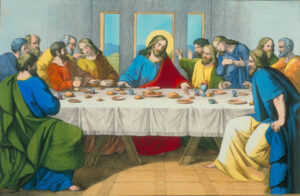 The institution of the Eucharist took place during the last Passover supper that He celebrated with his disciples, and the four accounts agree on the essentials: in all of them the consecration of the bread precedes that of the chalice; although we must remember that, in historical reality, the celebration of the Eucharist ( the Breaking of the Bread ) began in the primitive Church before the writing of the Gospels.
To understand the Eucharist better, let us situate ourselves within the framework of the events:
a) Within a festive farewell meal.
b) The institution of the Eucharist was set within the framework of the Passover supper.
In this context there is a clear message: Christ in person is the new Passover. The Old Covenant has been surpassed by the New and definitive Covenant, which is sealed with the blood of the paschal Lamb who is Christ. The people of the Old Covenant commemorate the passing, the Passover, of Yahweh; whereas the people of the New Covenant celebrate the presence of the Lord among us.
The Eucharistic celebration goes further—as we can deduce from what has been set forth above—than gathering to remember what Jesus did for us, as our separated brethren do; the Lord cannot be a mere remembrance: the bread of life is that, Life; and as a “memorial,” the Eucharistic celebration has the connotation of present actuality; through the action of the Holy Spirit the saving event, to which we in our here and now associate ourselves, is not repeated again and again but is made present.
During the consecration the miracle of transubstantiation takes place, that is to say that even though before our eyes the species of bread and wine may appear, these are no longer such, but rather we are before the real and substantial presence of Christ with his body, blood, soul and divinity; this is the Eucharist, which we can contemplate in its two aspects: as a sacrament in which Christ gives himself to us as food to sanctify us, and as a sacrifice inasmuch as Christ offers himself to God as a victim for the forgiveness of sins. Christ was indeed not immolated at that moment, but he did offer himself to be immolated on the Cross: “This is my body which shall be delivered for you. This is my blood which shall be shed for you.” It is seen, then, that his body and his blood already had the character of an immolated victim; and for that reason, if the Mass is the renewal of the sacrifice of the Cross, the Last Supper was the anticipation of it.
There is also an intimate relationship between the Mass and the Last Supper, because the latter was the first Mass celebrated by Christ; those that follow afterward are the fulfillment of the words He then pronounced: “Do this for a commemoration of me.”
In the light of Revelation in Scripture, and in the development of Tradition, we see and understand that the Lord has a clear intention at the Last Supper, where the sacrament of Holy Orders is also instituted (by virtue of the requirement of the command). He leaves a clear commandment, “Do this for a commemoration of me,” so that his presence and his salvation may reach all men and in all ages, so that we may have eternal life by eating his flesh and drinking his blood.
All the elements and words present in the accounts of the institution of the Eucharist gather all the great ideas of the Old Testament. ( Covenant and Kingdom of God, expiation and martyrdom, worship and eschatological preaching ). Christ is the center of everything; through Him the saving work of God is accomplished in fullness and consummation. In the Eucharist is concentrated all that God has done and is to do for men in the history of salvation. The Kingdom of God is not only proclaimed by Him as near, but was already inaugurated by his presence and by his work; in this sense, the Eucharist is a foretaste of what we shall enjoy in fullness in Heaven.
To illustrate what the Eucharist signifies as a mystery of faith, let us turn to John 6:25-40 within the discourse of the Bread of Life. Jesus declares to them that that bread destined to give life to the world is He in person, but he points out that it is an indispensable condition to have faith; one must believe in Jesus, and that poses a question to us: What is it to believe in Jesus? For Him, “to believe in Him” is the same as “to go to Him,” it is to give oneself to Him. It is not a mere event, but an affective drawing near and a decision of the will to follow Jesus; and he further says that this is a Grace which the Father grants: “that every one who sees the Son and believes in him may have life everlasting,” Jesus throughout the Gospel repeats that God calls all men to faith; hence the gift is offered to all men, but it is accepted by some and rejected by others. On the other hand, as a gift of God it is understood to be gratuitous and that man has no merit of his own to receive it. The merit we can have consists in the use we make of that gift, that is, whether we embrace it and live it.
In theory every Christian knows ( or ought to know ) that in the Eucharist Jesus is present in body, blood, soul and divinity. But it seems in practice that we do not carry it imprinted on our conscience, nor on our heart, because if it were so we would feel in our being hunger and thirst to receive him daily as true food and true drink; our whole life would be centered around the real presence of the Master, and Holy Mass would be, as a logical consequence, the first, daily and most important necessity of our life.
On the other hand, being immersed in the Eucharistic celebration, no distraction would have any place, and the depth of the mystery would overtake us. In this way, living and letting ourselves be penetrated by Grace, those around us would see through it that our faith is life and not only theory.
The character of “memorial” that Holy Mass has, by definition, requires of us the attitude of entering into the paschal mystery just as it is; not as the remembrance of something that happened, but by associating ourselves with an action that continues to be verified today; therefore, when we celebrate Holy Mass, we are transported, we are made present at the Supper of the Lord and we are with Mary at the foot of the Cross. We are feeding on the Body and Blood of the Lord; we are being saved by virtue of his sacrifice. We will be participating in unity in communion with the Lord, and for that reason we can unite our sacrifices and sufferings to those of Christ. Only “by Him, with Him and in Him” do they have a profound meaning and gain access to the redemptive dimension.
 Necessarily, the encounter with Christ the Eucharist is a personal and intimate experience; it must be the full encounter of two who love each other. It is therefore impossible to generalize about them, because only God knows the hearts of men. Nevertheless, we must indeed let shine through in our life the transcendence of the intimate encounter with Love. It is logical to think that whoever receives this Grace is in a greater capacity to love and to serve his brother, and that, moreover, being nourished with the Bread of Life, he ought to be more strengthened to face trials, to confront suffering, to spread his faith and his hope. In short, to bring to a happy conclusion the mission, the vocation, that the Lord may grant him.
If we truly appreciated the real Presence of Christ in the tabernacle, we would never find him alone, accompanied only by the lighted Eucharistic lamp. The Lord today says to all and to each one of us the same that he said to the Apostles: “With desire I have desired to eat this Passover with you,” Lk 22:15. The Lord awaits us with longing to give himself to us as food; are we conscious of it, that the Lord awaits us in the Tabernacle, with the heavenly table set? And we—why do we leave him waiting? Or is it perhaps that, when someone comes to visit our house, we leave him alone in the parlor and go off to attend to our own affairs?
That is exactly what we do in our apostolate, when we fill ourselves with activities and neglect prayer before the Lord, who awaits us in the Tabernacle, a prisoner because he “loved us to the very end,” and it turns out that the One for whom the world and all it contains was made ( ourselves included ) is found there, hidden from the eyes, but incredibly luminous and powerful to satisfy all our needs.
Author: Milagros Sotelo de Gómez / Venezuela
Source: Apologetica.org
