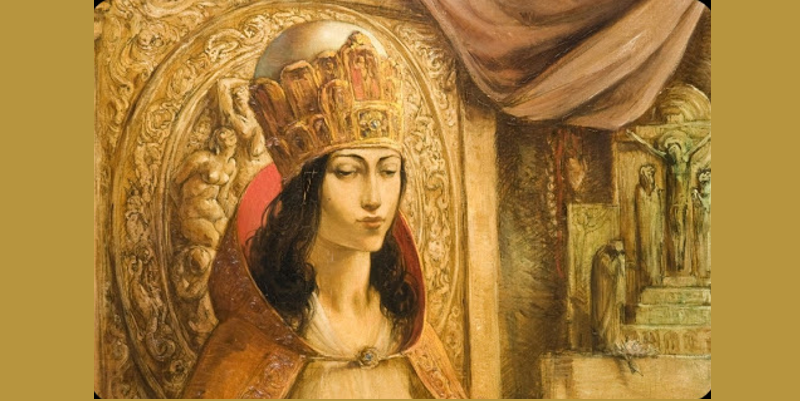
The fable about a female pope, who afterwards bore the name of Johanna (Joan), is first noticed in the middle of the thirteenth century.
VARIATIONS OF THE FABLE
First Version: Jean de Mailly. The first who appears to have had cognizance of it was the Dominican chronicler Jean de Mailly (Archiv der Gesellschaft für ältere deutsche Geschichte, xii, 17 sq., 469 sq.) from whom another Dominican, Étienne de Bourbon (d. 1261), adopted the tale into his work on the “Seven Gifts of the Holy Ghost.”
In this account the alleged popess is placed about the year 1100, and no name is yet assigned her. The story runs that a very talented woman, dressed as a man, became notary to the Curia, then cardinal and finally pope; that one day this person went out on horseback, and on this occasion gave birth to a son; that she was then bound to the tail of a horse, dragged round the city, stoned to death by the mob, and was buried at the place where she died; and that an inscription was put up there as follows: “Petre pater patrum papissae prodito partum”. In her reign, the story adds, the Ember days were introduced, called therefore the “fasts of the popess”.
Second Version: Martin of Troppau. A different version appears in the third recension of the chronicle of Martin of Troppau (Martinus Polonus), possibly inserted by the author himself and not by a subsequent transcriber. Through this very popular work the tale became best known in the following form: After Leo IV (847–855) the Englishman John of Mainz (Johannes Anglicus, natione Moguntinus) occupied the papal chair two years, seven months and four days. He was, it is alleged, a woman. When a girl, she was taken to Athens in male clothes by her lover, and there made such progress in learning that no one was her equal. She came to Rome, where she taught science, and thereby attracted the attention of learned men. She enjoyed the greatest respect on account of her conduct and erudition, and was finally chosen as Pope, but, becoming pregnant by one of her trusted attendants, she gave birth to a child during a procession from St. Peter’s to the Lateran, somewhere between the Colosseum and St. Clement’s. There she died almost immediately, and it is said she was buried at the same place. In their processions the popes always avoided this road; many believed that they did this out of abhorrence of that calamity.
Here occurs for the first time the name of Johanna (Joan) as that of the alleged popess. Martin of Troppau had lived at the Curia as papal chaplain and penitentiary (he died in 1278), for which reason his papal history was widely read, and through him the tale obtained general acceptance. One manuscript of his chronicle relates in a different way the fate of the alleged popess: after her confinement Joan was immediately deposed and did penance for many years. Her son, it is added, became Bishop of Ostia and had her interred there after her death.
Later Versions. Later chronicles even give the name which she bore as a girl; some call her Agnes, others Gilberta. Further variations are found in the works of different chroniclers, for example in the “Universal Chronicle of Metz”, written about 1250, and in subsequent editions of the twelfth-century (?) “Mirabilia Urbis Romae”.
According to the latter, in a vision the popess was given the choice between temporal disgrace and eternal punishment; she chose the former and died during childbirth in the street.
EARLY EVALUATIONS OF THE LEGEND
Credulous Acceptance. In the fourteenth and fifteenth centuries this popess was already counted as a historical personage, whose existence no one doubted. She had her place among the busts of Siena Cathedral. Under Clement VIII, and at his request, she was transformed into Pope Zacharias. The heretic Jan Hus, in the defense of his false doctrine before the Council of Constance, referred to the popess and no one questioned the fact of her existence. She is not found, however, in the “Liber Pontificalis” nor among the portraits of the popes in St. Paul Outside the Walls in Rome.
Critical Evaluation. This alleged popess is entirely a figment of the imagination. In the fifteenth century, after the awakening of historical criticism, a few scholars such as Aeneas Silvius (Epist., I, 30) and Platina (Vitae Pontificum, No. 106) saw that the story had no foundation. Since the sixteenth century Catholic historians began to deny the existence of the popess; examples include Onofrio Panvinio (Vitae Pontificum, Venice, 1557), Aventinus (Annales Boiorum, lib. IV), Baronius (Annales ad a. 879, n. 5), and others.
Protestant Evaluation. A few Protestants also, such as Blondel (“Joanna Papissa”, 1657) and Leibniz (“Flores sparsae in tumulum papissae” in “Bibliotheca Historica”, Göttingen, 1758, 267 sq.), admitted that the popess never existed. Numerous Protestants, however, made use of the myth in their attacks on the papacy. Even in the nineteenth century, when the untenableness of the legend was recognized by serious historians, some Protestants (e.g. Kist, 1843; Suden, 1831; and Andrea, 1886) attempted, in an anti-Roman spirit, to prove the existence of the popess. Even Hase (“Kirchengesch.”, II, 2nd ed., Leipzig, 1895, 81) could not refrain from writing a spiteful note utterly lacking in historical value on this subject.
PROOFS OF ITS MYTHICAL CHARACTER.
The principal proofs of the entirely mythical character of the popess are:
- No contemporary historical source among the histories of the popes knows anything about her; nor is any mention made of her until the middle of the thirteenth century. It is incredible that the appearance of a “popess”, if it had been a historical fact, would not have been noticed by any of the numerous historians from the tenth to the thirteenth centuries.
- In the history of the popes there is no place where this legendary figure can fit. Between Leo IV and Benedict III, where Martinus Polonus places her, she cannot be inserted, because Leo IV died on 17 July 855 and immediately after his death Benedict III was elected by the clergy and people of Rome; only, owing to the setting up of an antipope in the person of the deposed Cardinal Anastasius, Benedict III was not consecrated until 29 September. Coins exist bearing the images of Benedict III and of Emperor Lothair I, who died on 28 September 855; therefore Benedict III must have been recognized as pope before that date. On 7 October 855, Benedict III issued a charter for the Abbey of Corvey. Hincmar, Archbishop of Reims, informed Nicholas I that a messenger whom he had sent to Leo IV learned of this pope’s death and therefore presented his petition to Benedict III, who decided it (Hincmar, ep. xl in P.L., CXXXVI, 85). All these witnesses prove that the dates given in the lives of Leo IV and Benedict III were correct and that there was no break in the line of succession between these two popes; thus there is no room here for the alleged popess.
- Later still it is even less probable that a popess could be inserted in the list of popes around the year 1100, between Victor III (1087) and Urban II (1088–1099) or Paschal II (1099–1110), as is suggested in the chronicle of Jean de Mailly.
ORIGIN OF THE LEGEND
This legend of a Roman popess seems to have had an earlier counterpart in Constantinople. Indeed, in his letter to Michael Caerularius (1053), Leo IX says that he would not believe what he had heard, namely, that the Church of Constantinople had already seen eunuchs, indeed even a woman, in its episcopal chair (Mansi “Concil.”, XIX, 635 sq.).
Concerning the origin itself of the legend of Popess Joan, different hypotheses have been advanced.
Bellarmine (De Romano Pontifice, III, 24) believes that the story was brought from Constantinople to Rome.
Baronius (Annales ad a., 879, n. 5) conjectures that the much-criticized effeminate weakness of Pope John VIII (872–882) in his dealings with the Greeks may have given rise to the story. Mai has shown (Nova Collectio Patr., I, Proleg., xlvii) that Photius of Constantinople (De Spir. Sanct. Myst., lxxxix) refers emphatically three times to this pope as “the Manly”, as though removing from him the stigma of effeminacy.
Other historians point to the degradation of the papacy in the tenth century, when so many popes bore the name John; it therefore seemed an ideal name for the legendary popess. Thus Aventinus sees in the story a satire on John IX; Blondel, a satire on John XI; Panvinio (notae ad Platinam, De vitis Rom. Pont.) applies it to John XII, while Leander (Kirkengesch., II, 200) understands it as applying in general to the baneful female influence that affected the papacy during the tenth century.
Other investigators tried to find in various events and reports a definite basis for the origin of the legend. Leo Allatius (Diss. Fab. de Joanna Papissa) connected it with the false prophetess Theota, condemned at the Synod of Mainz (847); Leibniz revived the story of an alleged bishop Johannes Anglicus who came to Rome and was there recognized as a woman. The legend was also connected with the Pseudo-Isidorian Decretals by scholars such as Karl Blascus (“Diatribe de Joanna Papissa”, Naples, 1779) and Gfrörer (Kirchengesch., iii, 978).
Döllinger’s explanation has generally found greater approval (“Papstfabeln”, Munich, 1863, 7–45). He recognizes the legend of Popess Joan as a survival of some Roman folk tradition originally connected with certain ancient monuments and peculiar customs. An ancient statue discovered in the time of Sixtus V in a street near the Colosseum, showing a figure with a child, was popularly regarded as representing the popess. In the same street a monument was discovered with an inscription at the end of which appeared the well-known formula P.P.P. (proprie pecuniâ posuit) together with a prefixed name reading: Pap. (?Papirius) pater patrum. This could easily have given rise to the inscription mentioned by Jean de Mailly (see above). It was also observed that the pope in solemn procession did not pass along this street (perhaps because it was very narrow). Later, on the occasion of the formal inauguration at the Lateran Basilica, it was noted that the newly elected pope always sat on a marble chair. This chair was an ancient bath-stool, of which there were many in Rome; the pope actually used it merely to rest. But popular imagination took it to mean that the pope’s sex was thereby tested, in order to prevent any woman from thereafter reaching the Throne of St. Peter.
Erroneous explanations—such as were often invented in the Middle Ages in connection with ancient monuments—and popular imagination were originally responsible for the myth of “Popess Joan”, which uncritical chroniclers, from the middle of the thirteenth century onward, dignified by consigning it to their pages.
Author: J.P. KIRSCH
Transcriber: Marie Jutras.
Translator: Eladio Megchún.
Source: Catholic Encyclopedia
